Future of Claims
A Job Is Not a Task: The structural redesign of the defense bar, the talent crisis and the ai transition
Why AI will not empty the defense bar and why insurance defense, of all places, may be the unlikely winner of the next decade
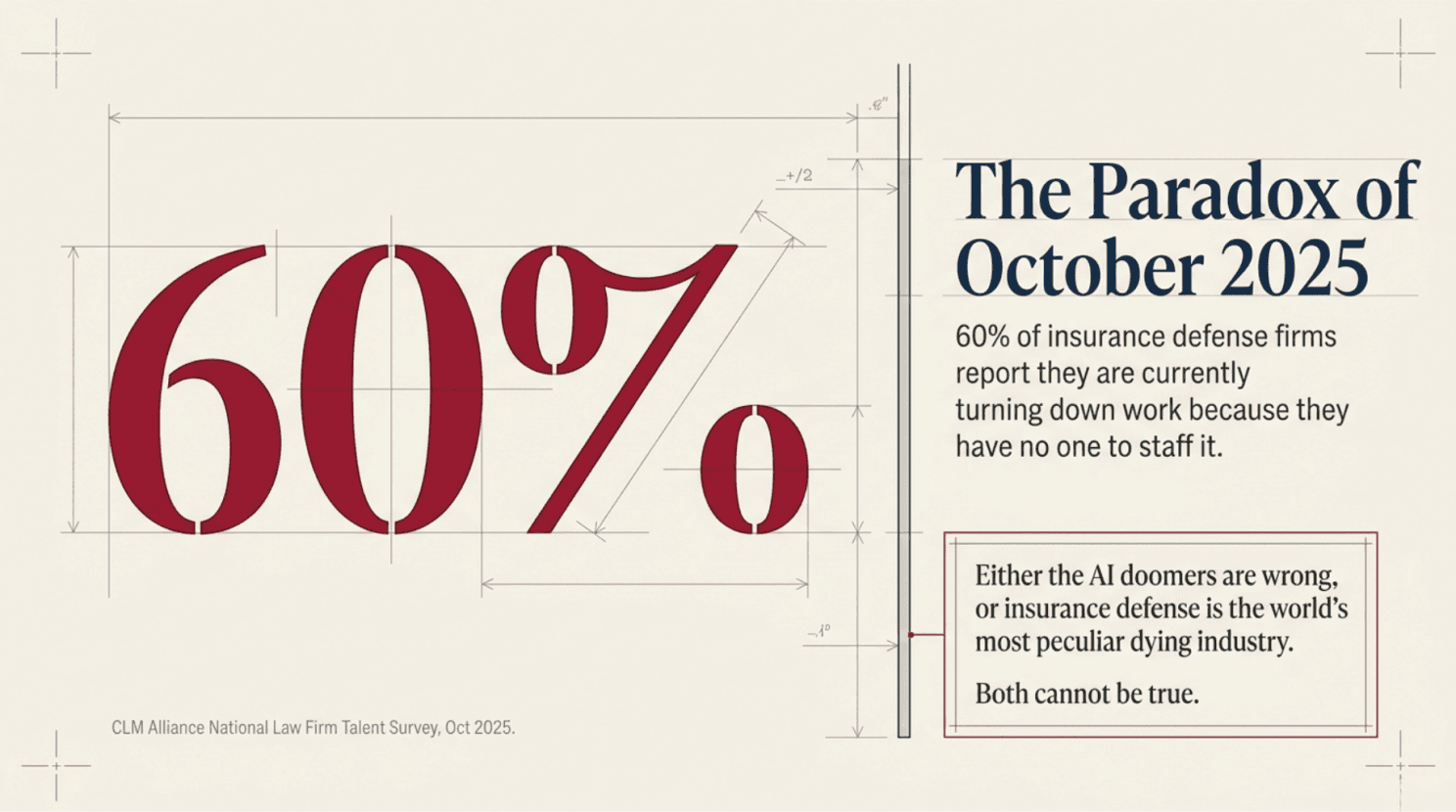
In October 2025, the Claims and Litigation Management Alliance unveiled the results of its first National Law Firm Talent Survey at a symposium in Chicago. One number leapt out of the deck and into the trade press: 60% of insurance defense firms reported that they were currently turning down work because they had no one to staff it.[1] Veteran panel-counsel firms the kind whose business model has, for forty years, been "say yes to whatever the carrier sends" were now saying no.
This is not the talent picture one would expect of a profession allegedly weeks away from being made redundant by artificial intelligence. Either the AI doomers are wrong, or insurance defense is the world’s most peculiar dying industry. Both cannot be true.
There is more work to do than people to handle it
The crisis nobody is selling
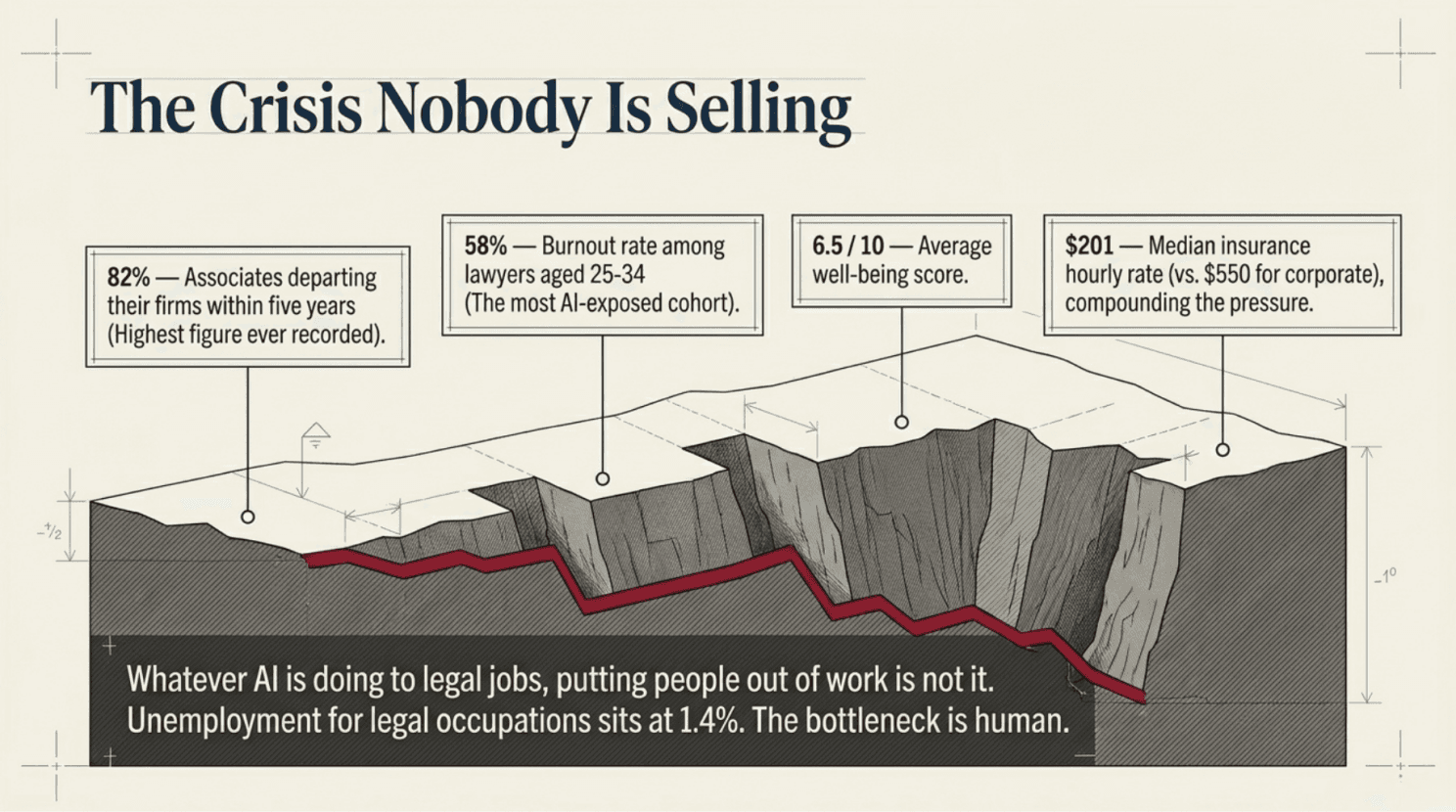
The talent crunch is real, well-measured, and most acute precisely where AI was meant to relieve it. The NALP Foundation’s 2024 attrition data shows 82% of departing associates leaving their firms within five years the highest figure ever recorded and the 2024 update has the median departure compressing further, into year four.[2] The ALM 2024 Mental Health Survey reports two-thirds of lawyers are anxious, a third are clinically depressed, and 65% citing billable-hour pressure as the principal cause.[3] Bloomberg Law’s well-being measure averages 6.5 out of 10; among lawyers aged 25 to 34 the cohort most exposed to AI-displaceable work burnout runs at 58%.[4] The U.S. Bureau of Labor Statistics reported an unemployment rate for legal occupations of 1.4% in January 2026.[5] Whatever AI is doing to legal jobs, putting people out of work is not it.
Retirment and resignation are more of a threat than AI replacement
Insurance defense compounds every variable. Clio’s most recent Legal Trends Report shows the median insurance hourly rate at $201, compared with $550 for corporate and $576 for tax — a gap that has widened, not narrowed.[6] Carrier billing guidelines are tightening. Panel-counsel rates are set, in some markets, by reverse auction. Associate billable expectations of 1,800 to 2,200 hours are normal. An administrative partner at Tyson & Mendes told American Lawyer last year that defense lawyers are "doing their time" and then leaving for any litigation specialty that pays more a description that sounds less like a career and more like a sentence.[7]
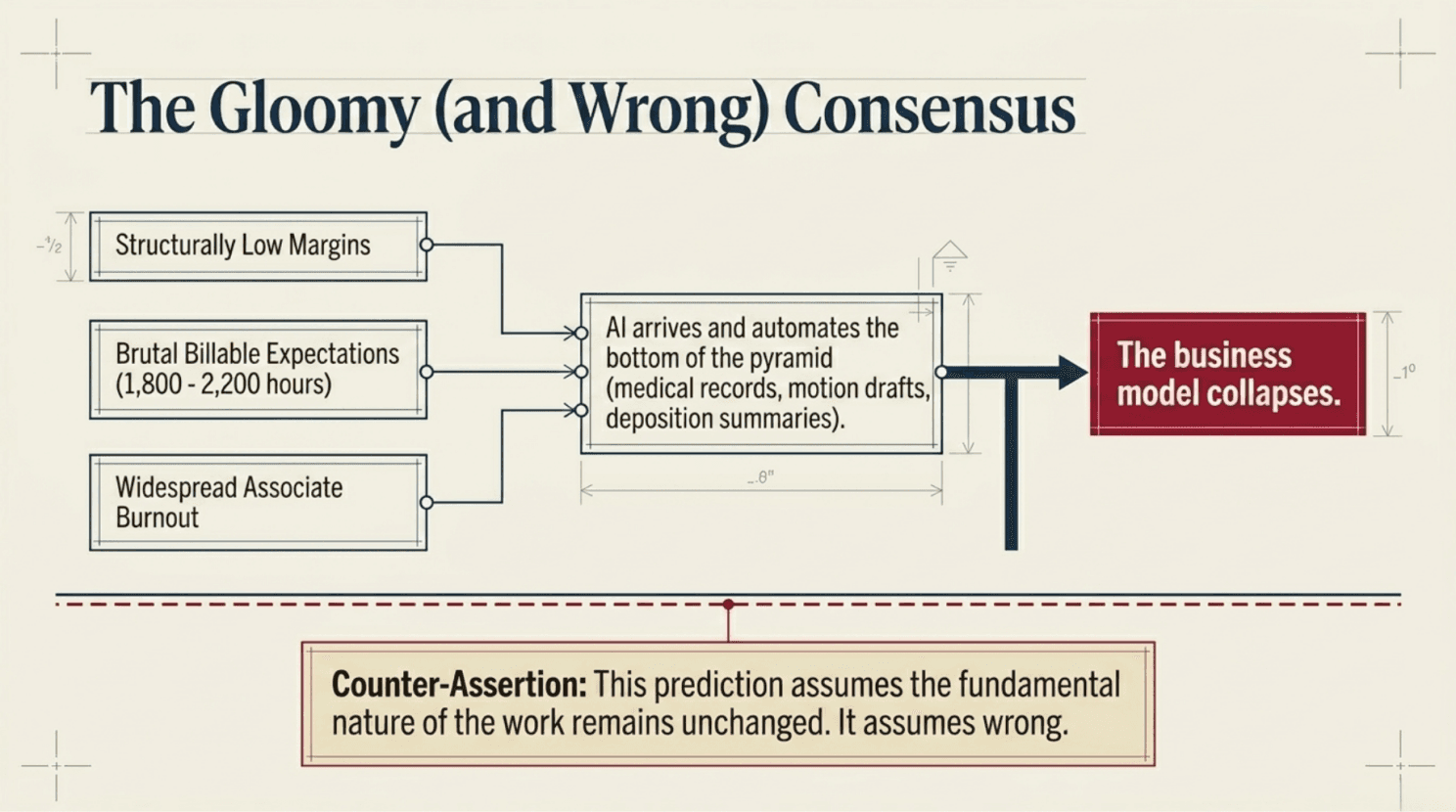
The standard interpretation is gloomy. Here is a profession with structurally low margins, brutal hours, and a generation of associates explicitly unwilling to grind for the equity-partner lottery their seniors won. AI then arrives, automates the bottom of the pyramid (medical record reviews, motion drafts, deposition summaries) and depending on the columnist either finishes off the model or rescues it.
Both predictions assume the same thing. Both assume wrong.
Litigation is more sport than fixed task
What the radiologists figured out first
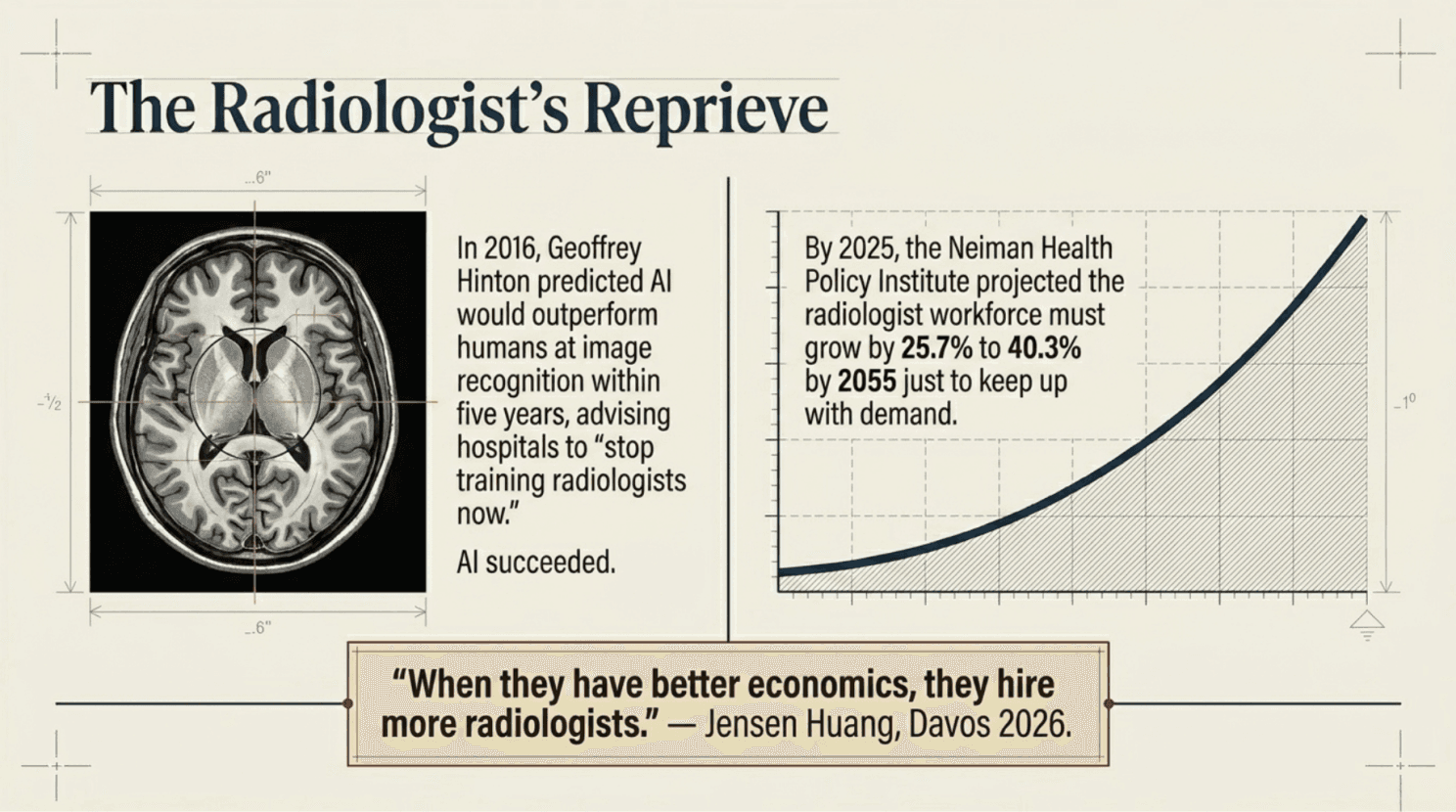
In 2016, Geoffrey Hinton sometimes called the godfather of modern AI told a conference that hospitals should "stop training radiologists now," because within five years AI would outperform humans at image recognition.[8] The five years passed. AI did, in fact, outperform humans at image recognition. Roughly every working radiologist now uses AI tools at some point in the workflow.
The number of radiologists in the United States, however, has gone up. Companion studies from the Harvey L. Neiman Health Policy Institute, published in the Journal of the American College of Radiology in February 2025, project the workforce will be between 25.7% and 40.3% larger in 2055 than it was in 2023, depending on residency growth and that even that increase will fail to keep pace with imaging demand, leaving the United States in a structural radiologist shortage for the next three decades.[9] The cohort whose annihilation was confidently predicted is, in fact, the bottleneck.
As the cost falls demand increases
Jensen Huang, who is fond of telling this story, has a single line that explains why: a job is not a task. "The purpose of a radiologist is to diagnose disease, not to study an image," Huang told Joe Rogan in late 2025. "The image studying is simply a task in service of diagnosing the disease."[10] When AI handled the task, the cost of the underlying service fell, hospitals could economically order more imaging, more imaging produced more diagnosis, and demand for radiologists rose. As Huang put it at Davos a few weeks later: "When they have better economics, they hire more radiologists."[11]
This is the parable that should hang on every defense managing partner’s wall.
What the job actually is
If the radiologist’s task was reading an image and the radiologist’s job was diagnosing disease, then the defense lawyer’s task is drafting a motion and the defense lawyer’s job is what, exactly? It is worth answering that question seriously, because the entire AI-and-defense conversation has been corrupted by the silent assumption that the answer is "drafting motions, faster."
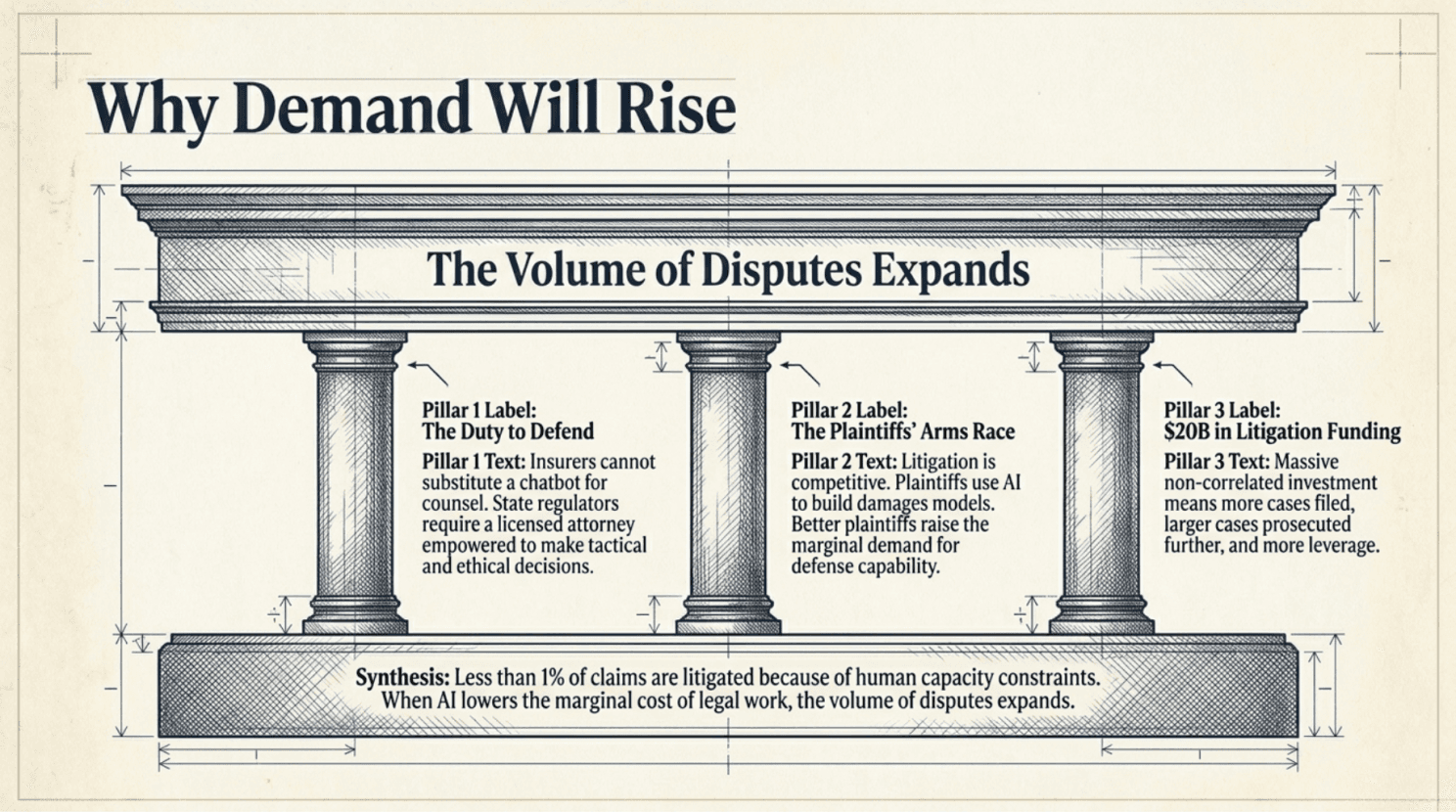
The defense lawyer’s job is the resolution of disputed claims through the adversarial system. That includes investigating, advising the carrier on exposure, framing the legal theory, taking depositions, working up experts, mediating, trying cases and, when warranted, settling for an amount that reflects what an actual jury would actually do. None of this work is going away. Three structural facts ensure it will not.
The pillars assuring attorneys role in insurance defense
The first is the duty to defend. Almost every American liability policy contains a contractual obligation requiring the insurer to defend its insured against claims that potentially fall within coverage. State insurance regulators have built a half-century of case law and regulation around the provision; in most jurisdictions, it cannot be drafted around without inviting serious consequences for the carrier.[12] Insurers cannot, even if they wished to, substitute a chatbot for counsel. The defense has to come from a licensed attorney empowered to make tactical and ethical decisions on behalf of an insured. AI shifts what the attorney does in a given hour. It does not abolish her.
The second is that litigation is a competitive enterprise, not a defined task. It is closer in shape to a sport or, if one wants to be more precise, an arms race than to a process flow. The plaintiffs’ bar is adopting AI at least as quickly as the defense bar; the same tools that draft motions also build damages models, mine medical records for narrative and produce reptile-theory deposition outlines. Every plaintiff’s firm that gets faster and better raises, rather than lowers, the marginal demand for defense capability. (This is exactly the reverse of the assumption that AI lowers demand for defense lawyers because it lowers the cost of producing a brief.)
The third is that the money is moving. Third-party litigation funding is now estimated at a $20 billion global asset class; even after some growth headwinds in 2025, hedge funds, private equity firms, and sovereign wealth funds continue to treat litigation finance as a non-correlated investment vehicle.[13] More money on the plaintiffs’ side means more cases filed, larger cases prosecuted further, and more leverage in negotiation. From the defense lawyer’s perspective, this is not a dystopia. It is more work.
To grasp the scale of the misframing, recall that less than one percent of American insurance claims are litigated. The constraint on that percentage has always been, and remains, the cost of legal capacity. AI, by lowering the marginal cost of producing legal work, will tend to expa not contract the volume of disputes that reach a courtroom or a mediation table. A lawyer paid by the hour to draft pleadings might find this terrifying. A lawyer paid for outcomes will find it the most lucrative shift in living memory.
What the data on AI and people actually shows
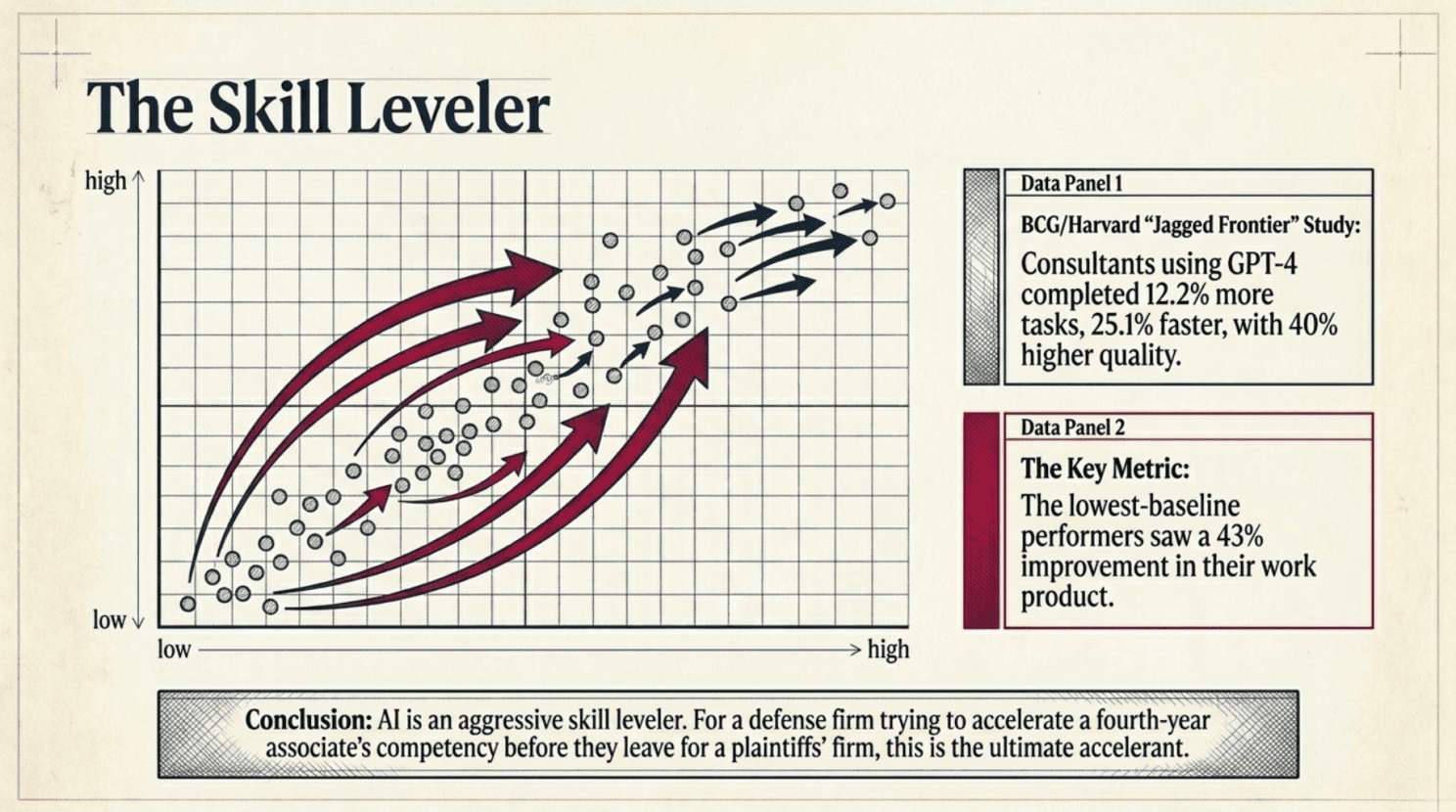
The empirical evidence on AI’s effect on knowledge workers is now substantial enough to draw conclusions from. The Boston Consulting Group/Harvard Business School "Jagged Frontier" experiment, run with 758 BCG consultants on 18 realistic tasks, found that those using GPT-4 completed 12.2% more tasks, did them 25.1% faster, and produced 40% higher-quality output. The lowest-baseline performers gained the most: a 43% improvement in their work product.[14] AI, in other words, is a skill leveler which, for a defense firm trying to bring along a fourth-year associate while losing the eighth-years to plaintiffs’ firms paying double, matters quite a lot.
AI helps both improve quality and speed among all groups
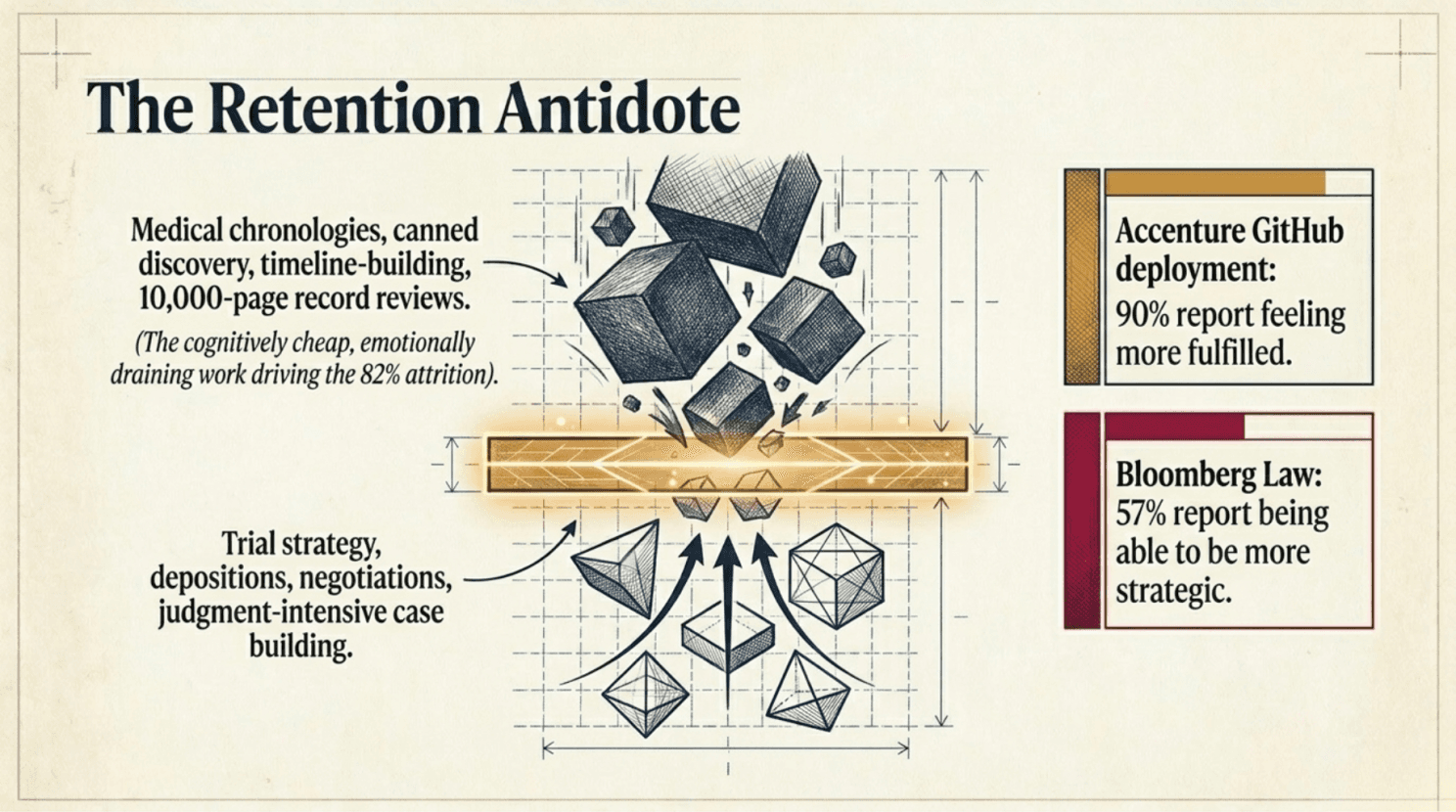
The retention story is sturdier still. Multiple studies of GitHub Copilot find that 60-75% of developers report increased fulfillment, reduced frustration, and better focus on complex work; one Accenture deployment showed 90% reporting feeling more fulfilled, 91% enjoying the work more, and 87% saying AI preserved their mental energy on repetitive tasks.[15] A 56-firm, 6,000-worker randomized field experiment of Microsoft 365 Copilot, run jointly by Microsoft Research and Harvard Business School in 2025, documented measurable shifts away from email triage and document drafting and toward judgment-intensive work.[16] When Bloomberg Law surveyed lawyers who actually use AI, 57% reported being able to use their time more strategically.[17]
AI may help with the biggest challenge which is attracting and keeping talent
Translated into the defense context: the cognitively cheap, emotionally draining work that drives associates out the door, the medical chronologies, the canned discovery responses, the timeline-building, the ten-thousand pages of records nobody wants to read, is exactly the work that AI eats first. The work that is left is what the associate went to law school for.
There is a real paradox, and it deserves naming. The same tasks that AI handles best are the tasks that traditionally produced competent senior lawyers. The Citi/Hildebrandt 2026 Client Advisory finds that 63% of large law firms now expect generative AI to reshape lawyer leverage models within two years, up from 43% the year before, and Citi’s analysts openly worry about how firms will, in this new world, produce competent fifth-years.[18] David Freeman Engstrom of Stanford Law warns of a generation of lawyers who supervise AI without ever building the judgment to know when its output is wrong.[19] Ethan Mollick at Wharton has put it more bluntly: hoping the apprenticeship still works, when the work it depended on has evaporated, is no longer a strategy.[20]
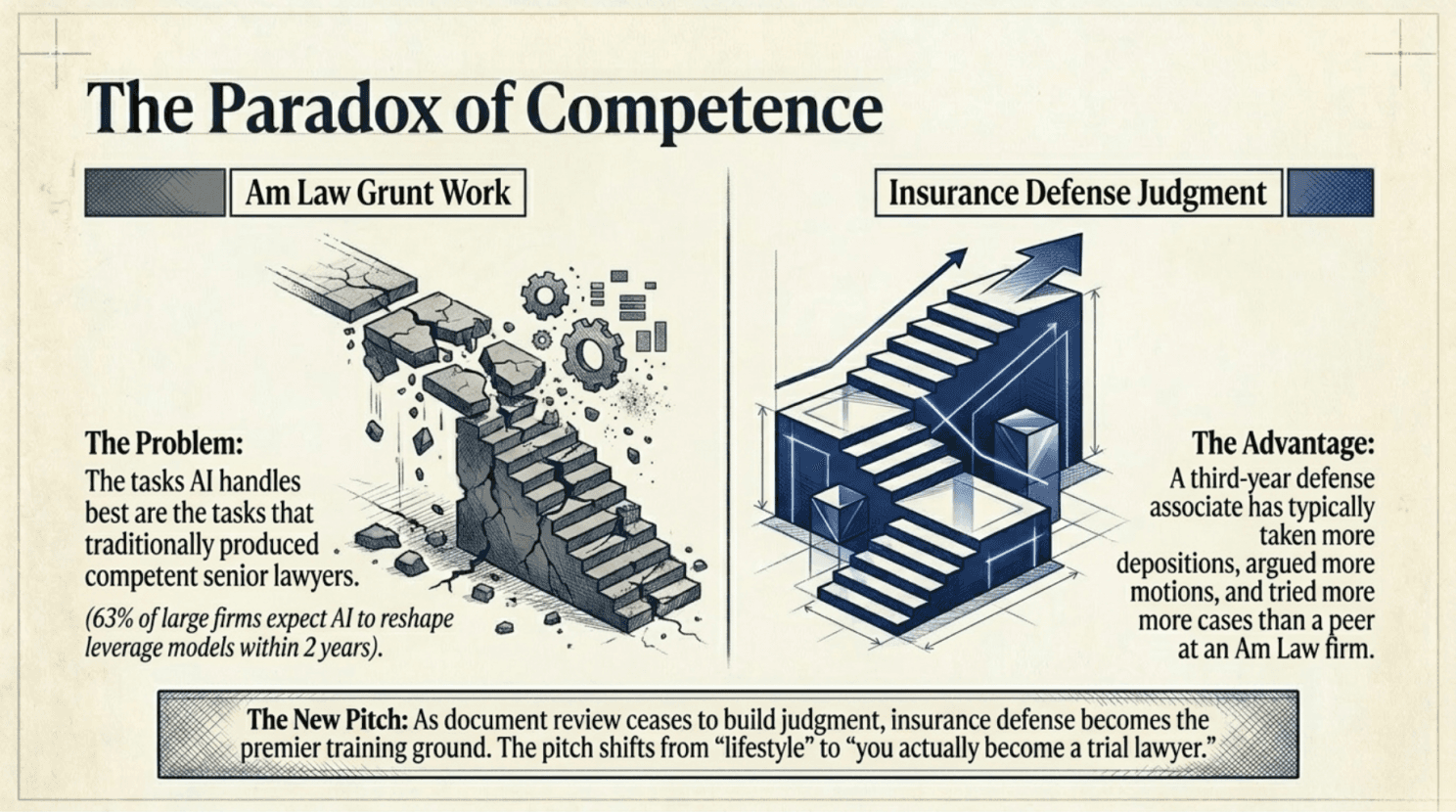
AI is makes insurance defense particularly appealing
For most legal practices, this is a serious problem. For insurance defense, it is something close to a competitive advantage. A third-year defense associate has typically taken more depositions, argued more motions, and tried more cases than a third-year at a peer Am Law firm, sometimes by an order of magnitude. If document review and routine drafting cease to function as judgment-builders across the profession, then a practice area that still produces real courtroom and client reps grows more, not less, attractive to the associates who actually want to become lawyers. The pitch shifts from "we pay less, but the lifestyle is better" to "we pay less, but you actually become a trial lawyer." The second proposition is durable.
Three doors
Once a defense partner accepts that the job is not the task, the strategic options open up in a way they never could when the conversation was about replacement. There are three doors. The firm taking AI seriously will walk through more than one of them.
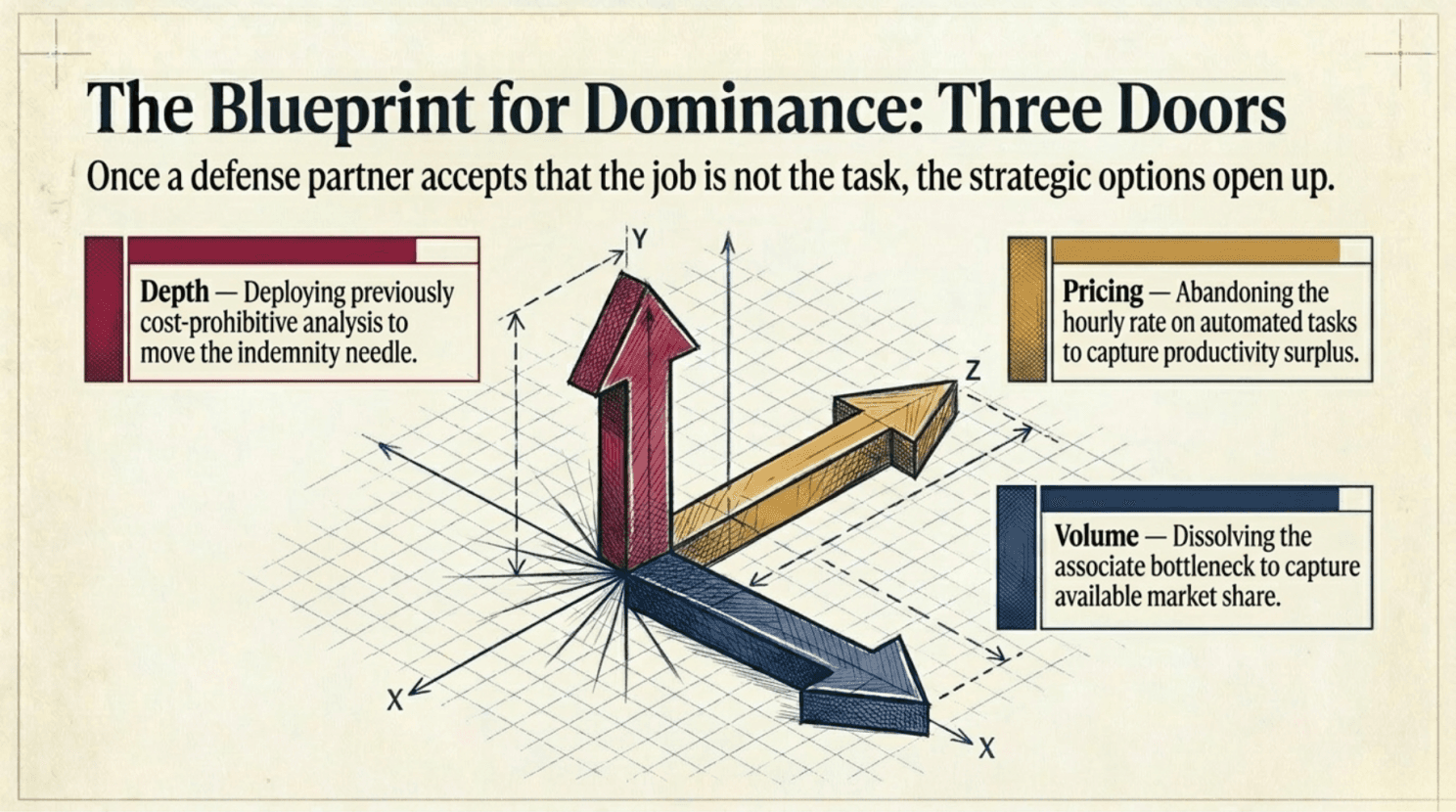
Multiple options for improving firm economics
The first door is volume. Defense firms have an associate-shaped bottleneck; AI dissolves it. A firm that handles a thousand cases a year today, capped by associate hours, can plausibly handle fourteen hundred with the same headcount once medical chronologies, document reviews, and routine discovery are AI-assisted. Revenue per case may fall slightly. Total revenue rises. Margins remain similar. With 60% of competitors turning down work, the door labeled "more cases" leads directly into market share that has not been available to grab in two decades.
The second door is depth. Most defense work, on most cases, is constrained not by what would be useful but by what is economically defensible to bill. Reviewing every prior deposition an opposing expert has given, building a probabilistic damages model for mediation, running competitive analyses on plaintiffs’ counsel — all of this was, until recently, beyond what any panel-counsel relationship would tolerate paying for. AI changes the math. Work that was cost-prohibitive becomes feasible; work that was already done becomes more comprehensive; outcomes improve. Carriers, who pay roughly 85 cents of every claim dollar in indemnity and 15 cents in defense fees, would gladly pay more for defense work that demonstrably moves the indemnity number — the argument the first issue of this newsletter made at length, and which gets only more durable as the data accumulates.
The third door is pricing. When tasks become AI-assisted, billing them by the hour becomes both economically suicidal, as carriers are already refusing to pay for what AI can do, and strategically lazy, since the firm captures none of the productivity surplus. The natural redesign is hybrid: flat fees for AI-assisted scopes of work, hourly rates preserved for the genuinely human parts of the case. A firm that gets this pricing architecture right captures a structurally larger share of every dollar it bills. Thomson Reuters’ 2025 Future of Professionals research suggests strategic AI adopters are roughly twice as likely to grow revenue and four times as likely to demonstrate ROI as their ad-hoc peers.[21] (The previous issue of this newsletter explored the corollary: ad-hoc adoption is also the principal source of cyber and confidentiality risk in defense practice. The danger is not AI in the firm. It is AI in the firm that no one has thought about strategically.)
The doors are not mutually exclusive. The interesting firms will walk through all three.
Walmart understood. Kmart didn’t.
In 1974, a clerk in Troy, Ohio scanned a ten-pack of Wrigley’s Juicy Fruit gum across a counter, marking the first commercial use of the universal product code. Through the late 1970s and early 1980s, every major American retailer adopted the technology. Walmart and Kmart adopted it at roughly the same time. By 1983, Walmart had committed to barcoding 100% of its products.[22]
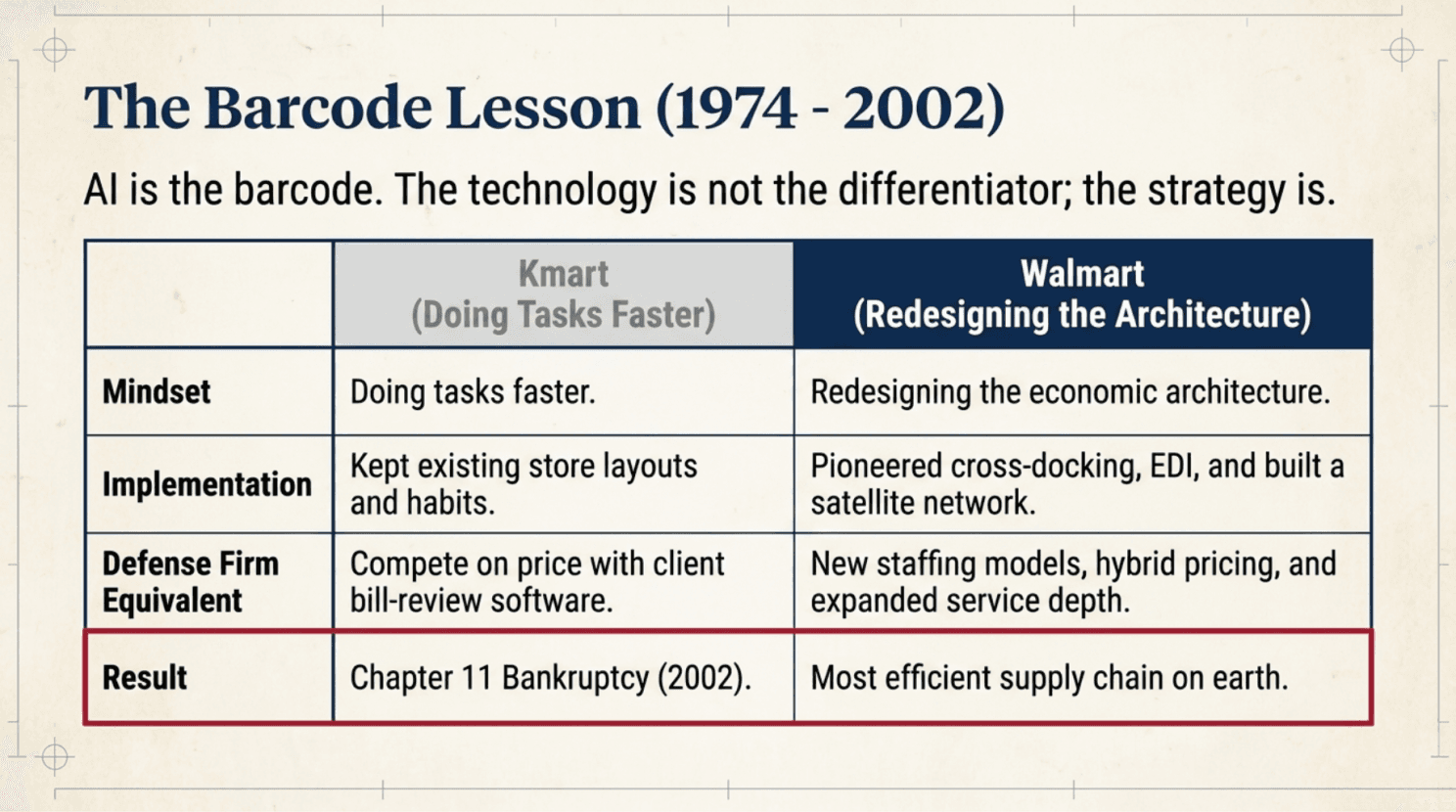
Thinking systemically is the key to success
What happened next is the most expensive lesson in retail history. Kmart treated the barcode as a means to improve checkout speed. The company kept its existing store layouts, supplier relationships, and managerial habits, and it scanned things faster. Walmart treated the barcode as the foundation of an entirely new economic architecture. Sam Walton built distribution centers around the data the barcodes produced; pioneered cross-docking; demanded electronic data interchange from suppliers; built the first retail satellite network in America; and, by the late 1990s, was running the most efficient supply chain on earth. In January 2002, Kmart filed for Chapter 11.[23]
The barcode was not the difference. The strategy around the barcode was the difference. Both companies had access to the same technology. One recognized that the technology was an invitation to redesign the business. The other recognized that the technology was an invitation to do the same business slightly faster. The second issue of this newsletter argued, in different terms, that successful technology transformation always comes down to managing the human system around the technology — what Chip and Dan Heath call the Rider, the Elephant, and the Path. Walmart did all three. Kmart did none.
The choice now before insurance defense managing partners is, structurally, the same. AI is the barcode. The firms that treat it as a way to do existing tasks more cheaply will compete on price with their own clients’ bill-review software, lose the associates who were already going to leave anyway, and find themselves in 2028 explaining to carriers why their numbers haven’t moved. The firms that treat it as the foundation for a different economic architecture — different staffing models, different pricing, different services, different competitive moats — will, in a market where 60% of competitors are currently saying no to work, find themselves saying yes to almost everything, and being paid more per yes than they are now.
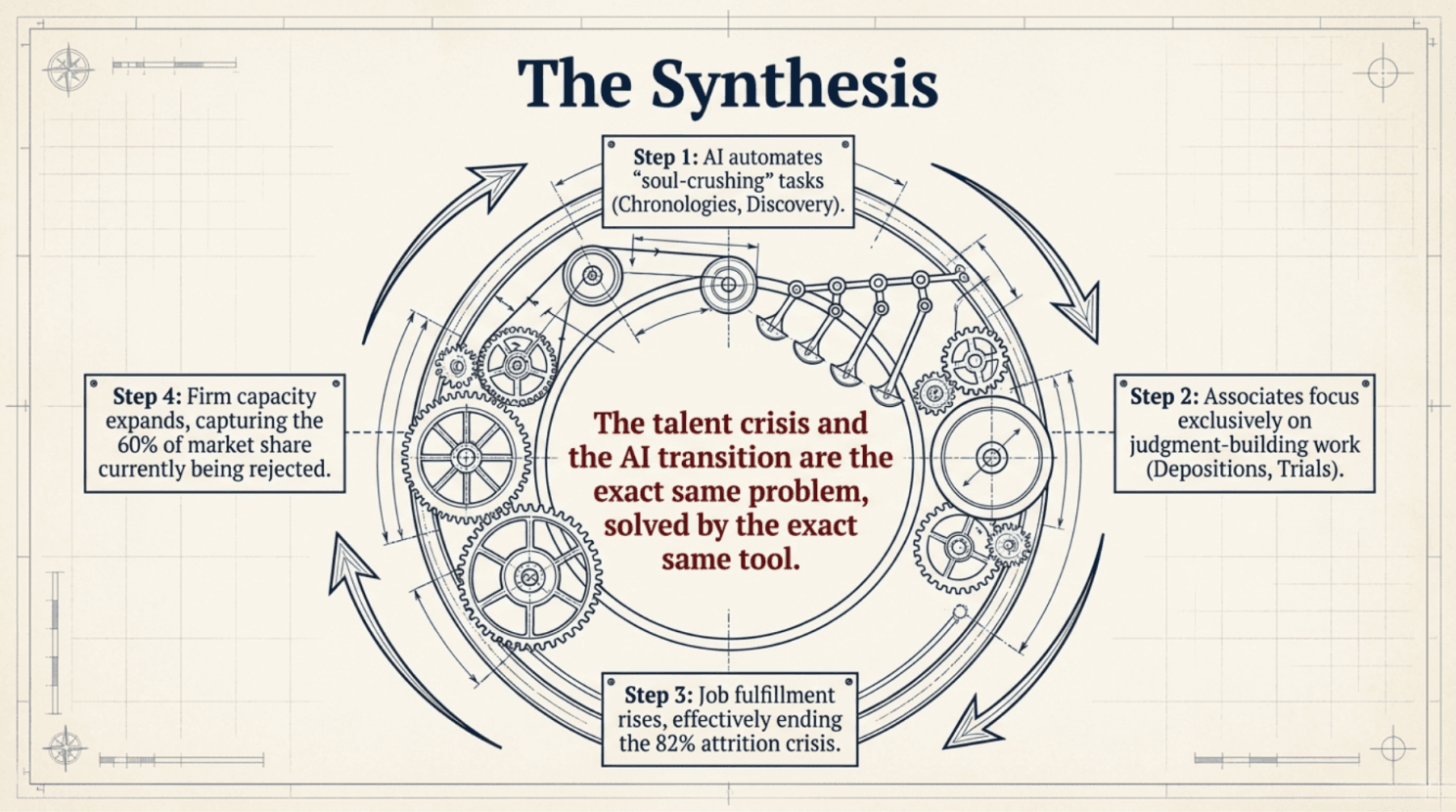
The talent crisis and the AI transition are not separate problems. They are the same problem, reframed. A defense lawyer who spends her week on what she went to law school for, instead of what she did not, is a lawyer who stays. A firm that retains its lawyers can grow. A firm that grows can take work the rest of the market is forced to refuse.
None of this is theoretical. The radiologists figured it out a decade ago. The barcode aisles taught the lesson twenty years before that. Whether the defense bar learns it in time is, at this point, a question of attention rather than evidence.
A postscript: The Future of Claims Academy
This is the fourth instalment of The Future of Claims. The three prior pieces argued, in turn: that nuclear verdicts and automated bill review form a single pincer movement against defense firms, and that the math sits in indemnity rather than legal spend; that successful technology transformation always requires managing the human system around the technology the Rider, the Elephant and the Path; and that the cyber and confidentiality risks of AI in defense practice are usually misdiagnosed.
The arguments compound. They also need to become operational. To that end, we are launching the Future of Claims Academy a nine-module online program for defense lawyers, claims professionals, and claims leaders who want a structured path through this transition rather than a permanent backlog of half-read LinkedIn posts.
The first module, How AI Changes the Economics of Litigation Defense, debuts as a LinkedIn Live event on 27 May 2026. It is the operating manual for the argument that opened this series. Subsequent modules will work through staffing and talent, cyber and confidentiality, implementation, and the parts of defense practice — depositions, mediation, trial — where AI is still mostly a spectator.
Registration is open: click here
Notes
[1] CLM Alliance, "CLM Unveils National Law Firm Talent Survey Highlighting Challenges for Both Firms and Clients," 16 October 2025. https://www.businesswire.com/news/home/20251016591634/en
[2] NALP Foundation, Update on Associate Attrition (CY23 and CY24 reports). The 82% within-five-years figure is the highest recorded in the survey’s history.
[3] ALM, 2024 Mental Health Survey of the Legal Profession.
[4] Bloomberg Law, Attorney Workload and Hours Survey 2024.
[5] U.S. Bureau of Labor Statistics, Current Employment Statistics, January 2026.
[6] Clio, Legal Trends Report 2024. State-level data for New York; rate spreads similar in most large jurisdictions.
[7] Cayce Lynch, quoted in "Are Insurance Defense Firms in ‘Aggressive Hiring Mode’?", ABA Journal, 21 August 2024. https://www.abajournal.com/news/article/are-insurance-defense-firms-in-aggressive-hiring-mode-new-hires-sought-amid-salary-disadvantage
[8] Geoffrey Hinton, remarks at the Machine Learning and the Market for Intelligence conference, 2016. Hinton later told The New York Times in March 2026 that he was "wrong on timing but not on direction."
[9] Christensen, E.W., Parikh, J.R., Drake, A.R., et al., "Projected US Radiologist Supply, 2025 to 2055," Journal of the American College of Radiology, February 2025. https://www.jacr.org/article/S1546-1440(24)00909-8/fulltext
[10] Jensen Huang, The Joe Rogan Experience, December 2025. Quoted in CNBC, "Jensen Huang Cited Radiologists to Dispute AI Jobs Impact," 4 December 2025. https://www.cnbc.com/2025/12/04/jensen-huang-cited-radiologists-to-dispute-ai-jobs-impact.html
[11] Jensen Huang, in conversation with BlackRock CEO Larry Fink at the World Economic Forum, January 2026. https://blogs.nvidia.com/blog/davos-wef-blackrock-ceo-larry-fink-jensen-huang/
[12] Hinshaw & Culbertson LLP, Navigating the Duty to Defend: Insights from the Third Edition of Hinshaw’s Fifty-State Survey, November 2025. https://www.hinshawlaw.com/en/insights/insights-for-insurers-alert/navigating-duty-to-defend-third-edition-hinshaw-fifty-state-survey
[13] Insurance Journal, "Litigation Finance Hits a Wall After Bets on Huge Gains Falter," 1 December 2025. https://www.insurancejournal.com/news/national/2025/12/01/849297.htm
[14] Dell’Acqua, F., McFowland, E., Mollick, E., et al., "Navigating the Jagged Technological Frontier: Field Experimental Evidence of the Effects of AI on Knowledge Worker Productivity and Quality," Harvard Business School Working Paper 24-013, 2023.
[15] Accenture GitHub Copilot deployment study, summarized in multiple longitudinal Copilot satisfaction studies, 2024-2026.
[16] Dillon, Jaffe, Immorlica, Stanton, "Shifting Work Patterns with Generative AI," Microsoft Research/Harvard Business School, April 2025. 56-firm, 6,000-worker M365 Copilot field experiment.
[17] Bloomberg Law, Generative AI Use in the Legal Profession Survey 2025.
[18] Citi Global Wealth and Hildebrandt Consulting, 2026 Client Advisory, February 2026.
[19] David Freeman Engstrom, Stanford Law School, quoted in MIT Technology Review, December 2025.
[20] Ethan Mollick, Wharton School, Co-Intelligence: Living and Working with AI, 2024; subsequent commentary on apprenticeship in Axios, May 2026.
[21] Thomson Reuters, 2025 Future of Professionals Report. Survey of 2,275 global professionals across legal, risk, compliance, tax, accounting, audit, and trade.
[22] Vector Logistics, "Walmart’s Supply Chain: A Detailed Look at How They Manage It"; Decision Point Technologies, History of the Barcode. Walmart was the first major retailer to commit to 100% barcoding of its products by 1983.
[23] Logistics Bureau, "How Supply Chain Strategy Misalignment is Killing Kmart USA"; Kmart filed for Chapter 11 bankruptcy on 22 January 2002, the largest retail bankruptcy in U.S. history at the time.