Blog
Claude for Legal vs. OraClaim — Why the Smartest Defense Firms Use Both

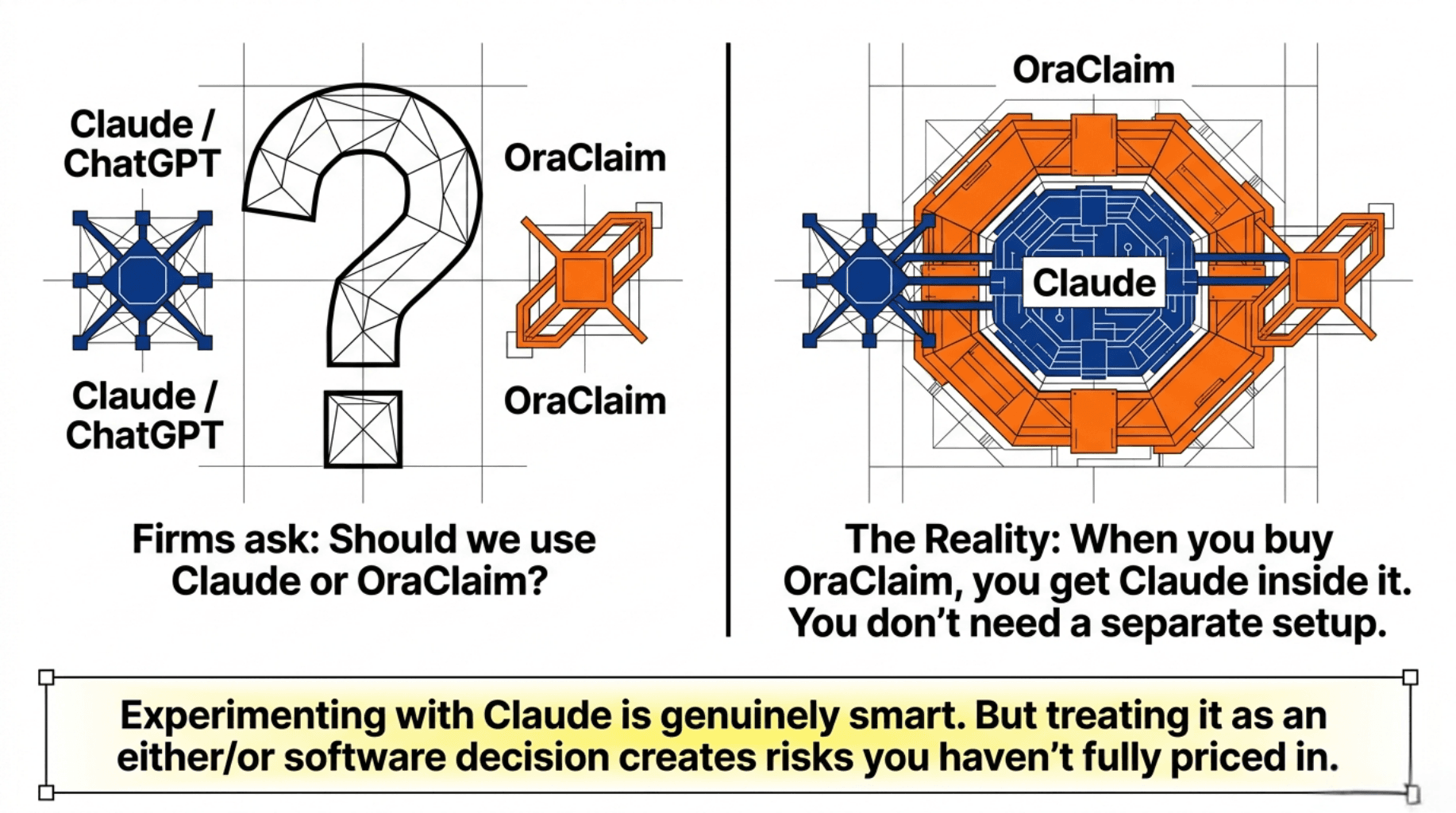
If your firm is experimenting with Claude or ChatGPT for insurance defense work, you're doing something genuinely smart. You're also creating a problem you may not have fully priced in yet.
Claude for Legal is one of the most capable AI tools available. It can read a deposition, analyze a coverage opinion, draft a carrier communication, and reason across all of them in plain language. For open-ended legal thinking, it's genuinely impressive.
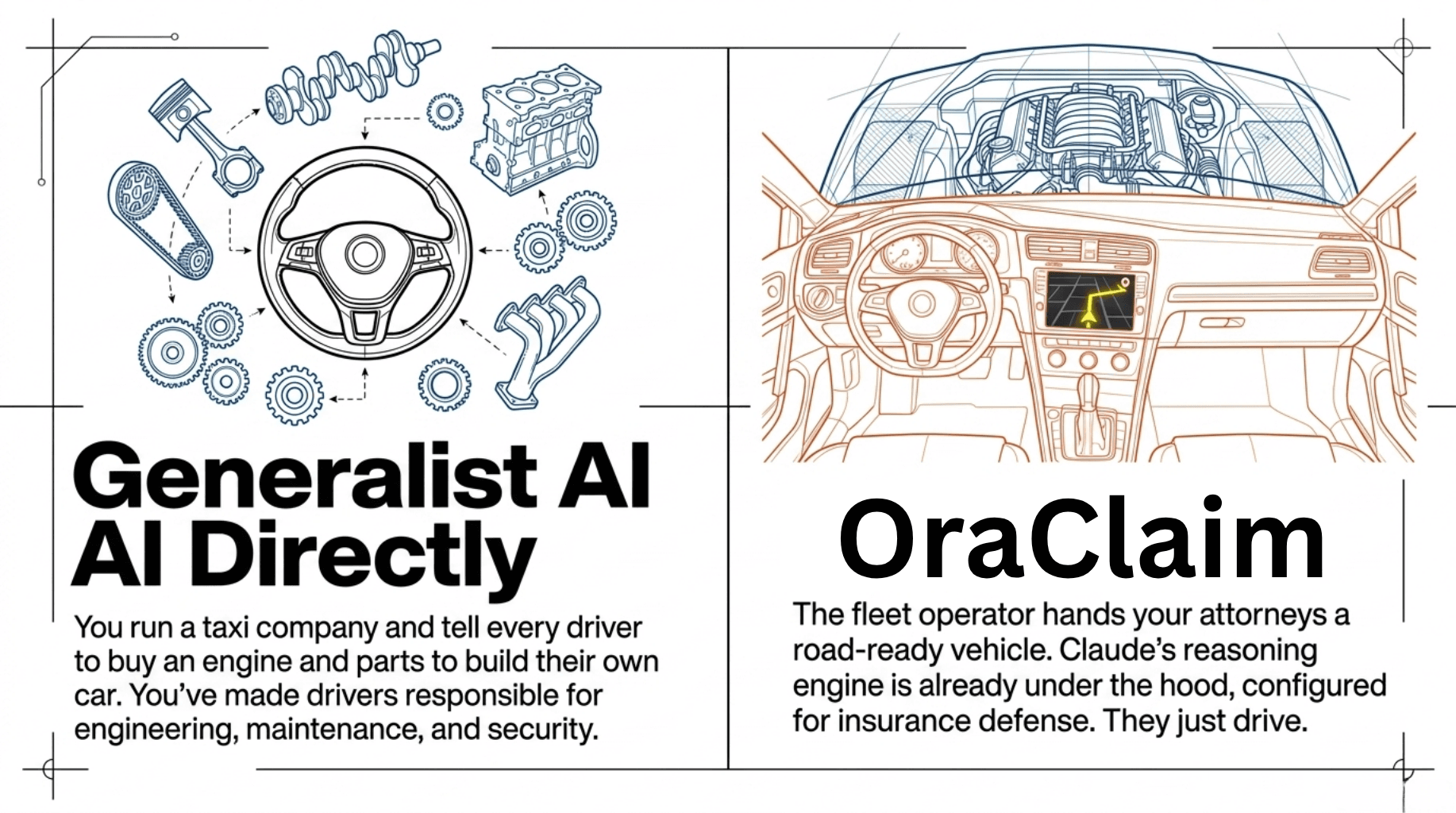
It is also, on its own, the wrong tool for high-volume insurance defense work. For the same reason that handing every driver at a taxi company an engine and a set of parts is the wrong way to run a fleet, handing your attorneys a general-purpose AI tool and telling them to figure it out creates a problem. The engine is not the issue. The problem is that someone still has to build the car, configure it for your specific roads, and maintain it when it breaks down. At a firm focused on defending claims, that work should not fall to your attorneys.
OraClaim handles all of it. Think of it as the fleet operator that hands your attorneys a road-ready vehicle: Claude's or ChatGPT reasoning engine already under the hood, already configured for insurance defense, maintained and improved continuously so your lawyers never have to think about what's powering it. They just drive.
The question most defense firms are asking, "Should we use Claude, ChatGPT, or OraClaim?", is the wrong question. When you buy OraClaim, you get Claude, ChatGPT and the best of other AI models inside it, already configured for insurance defense and already doing the work your practice requires. You don't need a separate AI model setup. You don't need to manage prompt engineering, model updates, or security compliance. Every advancement the underlying AI models release gets absorbed into OraClaim automatically, so your firm benefits from the cutting edge without anyone on your team having to track it. This post explains what that means in practice, where the risk of going generalist-only lies, and why the build-vs-buy question has a clear answer for firms of 5 to 150 attorneys.[1]
Why Insurance Defense Is Harder to Automate Than It Looks
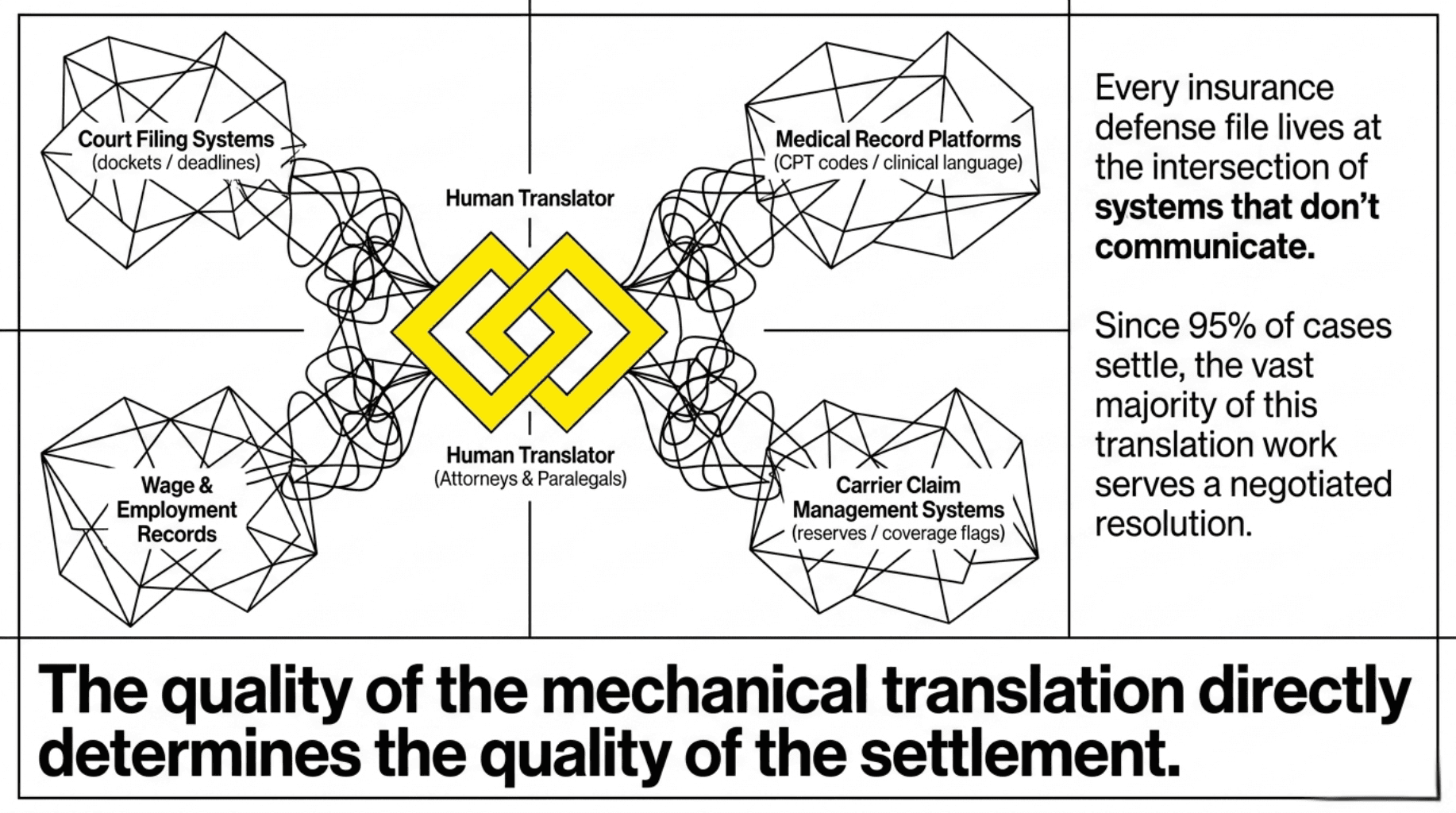
Every insurance defense file lives at the intersection of systems that don't communicate with each other: court filing systems, medical record platforms, wage and employment records, carrier claim management systems, and the firm's own document management infrastructure. These systems weren't designed to interoperate. A medical record system speaks in CPT codes and clinical language. A court system speaks in docket entries and procedural deadlines. A claim management platform speaks in reserves, coverage flags, and assignment status.
The humans in the middle, such as attorneys, paralegals, and adjusters, have historically served as the translators: reading across all of these systems, reconciling the differences, and producing the analysis that drives decisions. And since 95% of cases settle, the vast majority of that translation work serves a negotiated resolution. The quality of the translation directly determines the quality of the settlement.
The promise of AI in insurance defense isn't replacing the human judgment that drives strategy. It handles the mechanical translation layer, including data extraction, record classification, cross-system comparison, and pattern recognition across similar cases, so that human judgment can focus on strategy, not data wrangling.
Two distinct AI layers have emerged to do this: generalist AI that reasons flexibly across any document or problem, and vertical-specific AI purpose-built for the specific data structures and decision points of insurance defense. Firms deploying only the generalist layer are getting partial value, and taking on risks that most managing partners haven't fully priced in.
What Generalist AI Does Well — and Where It Stops
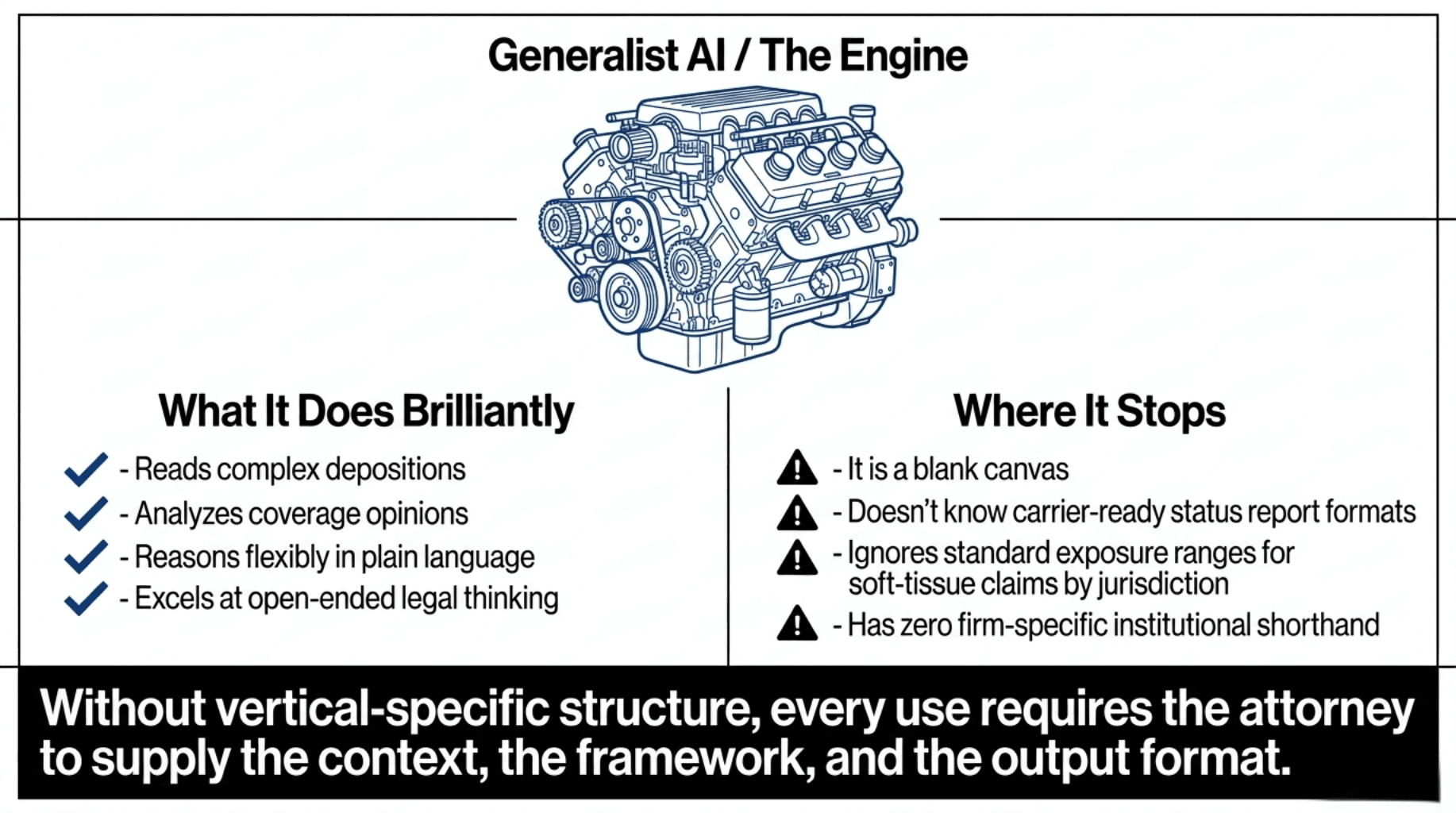
Claude and ChatGPT are genuinely capable tools. They can read a deposition transcript, a coverage opinion, a medical record, or an email thread and reason across all of them in plain language, such as summarizing, synthesizing, drafting, and answering questions. For unstructured or novel situations, such as a coverage dispute that doesn't fit standard templates, a cross-jurisdictional issue, or a carrier communication requiring careful drafting, generalist AI is the right tool. Attorneys can use it to think through a case, stress-test a theory, or draft communications that require open-ended reasoning.
But generalist AI is a blank canvas. It doesn't know what a carrier-ready status report should contain. It doesn't know the standard exposure range for a soft-tissue claim in a specific jurisdiction. It doesn't know how your firm structures a case assessment, what your institutional shorthand means, or how your historical files should inform the file in front of you today.
Without vertical-specific structure, every use requires the attorney to supply the context, the framework, and the output format. That creates inconsistency among attorneys, requires real technical sophistication to use effectively, and limits its utility for junior staff: the people who need it most.
The Taxi Company Problem
Here's the analogy that captures it best. Imagine you run a taxi company and you tell every driver to go out, buy an engine and parts, and build their own car. Some of them might pull it off. The technically inclined ones will build something that works. But you've now made every driver responsible for engineering, maintenance, and upgrades, work that has nothing to do with driving passengers from one place to another.
That's what happens when a firm of 20 or 50 or 100 attorneys deploys generalist AI directly as their primary insurance defense tool. Someone has to configure the prompts, maintain them as models change, manage security and compliance, and rebuild the institutional knowledge every time a person leaves. For a firm focused on a legal niche, and not software development, that's an unsustainable dependency.
The counterintuitive risk of going "bigger" is worth naming directly. Many managing partners assume that bigger platforms feel safer: Claude is Anthropic, OpenAI is OpenAI, Gemini is Google these are large and reputable companies. But for specialized legal workflows, bigger is not safer. A general-purpose platform doesn't know your workflow, doesn't improve based on insurance defense cases, and doesn't carry forward the institutional learning from your historical files. The safer bet for a specialized practice is a vertical tool that advances at the model level alongside the underlying AI platforms, capturing every improvement in Claude and OpenAI automatically while applying it to the specific problem your firm actually has.
What OraClaim Delivers — and Why It Can't Be Replicated with a General-Purpose Tool
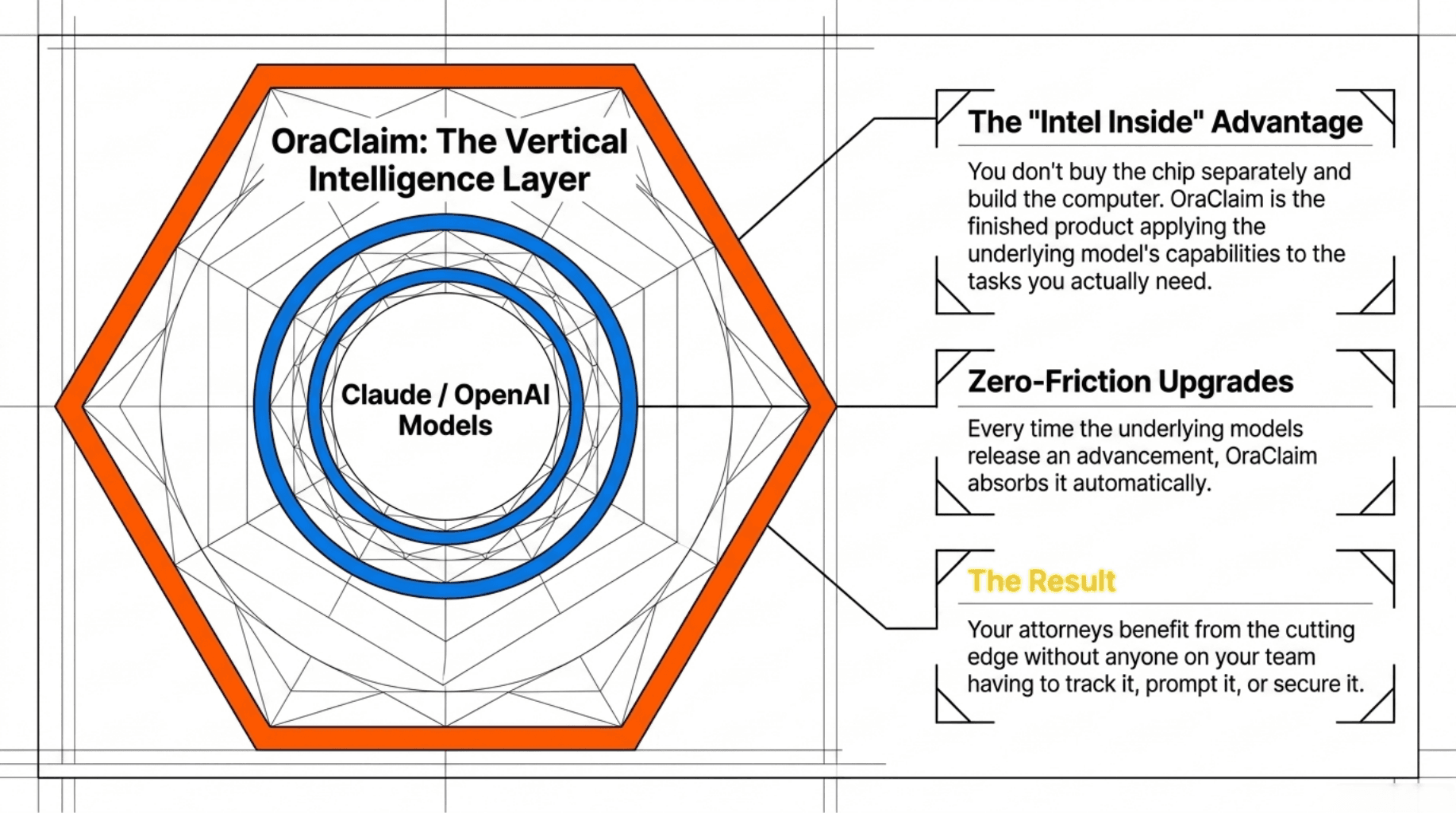
OraClaim is not a chatbot for lawyers. It's the vertical intelligence layer that the entire defense practice runs on, and it's built on top of the same underlying models as Claude and ChatGPT, already configured for insurance defense so your attorneys don't have to configure anything themselves.
Think of it the way you think about buying a computer with an Intel chip inside. You're not buying the chip separately and building the computer yourself. You're buying a finished product that uses the chip's capabilities and applies them to the tasks you actually need to accomplish. And as OraClaim continues to advance, your firm benefits automatically, without anyone on your team having to manage what's under the hood
Here's what that means in practice, capability by capability.
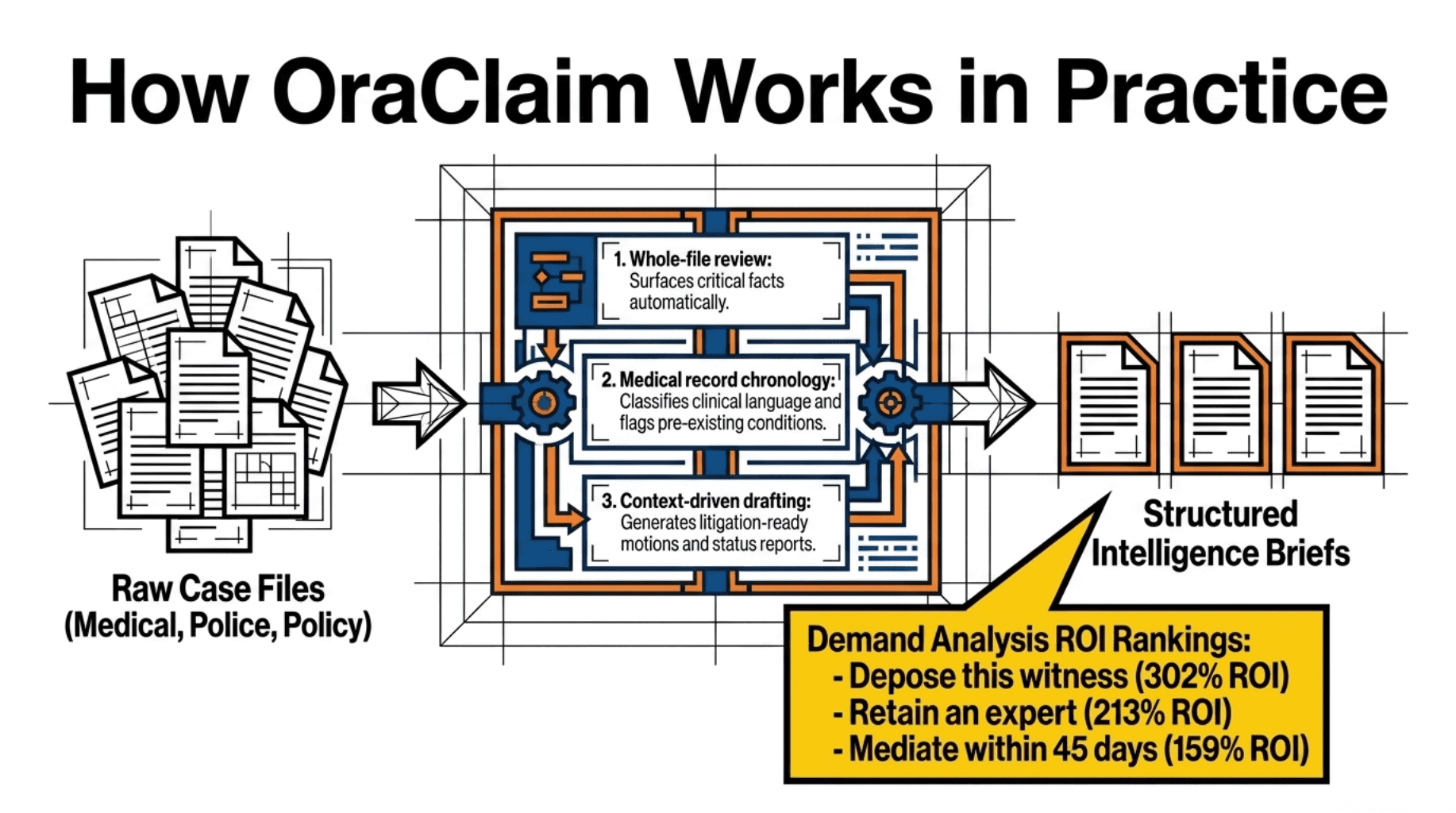
Whole-file review and fact surfacing. OraClaim reviews the complete claim file — police reports, witness statements, medical records, insurance policy, complaint — and surfaces the critical facts that matter, automatically. Not a summary. A structured, searchable intelligence layer on top of everything in the file.
Medical record classification and chronology. Medical records arrive in clinical language across multiple providers and date ranges. OraClaim classifies and organizes them into a timeline, flags significant pre-existing conditions, and makes the medical picture legible to attorneys and adjusters without manual review.
Demand analysis and settlement range identification. OraClaim analyzes the demand letter against the record and identifies a likely settlement range, with suggested actions ranked by ROI. Depose this witness: 302% ROI. Retain an expert: 213% ROI. Mediate within 45 days: 159% ROI. This is not generic AI output. It is decision support calibrated to the specific facts of the file.[2]
Context-driven work product generation. OraClaim generates litigation-ready work products, such as medical chronologies, deposition outlines, motions, demand letters, and status reports, tailored to the firm's style and the unique facts of the case. The institutional knowledge is in the system, not in the head of whoever happened to configure the prompt last quarter.
Historical case benchmarking. OraClaim structures and benchmarks historical case files so attorneys can identify patterns across similar cases, anticipate outcomes, and refine strategy based on real-world performance from the firm's own data — not generic AI training data.
Portfolio-level financial intelligence. OraClaim connects operational data with revenue and cost insights, giving managing partners visibility into efficiency, margin, and portfolio health across all active cases — not just individual file review.
The Cross-Pollination Effect
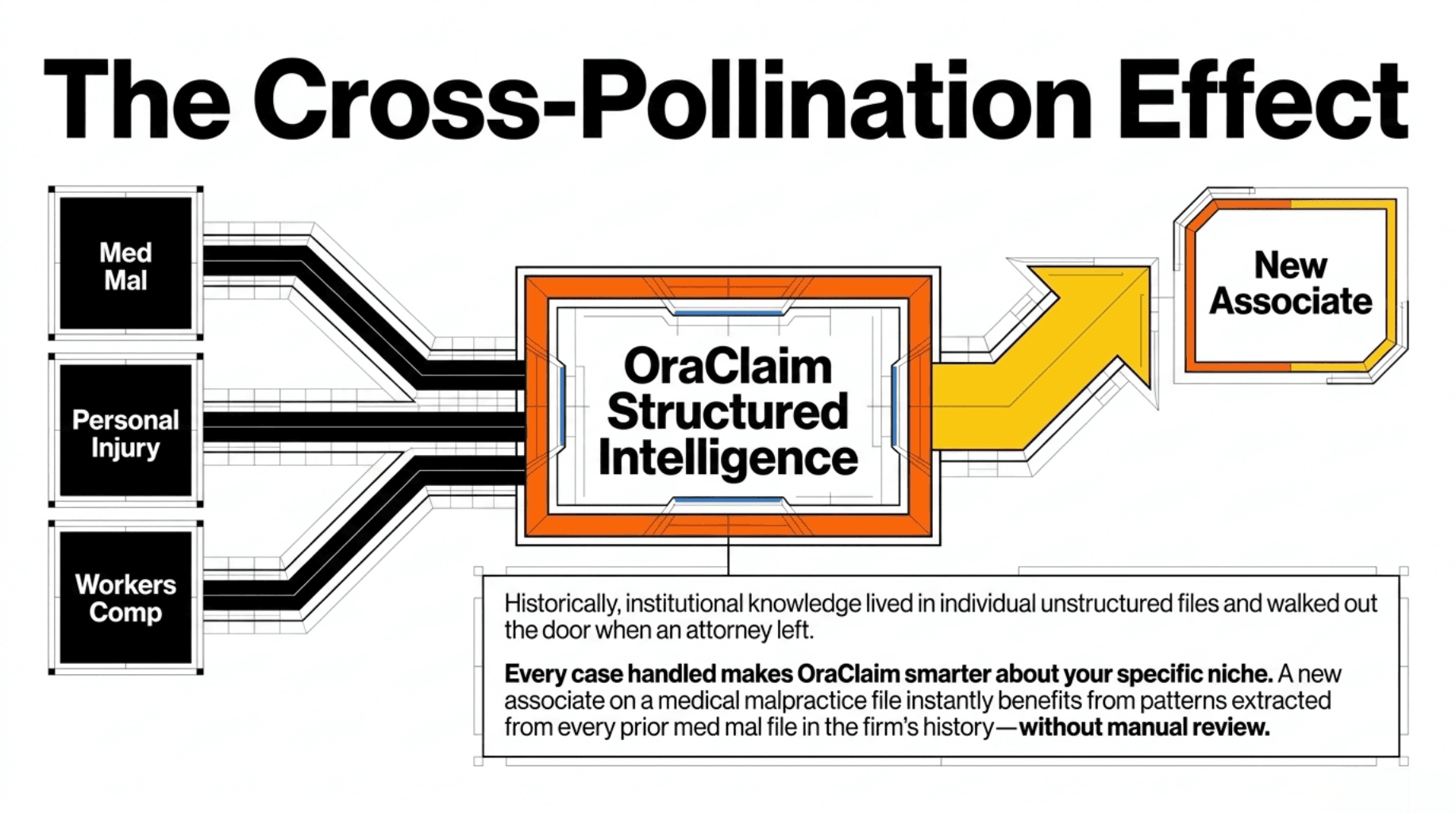
A firm handling medical malpractice, personal injury, and workers' compensation across multiple jurisdictions generates enormous institutional knowledge, but that knowledge has historically lived in individual attorneys' heads and in unstructured case files. When an attorney leaves, it leaves with them.
OraClaim turns that institutional knowledge into structured, searchable intelligence that the entire firm can access. Every case handled through OraClaim makes the system smarter about the firm's specific niche. An associate on a new medical malpractice file benefits from the patterns extracted from every prior medical malpractice file in the firm's history without having to find and read them manually. The knowledge stays in the firm. It compounds over time. It doesn't walk out the door.
The Complete Stack — and How It Works in Practice
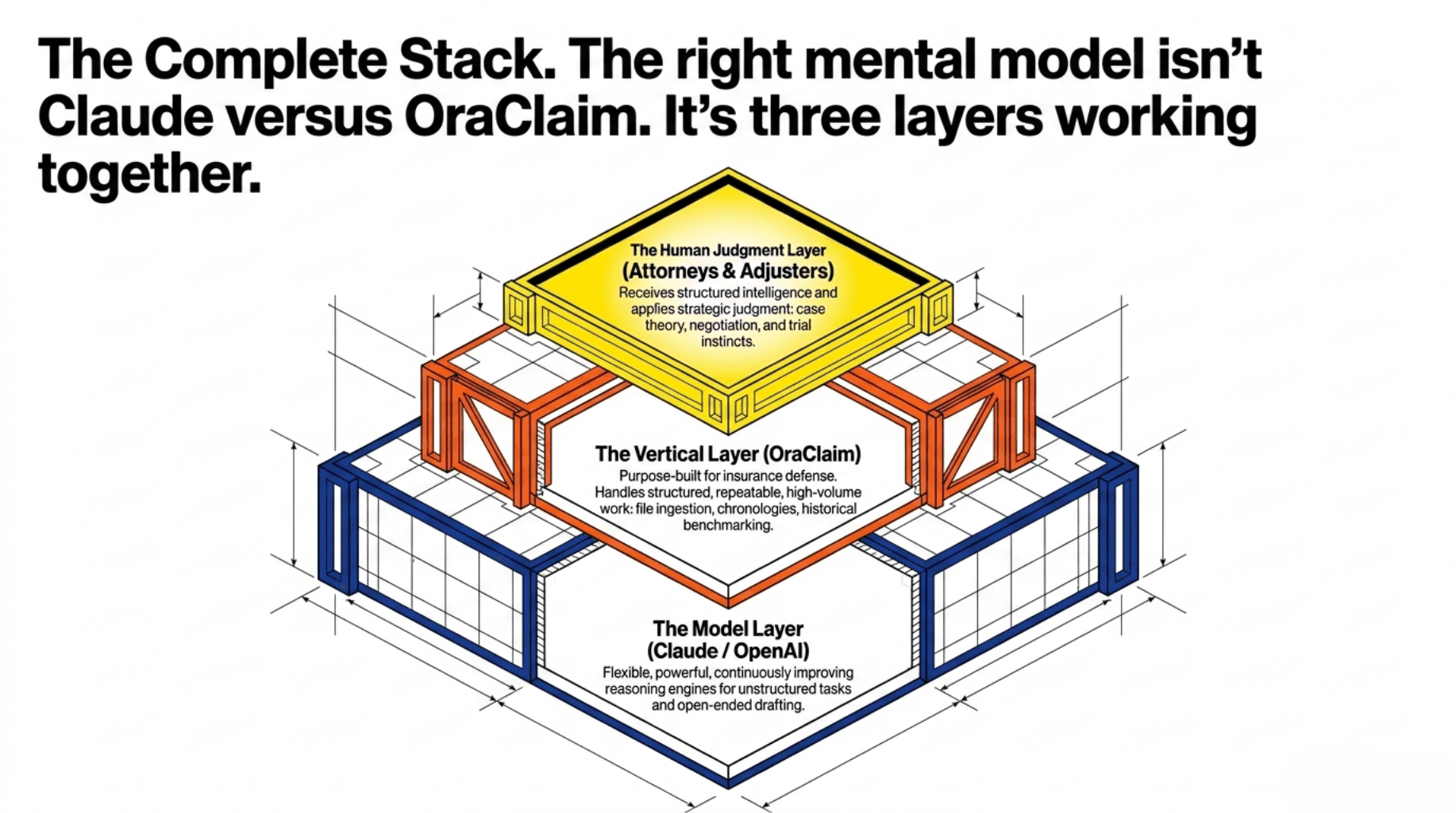
The right mental model isn't Claude versus OraClaim. It's three layers working together.
The model layer is Claude, OpenAI, and the other underlying reasoning engines. Flexible, powerful, continuously improving. Best used directly by attorneys for unstructured tasks: drafting, research synthesis, coverage analysis, client communication, and any situation requiring open-ended reasoning that doesn't fit a repeatable workflow.
The vertical layer is OraClaim. Purpose-built for insurance defense, built on top of the same underlying models, already configured for the specific workflows and decision points of claims defense. Handles the structured, repeatable, high-volume work automatically — file ingestion, record classification, demand analysis, work product generation, historical benchmarking, portfolio reporting.
The human judgment layer is your attorneys and adjusters. They receive structured, complete information from both layers and apply the strategic judgment that AI cannot replace: case theory, client relationships, negotiation, and trial instincts.
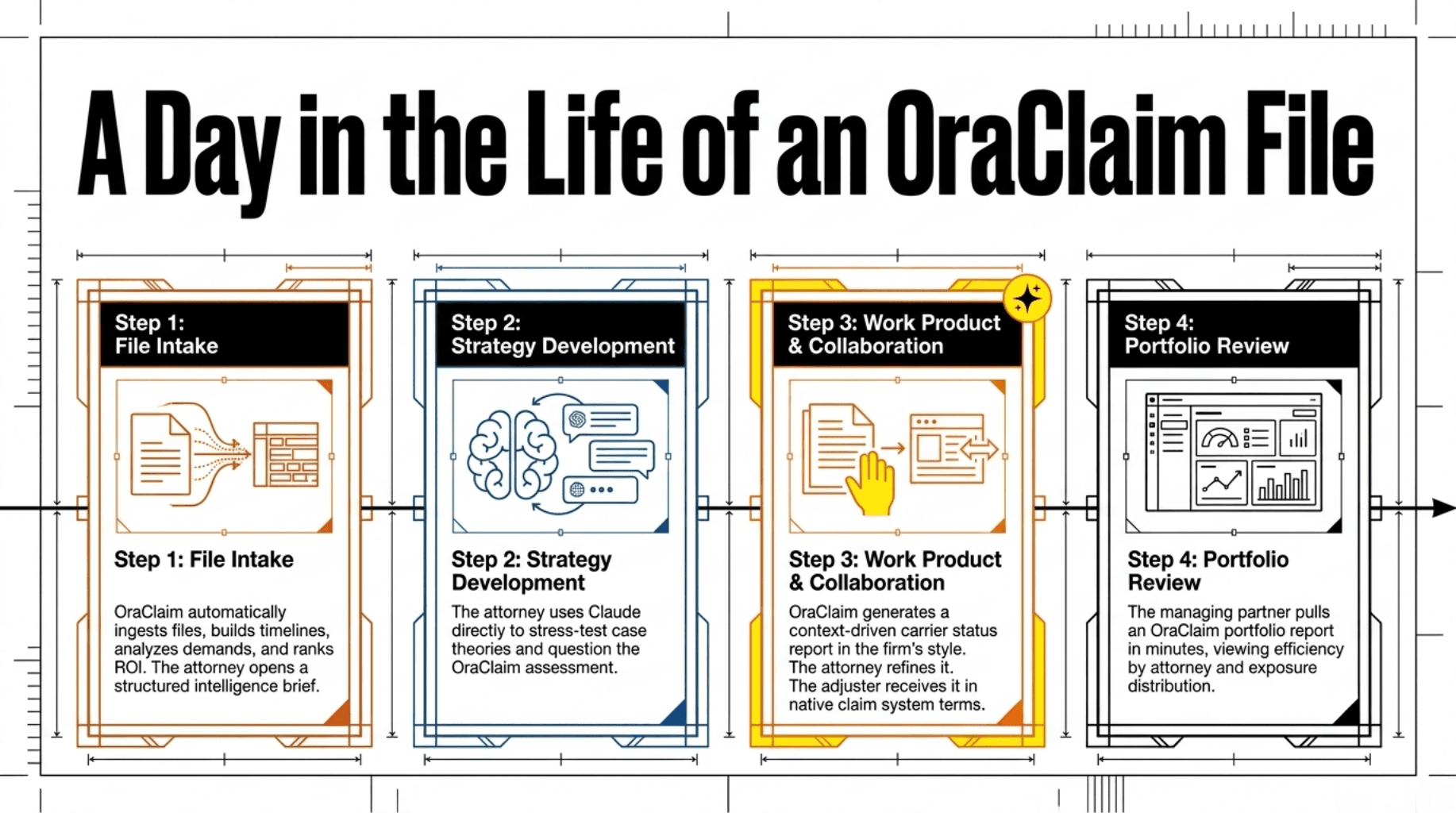
Here's what a file looks like when the stack is working:
File intake: OraClaim ingests the new file automatically — records classified, timeline built, demand analyzed, settlement range identified, actions ranked by ROI. The attorney opens a structured intelligence brief, not a pile of raw documents.
Strategy development: The attorney uses Claude directly to think through the case theory, ask questions of the OraClaim assessment, and stress-test the exposure range against their own judgment.
Work product: The attorney generates the carrier status report through OraClaim's context-driven work product generation, tailored to the firm's style, and then refines the language for a specific carrier relationship.
Collaboration: The adjuster, working from the claim management system, receives a status report that speaks in reserve and coverage terms that is produced by OraClaim, reviewed by the attorney, and delivered without manual translation.
Portfolio review: The managing partner pulls an OraClaim portfolio report: efficiency by attorney, margin by case type, exposure distribution across the active docket. Data that previously required hours of manual compilation is available in minutes.
The Build-vs-Buy Question Has a Clear Answer
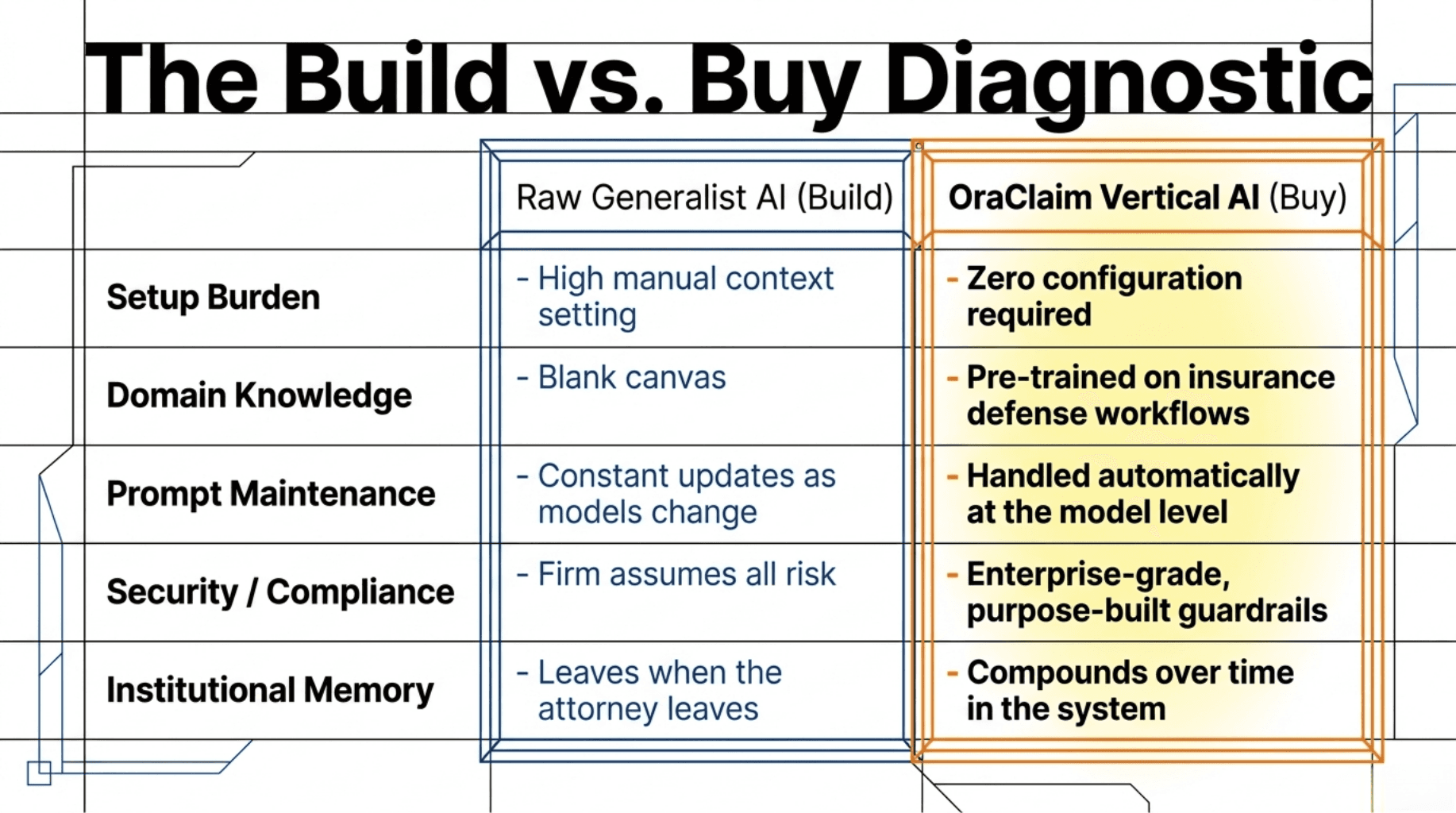
Every firm deploying Claude or ChatGPT directly as its primary insurance defense AI tool is, functionally, in the software development business: building and maintaining a custom AI stack, managing security and compliance, updating prompts as models change, and hoping the person who built it doesn't leave.
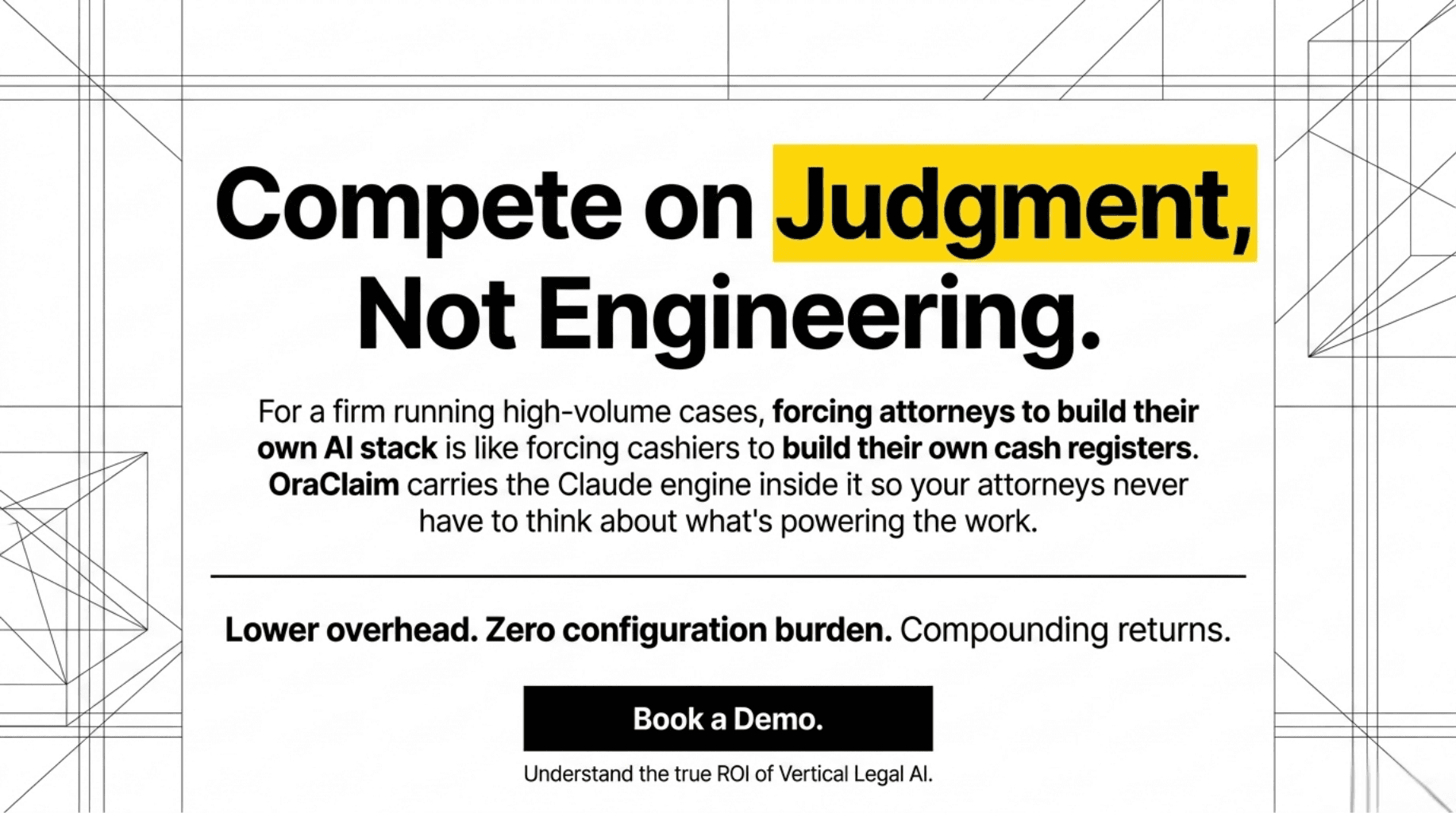
For a firm running high-volume, similar-type cases, which is the core of most insurance defense practices, that approach has the same logic as running a store and having every cashier build their own cash register from a chip and parts. The cashier's job is to check out customers. The attorney's job is to defend claims. Neither should be in the engineering business.
OraClaim is the buy answer. It absorbs the security risk, keeps pace with every model improvement automatically, and applies that improvement specifically to insurance defense. For firms in the 5–150 attorney range, the math is straightforward: lower overhead, no configuration burden, and compounding returns as the system gets smarter about your specific practice over time. The alternative is paying your attorneys to be AI engineers. That's not a trade worth making.
The smarter play isn't choosing between generalist and vertical AI. It's using each for what it does best — and letting OraClaim carry the Claude engine inside it so your attorneys never have to think about what's powering the work.
The Bottom Line
Claude and the other generalist models are extraordinary reasoning engines and they will keep getting better. OraClaim captures every one of those improvements automatically and applies them specifically to insurance defense. Your attorneys get the cutting edge without managing it.
Your competitive advantage is legal judgment, not AI engineering. OraClaim handles the vertical layer so your attorneys can focus on the work that actually requires them: more cases handled, better outcomes delivered, and institutional knowledge that stays in the firm when attorneys leave.
[1]Need to confirm this is accurate.
[2]Are these real stats or just UI examples from the website?