Blog
How to Price Legal Work in the Age of AI
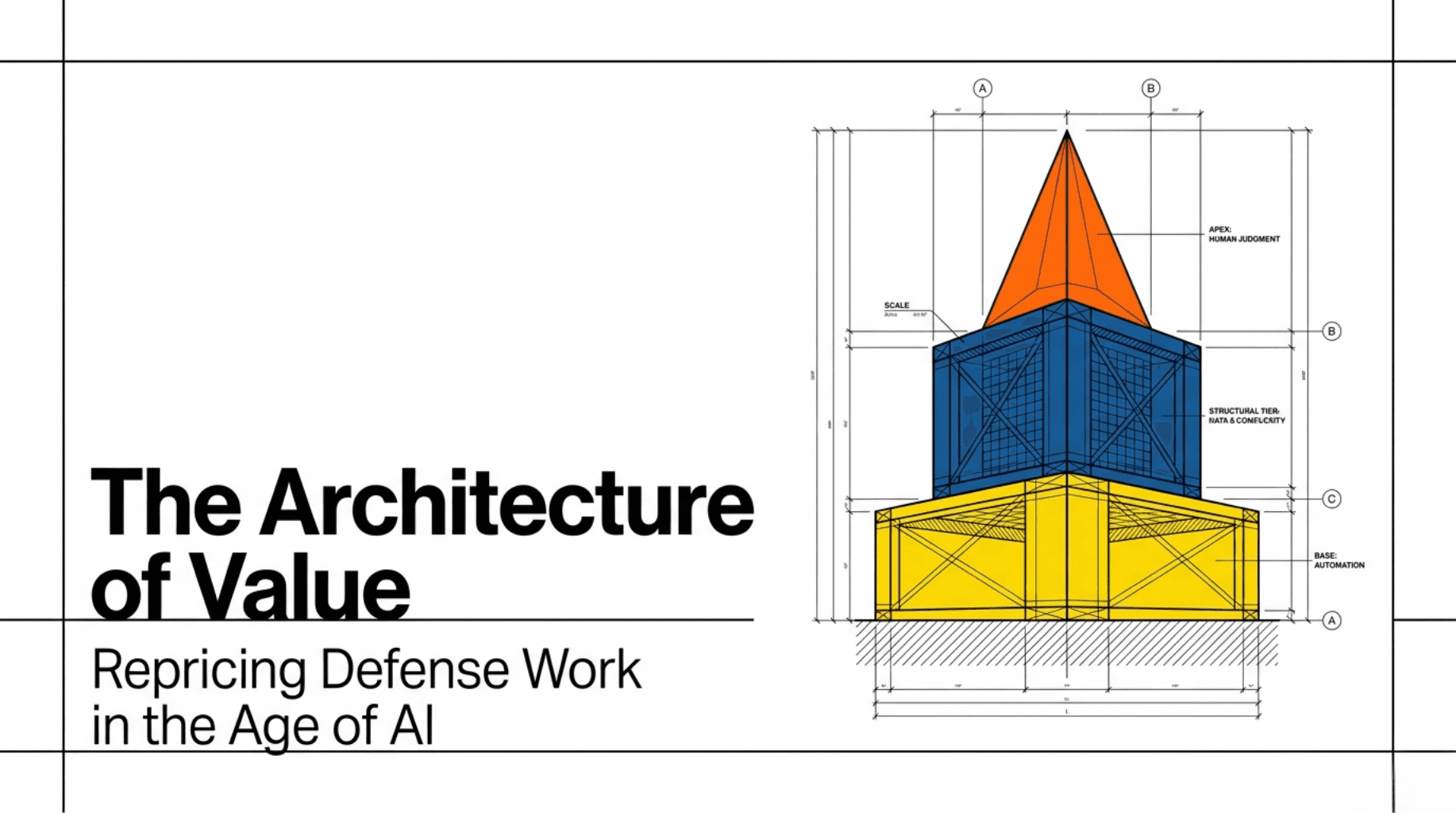
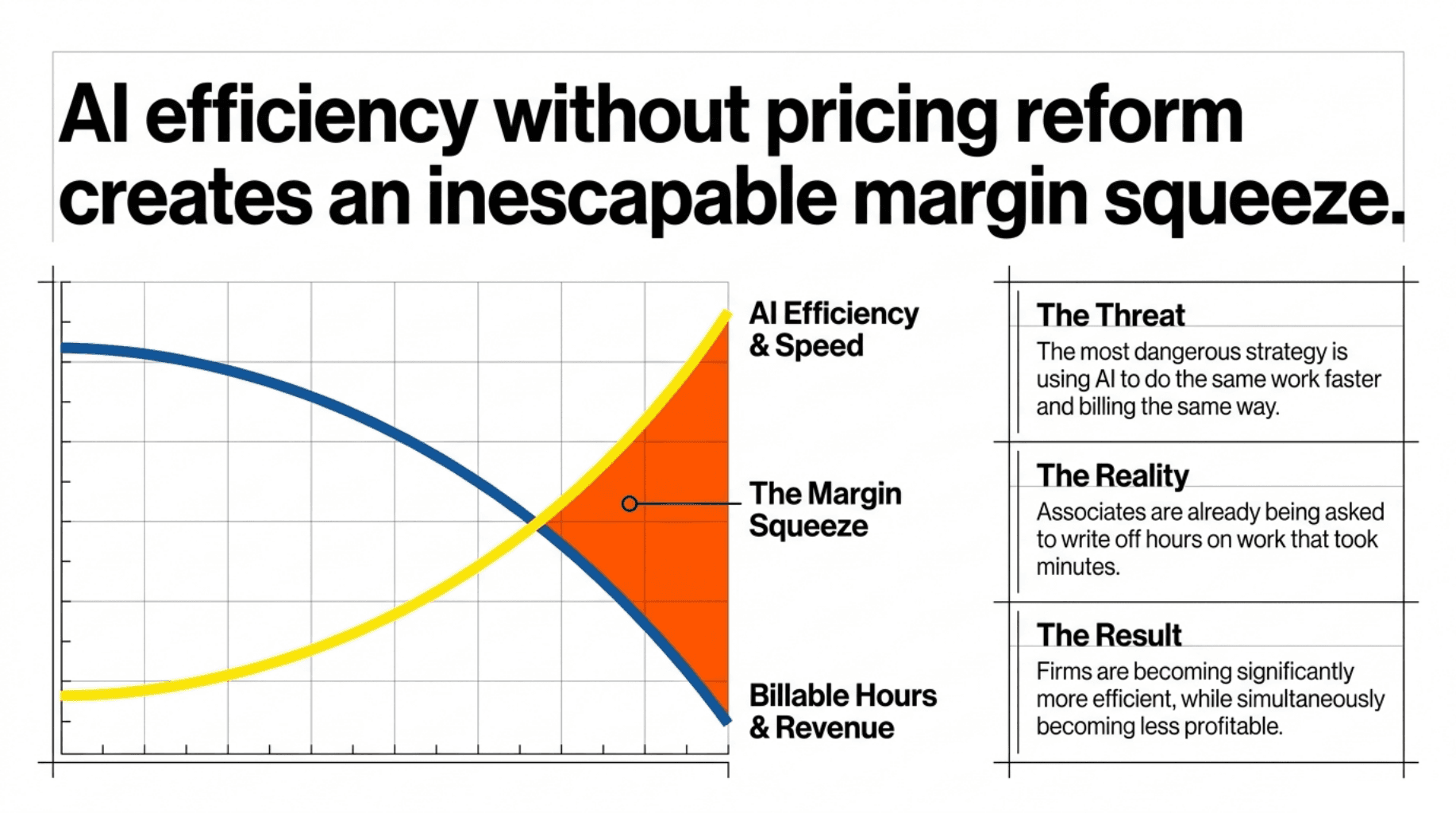
The most dangerous thing a defense firm can do with AI right now is use it to do the same work faster and bill the same way. Carriers are already refusing to pay for tasks AI can perform. Associates are being asked to write off hours on work that took minutes. And the firms that haven't thought through the pricing question are discovering that AI is making them more efficient while making them less profitable.
Pricing legal work in the age of AI is not primarily a technology question. It's a question about understanding how behavior changes when incentives change, and designing a billing model that aligns the firm's incentives with the carrier's and the outcome both parties actually want.
Here's the counterintuitive argument: billable hours are not going away. The firms predicting their death are wrong, and the firms abandoning them entirely are making a strategic error. The right answer is a hybrid architecture: flat fees where AI has made scope predictable and cost-efficient, and hourly rates preserved where human judgment remains genuinely variable and high-stakes. Getting that architecture right is the difference between capturing the productivity surplus AI creates and giving it away.
AI doesn't eliminate billing models. It exposes which parts of your work were always commodity tasks priced like professional services, and which parts are genuinely irreplaceable judgment worth more than you've been charging. The firms that understand that distinction will reprice accordingly. The firms that don't will find themselves in a margin squeeze with no exit.
Why Billable Hours Are Not Going Away
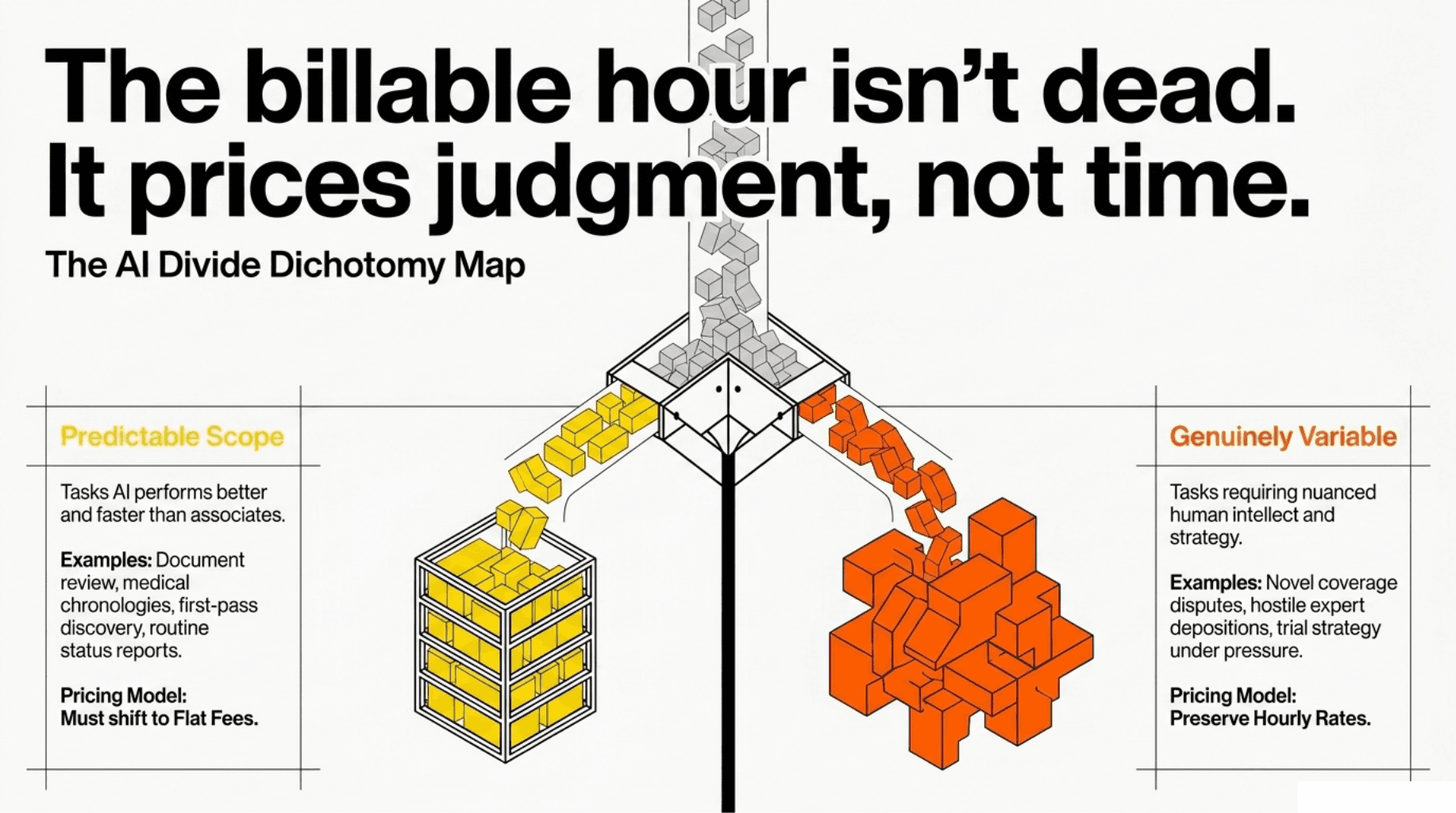
The argument that AI kills the billable hour misunderstands what billable hours are actually pricing: not time, but variability and judgment. When the outcome of a task is genuinely uncertain, such as a coverage dispute with no clear precedent, a deposition of a hostile expert witness, or a trial strategy developed under time pressure, billing by the hour is the correct model. Neither party can accurately predict the cost in advance.
The tasks where billable hours make the most sense are exactly the tasks AI cannot yet reliably perform: nuanced legal judgment, client relationship management, courtroom advocacy, and strategic decision-making on genuinely novel facts. The tasks where billable hours make the least sense, and where carriers are already pushing back, are the tasks AI now performs better and faster than associates: document review, medical record chronology, first-pass discovery responses, routine status reports.
The right framing is not "hourly vs. flat fee." It's "which parts of the work are genuinely variable, and which parts are now predictable enough to price differently?"
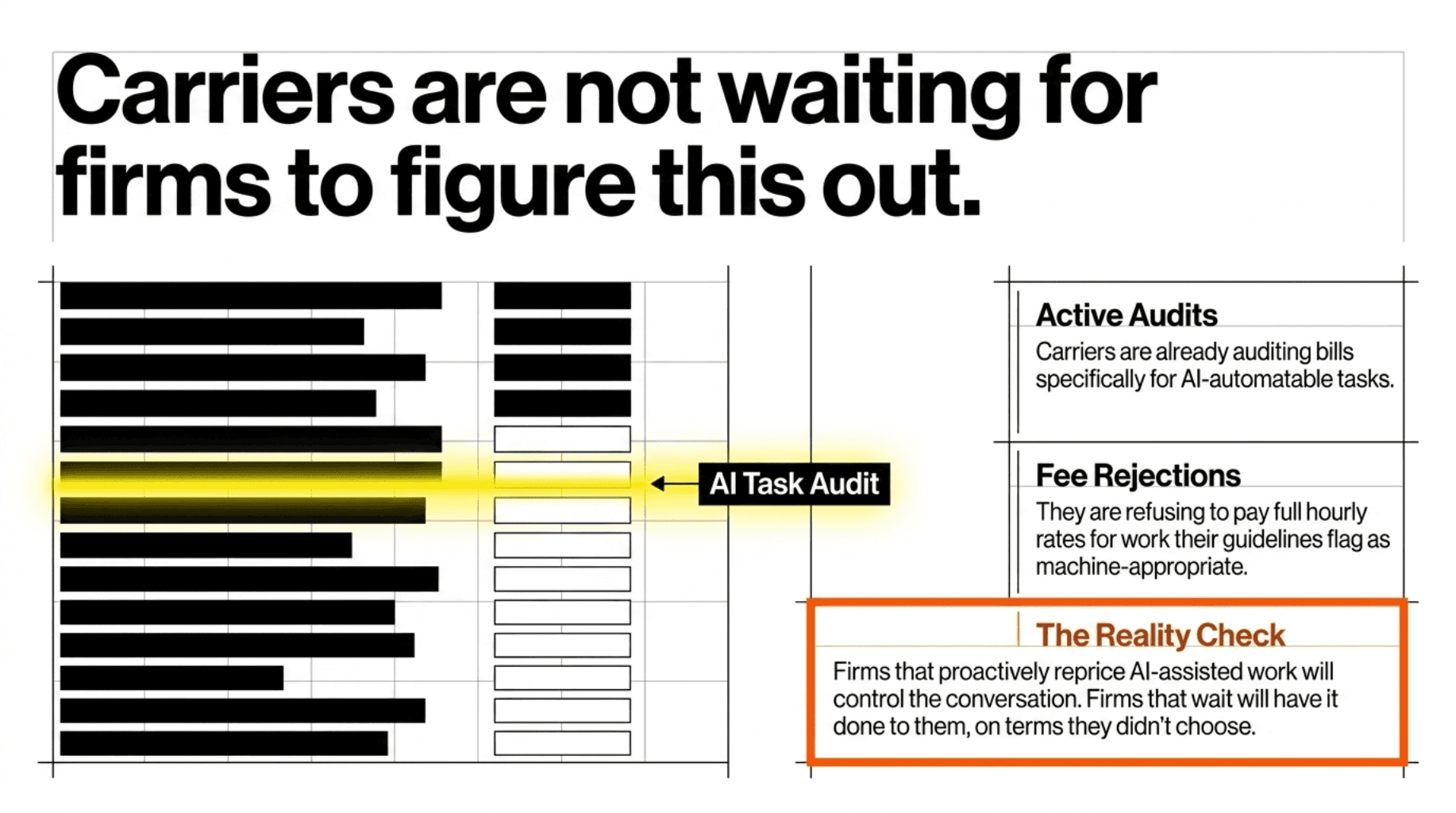
Carriers are not waiting for firms to figure this out. Many are already auditing bills for tasks they consider AI-automatable and refusing to pay full hourly rates for work their own guidelines flag as machine-appropriate. The firms that get ahead of this by proactively repricing AI-assisted work will control the conversation. The firms that wait will have it done for them, on terms they didn't choose.
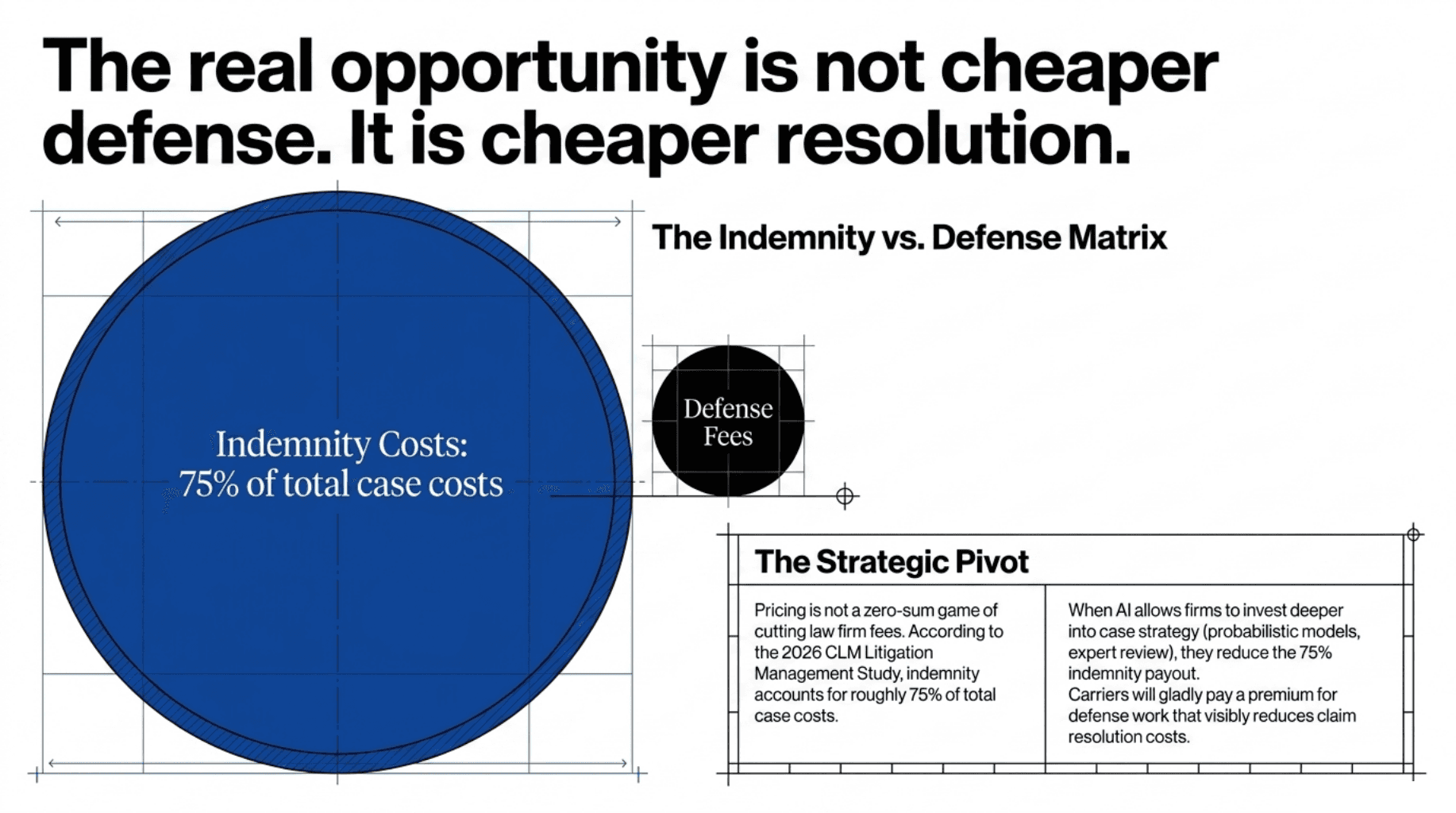
The opportunity is real. The 2026 CLM study found that indemnity accounts for roughly three-quarters of total case costs — which means the real opportunity isn't in cutting defense fees, it's in investing in defense work that actually reduces what carriers pay to resolve claims. The pricing conversation is not zero-sum — it's an opportunity to reframe the value proposition entirely.
Before You Redesign Your Billing Model, Understand What AI Actually Makes Possible
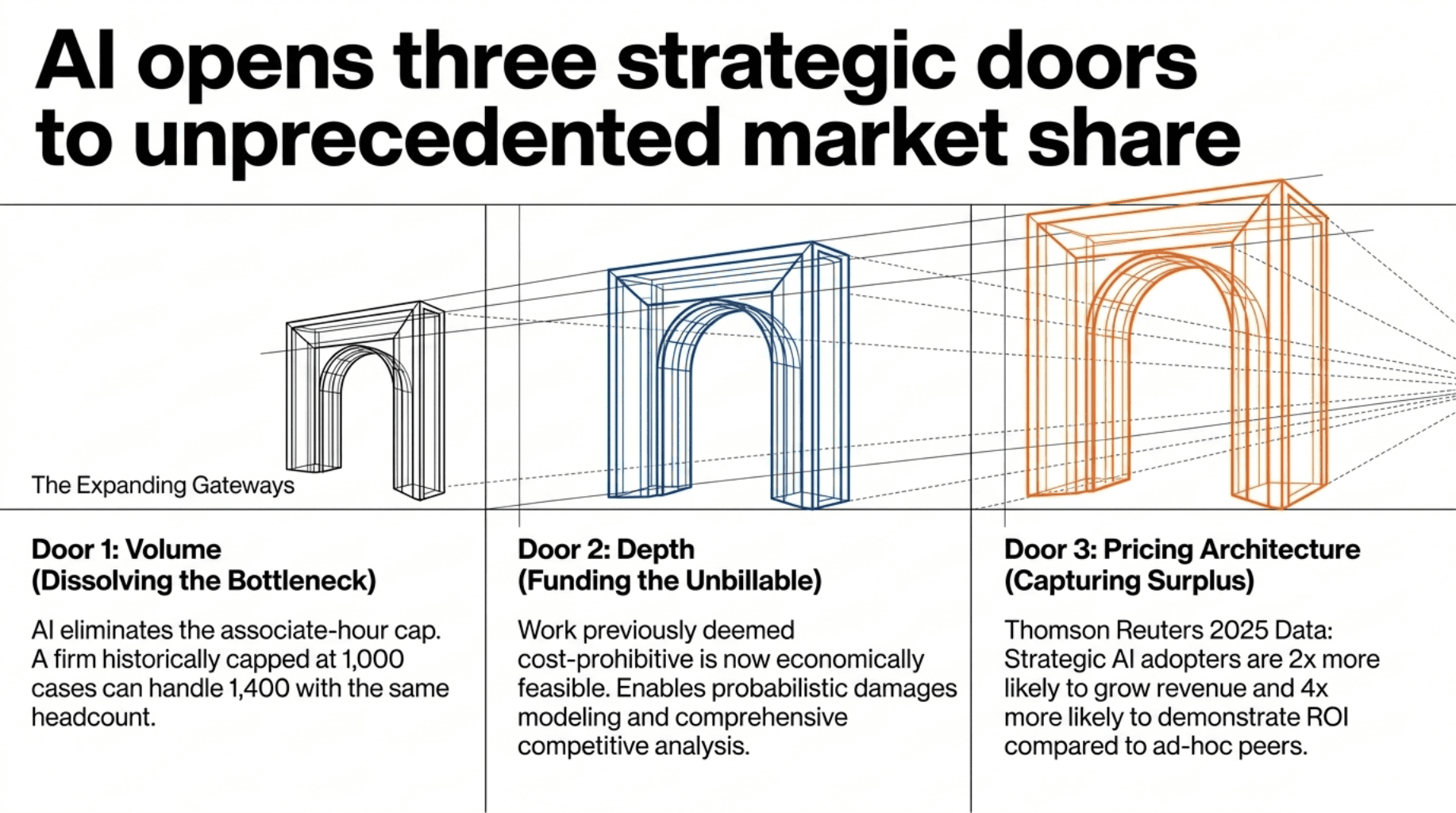
AI doesn't just change how fast you do existing work. It opens strategic doors that weren't previously available.
The first door is volume. AI dissolves the associate-shaped bottleneck. A firm capped at a thousand cases a year by associate hours can plausibly handle fourteen hundred with the same headcount once medical chronologies, document reviews, and routine discovery are AI-assisted. Revenue per case may fall slightly under a repriced model, but total revenue rises and margins remain similar or improve. With 60% of competitors turning down work, the door labeled "more cases" leads directly into market share that hasn't been available in two decades. Volume pricing requires predictable unit economics — which requires knowing what each case type actually costs to handle with AI assistance. That data is the foundation of any viable flat fee or tiered model.
The second door is depth.The second door is depth. Most defense work is constrained not by what would be useful but by what's economically defensible to bill. Reviewing every prior deposition an opposing expert has given, building a probabilistic damages model for mediation, and running competitive analyses on opposing counsel was all cost-prohibitive until recently.
AI changes that math. Work that was previously unbillable becomes feasible. Work that was already being done becomes more comprehensive. And when OraClaim surfaces ROI-ranked recommended actions[1] , carriers can see exactly what they're paying for and why it moves the indemnity number. That's the foundation of a premium pricing conversation that simply didn't exist before.
The third door is pricing architecture. When tasks become AI-assisted, billing them by the hour becomes both economically problematic, since carriers are already refusing to pay for what AI can do, and strategically wasteful, since the firm captures none of the productivity surplus. Thomson Reuters' 2025 Future of Professionals research finds that strategic AI adopters are roughly twice as likely to grow revenue and four times as likely to demonstrate ROI as ad-hoc peers. The firms walking through all three doors (more volume, deeper work, and better pricing architecture) are the ones building durable competitive advantage.
The Practical Architecture: Building a Hybrid Pricing Model
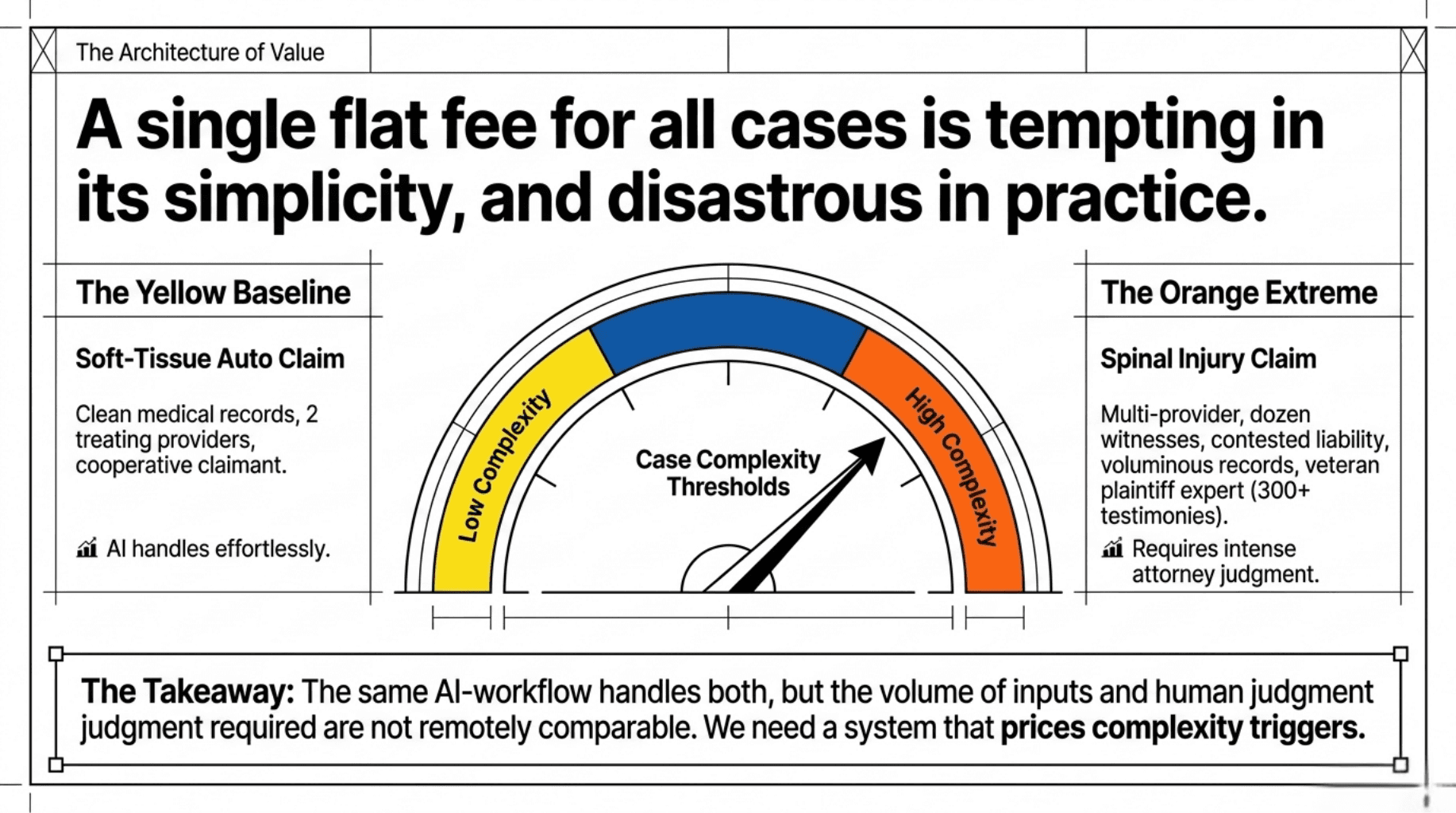
A single flat fee for all cases of a given type is tempting in its simplicity and almost always wrong in practice. Case complexity varies enormously. A soft-tissue auto claim with clean medical records, two treating providers, and a cooperative claimant is a fundamentally different product than a multi-provider spinal injury claim with a dozen witnesses, contested liability, voluminous records, and a plaintiff's expert who has testified three hundred times. The same AI-assisted workflow handles both, but the inputs, the volume of material, and the attorney judgment required are not remotely comparable.
The answer is tiers. Not differentiated service offerings, but a pricing structure that reflects what actually drives cost and complexity in the work. Think of it like a software pricing page with clearly defined thresholds: what moves a case from one tier to the next is the volume of witnesses, medical records, treating providers, and experts involved, and the exposure level the case carries.
A base tier covers straightforward claims: limited treating providers, clean or modest medical records, minimal witnesses, and manageable exposure. These cases are the clearest candidates for flat fee pricing. The AI-assisted process is consistent, the inputs are predictable, and the cost is controllable. This is where the efficiency gains are most immediately visible to the carrier and most straightforward to price.
A mid tier covers cases with meaningfully greater complexity: more treating providers and facilities, a higher volume of records requiring classification and analysis, multiple witnesses, disputed liability, and significant damages exposure. The same tools and processes apply, but the volume of material and the demands on attorney judgment increase accordingly. A flat fee or capped hourly structure grounded in actual cost data across comparable files reflects the reality of what these cases require.
A premium tier covers high-exposure, high-complexity cases: extensive witness lists, multiple testifying experts, large-scale document review, coverage disputes, or cases where the facts are genuinely novel and trial is a real possibility. Here, hourly billing is preserved. Not as a default, but as the correct model, because neither party can accurately predict the cost in advance. These are the cases where human judgment is doing most of the heavy lifting, and pricing that reflects variability is the honest answer.
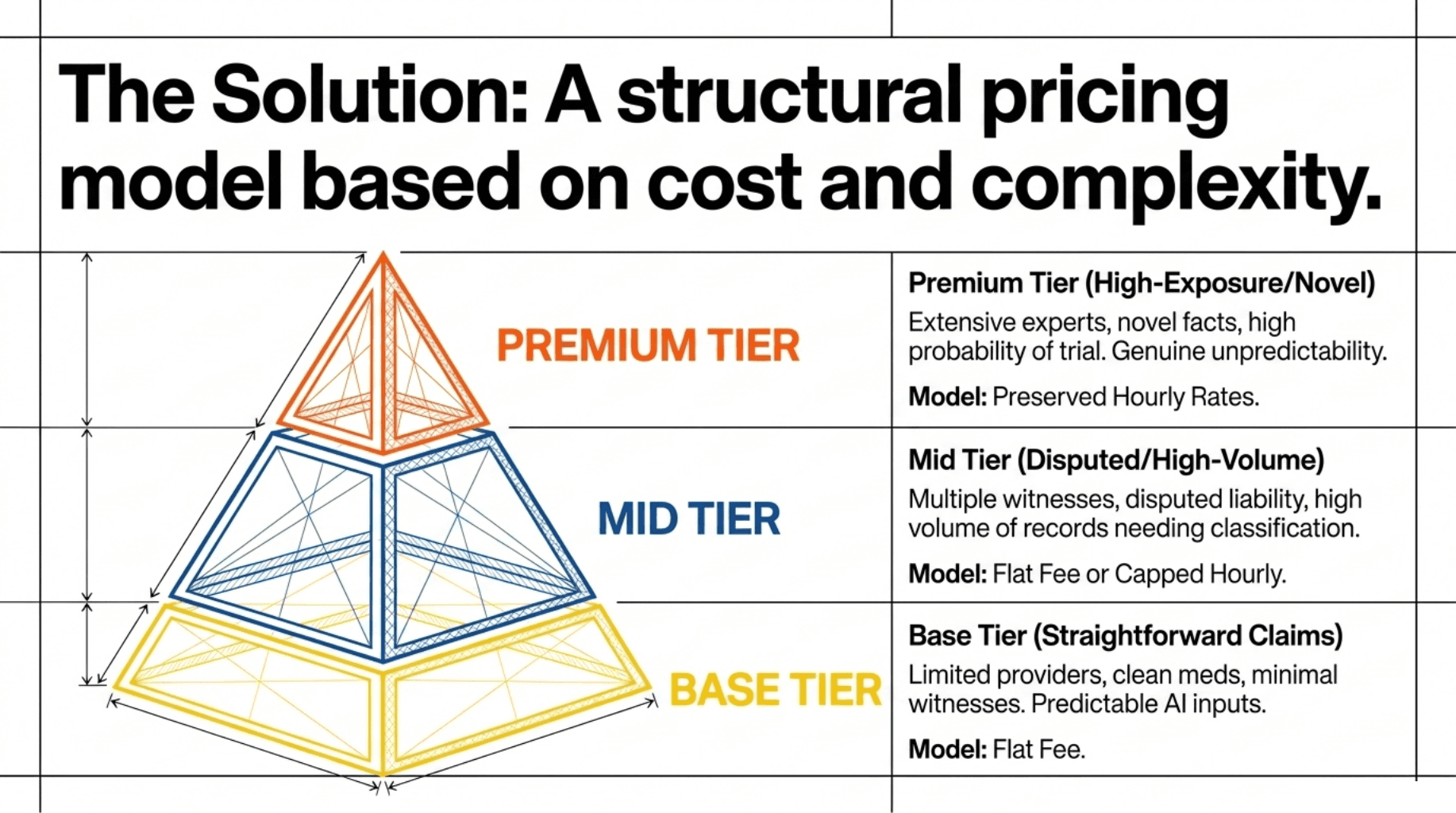
The tiers are not a convenience. They're a communication tool. They give carriers a clear picture of what they're buying at each level of case complexity, make the firm's AI investment legible as a service differentiator, and create a pricing conversation that's grounded in the actual drivers of cost rather than an undifferentiated hourly rate applied to everything.
How Behavior Changes When Pricing Changes — and Why That Matters
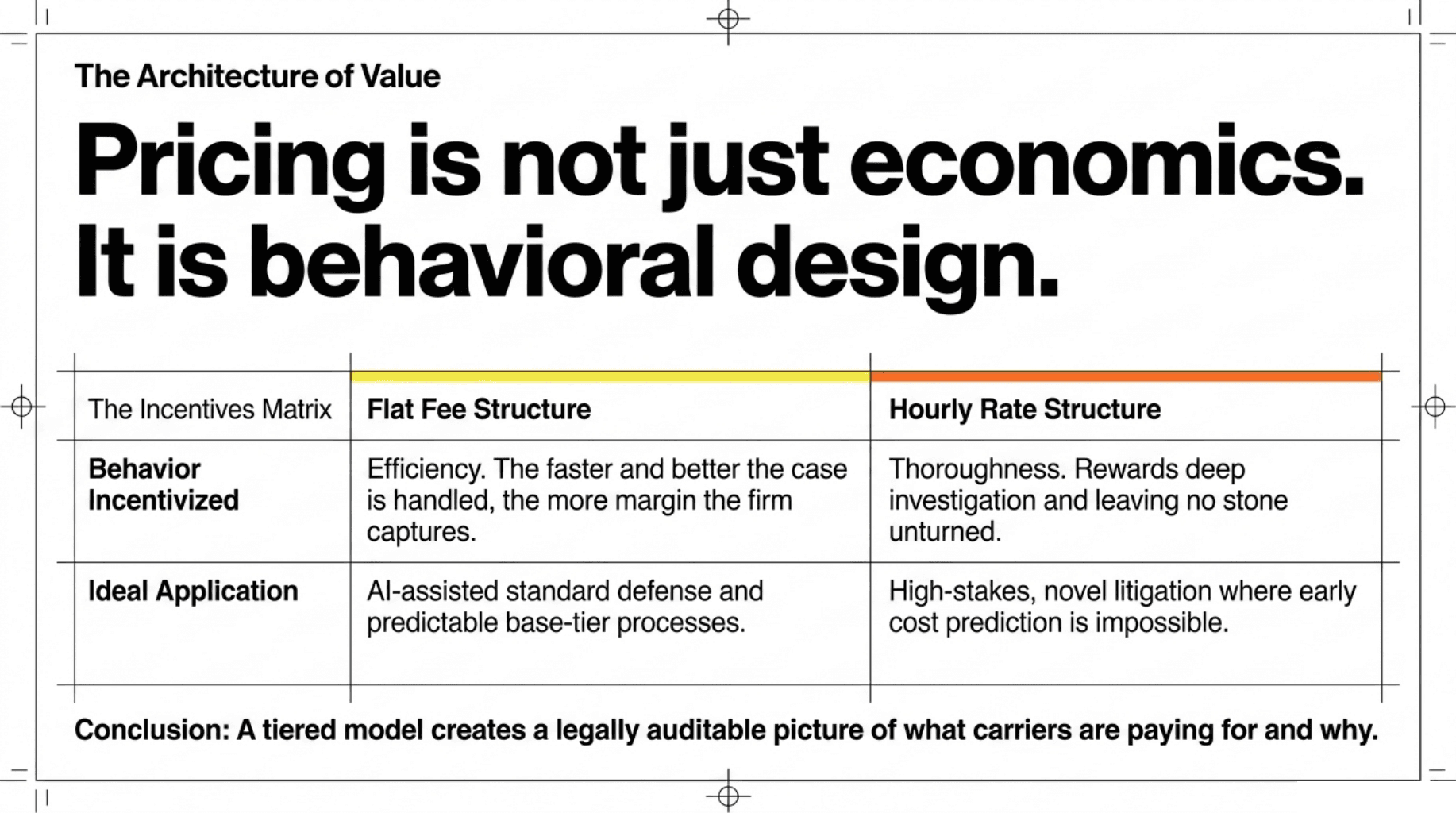
Pricing is not just an economic decision. It's a behavioral one. When you move from hourly to flat fee on a scope of work, you change the incentives for everyone involved: the attorney handling the file, the associate doing the support work, and the carrier approving the budget.
Flat fees align the firm's incentive with efficiency: the faster and better you handle the case, the more margin you capture. Hourly rates align the firm's incentive with thoroughness, sometimes appropriately, sometimes not. Understanding which incentive structure fits which type of work is the core design question. Carriers respond to transparency and predictability. A tiered model that clearly defines what moves a case from one level to the next gives carriers something they've rarely had: a legible, auditable picture of what they're paying for and why.
Look at the payout structure from the carrier's perspective. A flat fee for AI-assisted base-tier cases that comes in at or below current hourly costs for the same scope is an easy yes. A premium tier for high-complexity work that demonstrably reduces indemnity exposure is a harder conversation, but one that OraClaim's outcome data makes winnable.
The Pricing Model Is Only as Good as the Data Behind It
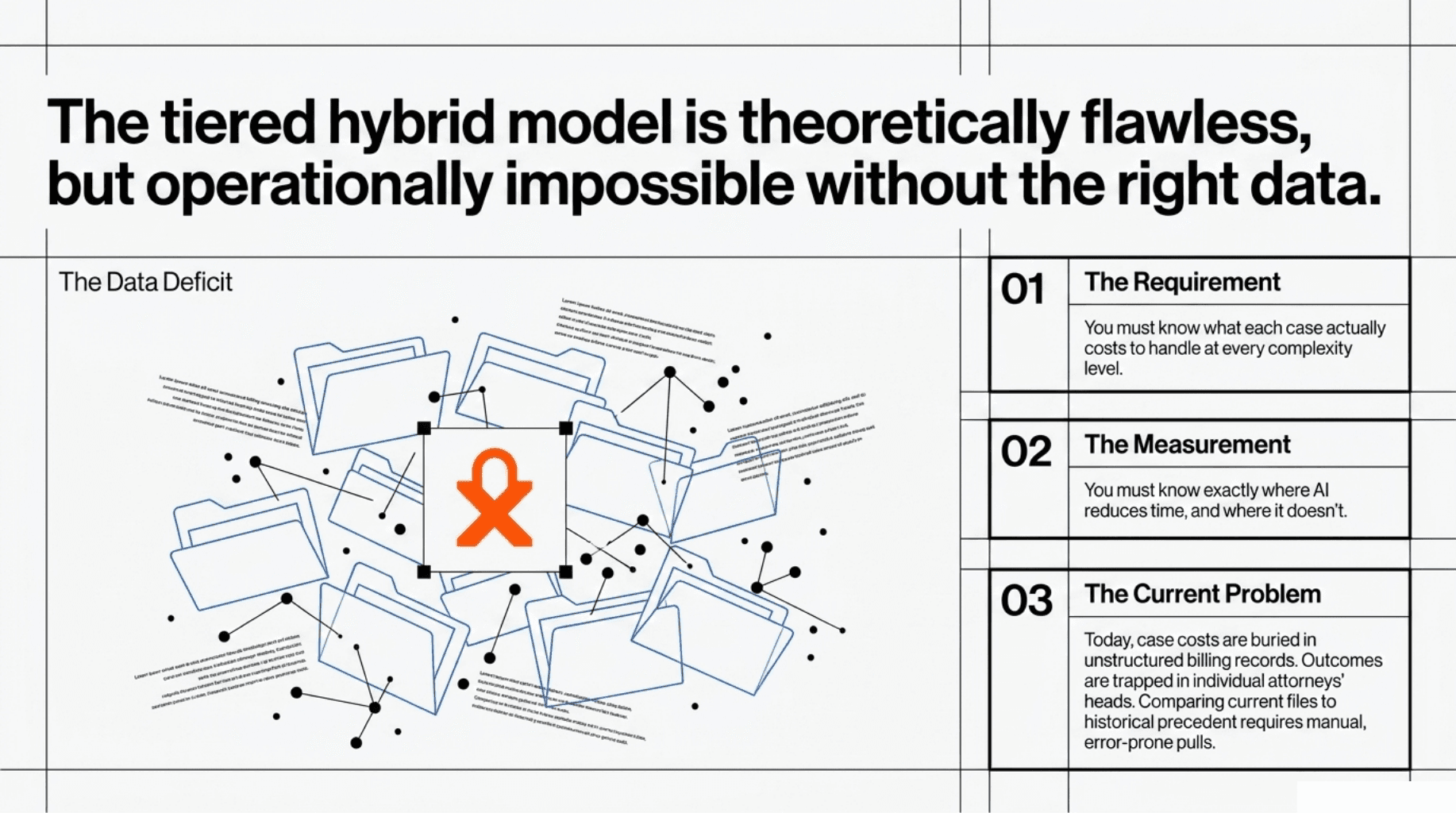
A tiered hybrid pricing model requires knowing three things with confidence: what each case type actually costs to handle at each complexity level, where AI assistance is genuinely reducing time and where it isn't, and what outcomes are being achieved at each tier relative to comparable historical cases.
Most firms don't have this data in a usable form. Case costs are buried in billing records. Outcomes are tracked in individual attorney heads or unstructured files. Comparing a current file to historical precedent requires pulling records manually and hoping someone remembers the relevant details. This is exactly the gap OraClaim closes: portfolio-level financial intelligence that connects case cost data with outcome data across the entire docket, making the economics of each case type visible and the basis for tiered pricing defensible.
At the base tier, OraClaim's automated file intake, record classification, and work product generation are what make flat fee pricing viable — the cost is predictable because the AI-assisted process is consistent and measurable. At the mid tier, OraClaim's historical benchmarking and comparable case data justify the enhanced pricing — the firm can show carriers exactly what additional complexity is being managed and what outcomes it has produced on similar files. At the premium tier, OraClaim's portfolio intelligence gives managing partners the visibility to ensure that genuinely high-judgment work is being staffed and billed appropriately, and that hourly rates are defensible against actual cost and outcome data.
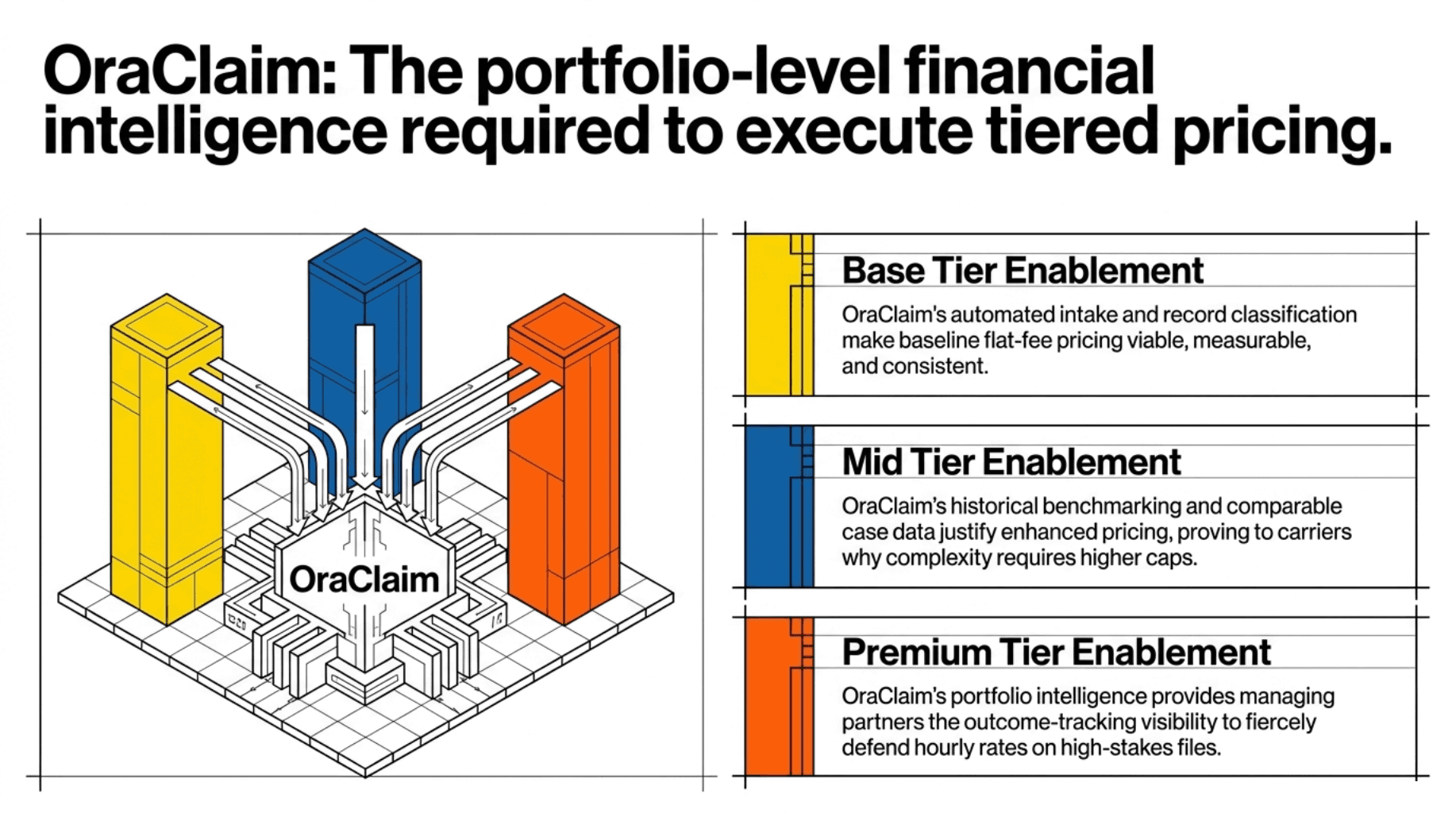
The result is a pricing model that isn't just theoretically sound but operationally executable, because the data infrastructure to support it is already built into the platform.
How to Have the Carrier Conversation
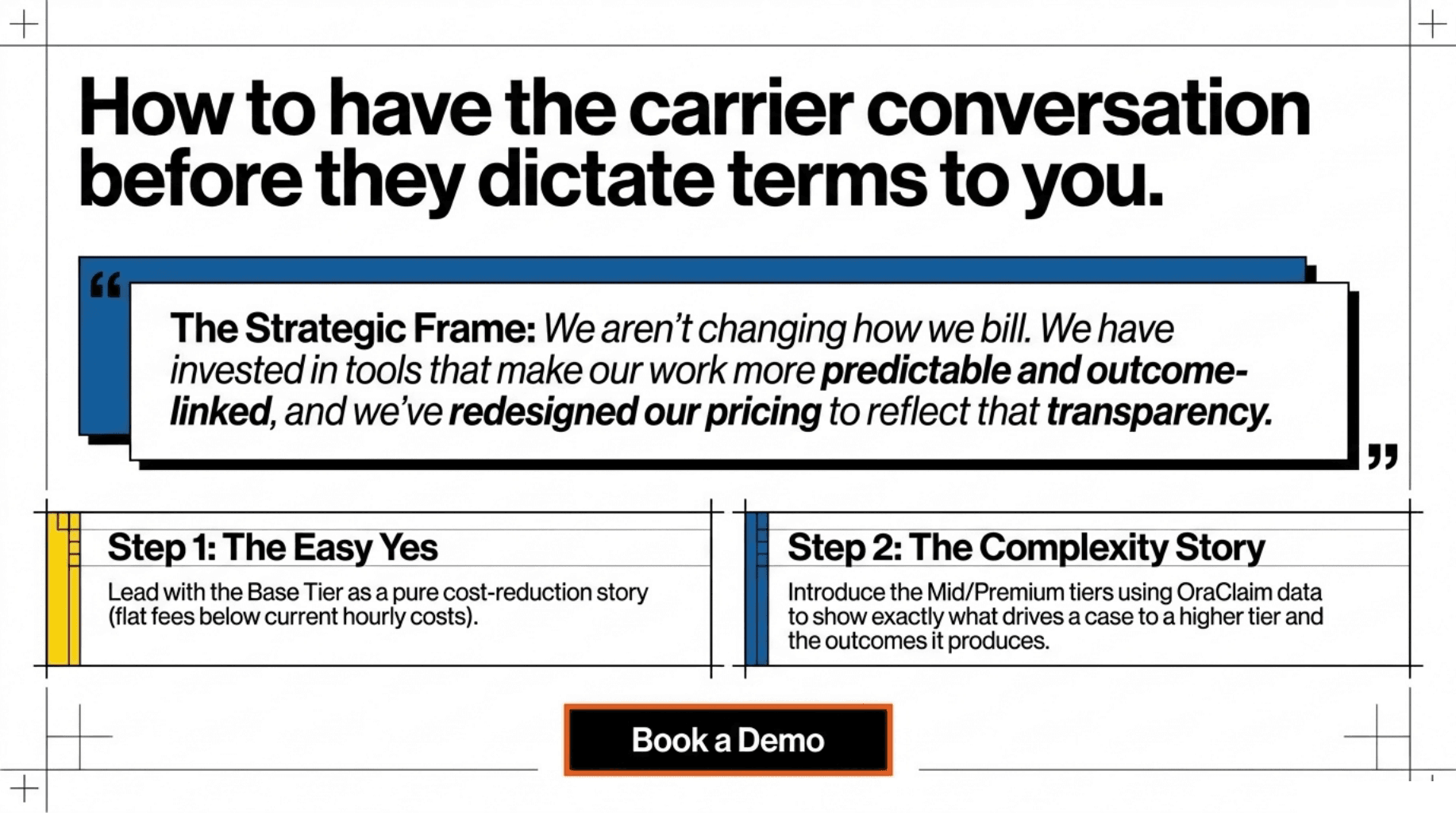
The conversation about repricing is easier than most managing partners expect if it's framed correctly. The frame is not "we're changing how we bill." It's "we've invested in tools that make our work more predictable, more transparent, and more outcome-linked, and we've redesigned our pricing to reflect that."
Lead with the base tier as a cost-reduction story: AI-assisted standard defense at a flat fee that comes in at or below current hourly costs for the same scope. Carriers say yes to this easily. Introduce the mid and premium tiers as a complexity story: here is what drives a case to a higher tier, here is how we define those thresholds, and here is the OraClaim data on what it has produced on comparable cases. The firms that have this conversation proactively before carriers start dictating terms will set the pricing architecture on their own terms.
The Bottom Line
The pricing question in the age of AI is not "hourly or flat fee." It's "which parts of our work involve straightforward, AI-assisted processes on predictable inputs, and which parts involve the kind of volume, complexity, and judgment that can't be priced in advance?"
The answer is a tiered hybrid model: flat fees on base cases where inputs are limited and costs are predictable, a structured mid tier for cases with greater complexity and exposure, and hourly rates preserved at the top for high-stakes files where neither side can predict the cost until the work is done.
Getting that architecture right requires data, and OraClaim is the infrastructure that makes that data available: portfolio-level financial intelligence, historical benchmarking, and outcome tracking that turns a pricing theory into a defensible, carrier-ready business model.
The firms that do this well will capture something most defense practices have never had: a pricing structure that aligns their incentives with their carriers', rewards efficiency without penalizing thoroughness where it matters, and makes the value of AI investment legible to the people writing the checks.
Sources
2026 CLM Litigation Management Study (Suite 200 Solutions / Claims and Litigation Management Alliance, 2026); "Job Task," Andy Liverman Anderson (LinkedIn, 2025); "CLM Unveils National Law Firm Talent Survey Highlighting Challenges for Both Firms and Clients" (BusinessWire / Claims and Litigation Management Alliance, October 2025); "Future of Professionals Report" (Thomson Reuters, 2025).
[1]On the website you list these as examples, but not sure if they are based on actual numbers/if we want to go with something else:
- Depose this witness, 302% ROI
- Retain this expert, 213% ROI
- Mediate within 45 days, 159% ROI