Blog
How to Get Client Buy-In for AI: What to Say, Who to Talk To, and What’s Working at Other Firms
Meta Description: Carrier clients aren’t waiting for permission to embrace AI - they’re waiting for a defense firm that can make the case in language they understand. A practical, stakeholder-by-stakeholder framework for getting carrier support for AI adoption.
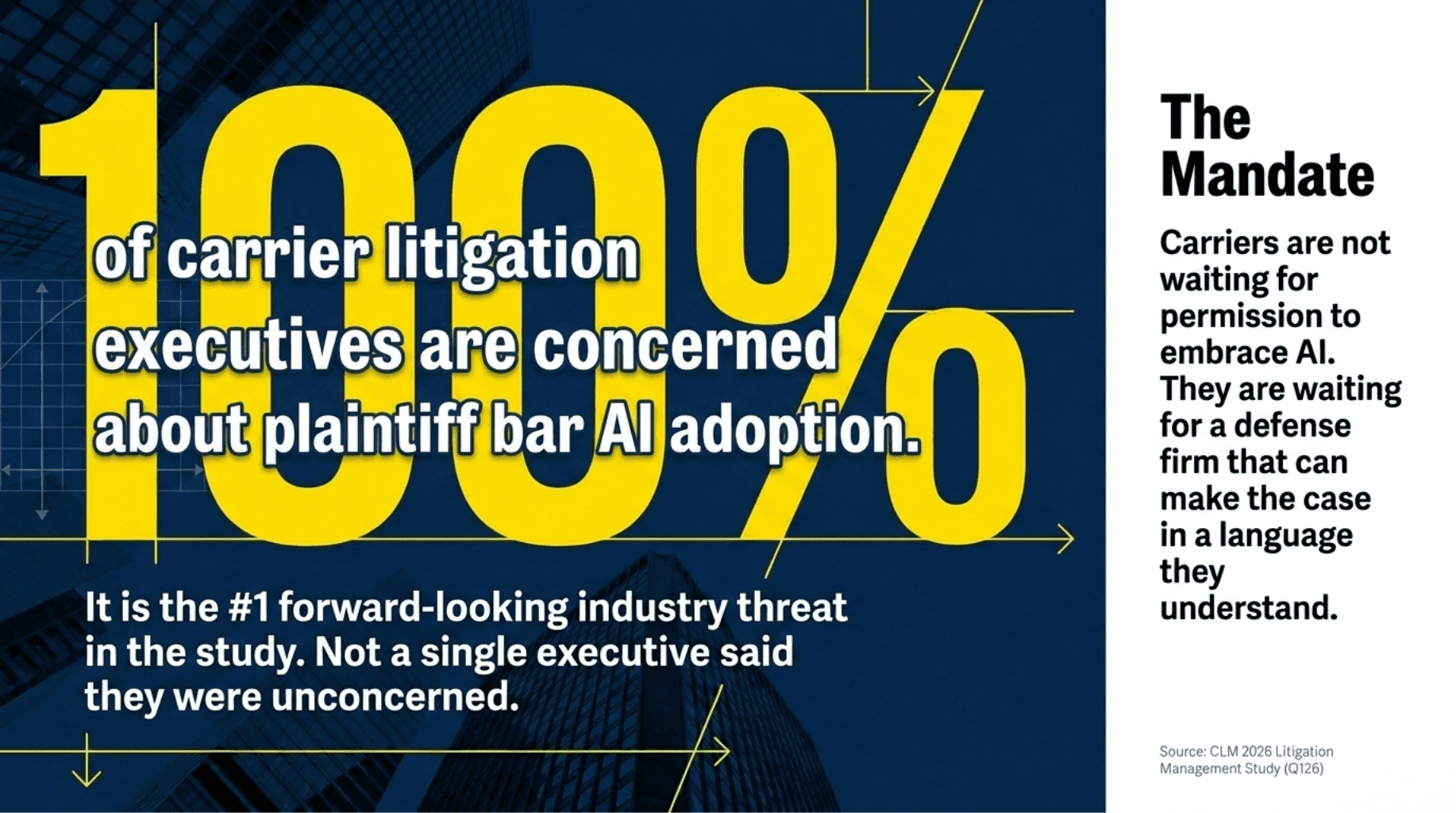
Every carrier litigation executive in the 2026 CLM study is concerned about plaintiff bar AI adoption. Not most of them - all of them. Not a single one said they are unconcerned. The adoption of AI by the plaintiff bar is the top forward-looking industry threat in the entire study (CLM 2026, Q126). Carriers want the defense side to respond. They are waiting for someone to show them how.
The gap that creates the opening: 79% of carrier executives haven’t agreed to pay for any AI tools their firms are using (CLM 2026, Q61), and 50% believe firms should absorb those costs as overhead (CLM 2026, Q84). But this is not a closed door. The conversation hasn’t happened - not because carriers don’t want AI on their files, but because firms haven’t made the case in language that maps to how carriers think about outcomes and risk.
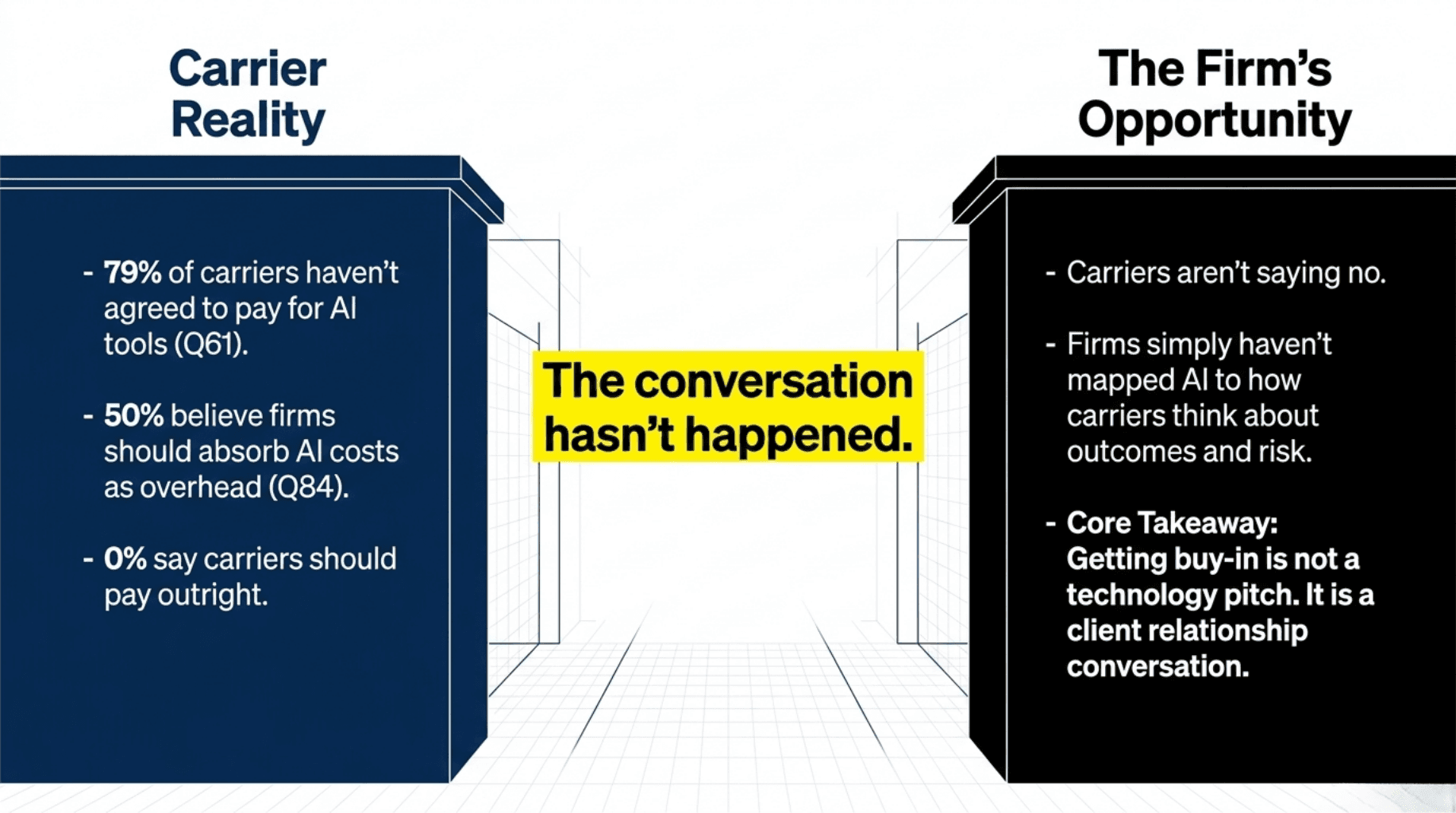
Getting client support for AI is not a technology pitch. It is a client relationship conversation - one about outcomes, indemnity management, and what kind of firm your carrier clients want on their panel five years from now. Handled well, it is also one of the clearest opportunities a defense firm has right now to differentiate itself: to signal that it is innovative, forward-thinking, and genuinely invested in client outcomes rather than just billing hours. What follows maps the audience, gives you the conversation framework for each stakeholder, and shares what’s working at firms that have already had this conversation successfully.
Who Has to Say Yes - and What Each Stakeholder Actually Cares About
Getting carrier buy-in for AI rarely involves one conversation with one person. It involves a small ecosystem of decision-makers with different priorities, different vocabularies, and different definitions of a good outcome. Getting this right starts with knowing who you’re talking to.
What Equity Partners and Managing Partners Need to Hear First
Inside the firm, equity partners hold the purse strings - and they have seen many technology promises that didn’t deliver. Law firm management consultants with decades in the industry observe that practice management systems are routinely adopted and then used at a fraction of their potential. Partners remember this. They have heard “this will change everything” before.
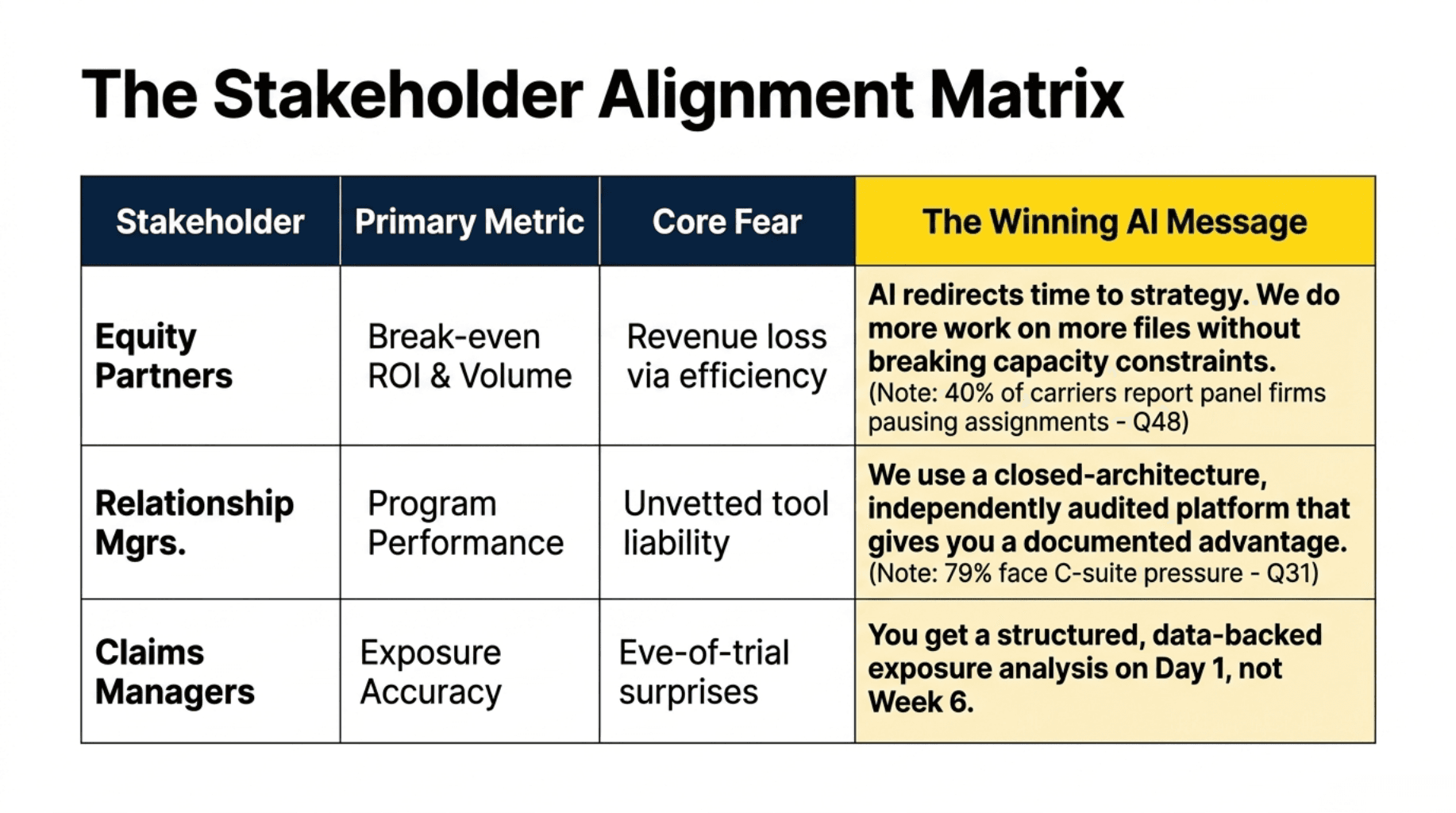
What moves equity partners isn’t vision - it’s ROI with a credible break-even calculation. The financial case is straightforward: on a case with $50,000 in legal fees and a $500,000 settlement, cutting fees 10% saves $5,000. Moving the settlement 10% saves $50,000. AI’s return is in the indemnity line, not the billing line. That math, presented clearly, is what gets internal sign-off - and it’s the same math that makes carriers take notice. A firm that can demonstrate it is actively investing in tools that move the indemnity line is a firm carriers want to keep on their panel. That alignment of financial incentives is the foundation of a trusted, long-term client relationship.
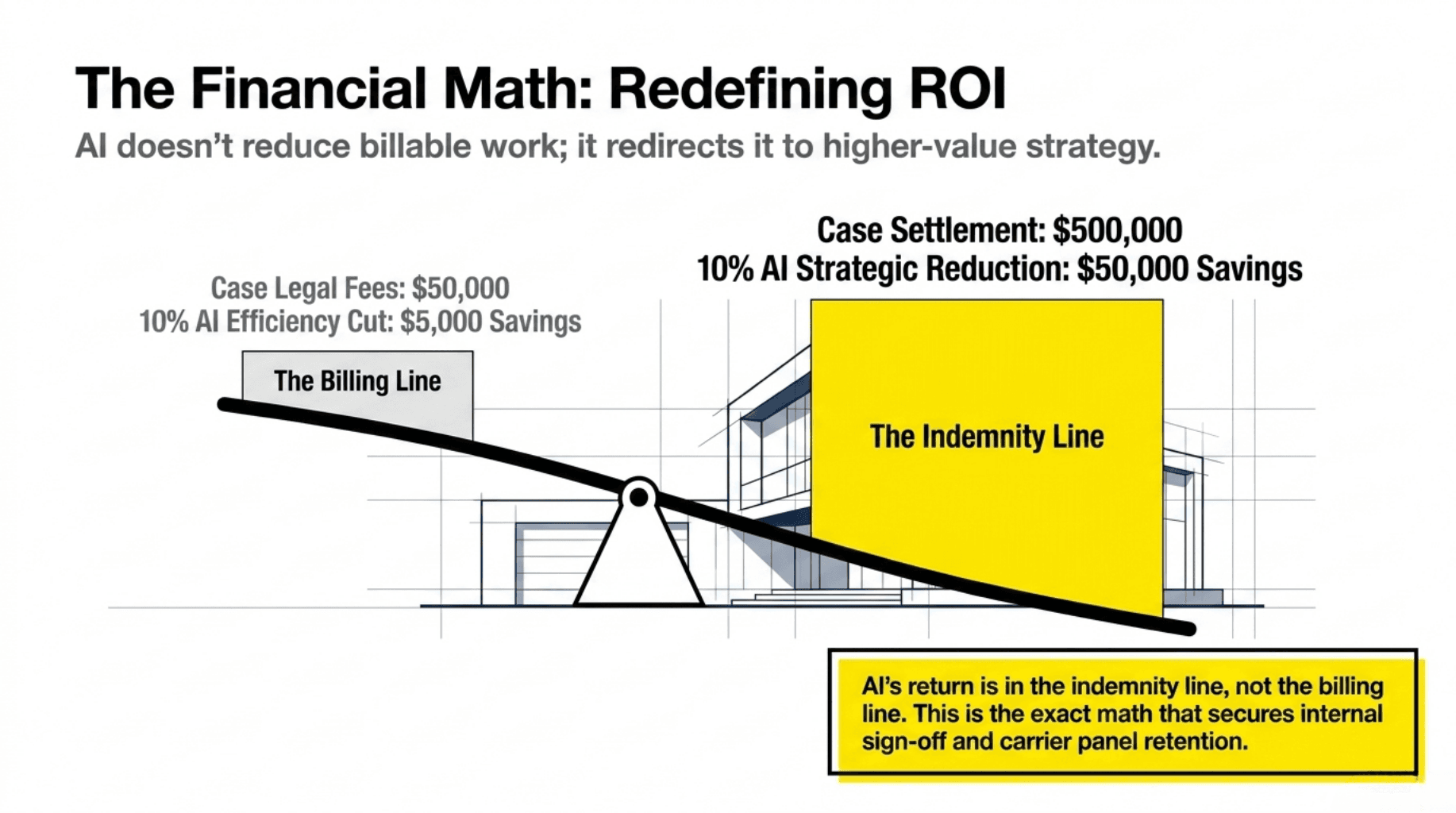
A question partners often ask: if we bill by the hour, doesn’t AI just reduce our revenue? The answer is no - and it’s worth making this case explicitly. AI doesn’t reduce billable work; it redirects it. Time that was absorbed by rote document review and intake tasks gets redirected to higher-value work: strategy, client communication, expert management, and the kind of nuanced legal analysis that only a senior attorney can provide. Firms that deploy AI effectively do more work on more files with the same headcount. That means more client relationships, more volume, and stronger panel positions - not a smaller bill.
The competitive case is equally direct. Nearly 4 in 10 carriers report that at least one panel firm has asked for a pause on new assignments in the past six months due to capacity constraints (CLM 2026, Q48). AI is how a firm does more with the same people - which means more revenue, not less, and panel relationships that don’t get strained by capacity ceilings.
How to Approach Carrier Relationship Managers
Relationship managers at carriers are measured on program performance, panel quality, and their ability to demonstrate to senior leadership that litigation is being managed effectively. C-suite attention to litigation management effectiveness is at its highest point in eleven years - 79% of carrier CEOs raised it in the past twelve months (CLM 2026, Q31). Relationship managers are feeling that pressure from above.
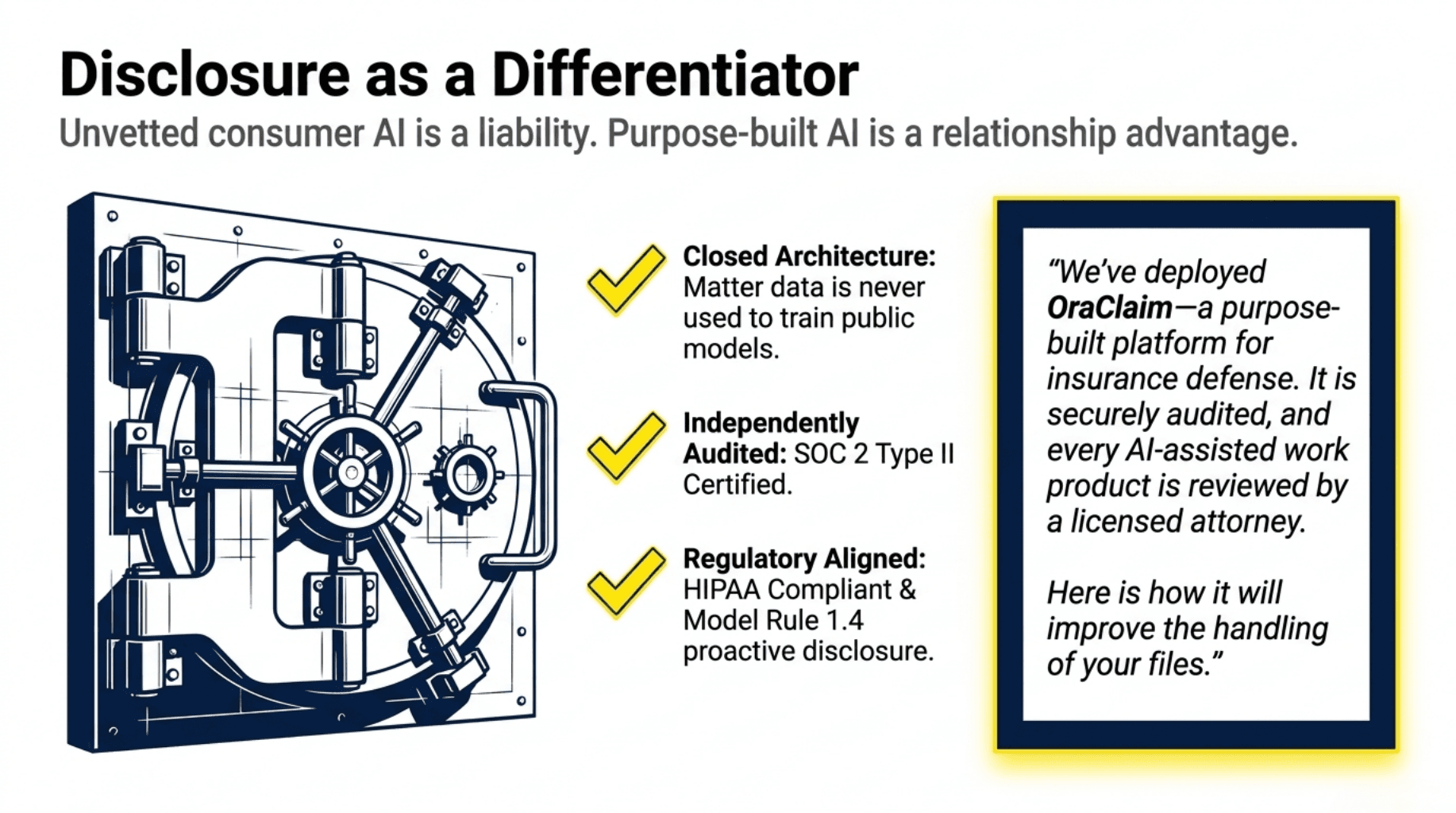
What they want to be able to say upstairs: our panel firms are using technology that helps us manage indemnity exposure better than our competitors’ panels. What you give them: a documented story about how your firm uses AI to produce faster, more comprehensive case assessments - and a platform they can point to with security credentials that won’t create liability for the carrier. Closed architecture. SOC 2 Type II. HIPAA compliance.
Proactive disclosure also builds trust in ways that a standard engagement letter never could. A relationship manager who can tell their CEO “our panel firms are using a purpose-built, independently audited AI platform” is in a far better position than one who has to explain why their outside counsel was using an unvetted consumer AI tool on sensitive claim files. The firms that get this right turn disclosure into a differentiator, not a formality.
The conversation to avoid: anything that sounds like “we need you to pay for this.” The conversation to have: “here’s what we’re doing and here’s what it means for your outcomes.”
What Claims Managers Need From Defense Firms Using AI
Claims managers live in the gap between what they’re supposed to deliver - better outcomes, lower indemnity, faster resolution - and what they have to work with: overwhelmed adjusters, overcrowded panels, late status reports. The number one carrier complaint about outside firms jumped from sixth to first place in the CLM 2026 study: inaccurate exposure analysis. Not billing. Not responsiveness. The assessment of what a case is actually worth (CLM 2026, Q109).
What claims managers want from a defense firm using AI: better exposure analysis, delivered faster, and supported by data. Not a gut feeling from a junior associate who spent two hours on the file - a structured, documented risk assessment that is grounded in comparable verdicts, complete medical records, and a clear-eyed demand analysis. AI makes this possible at day one of a file, not week six.
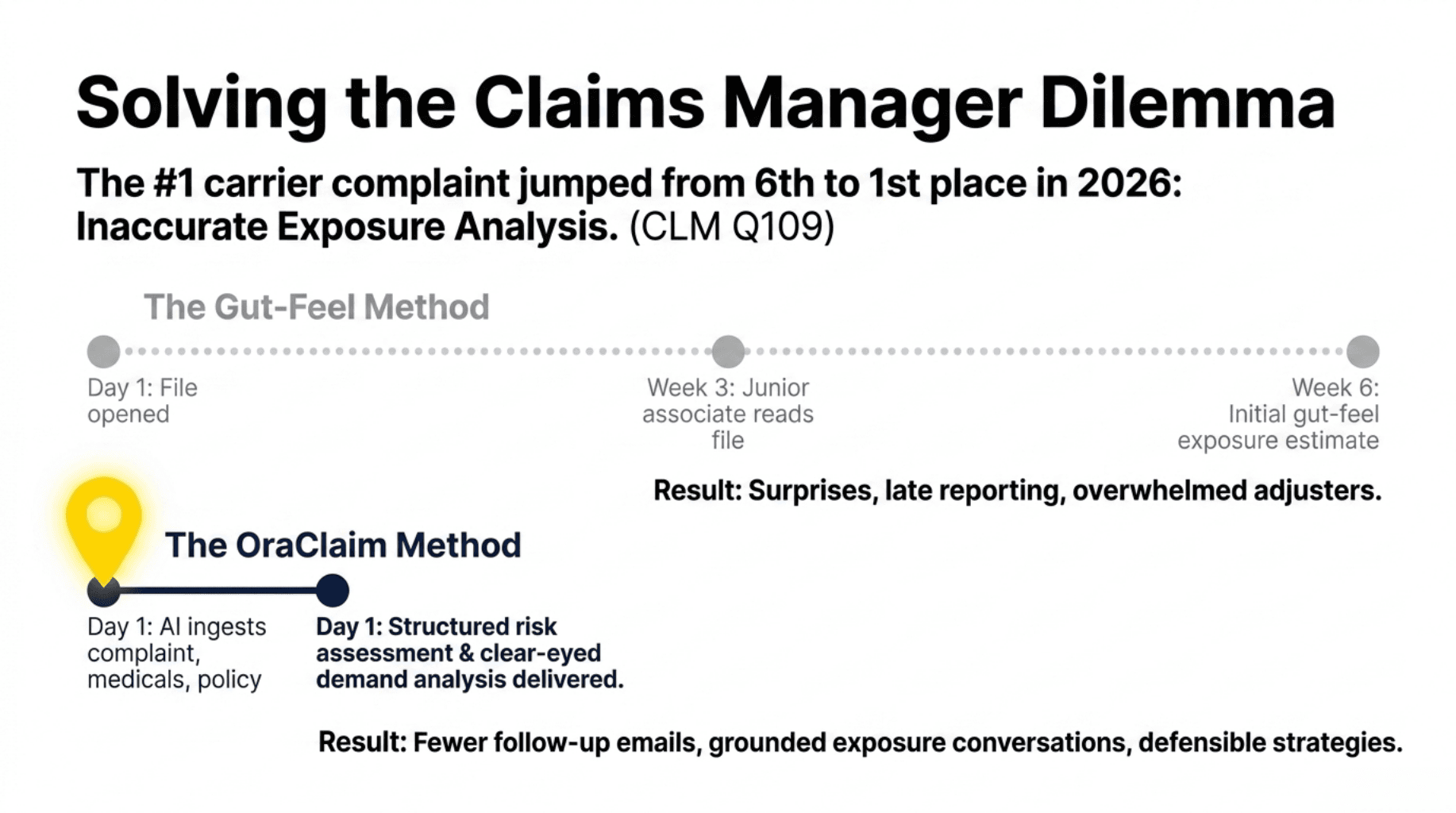
The question that should drive every carrier-facing AI conversation: how does this make the claims manager’s life better? The answer is concrete: fewer follow-up emails to get a status update, fewer surprises at the eve of trial, and a clearer picture of exposure on every file in their portfolio. OraClaim addresses this directly - structured case assessments from day one, organized medical records and timelines, and demand letter analysis that makes exposure conversations more grounded and more defensible.
Triage Early, Triage Often: The Highest-Leverage Thing AI Does
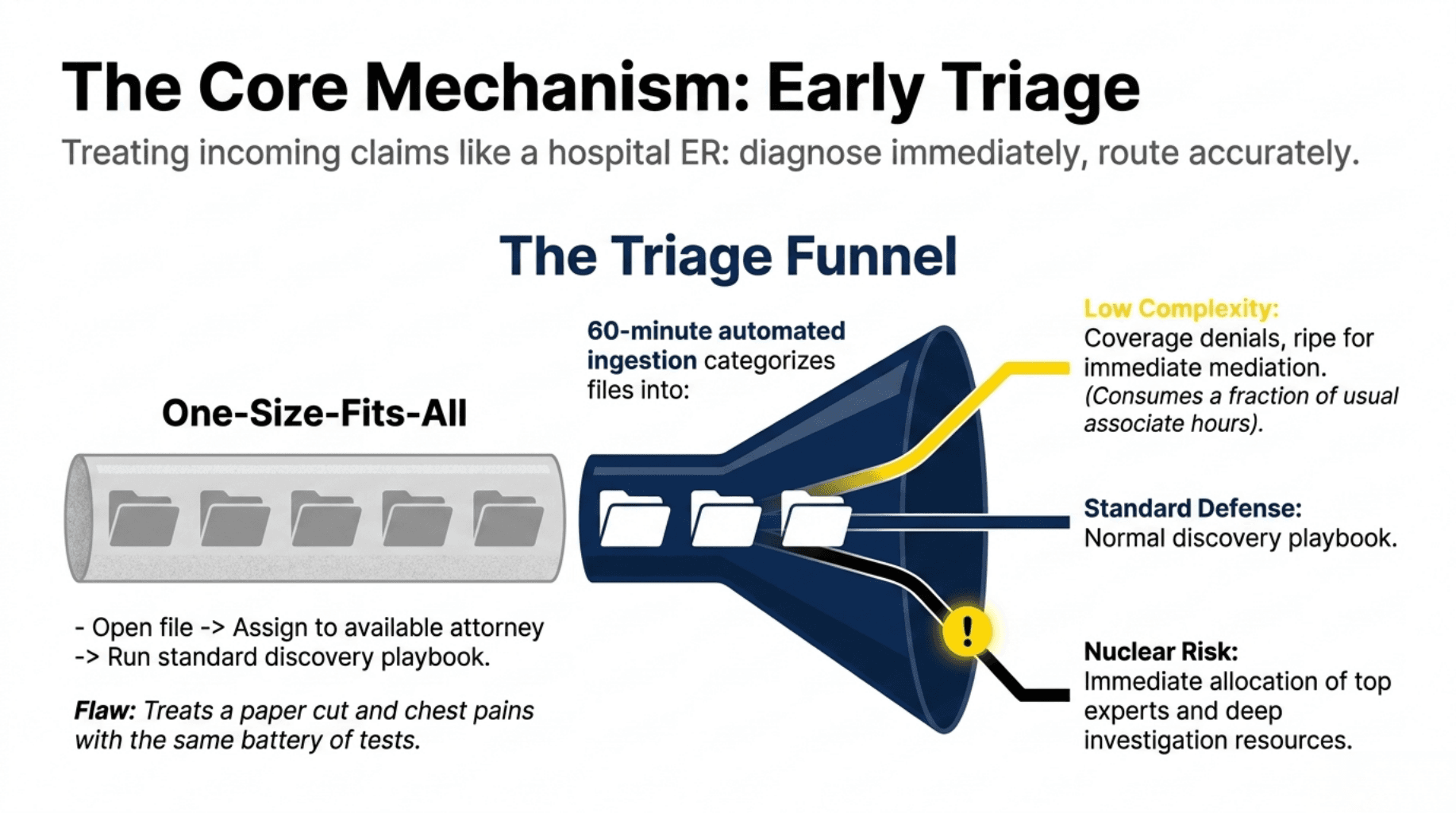
The single highest-leverage intervention AI enables for defense firms is upfront case triage. Today, most defense firms treat incoming cases with a one-size-fits-all approach: open the file, assign it to the next available attorney, begin the standard discovery playbook. This is roughly as efficient as a hospital emergency room that gives every patient the same battery of tests regardless of whether they arrived with a paper cut or chest pains.
AI can ingest a new claim file - the complaint, medical records, policy documents, prior adjuster notes - and produce an initial risk assessment in minutes rather than the hours or days it currently takes an associate to get up to speed. More importantly, it can classify cases into meaningful tiers: straightforward coverage denials, cases ripe for early mediation, cases that will require deep expert discovery, cases that show the early indicators of nuclear verdict exposure.
Different classifications demand different strategies. The low-complexity case that currently absorbs 40 hours of associate time can be resolved with a fraction of that effort if AI handles the initial factual analysis and drafts preliminary documents. The high-stakes case that might produce a $10 million verdict deserves the deep investigation that was previously uneconomical - hiring the best experts, running comprehensive background research, building a data-driven defense strategy. Triage makes both possible by directing resources where they generate the highest return.
The Short-Term and Long-Term Case for Better Triage
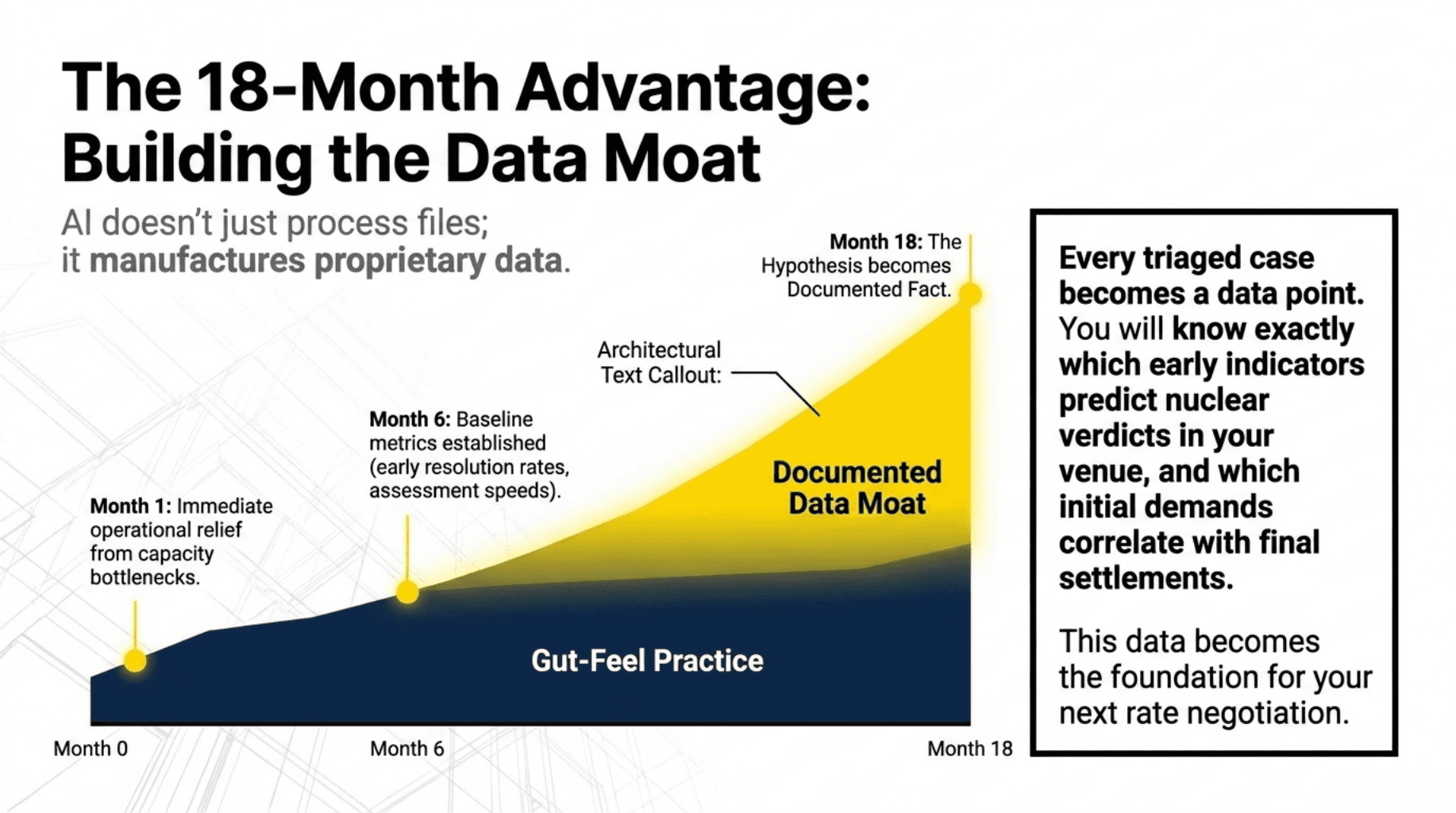
In the short term, triage delivers immediate operational relief. Defense firms are supply-constrained. Capacity bottlenecks - too many files, not enough attorneys with bandwidth to give each one meaningful early attention - are a structural problem for most litigation practices. AI doesn’t solve the headcount problem, but it does solve the bottleneck problem: by handling the first 60-90 minutes of file review and generating a structured intake summary, it frees attorneys to focus on analysis rather than orientation. Files that would have sat untouched for a week get meaningful triage in hours. That has immediate implications for early resolution rates, client satisfaction, and the quality of the first status report.
In the long term, triage builds something even more valuable: data. Every case that gets AI-assisted triage and a structured initial assessment becomes a data point. After 12 to 18 months, a firm using systematic triage will have a body of evidence that no gut-feel practice can match: which early indicators predict nuclear verdicts in this jurisdiction, which case types resolve best in mediation before depositions begin, what the actual correlation is between initial demand amount and final settlement in their specific book of business. The hypothesis - that better triage leads to lower settlements - becomes a documented fact. That data becomes the foundation for the next rate negotiation, the next panel renewal, and the next carrier conversation about what makes this firm different from the other names on the roster.
How to Frame the AI Conversation With Carrier Clients
Lead With Outcomes, Not Features
The instinct is to explain what the AI does - document summarization, case triage, medical record organization. Carriers don’t care what the AI does. They care what happens to their cases.
Lead with the outcome story, not the feature list. Three openings that work:
“We now have a structured assessment of every new file within twenty-four hours of assignment - including medical record timeline, demand letter analysis, and initial exposure range. Here’s what that’s done to our early resolution rate.”
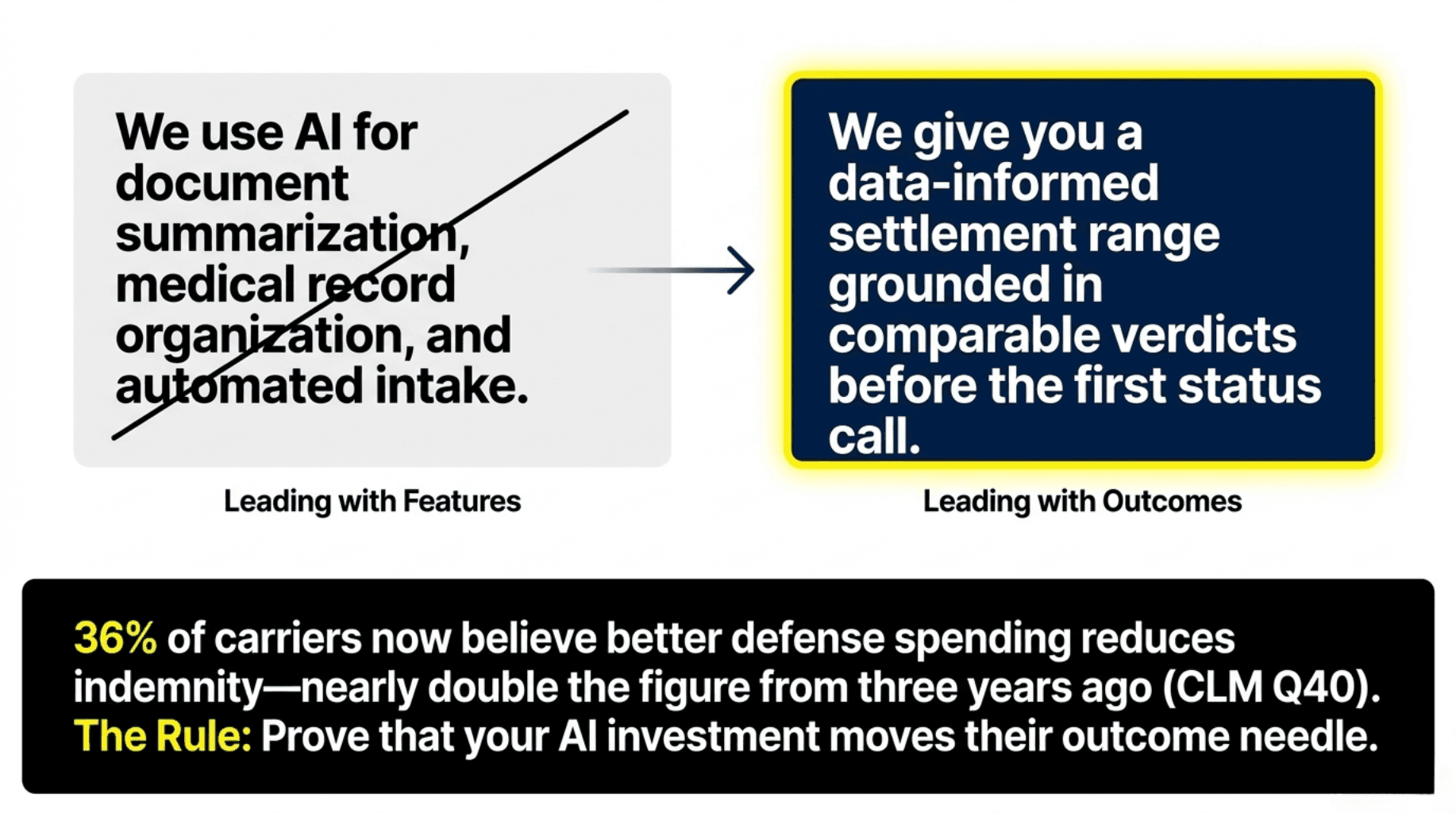
“We can now give you a data-informed settlement range on every file before the first status call - grounded in comparable verdicts in this venue against this type of claim.”
“We’ve reduced the time between file opening and case strategy from days to hours. In your book, that looks like this.”
The 2026 CLM study found that 36% of carriers now believe better defense spending reduces indemnity - nearly double the figure from three years ago (CLM 2026, Q40). That shift is your opening. Carriers are increasingly receptive to the argument that investing in better defense produces better outcomes. Your job is to prove it on your files.
How to Use Process Data to Build the Conversation
The most persuasive thing you can bring to a carrier conversation is not a platform demo - it’s your own data. Start tracking before you ask: time from file opening to first structured case assessment, percentage of files with comprehensive affirmative defense analysis in the first thirty days, response time on status requests, early resolution rate on AI-assisted files versus historical baseline.
When you have sixty to ninety days of data, the conversation changes from “we think AI will help” to “here’s what it’s doing on your files specifically.” OraClaim’s audit logging and reporting infrastructure is designed to produce exactly this kind of carrier-facing performance documentation - not just internal metrics, but a story that makes the next rate conversation different.
What to Say When Carriers Ask Who Pays
The CLM 2026 study found that 50% of carrier executives believe firms should absorb AI tool costs as overhead, and the remaining 50% haven’t yet formed a view. Zero percent said carriers should pay (CLM 2026, Q84). This is not the obstacle it appears to be. Most carriers aren’t saying no - they haven’t been asked the right question yet.
The right question isn’t “will you pay for our AI?” It’s “would you like to understand how we’re investing in tools that improve outcomes on your files, and how that should affect how we think about our relationship going forward?”
Firms that have had this conversation successfully position AI as a practice investment - like hiring a senior associate or opening a new office - that produces better results for clients and stronger relationships over time. The logic that applies to top-quartile billing rates applies equally to technology investment: firms that invest in tools that produce demonstrably better outcomes build carrier relationships that don’t get disrupted by the next rate negotiation.
What’s Working at Firms That Have Already Had This Conversation.
Start With One or Two Carrier Relationships, Not a Firm-Wide Announcement
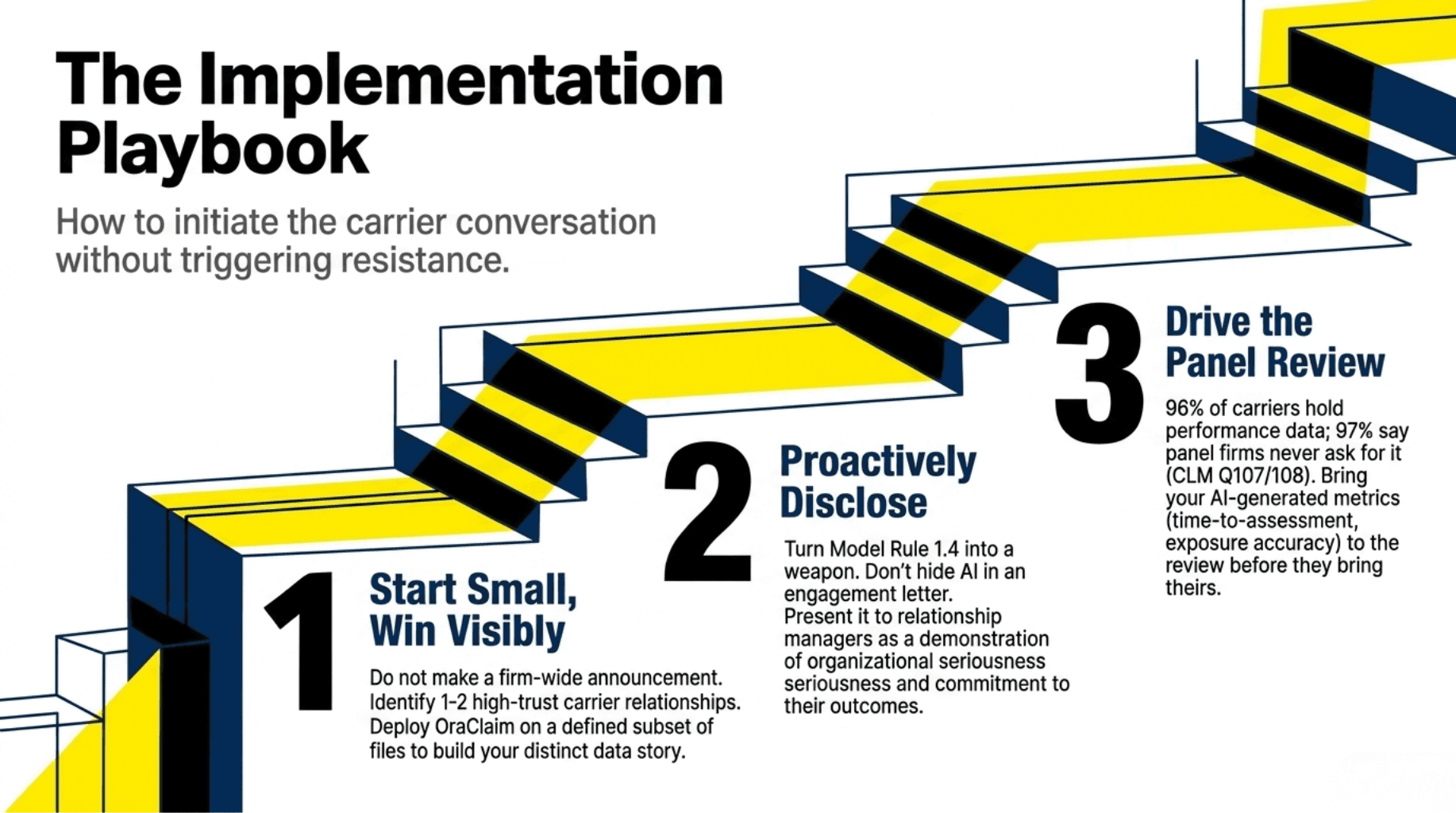
The firms making the most progress aren’t rolling out AI to all carrier clients simultaneously - they’re picking one or two relationships where trust is high, outcomes are visible, and the relationship manager is already interested in technology. The pattern in successful rollouts is consistent: start small, win visibly, let momentum build.
The practical approach: identify the one or two carrier relationships where you have the most data, the clearest outcome story, and the most receptive relationship manager. Have the conversation there first. Use what you learn to sharpen the conversation for the next one. OraClaim’s deployment model supports this - firms can start with a defined subset of files and carrier relationships, build the data story, and expand from there.
Turn AI Disclosure Into a Carrier Relationship Advantage
Model Rule 1.4 creates an affirmative communication obligation when AI use materially affects how matters are handled. Proactive disclosure is both ethically required and strategically smart. The firms handling this well don’t bury disclosure in an engagement letter amendment. They lead with it as a demonstration of how seriously they take the relationship.
Suggested framing:
“We want you to know that we’ve deployed OraClaim on your matters - a purpose-built AI platform for insurance defense that operates on a closed architecture, is independently audited (SOC 2 Type II), and is HIPAA compliant. Your matter data is never used to train AI models. Every AI-assisted work product is reviewed by a licensed attorney before use. Here’s what you should expect to see differently in how we handle your files.”
This kind of disclosure doesn’t create risk - it builds confidence and differentiates. Carriers are sophisticated enough to understand that a firm using a properly secured, purpose-built platform is a lower-risk partner than one where staff is using whatever tool is fastest at eleven o’clock at night. A firm that leads with this disclosure is signaling organizational seriousness, not just technological capability.
Use Performance Data to Drive Panel Conversations
The 2026 CLM study found that 96% of carriers hold performance data about their panel firms and would share it - but 97% say firms almost never ask for it (CLM 2026, Q107 and Q108). That disconnect is one of the most actionable findings in the study. Carriers want this conversation. Firms aren’t initiating it.
AI creates the data infrastructure to change this. A firm using OraClaim can bring carrier-specific performance metrics - time to assessment, early resolution rate, exposure accuracy - to a panel review conversation rather than waiting for the carrier to bring generic data. The firms winning better rate conversations aren’t winning them by arguing harder. They’re winning them by bringing data that makes the argument for them.
The Conversation Carriers Are Waiting to Have
Getting carrier support for AI is not fundamentally a technology decision. It is a client relationship decision - one about what kind of firm you want to be, what kind of outcomes you want to be accountable for, and what kind of partner your carrier clients deserve.
The carriers watching this unfold are not waiting for the perfect AI firm. They are waiting for the firm that shows up with a credible story, documented results, and the organizational seriousness to back it up. A firm that arrives at that conversation having already built the data, deployed the platform, and proactively disclosed its approach isn’t just ahead of the technology curve - it is demonstrating the kind of forward-thinking client partnership that earns panel relationships for the long term.
Every stakeholder in the conversation - equity partners, relationship managers, claims managers - has a version of that story they need to hear. The framework above gives you each one.
OraClaim gives insurance defense firms the platform, the security credentials, and the reporting infrastructure to have that conversation with confidence - and to keep having it as the data accumulates and the outcomes compound.
The carrier conversation is ready to happen. The question is whether you’re ready to lead it. Learn more at oraclaim.com.
Sources
CLM 2026 Litigation Management Study (U.S. Legal Support / Claims and Litigation Management Alliance, 2026); ABA Model Rule 1.4.