Blog
How to Roll Out AI at a Law Firm in 90 Days: A Step-by-Step Implementation Plan for Insurance Defense
Meta Description: A practical, phase-by-phase AI implementation roadmap for insurance defense managing partners — covering platform selection, safe use policy, workflow deployment, and carrier-facing performance measurement.
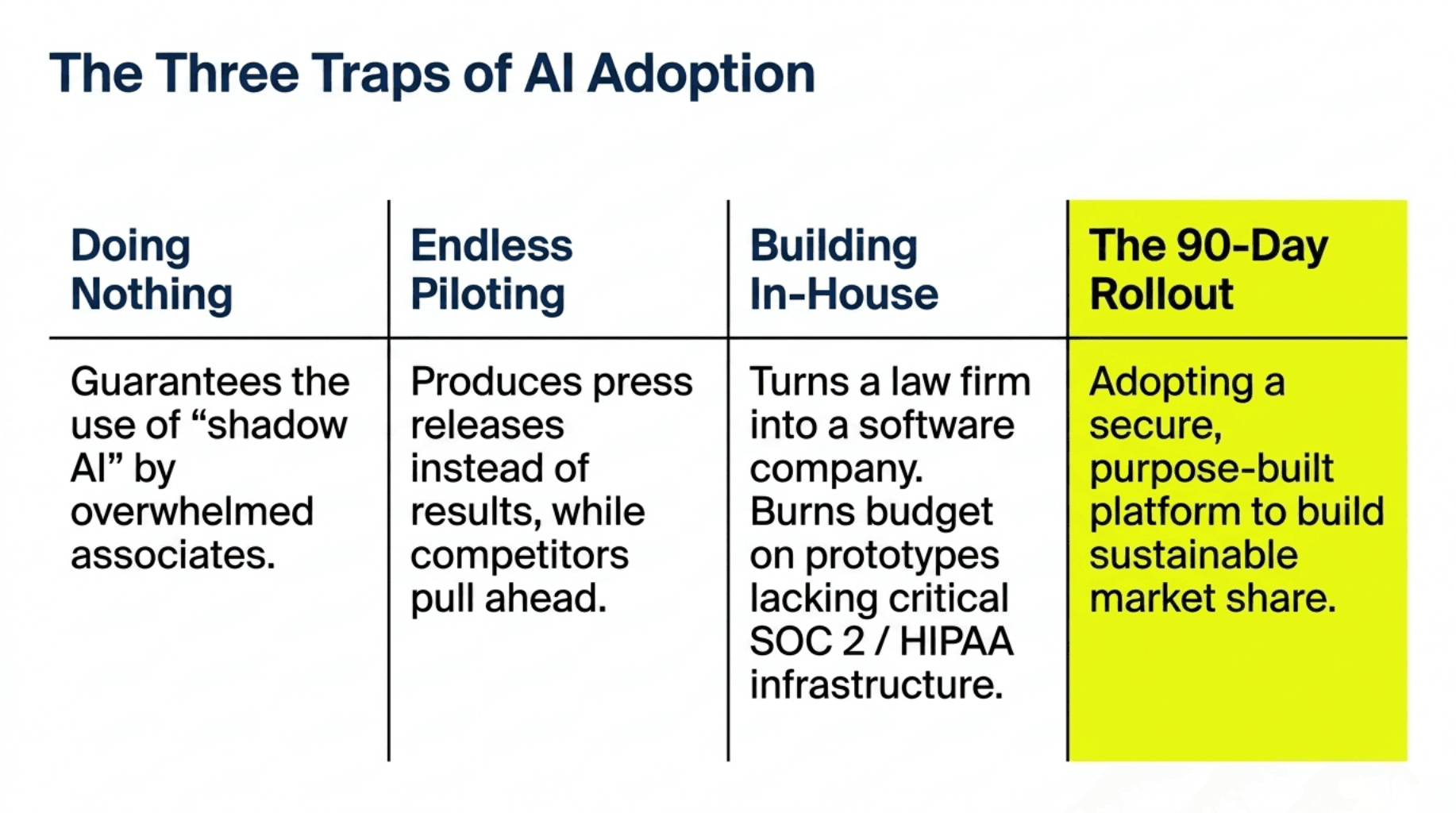
Plaintiff AI tools are already profiling every negotiation move the defense side makes — on your cases, right now. Most defense firms respond by doing one of three things: nothing, which guarantees shadow AI anyway; piloting endlessly without committing, which produces press releases instead of results; or building their own platform, which turns a law firm into a software company without the revenue to fund it.
The firms pulling ahead don't wait for the perfect moment. They picked a purpose-built platform, ran a disciplined ninety-day rollout, and got moving.
What follows is that plan.
Before You Start: How to Choose the Right AI Platform for an Insurance Defense Firm
The wrong question is: "Which AI has the most features?" The right question is: "Which platform was built for this specific work, in a way that protects privilege, satisfies carriers, and will actually get used at 11pm on a deadline?"
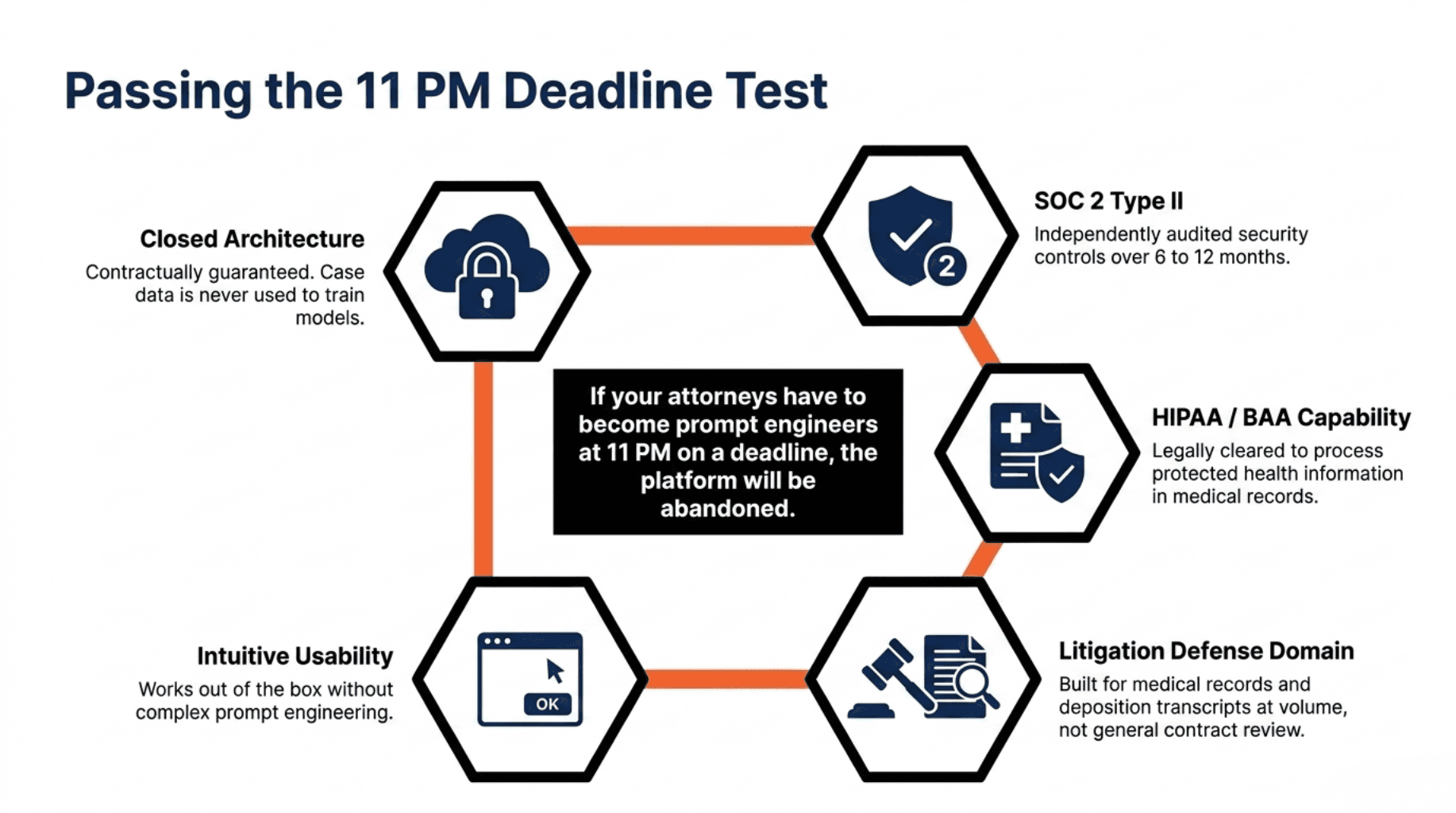
One question you should never have to ask: "How do I prompt this thing?" If your attorneys are spending meaningful time learning how to phrase queries, you picked the wrong platform. The right tool understands insurance defense workflow out of the box — medical records, deposition transcripts, claims files, expert reports — without requiring your team to become prompt engineers. Usability isn't a nice-to-have. It's the difference between a platform that gets used and one that gets abandoned for ChatGPT when a deadline hits.
Five criteria eliminate most options immediately.
Closed architecture. Your prompts, inputs, and case data are never used to train models — contractually guaranteed. Not stated in an FAQ, not implied in a sales call. In the contract. If you have to ask whether the system is closed, it's open.
SOC 2 Type II. An independently audited set of security controls over time, not a one-time assessment. Achieving SOC 2 Type II takes six to twelve months. A vendor without it has not demonstrated sustained, audited security.
HIPAA compliance and BAA capability. Any firm handling medical records in claims files is processing protected health information. A vendor unwilling to sign a Business Associate Agreement cannot legally process that data on your behalf.
Built for litigation defense, not general legal work. General-purpose legal AI is built for transactional work and contract review. Insurance defense involves medical records, deposition transcripts, expert reports, and claims data at volume. The platform needs to understand that workflow, not approximate it.
Usability that passes the 11pm test. A technically sound but clunky platform gets abandoned for ChatGPT when a deadline looms. Security only works if people actually use the sanctioned tool.
A note on building your own: two engineers can demo something impressive in three months. The gap between that demo and a system you can run privileged client data through every day is enormous. Prompt injection monitoring, audit logging, role-based access, citation verification, a legal-industry incident response plan — closing that gap is roughly the same undertaking as the gap between a working prototype and a production aircraft. You'll spend the budget, lose the engineers to better offers, and end up with critical infrastructure nobody fully understands. And you'll still have the shadow AI problem.
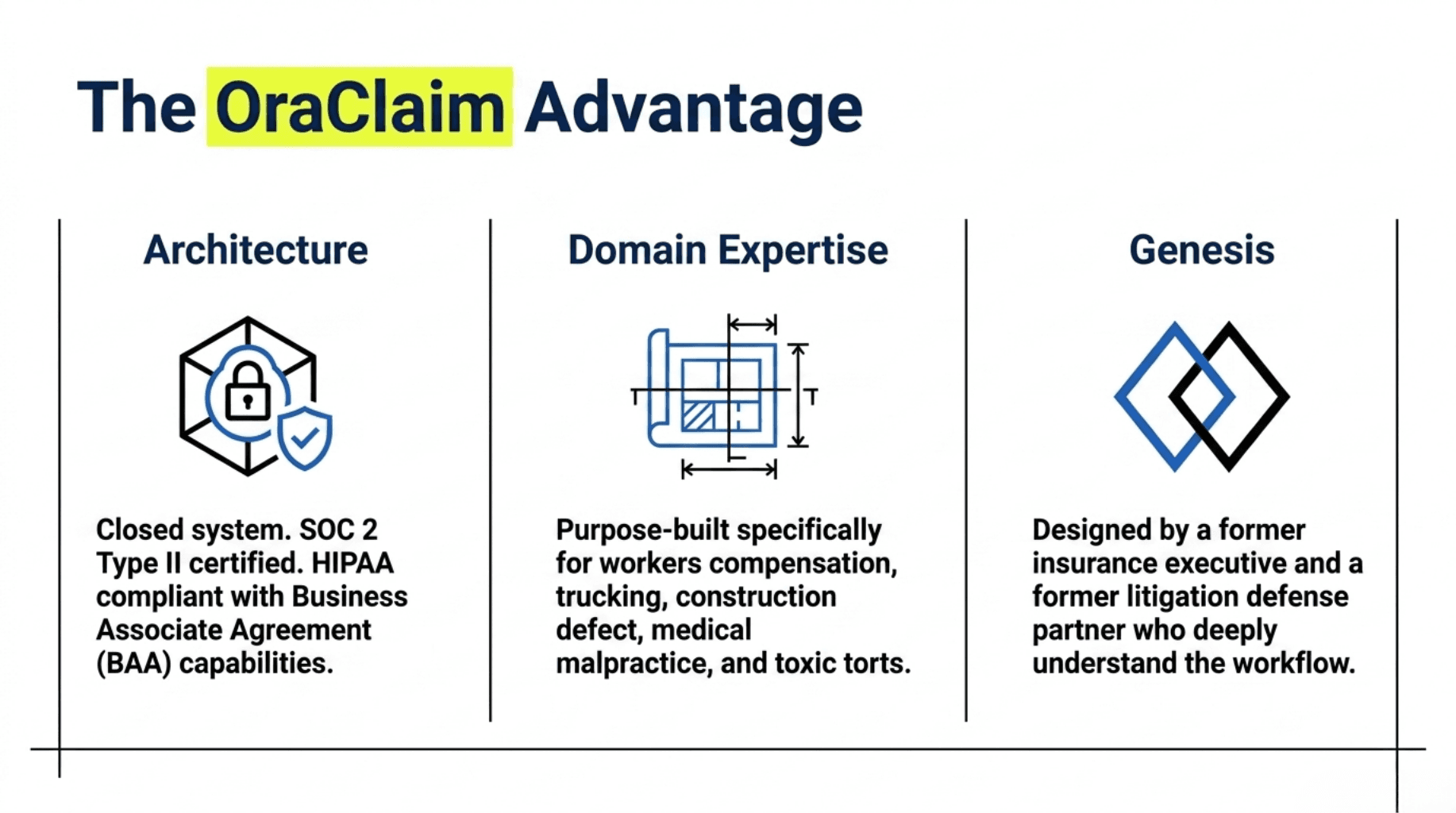
OraClaim is built specifically for insurance defense: workers comp, trucking, construction defect, med mal, toxic torts, and everything in between. Closed architecture. SOC 2 Type II. HIPAA compliant with BAA capability. Built by a former insurance executive and a former litigation defense partner who understood the workflow before writing the first line of code.
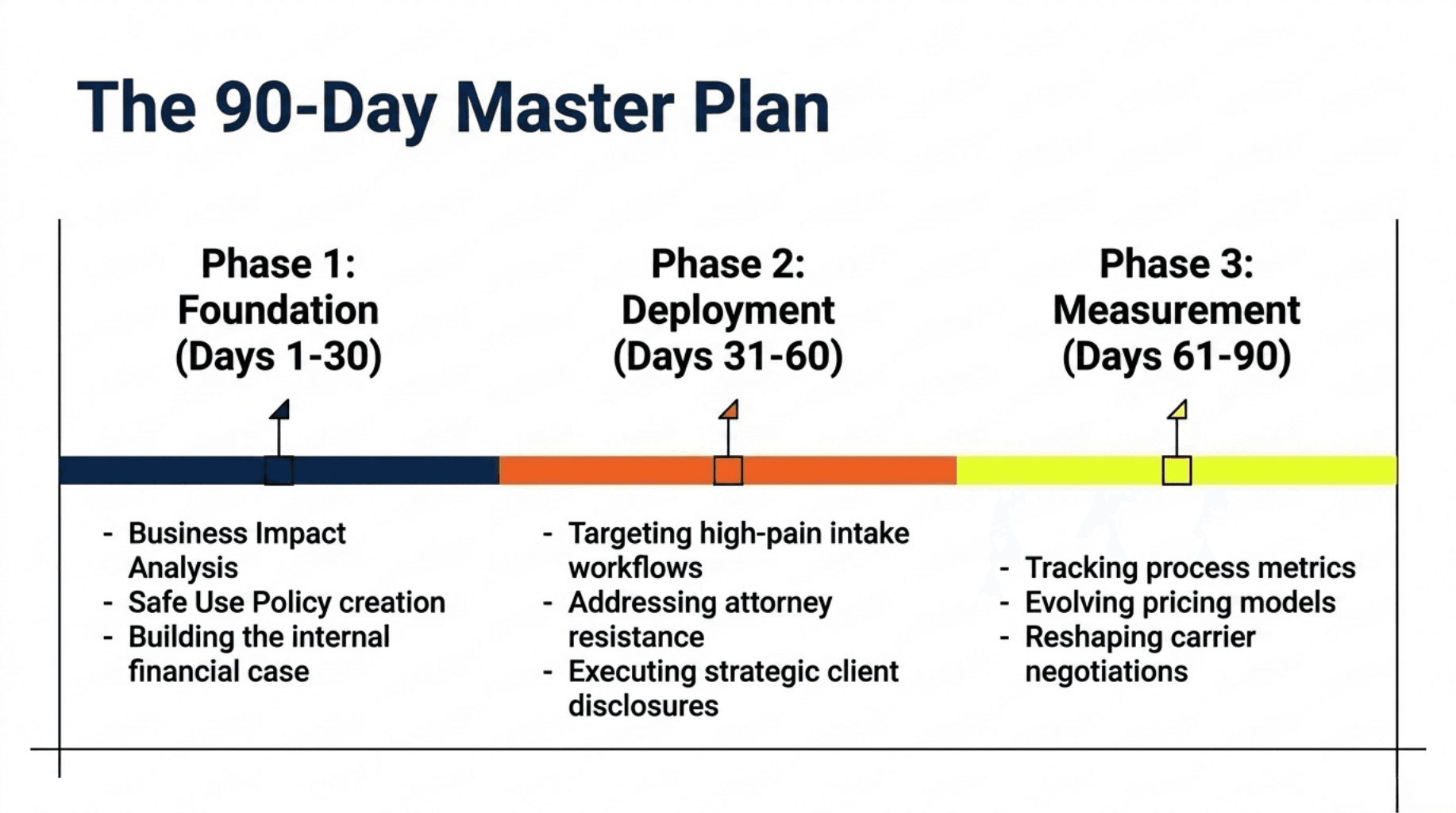
Phase 1: Days 1–30 — Foundation
Conduct a Business Impact Analysis Before Deploying Legal AI
Before selecting a platform or writing a policy, map your critical workflows: which processes, if disrupted, would most damage client outcomes and firm operations? For an insurance defense firm, the critical path is the litigated claims workflow — file intake, document review, case assessment, negotiation prep, and status reporting.
A Business Impact Analysis answers three questions that drive every subsequent decision: What data will the AI touch, and what are the privilege implications of each category? What is the cost of a security incident at each point in the workflow? What uptime commitments do you need from a vendor to protect that workflow? OraClaim's implementation team supports BIA planning with documented data flows, audit logging architecture, and uptime commitments that map directly to your critical path.
What a Law Firm AI Safe Use Policy Must Include to Be Enforceable
A policy that says "use AI responsibly" is not a policy. It's a suggestion that provides no protection when something goes wrong.
An enforceable AI safe use policy for insurance defense must specify six things. First, approved platforms: named, with the security criteria that make them approved. Second, prohibited uses: open AI platforms for any client matter data, PHI, or privileged communications, with specific examples your team will recognize. Abstract prohibitions don't change behavior; concrete examples do. Third, supervision requirements: human review of all AI-generated work products before filing, sending, or relying upon it. "The AI did it" is not a defense to a bad faith claim or a Rule 11 sanction. Fourth, disclosure obligations: when and how AI use is disclosed to clients, with standard firm language that removes the decision from individual attorneys. Fifth, audit and monitoring: how compliance is verified. OraClaim's audit logging makes this enforceable rather than aspirational. Sixth, violation consequences: without defined consequences, the policy is optional.
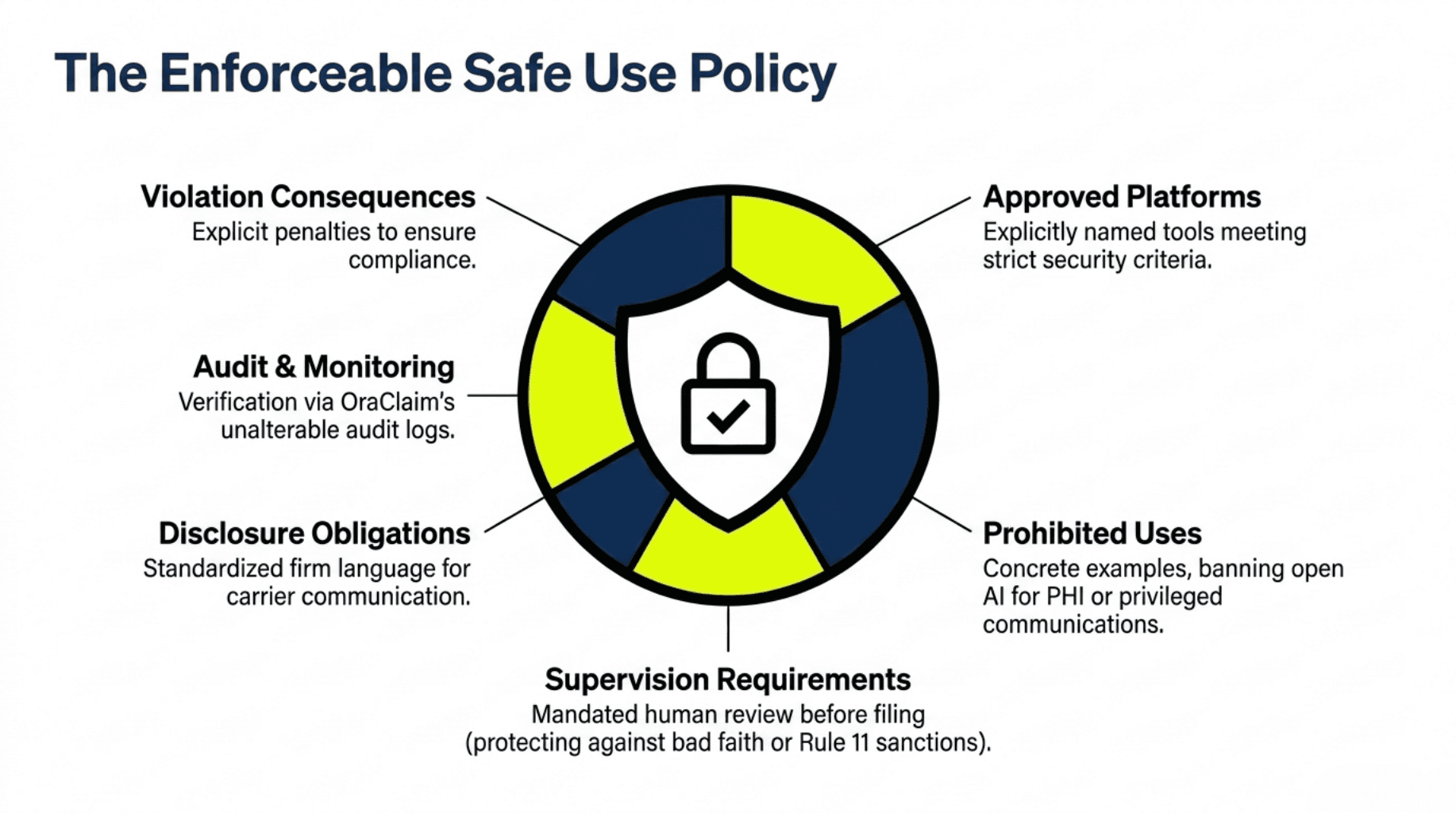
Timing matters: publish the policy before the platform goes live, not after.
Build the Internal Business Case for AI Investment
The managing partner's job in Phase 1 is to win the internal argument before the external rollout begins.
The financial case for carriers is simple, and it should be the anchor of every conversation you have internally and externally: for a case with $50,000 in legal fees and a $500,000 settlement, cutting billing 10% saves $5,000. Moving the settlement outcome 10% saves $50,000. That's a 10x difference: and approximately 85% of total claims cost sits on the indemnity side. When you're the firm that moves that number, carriers notice.
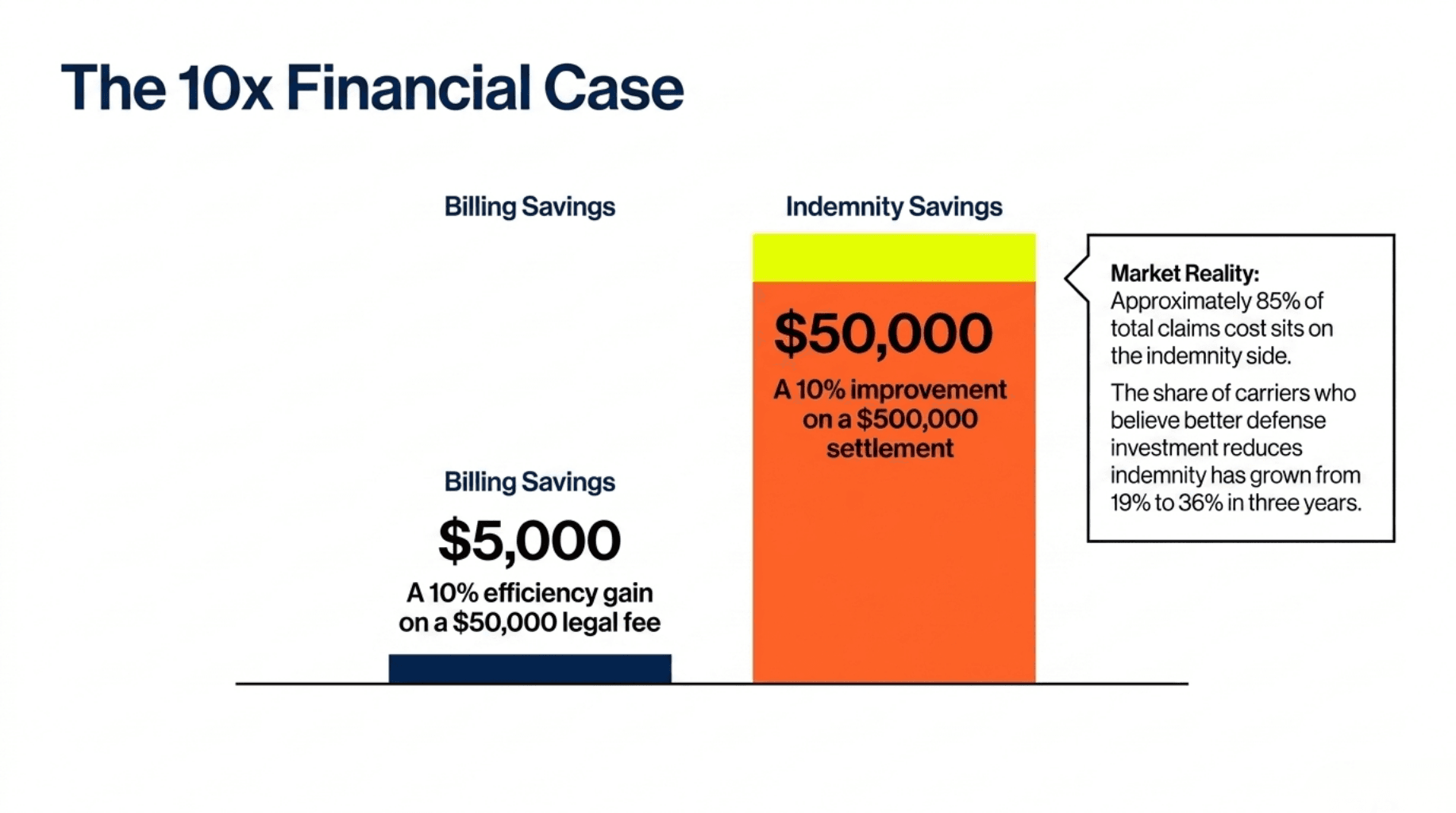
That's how trust gets built.
This is also how AI changes your firm's value proposition. The number one carrier complaint about outside firms is now inaccurate exposure analysis, not billing. The share of carriers who believe better defense investment reduces indemnity has grown from 19% to 36% in three years (CLM 2026, Q40). The conversation carriers want to have has shifted. AI is how you show up to it: not as a vendor pitching efficiency, but as a partner demonstrating that you're moving the number that actually matters.
AI also opens three doors that have been closed to most defense firms.
The first is volume. Defense firms have an associate-shaped bottleneck; AI dissolves it. A firm handling a thousand cases a year today, capped by associate hours, can plausibly handle fourteen hundred with the same headcount once medical chronologies, document reviews, and routine discovery are AI-assisted. Revenue per case may fall slightly. Total revenue rises. With roughly 60% of competitors turning down work, the door labeled "more cases" leads directly into market share that hasn't been available to grab in two decades.
The second is depth. Most defense work isn’t limited by what would improve outcomes; it’s limited by what clients are willing to pay for. Until recently, tasks like reviewing every prior deposition from an opposing expert, building probabilistic damages models for mediation, or conducting competitive analysis on plaintiffs’ counsel were simply too expensive to justify within the economics of most panel-counsel relationships. AI changes that equation. Work that was once cost-prohibitive becomes scalable and financially viable. And because carriers pay roughly 85 cents of every claim dollar toward indemnity, they have strong incentives to invest more in defense strategies that can materially reduce those costs.
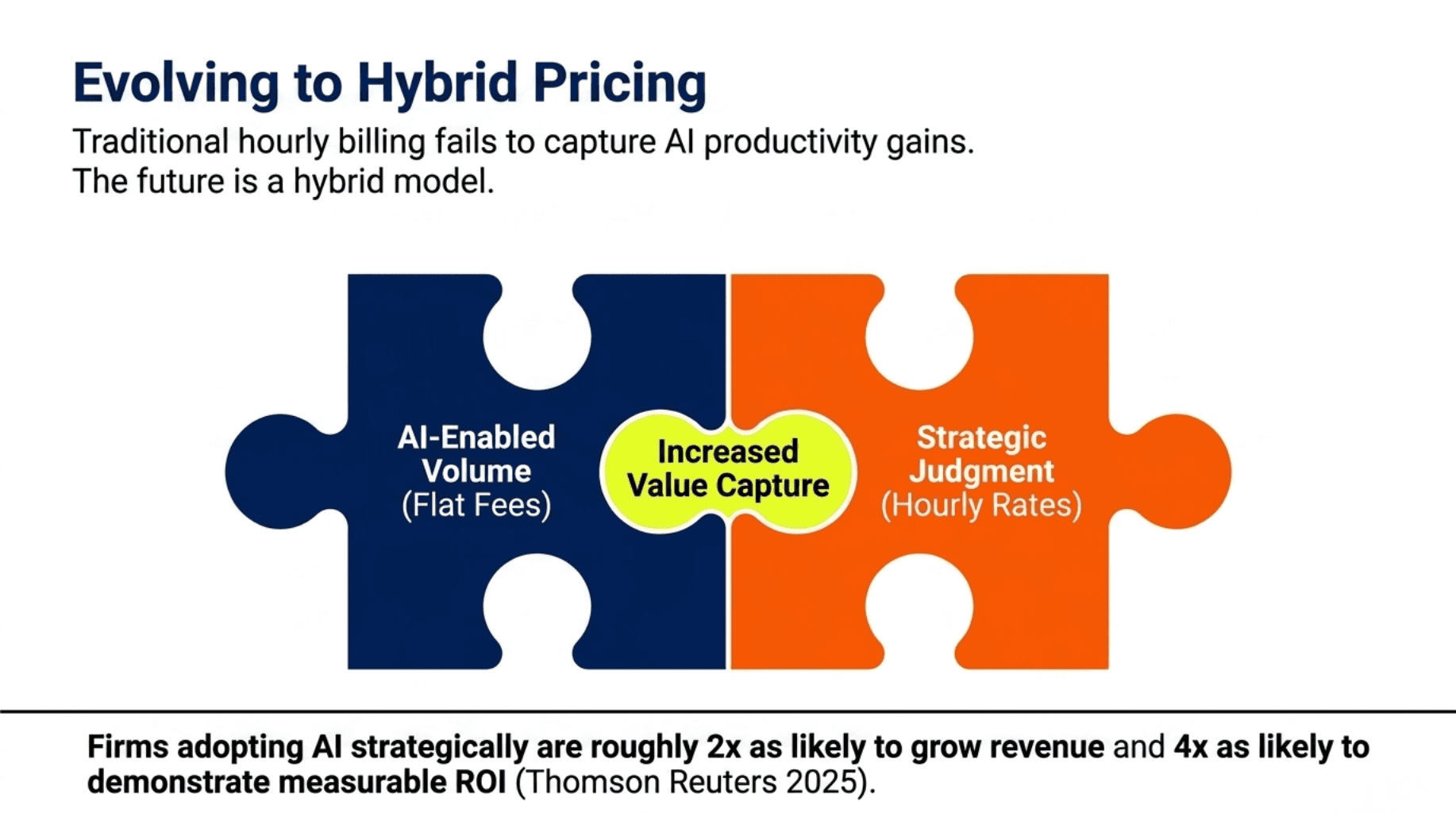
The third is pricing. As more legal tasks become AI-assisted, the traditional hourly billing model starts to break down. Carriers are already pushing back on paying hourly rates for work AI can complete faster and more efficiently. At the same time, firms that continue billing conventionally fail to capture the productivity gains AI creates. The more sustainable model is likely hybrid pricing: flat fees for AI-enabled workflows, paired with hourly billing for the genuinely strategic, judgment-driven aspects of litigation. Firms that structure pricing this way stand to capture a significantly larger share of the value they create. Thomson Reuters’ 2025 Future of Professionals research found that firms adopting AI strategically are roughly twice as likely to grow revenue and four times as likely to demonstrate measurable ROI compared to firms taking a more ad hoc approach.
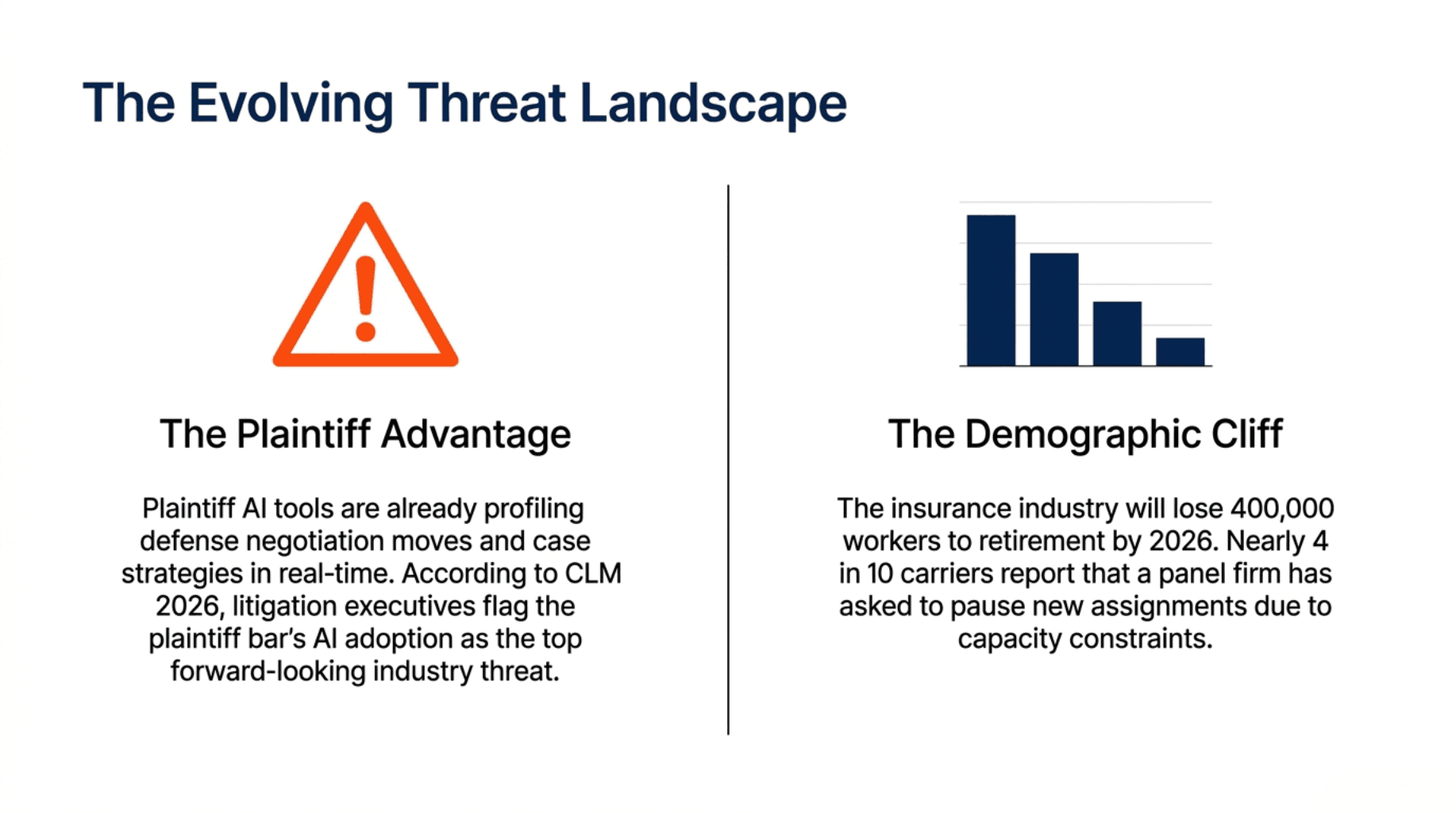
According to the CLM 2026 study, litigation executives have flagged the plaintiff bar's adoption of AI as the top forward-looking industry threat (Q126) — and not a single executive said they are unconcerned (Q58). The defense side is the only party in this ecosystem that hasn't responded at scale.
Phase 2: Days 31–60 — Deployment
Start with One High-Pain Workflow
The pattern in every successful AI rollout is the same: start with one high-pain workflow, win visibly, and let momentum build.
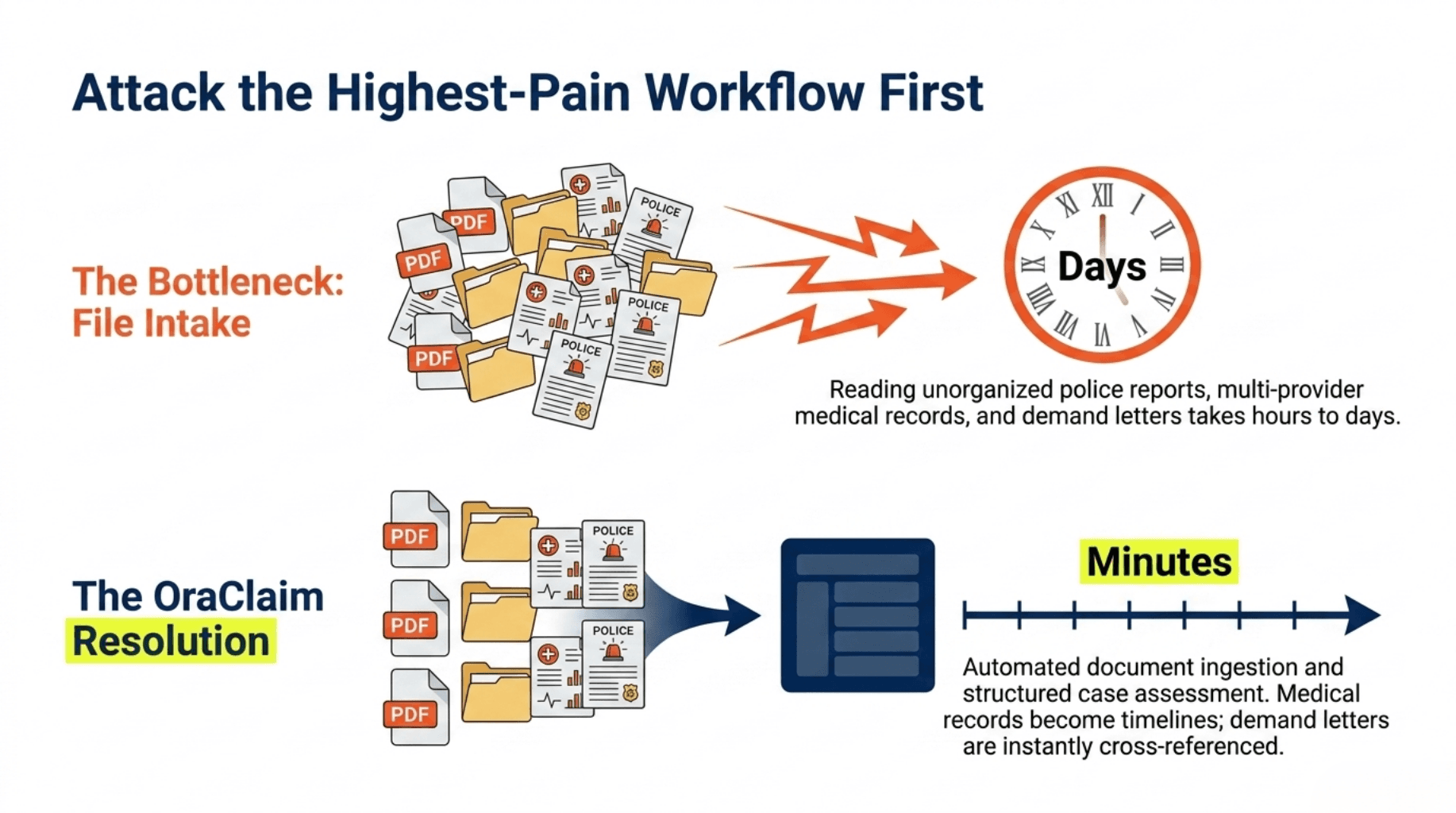
For insurance defense, the highest-pain, highest-frequency workflow is file intake and initial case assessment. A folder of unorganized PDFs arrives — police report, medical records from four providers, demand letter, photos, witness statements — and someone has to read it all and understand the case. That currently takes hours on a simple file and a full day on a complex one. Every hour between file opening and case understanding is time the matter sits still. Cases do not improve by sitting still.
OraClaim's document ingestion and structured case assessment addresses this workflow directly: medical records become a structured timeline, the demand letter is compared against the record for consistency, and the attorney opens the file with a first draft of the case already built. Start here. Win here visibly. Let the team ask what's next.
Address Attorney Resistance to AI Adoption Without Losing the Argument
The fear is predictable: "This is going to replace me." The data says otherwise — and you need to say so directly, not reassuringly.
The broader insurance industry is projected to lose 400,000 workers to retirement by 2026. Defense firms are already in the thick of it: the CLM 2026 study calls it "a generational staffing crisis, the likes of which our industry has never seen" — and nearly 4 in 10 carriers report that a panel firm has asked to pause new assignments in the past six months due to capacity constraints (Q48).
The question isn't whether AI will take jobs — it's who will do the work the retirees leave behind.
The honest message: AI handles document review, medical record chronologies, and first-pass case assessments: the work nobody went to law school to do. What remains is strategy, judgment, client relationships, and advocacy. AI promotes associates into that work faster, not out of it.
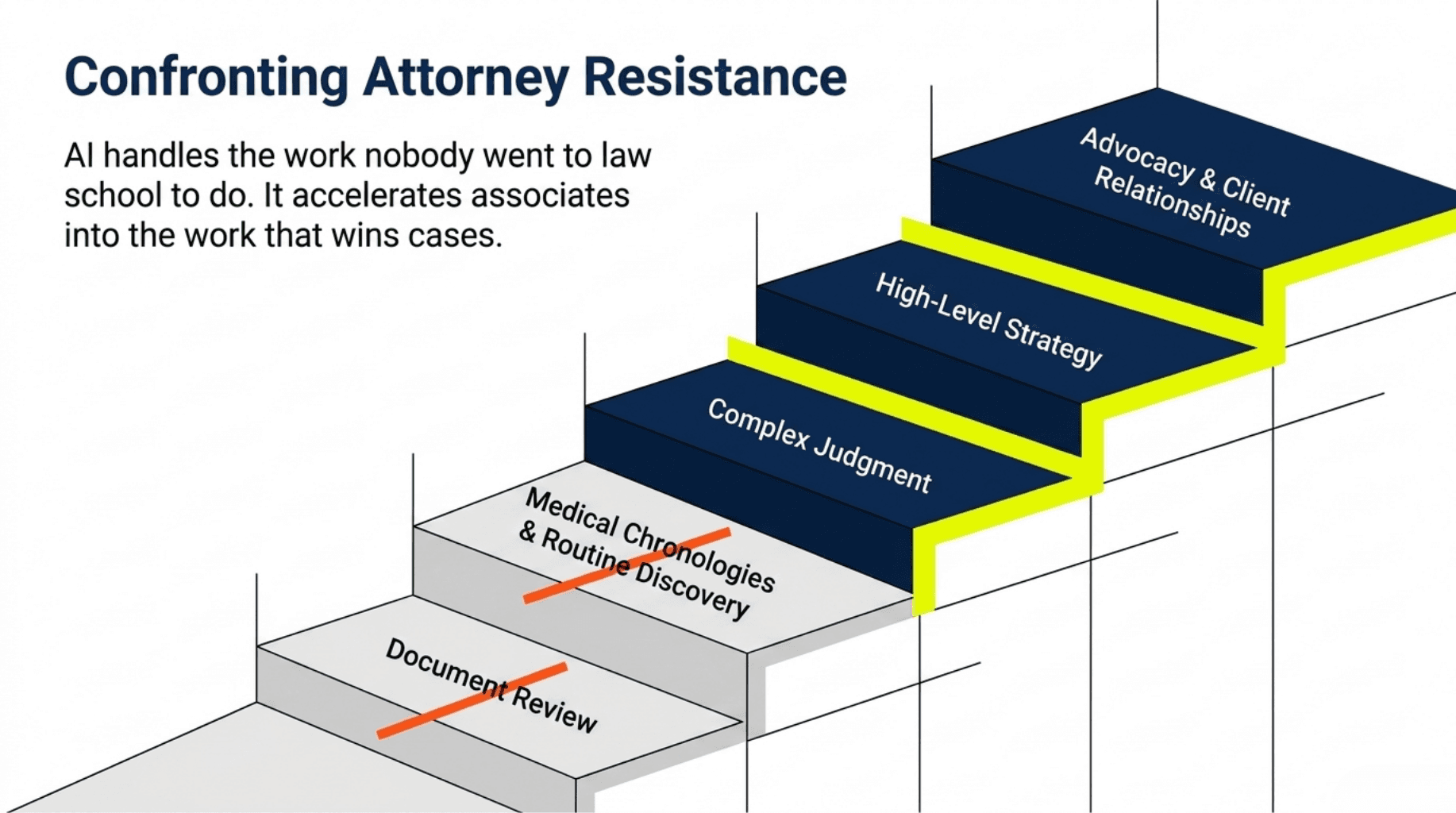
The firms that succeed at this don't roll out technology in isolation. They build processes, culture, and technology together. Start with low-stakes work. Build the muscle before the stakes are high.
Communicate AI Use to Insurance Defense Clients to Build Trust, Not Liability
Model Rule 1.4 creates an affirmative communication obligation when AI use materially affects how matters are handled. Proactive disclosure is both ethically required and strategically smart — and done well, it becomes the foundation of a stronger carrier relationship.
The firms that handle this well turn disclosure into a differentiator. The firms that handle it poorly create the impression they have something to hide.
Standard disclosure language: "Our firm uses OraClaim, a purpose-built AI platform for insurance defense litigation. It operates on a closed architecture — your matter data is never used to train AI models, is protected by independent security audits (SOC 2 Type II), and is handled in compliance with HIPAA requirements. All AI-assisted work products are reviewed by a licensed attorney before use or filing."
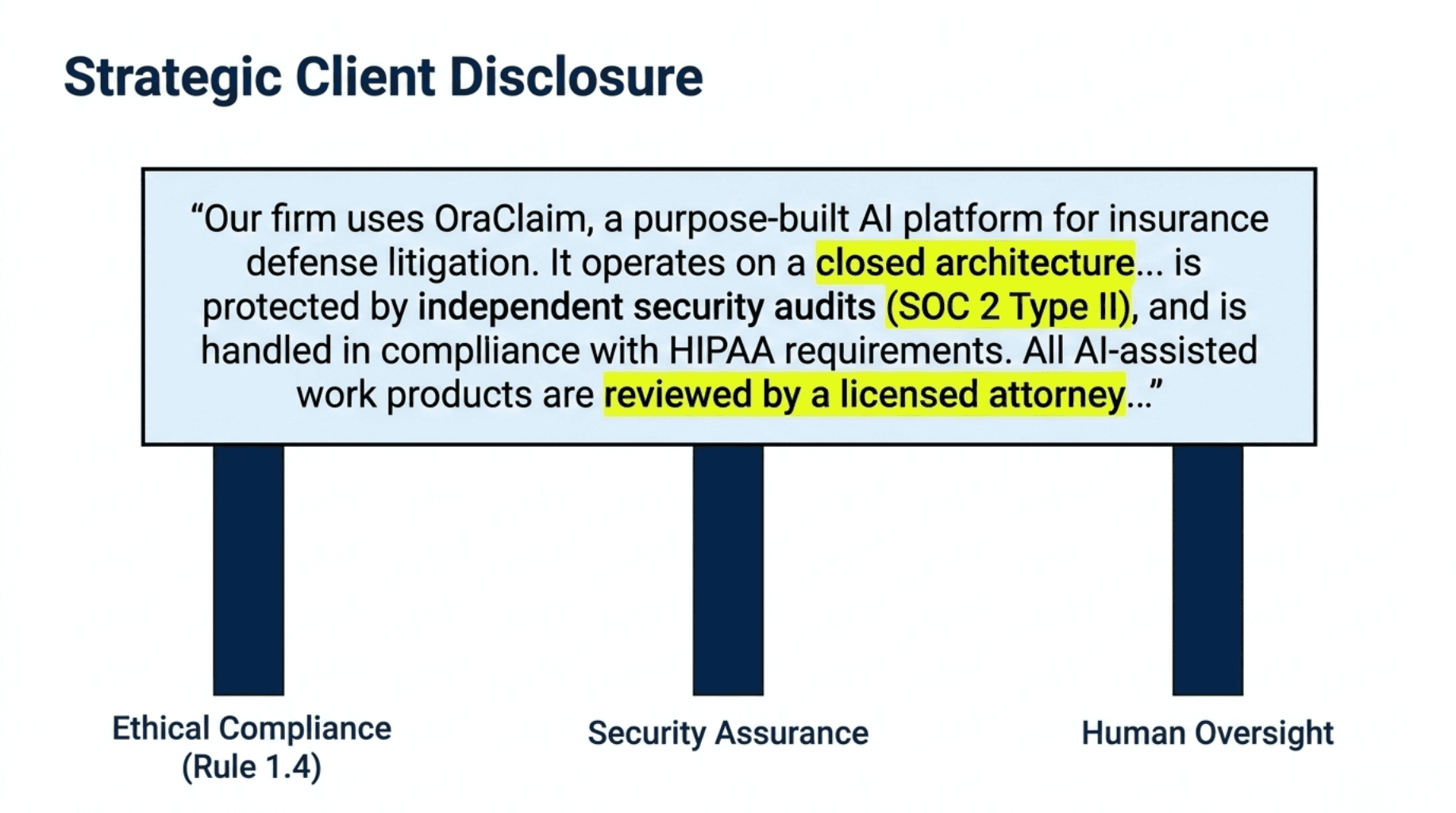
Carriers are not afraid of AI — they're already using it. What concerns them is firms using it badly. A credible disclosure story, with specific answers about platform security and human oversight, signals you're not in that category. It also opens the door to a different kind of conversation: one where you're a partner who's thought this through, not a vendor hoping nobody asks. That's how trust gets built one case at a time.
Phase 3: Days 61–90 — Measurement and Expansion
Track Process Metrics First
Outcome metrics, such as settlement values, verdict rates, are slow to materialize and too noisy to isolate AI's contribution within ninety days. Process metrics are different: immediately observable and directionally predictive of the outcomes that follow.
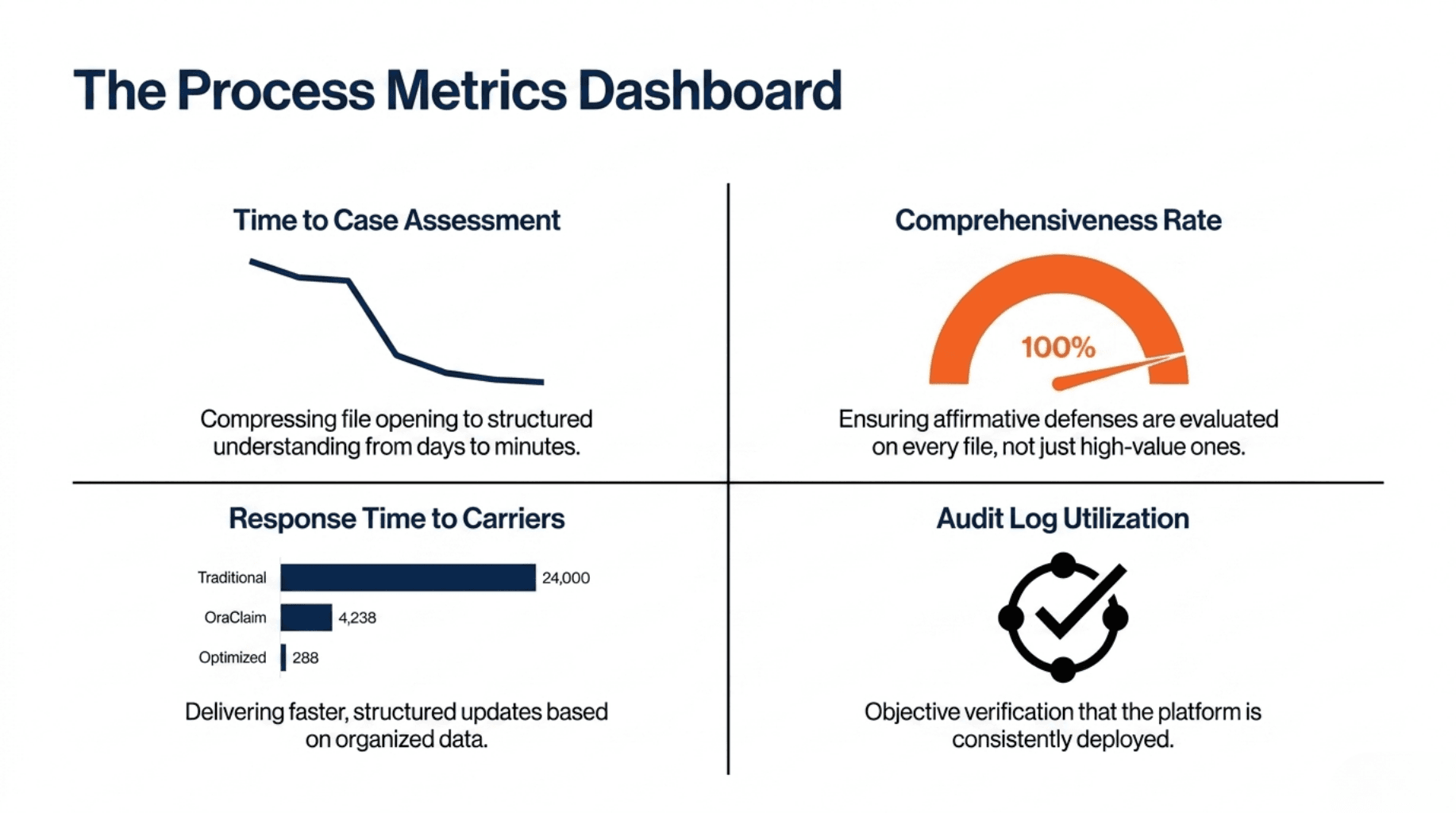
Four are worth tracking from day one, and OraClaim is built to move all four.
Time to case assessment: How long from file opening to a structured understanding of the matter? OraClaim ingests the file, organizes the medical records, and produces a structured case assessment in minutes — compressing what used to take days into hours.
Comprehensiveness rate: Are all affirmative defenses being evaluated on every file, not just the high-value ones? OraClaim makes comprehensive analysis the default rather than the exception, on every file, regardless of complexity.
Response time to carriers: Responsiveness is consistently among the top criteria carriers use to select and retain outside firms, and teams working from OraClaim's structured case assessments deliver faster, better-organized updates.
Audit log utilization: Is the platform consistently used on the files it was deployed for? OraClaim's audit logging answers that question objectively — the difference between a rollout that took hold and one that quietly stalled.
Use Performance Data to Negotiate Higher Rates — and Strengthen Carrier Relationships
At ninety days, you have something most defense firms have never had: documented evidence of how your firm handles cases differently.
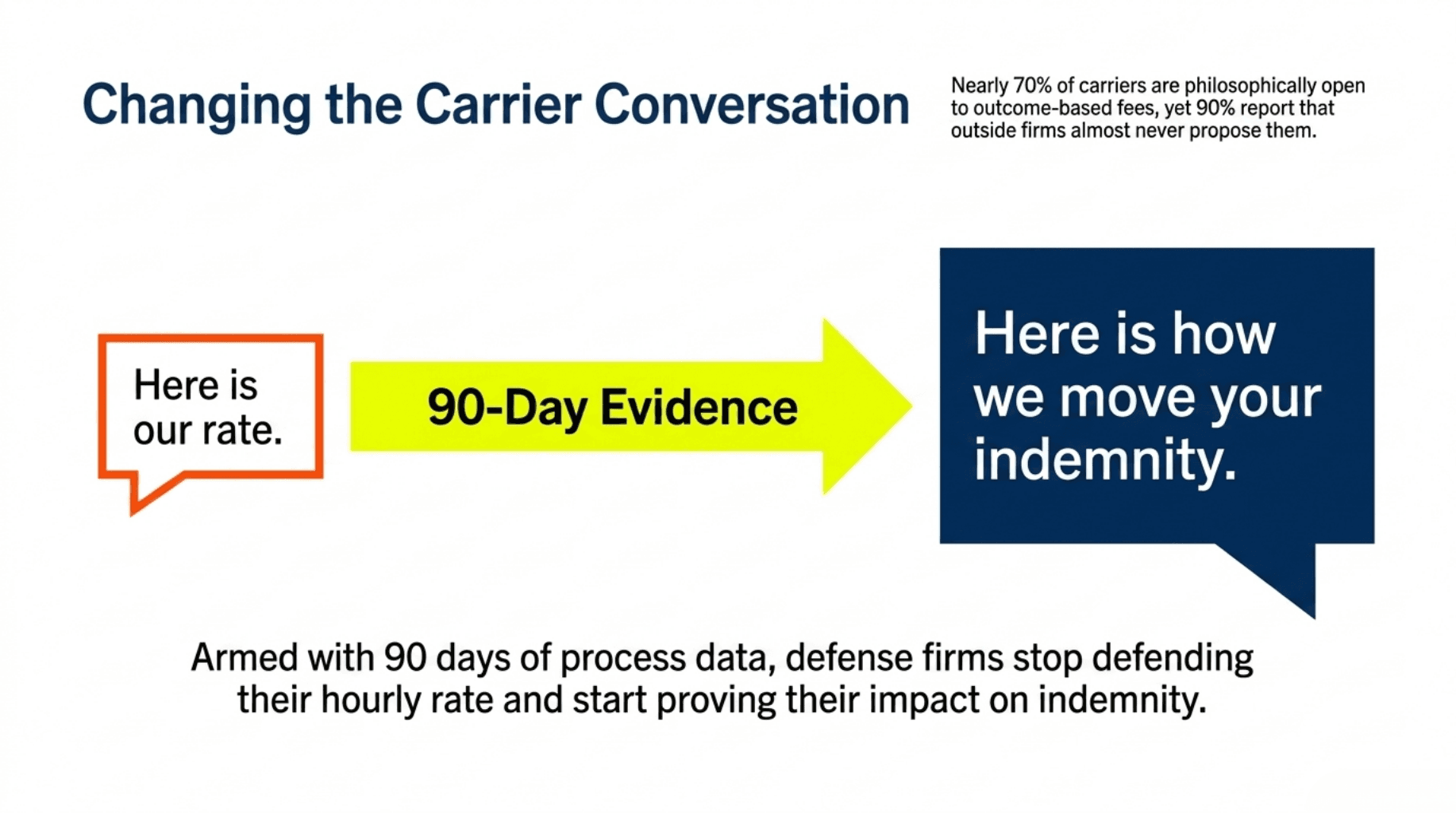
Time-to-assessment data, comprehensiveness records, and response time metrics are the inputs to a carrier conversation that shifts from "here's our rate" to "here's what you get for our rate" — and ultimately to "here's how we're moving the number that matters to you." That 10x difference between billing-line savings and indemnity-line savings becomes your competitive argument. Carriers are increasingly open to outcome-based thinking, and the share believing better defense spending reduces indemnity has nearly doubled in three years (CLM 2026, Q40).
Nearly 70% of carriers are philosophically open to outcome-based fees. 90% say firms almost never propose them (CLM 2026, Q92 and Q93). At ninety days, you have the data to start that conversation. Most of your competitors don't.
This is also where the relationship argument closes the loop. The firm that shows up with performance documentation — that can demonstrate faster assessments, more comprehensive defense analysis, and measurable responsiveness improvements — isn't just a vendor. It's a partner. That's the differentiation that outlasts any individual case result.
OraClaim's reporting infrastructure is designed to produce exactly this kind of carrier-facing performance documentation: not just internal metrics, but the story that changes the rate negotiation and deepens the relationship.
The Window Is Open
Ninety days is enough time to go from deciding to act to having documented evidence that you acted well. It is not enough time to close the gap entirely — AI adoption is a marathon, and the firms that compound their data advantages with every case will widen their lead over time.
But the firms that start now are already a year ahead of the ones still piloting. The plaintiff bar didn't wait. The carriers are noticing who's responding. The window of first-mover advantage is real, and it is narrowing.
OraClaim is built for this rollout: a closed, secure, purpose-built AI platform for insurance defense, with the implementation support, audit infrastructure, and carrier-facing reporting that turns a ninety-day plan into a sustainable competitive position.
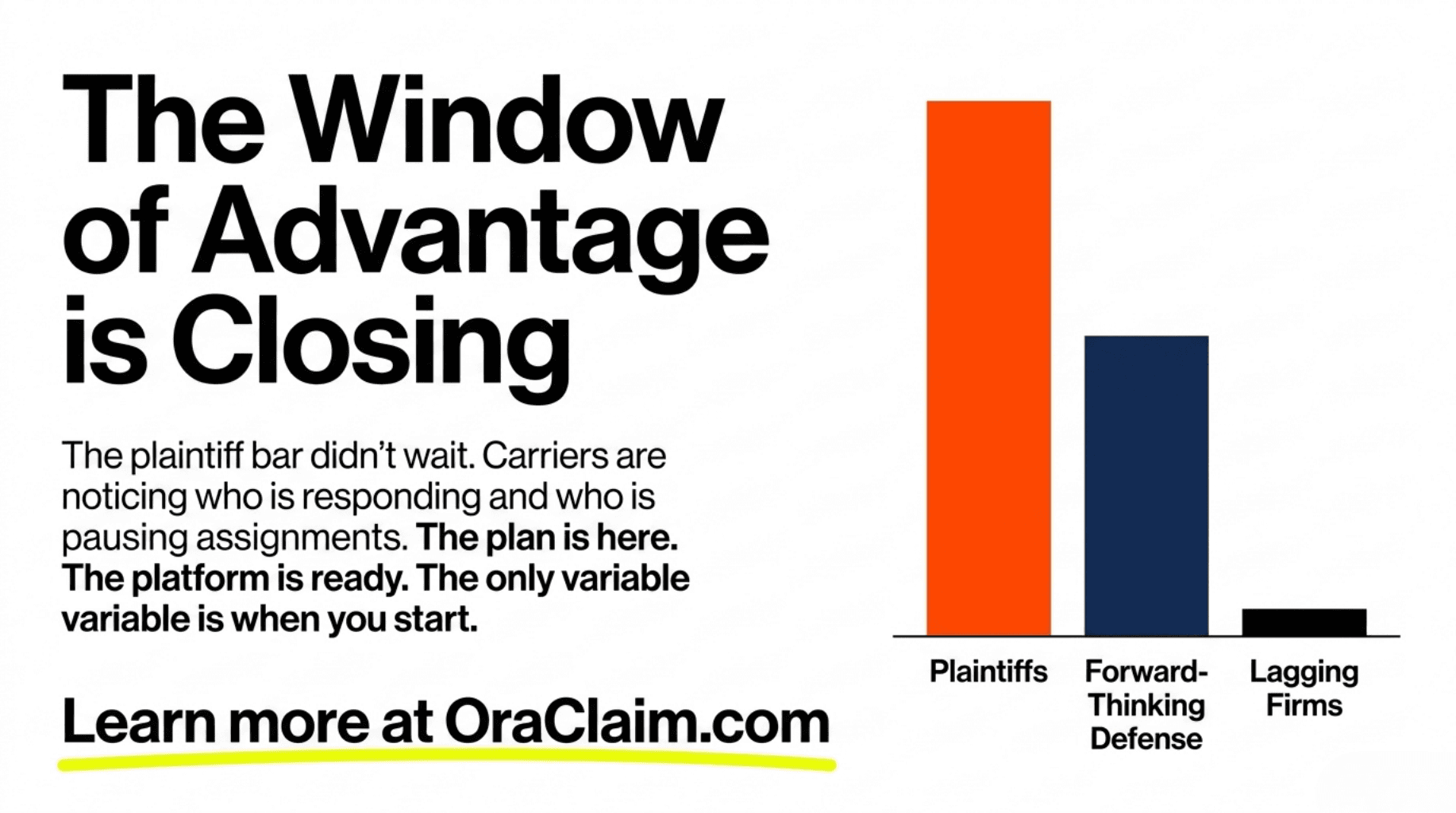
The plan is here. The platform is ready. The only variable is when you start. Learn more at oraclaim.com.
Sources: CLM 2026 Litigation Management Study (U.S. Legal Support / Claims and Litigation Management Alliance, 2026); ABA Model Rule 1.4; RSM, "Skills Gap in Insurance Industry's Aging Workforce Is a Growing Concern" (rsmus.com), citing U.S. Bureau of Labor Statistics projections; Thomson Reuters, Future of Professionals Report 2025.