Podcasts
Episode 6: Building AI for the Defense and Rethinking How Firms Bill with David

The Future of Claims — Episode 6: David
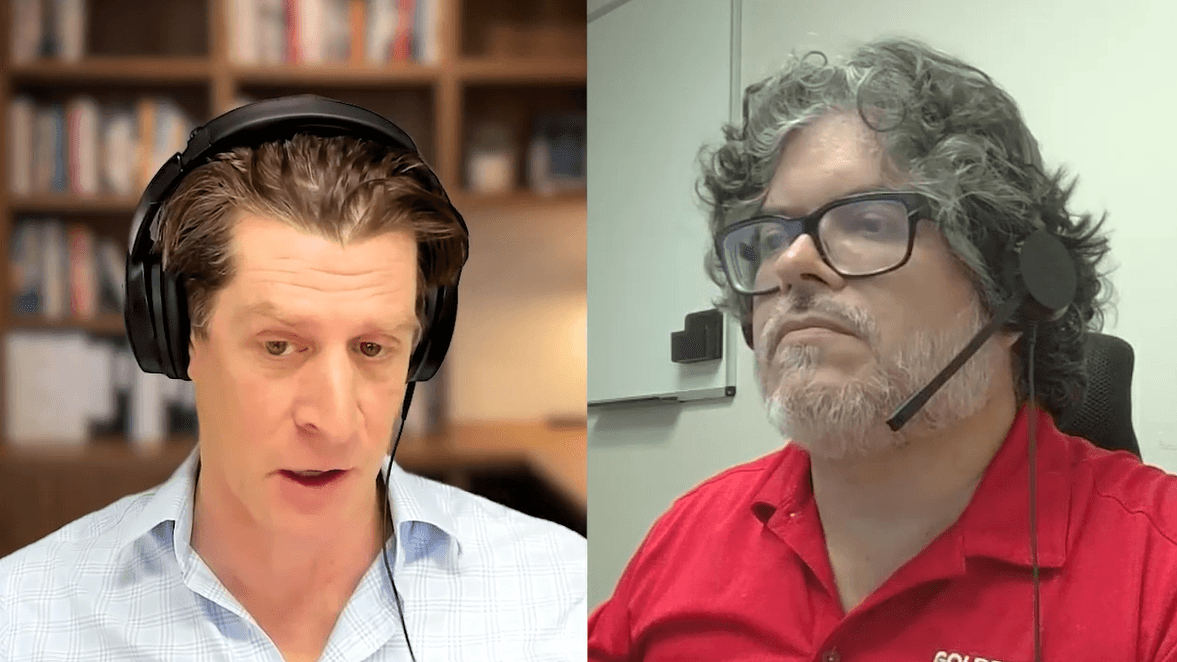
Host: Mark | Guest: David
You're listening to "The Future of Claims," a show about the changes happening in the world of insurance claims. I'm your host, Andy Anderson. I've spent over a decade at the intersection of insurance and technology as a founder, a CEO, and a podcast host. We're going to sit down with some of the leading minds in claims to hear how they think technology, people, and organizations will transform claims over the next 10 years. Mark, good morning.
Morning. Thank you so much for joining me today. Yeah. Thanks, David. Thanks for having me.
I'm really excited to get into this conversation around litigation and claims defense with you and AI. Before we get into that, perhaps would you mind just telling us a little bit of your story and how you got to this space where you founded AuraClaim, and this is the area where you're really living in today? Yeah, absolutely. So I'm a lawyer. I've been one for about 15 years.
I spent most of my career as a partner at a law firm on the West Coast of the US, and my practice was a mix of a bunch of different things, but in large part, it was working with insurance companies defending claims of all different types, mostly in the transportation arena, trucking companies, maritime operators, airlines, stuff like that. But I also handled construction defect cases and general liability cases, and a lot of times I would handle commercial disputes as well. So litigation was a big part of my practice always. And then I decided to take a swing at the corporate world, and I went in-house at a freight technology company, became chief legal officer there. And among the many things that I did, looking out for the company's best interest in defending claims was always a big part of my job.
And in freight, there are claims galore, and so I took my skills as a litigator and applied them to managing claims in-house. And why defending claims is a really hard job, because you've got usually so many that you're always looking out for, always trying to figure out what's the best strategy to get this resolved. And if you're doing that at scale, if you have tens or hundreds of claims at a time that you're responsible for, the deadlines become almost unmanageable. And your clients expect you to have the best, most detailed strategy to get every claim resolved and look out for their best interests. And so that becomes a real time crunch, a big challenge.
And being in San Francisco, close to the tech innovation capital of the world, and in that community of a lot of my friends are in tech, and I think I was one of the relative early adopters of ChatGPT when it first came out. And I remember trying it for the first time and having this immediate moment of, "Wow, this can really help me in my daily practice." And I couldn't even think of all the ways that it might help me, but I did think to myself that if this is as interesting as it feels like it is, I think that I can turn this into something that would not only make my work and my colleagues' work a lot better in its form that I'm dealing with it now, but I could create something that would change the way the entire defense ecosystem functions for the better. Because that volume, that level of detail that you need to get familiar with, that you need to leverage, that you need to think about for strategic purposes and just for executing daily tasks, that is something that this large language model technology can augment like crazy. And I thought, "Wow, I want to repurpose this and turn it into something that becomes the new way of doing things as a defense lawyer, as a client of defense lawyers who are facing these claims at scale every day, and really optimize it, make it better for everybody, and give a strategic advantage to all of those players on the defense side ecosystem." It's brilliant. I love it.
And let's get straight into it. How do you feel that AI changes that defense litigation landscape? Yeah. It can change everything. Look, I will say that it already has changed the game so much on the plaintiff side.
The plaintiff side, the folks that are asserting claims on behalf of consumers every day, mostly personal injury cases, but other types of property damage cases, they are very incentivized by efficiency, and they quickly realized, "Hey, large language model technology can help me draft stuff. It can synthesize a lot of information very quickly, and I want to be able to evaluate my claims faster, pick the ones that I think are going to be winners. And then once I file those claims, now I can blitz the defense side with more discovery, deeper discovery, pleadings that I wasn't sure I wanted to write before because I didn't want to waste my time." Now, there's no calculus about wasting time. You just do it really quick. And I think what has happened is there's been a flood of new cases, more volume than the defense side has ever seen before.
And plaintiffs' firms are very much benefiting from that. And of course, what comes with that too is like They push the envelope. They're using it in ways that a lot of people would say is irresponsible, because they're using oftentimes consumer-grade free products that the quality control is not there. You've heard the horror stories about hallucinating cases and citing to cases that don't exist, or citing to cases that stand for a proposition that it doesn't actually stand for, and that's a real problem. And most of those types of ethical violations you see on the plaintiff side, because they are just so eager to make more claims, be more efficient, and I think that type of use has infected the whole ecosystem, and the perception that maybe this isn't such great technology.
Well, I actually think that if harnessed and used in the right way, it can be the thing that the defense side can use to finally get ahead of their work and ahead of their strategy on every claim, and actually give meaningful thought to every task that you do on the defense side, which is a luxury that in the current landscape you just don't have. And so what does that mean? That means when you get a new claim, or you parachute in midway through, or you get a huge dump of discovery on you, you can use large language model technology to help you surface factual information that lives in that sea of documents and correspondence very quickly. And you don't have to waste your time or anyone else's time, whether it's a partner or an associate, going through all of the material just to figure out what's in there. And then you can take it the next step and actually have the language models do an analysis for you on how does this impact the tried-and-true standards of liability and proof of damages in all sorts of different types of claims.
And is that the end-all, be-all? Is it doing your job wholesale for you? No, it's not, but it is teeing up for you all the things that you definitely want to be looking at when you are developing a strategy, not just for the case as a whole, but also for the tackling of every individual task. It's really powerful. And I'm going to ask you, this is maybe a bit of a loaded question, so feel free to dodge it if you want.
There's a sense that I get when speaking to you that the plaintiff side has been faster to adopt this technology than the defense side has been. Do you think that's true, and why do you think that might be the case? It's a great question. Yes. Yes, it's 100% true.
Why? Because they care very much about efficiency. Their whole practice is structured around efficiency. Their fee structure dictates how they are incentivized. They take a contingency fee on the outcome of the case, and that fee is often somewhere around a third.
Can be more than that if the case goes further down the road. If it goes to trial, it's usually going to be somewhere in the 40s in terms of the percentage that they take. They are not rewarded for time spent on every case, and the more cases they have going at any given time, the more likely they are to get a settlement that's going to pay the bills and buy them the Ferraris and private jets that some of them have because they're so successful in what they do. And so efficiency is the name of the game. The fewer people they have to pay to get the job done, the happier they are.
I don't want to paint them as just as bad guys that aren't thinking about quality. There are many amazing plaintiffs' lawyers out there. They're very detail-oriented, that really care about people. Of course they do. But the bottom line is when you are financially incentivized to be efficient, you're going to pursue that path.
On the defense side, they are largely predominantly paid by the hour, which is a complete misalignment of incentives with what their clients actually want. Nobody wants anyone to be spending an inordinate amount of time on any particular task in the legal domain. Clients want answers fast. They want their cases resolved quickly. I don't care what anyone says.
No client is excited to have litigation pending unless they filed it aggressively for leverage. But in almost every claim, every client wants that case done with as efficiently as possible. And yes, they may stand for certain principles, but they want to get to resolution fast. And these lawyers are incentivized to spend as much time churning on tasks as possible, keep cases open as long as they can. And a lot of lawyers on the defense side will tell you, "No, I'm not incentivized to do that.
I want to keep my clients happy." And of course, they do want to keep their clients happy, but there is a misalignment if you think about the logic of being compensated by the hour versus what the clients actually want to see happen. Fascinating. Halfway through that answer, I was already teeing up a question about billable hours and how that might be a flawed model. I'm guessing, though, it's not black and white. It's not like billable hours bad, contingent outcome-based good.
So what are you seeing in the marketplace at the moment, and how would you recommend firms look at that as an equation? So here's the thing. It is hard to figure out what is the proper compensation model on the defense side. On the plaintiff side, it's easy. I'm going to take a bet on your case, and however well I do I'm going to take a portion of that recovery, okay?
On the defense side, why is it hard to do that? There has never been enough data to be able to say, "This is what the case should settle for." And so we're going to benchmark your performance as a defense lawyer against that forecast. There's never been that. There's been lots of loose hypotheses, and that is largely what defense lawyers have to do every day, and claims adjusters, what they have to do every day is figure out, what do I actually think it's going to settle for, and reserve against that, and plan against that. But it's an art, not a science.
There are quantitative measures that you apply to various aspects of a claim to forecast that, but nobody has ever come up with a nice algorithm that puts all the data together that tells you, this is really within a very tight window what the case should settle for. Which makes it really hard to figure out a success fee on the defense side. And also, defense lawyers do not get to choose the fact pattern that they're dealing with. On the plaintiff side, you get to choose. You get to say, "I want to take a bet on this case, but I don't want to take a bet on that case." So sorry, Mark, I'm not going to take your case, but David, I'm taking your case because this is a slam dunk.
When you're on the defense side, you get all the dog cases. You know what I mean? And you're sitting there. There's an old adage that my partners used to say all the time whenever we were dealing with a difficult situation, we would say, "Well, we don't make up the facts. We deal with it as it comes.
We deal with the cards that we're dealt." And that is so true. So if you have no control over how long this case is going to go, how bad the outcome might be, it's very hard to say, "Well, you should pay me based on those measures." AI changes that, I think, a lot in a lot of ways. So what we are working very hard on is coming up with algorithmic benchmarks to help lawyers and adjusters much more accurately forecast what should happen in a case based on the facts, the demographics of the parties involved, the venue you're in, the experts that have been retained. All these factors that usually are hard to quantify, we are working hard to quantify that using the technology, the large language model technology, in conjunction with machine learning. So we're striving to make that piece more reliable for everybody, and I think eventually you will be able to benchmark fees, not the whole fee, but a part of the fee based on expected outcomes.
Right now, what we're doing is we are allowing firms to get through very document analysis-heavy parts of the work much faster, which aligns incentives with their clients. And what we're seeing happen is our customers are actually able to create hybrid fees where they're incentivized to go faster through the parts of the case that take a long time and that no one's particularly excited about. Just a lot of information gathering and analysis. So our customers can actually, if they want to, they can charge a flat fee for that portion of the work based on the anticipated volume of documents and analysis that has to go into it. And then for all the parts where AI cannot touch, which is taking depositions, advocacy at hearings, trial, visiting and preparing witnesses, all that stuff, AI can help with it, but it can't do the job, nor can it do it well.
And so those parts of the job where you never know how much time it's going to take the lawyer to actually do that, you can still charge hourly for that. So when you couple those types of fees together in a hybrid fee model, now the defense side can actually start looking at making a lot more money and aligning their incentives with their clients to get more cases, do a better job, faster job, and focus on the parts of the job that really move the needle. That's how I see the fees changing. Defense teams are drowning. Tighter deadlines, thinner margins, and the plaintiff firms armed with AI and litigation defense.
That's why we built Oraclaim. I'm a former insurance executive. My co-founder is a former litigation defense partner. We built Oraclaim specifically for the work defense teams actually do inside a fully closed, secure system. The result, faster, more comprehensive work, better outcomes for carriers, increased profitability for firms.
Today, Oraclaim is being used by top national insurance defense firms and regional boutique specialists handling workers' comp, trucking, construction defect, med mal, toxic torts, and everything in between. Oraclaim, AI for the defense. Learn more at oraclaim.com. That's O-R-A-C-L-A-I-M.com. And I can hear you're very passionate about helping defense firms with this AI adoption piece.
I'd love us to talk a little bit about that. How do you think firms should approach this? And obviously, you're in a very privileged position where you're working with AI across lots of different firms. You've obviously got a custom platform that you guys are building. So talk to me about that.
What are the market-leading firms within the AI? What are they doing well, and how do you recommend AI adoption? I want to say first that I focus on the defense side because the defense side is what I care about, because I've seen how hard it is to do this job, and I think the people are extremely smart who do it, but they sacrifice way too much. They sacrifice their health, mental health, physical health, because the incentives are It's just you're always grinding. And I really believe that my colleagues deserve help and deserve a platform that focuses only on them.
We don't want to share data with the plaintiff side, and I don't want any of our customers thinking that if you feed us data, we are going to arm the other side against them. So that's why those are the main reasons why we have focused exclusively on the defense side, okay? Right now, again, the defense side are more laggards in adopting AI compared to the plaintiff side. And so we encounter defense lawyers at all different levels of AI adoption and readiness, and very often there's none. They're complete blank slate.
"I've been avoiding it. I don't see how it helps my practice. I charge by the hour, and I love making money on my paralegals that summarize medical records for days." That attitude I encounter a lot, and I think it's backwards and antiquated, and they need to stop thinking like that. But then you get some really forward-thinking defense firms who are like, "Hey, I've tried Claude, I've tried ChatGPT, I've tried Harvey, Lagora. I've tried other products that are meant for corporate legal." Or maybe it's the Lexis or Westlaw products because they already are working with them, and they get blasted with marketing emails that they've rolled out an AI product, and so why not try it?
And almost inevitably for those firms, I encounter them and they say, "These AI tools are cool. They help with depo summaries and help me think about things a lot faster, but I feel like there's a lot more they can do, and I'm just not getting the benefit of that." And so my thesis is, in this moment where there are a lot of products out there that are all marketing themselves to you, you should be curious, and you should experiment. Huge commitment to any one product, and a lot of them are actually demanding that. But right now, the key is figure out which product is actually best suited for the lawyers at your firm and the particular practice type that you have. Very focused solutions on particular practice types are going to be way better than general legal AI platforms or general AI platforms at large.
And so curiosity is the key. Then you want to make sure you run some pilot, and that pilot needs to be a meaningful pilot. I have seen because these professionals are so busy, if you just say, "Yeah, I want to try this on one case, and I'll decide whether it feels good or right," they won't even do it sometimes. Sometimes they'll get a case into a product, and three weeks later, they'll be like, "Oh, I just never got to it." And that habit of, "I'm just going to do things the way I've done it for 20 years," dominates. To do a pilot the right way, to really decide and make a meaningful decision for you and your firm, whether AI is going to help you and change the way you do things for the better and impress your clients and get you more cases, you need to give it a real swing.
And the way to do that is make sure that you do a pilot that has enough people involved and enough volume of work so that you are able to build some muscle memory over the first few weeks of using this product, and really meaningfully getting enough opinions and enough work accomplished so that you can say, "I really like how this is helping me. I can really see the value," or, "No, this is not worth investing in long term or at scale." That is how you really need to do it. And to do that well, you need to get, I think it's a smattering of people within the firm to render those opinions and to do that pilot well. You need to get some decision-makers within the partnership ranks. You need to get some partners that source work and that have deep client relationships.
And then you need to get some associates and paralegals and staff involved, and really have them work together on the platform if that is supported. And because everybody has a different role in defending a claim. Some are high-level strategic thinkers, some are in-the-weeds grinders on particular tasks. And each one of those people within the team are thinking about different aspects of the job, and it's important for them all to see how AI supports them well and what they do, and come together and build a consensus around what should we optimize for within our workflow. That has worked really well.
Really interesting. And I'd like to just get into, if we can, some more specific use cases because I think that really helps anyone listening to this bring it to life. What are some of the possibilities using these LLMs and machine learning and the tools that are available? So maybe you can talk me through some examples from some of your partners and some of your clients of how they're actually using it in practice, and how is it impacting their day in a meaningful way. Yeah, great question.
So I'll start off just by talking about what we don't focus on, but is a use case that I think a lot of lawyers think about very naturally, and that is legal research. Legal research has always been a search-for-cases type of motion, and AI is with the Lexis and Westlaws of the world. That is their wheelhouse. That is what they focus on, and I think you're going to see a lot of advertisement and use cases for legal research assisted with AI. What I have been much more passionate about is what I actually think AI does best, and that is help you find factual information and details within the sea of information, documents, and correspondence that you inevitably have to go through in every single claim or case, and structuring that information in a way that allows you to hit the ground running and be a much more strategic thinker.
Because let's face it, the amount of time as a defense lawyer that you spend doing legal research is de minimis compared to the amount of time that you spend finding facts and making sense of those facts, and then leveraging those facts in your attorney work product. So what we've focused on, what AI does really well is intake all of the documents in your case file. This is what we do. This is not what everyone does. This is not what every AI product does because they don't have this capability.
But what we've focused on is building the capability to take in your entire case file and capture every line of every bit of text said within correspondence, discovery, documents, investigative materials, everything, pleadings, everything, and structuring it for you, surfacing it, and organizing it. What matters here? What points have been raised in this claim? Structuring it around all the different analyses that you have to do, focusing on liability standards, evaluating damages, categories that might be available, and how they might affect exposure. So we do that.
That is one thing AI is capable of if done right. And then, of course, drafting work product of any kind, whether it's discovery to propound discovery responses, pleadings, getting a good first draft, status reports, or case evaluation reports. One of the things that every one of my colleagues has come to me and said, "Mark, if you can help me draft status reports, then you would be saving my life." And it's because they require so much time and effort to put all of the analysis together and send something to the client. And that's actually what one of the motivating factors for me was to be able to kind of automate and create that first draft of a status report, and the only way you can do that is if you know everything about the case. And so that's how we arrived at the product that we have.
But drafting, creating that work product, and then really using it as a thought partner to come up with the best strategy, the best story to tell perhaps a judge or a jury if you're far down the road in a case on why you should win. Fascinating. Thank you for the conversation today. This has been really insightful.