Blog
The Defense Firms Raising Rates Right Now Are the Ones That Adopted AI
Meta Description: From associate burnout to outcome-based billing, the 2026 CLM data reveals why insurance defense AI is no longer optional. A practical look at law firm AI ROI across capacity, depth, and rate strategy.
Defense firms are caught in a two-front squeeze. On one side, plaintiff firms armed with AI are driving up claim costs. EvenUp Law reports that AI-generated demands are 69% more likely to reach policy limits. On the other hand, carriers deploying bill review software are cutting invoices 5-15% per file as a matter of course.
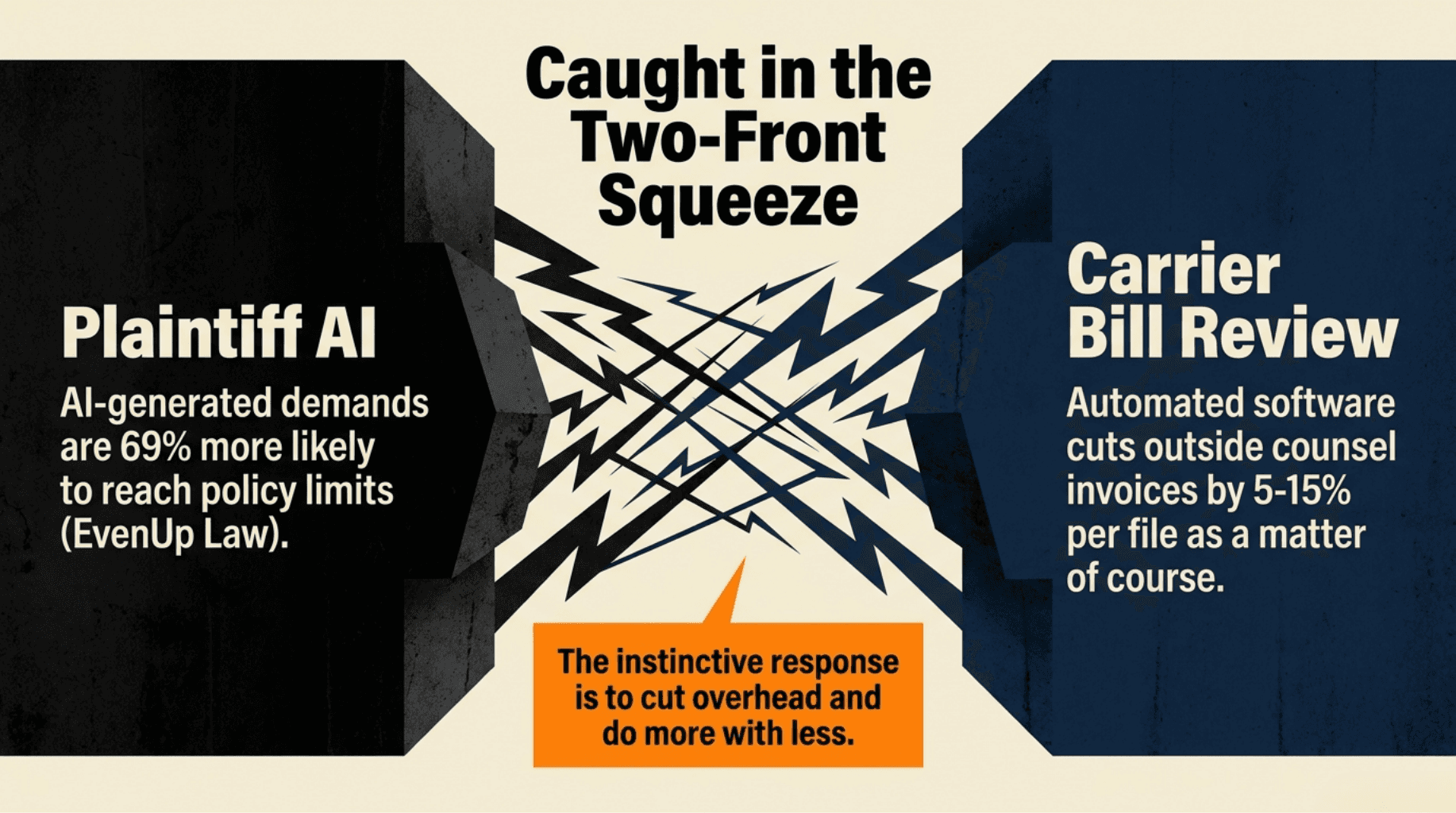
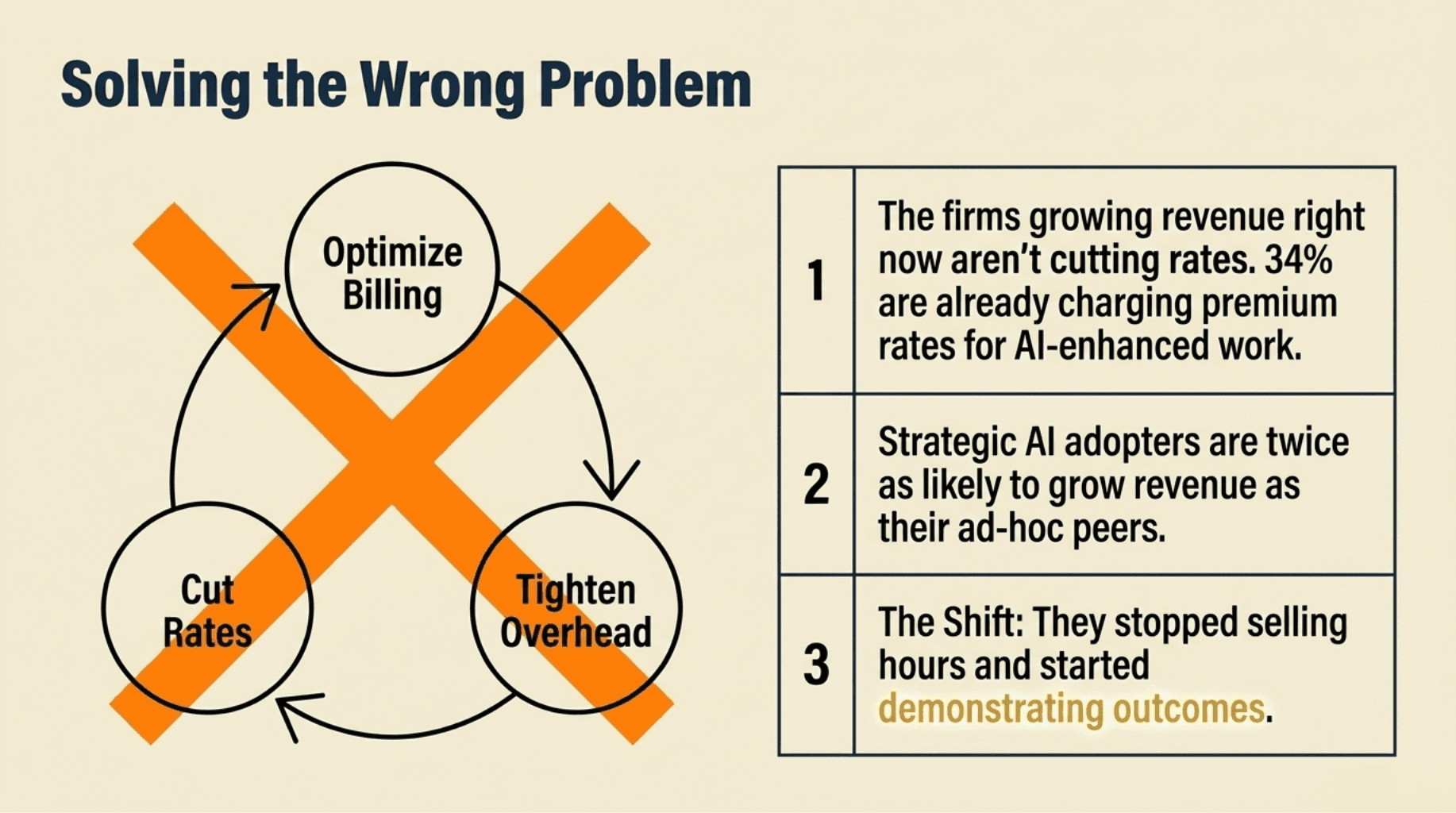
The instinctive response is to optimize billing, tighten overhead, do more with less. It's the wrong response. It solves the wrong problem.
The firms growing revenue right now aren't cutting rates. 34% are already charging premium rates for AI-enhanced work, and strategic AI adopters are twice as likely to grow revenue as their ad-hoc peers, because they've shifted from selling hours to demonstrating outcomes.
The Arithmetic Every Defense Firm Should Know
Stop Optimizing the Wrong Number
In a case with $50,000 in legal fees and a $500,000 settlement, cutting fees 10% saves $5,000. Moving the settlement 10% saves $50,000. The indemnity number is ten times more consequential than the billing line, and approximately 85% of total claims cost sits on the indemnity side, not legal fees. When you're the firm that moves that number, carriers notice. That's how trust gets built.
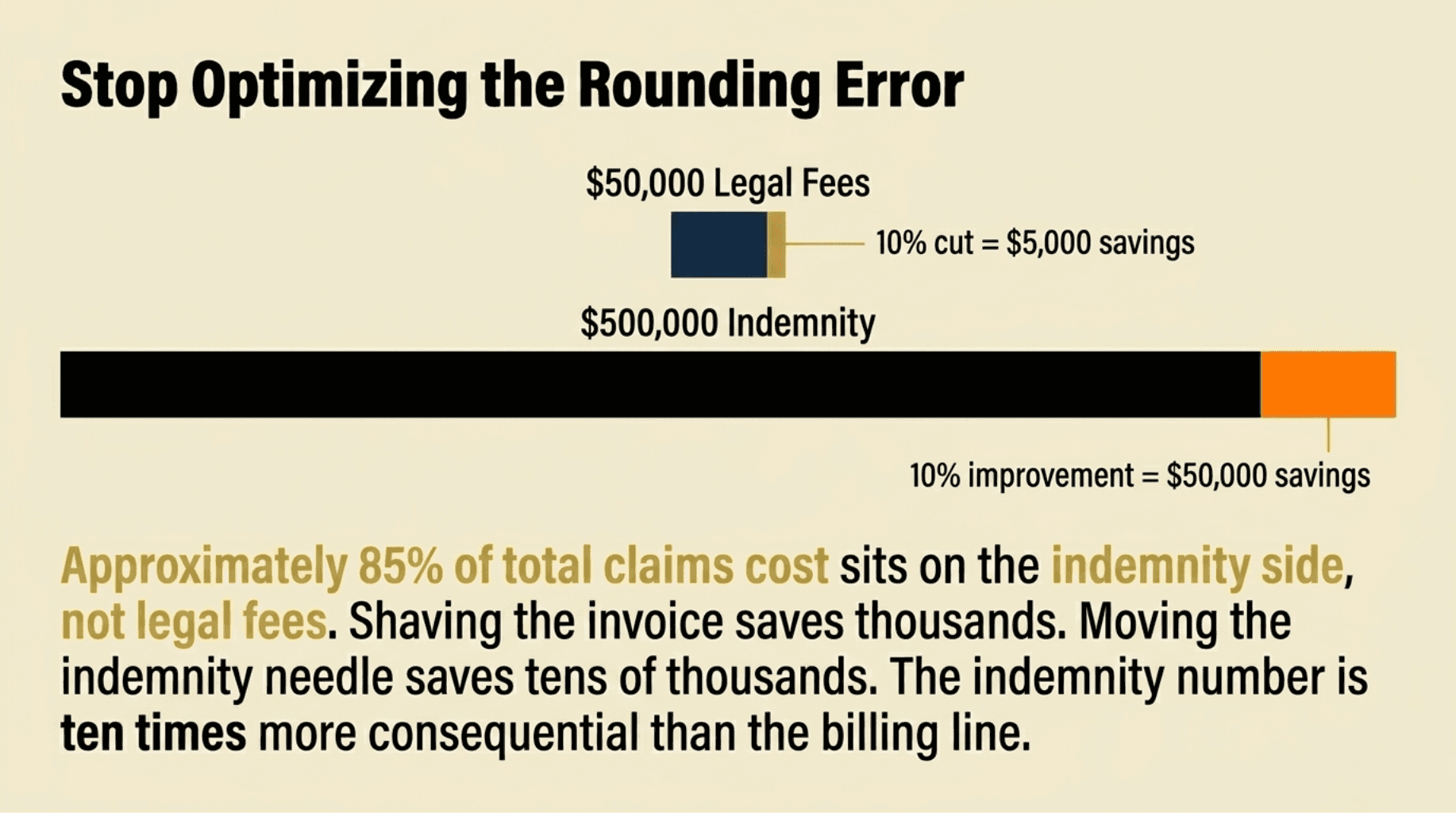
Shaving the invoice is a rounding error. Moving the indemnity needle is where the financial leverage lives.
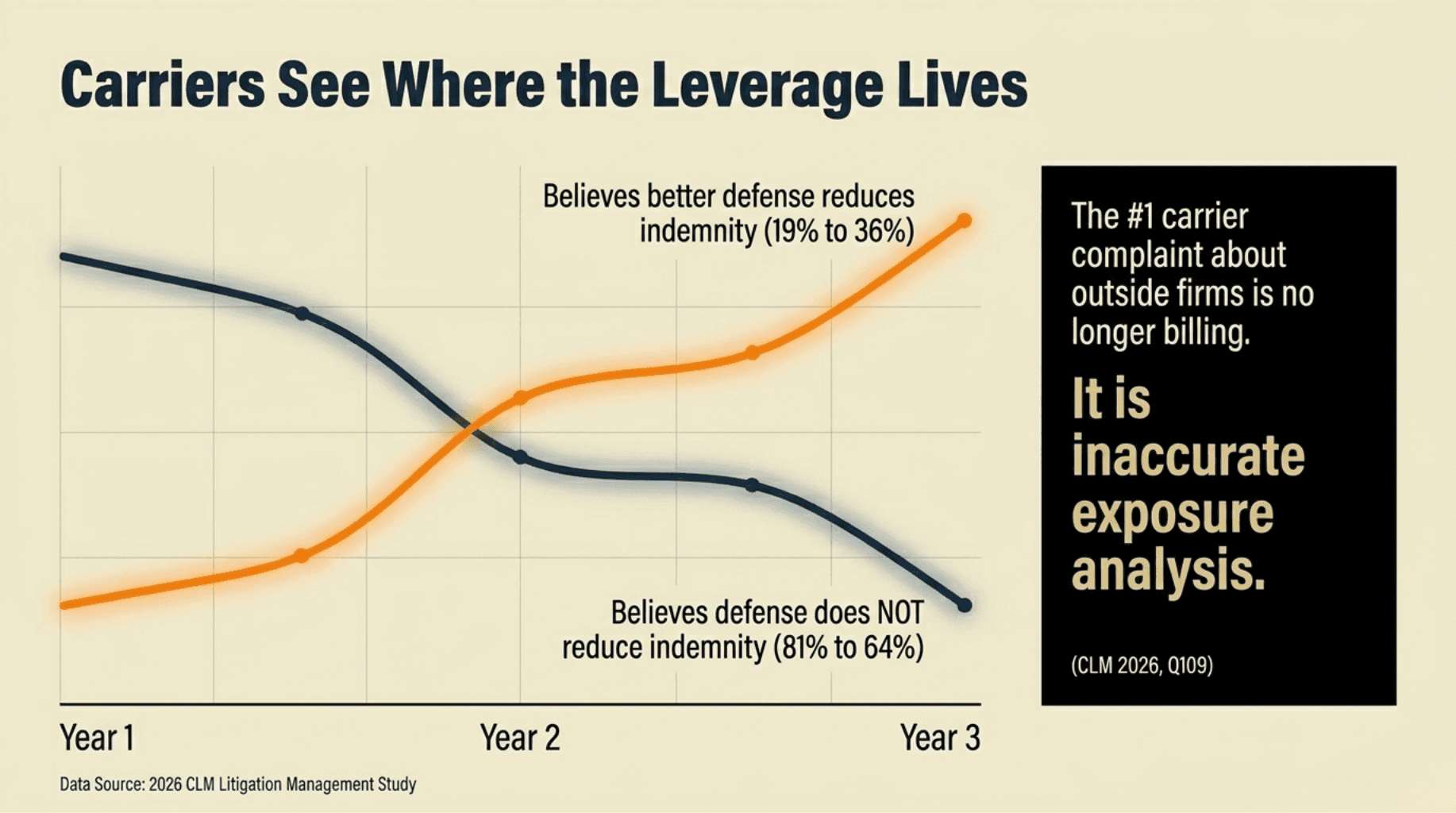
Carriers are starting to see it that way too. The share of carriers who believe better defense investment reduces indemnity has grown from 19% to 36% in three years, as the percentage that said it does NOT dropped from 81% to 64% (CLM 2026, Q40). More tellingly, the number one carrier complaint about outside firms is no longer billing. It's inaccurate exposure analysis (CLM 2026, Q109).
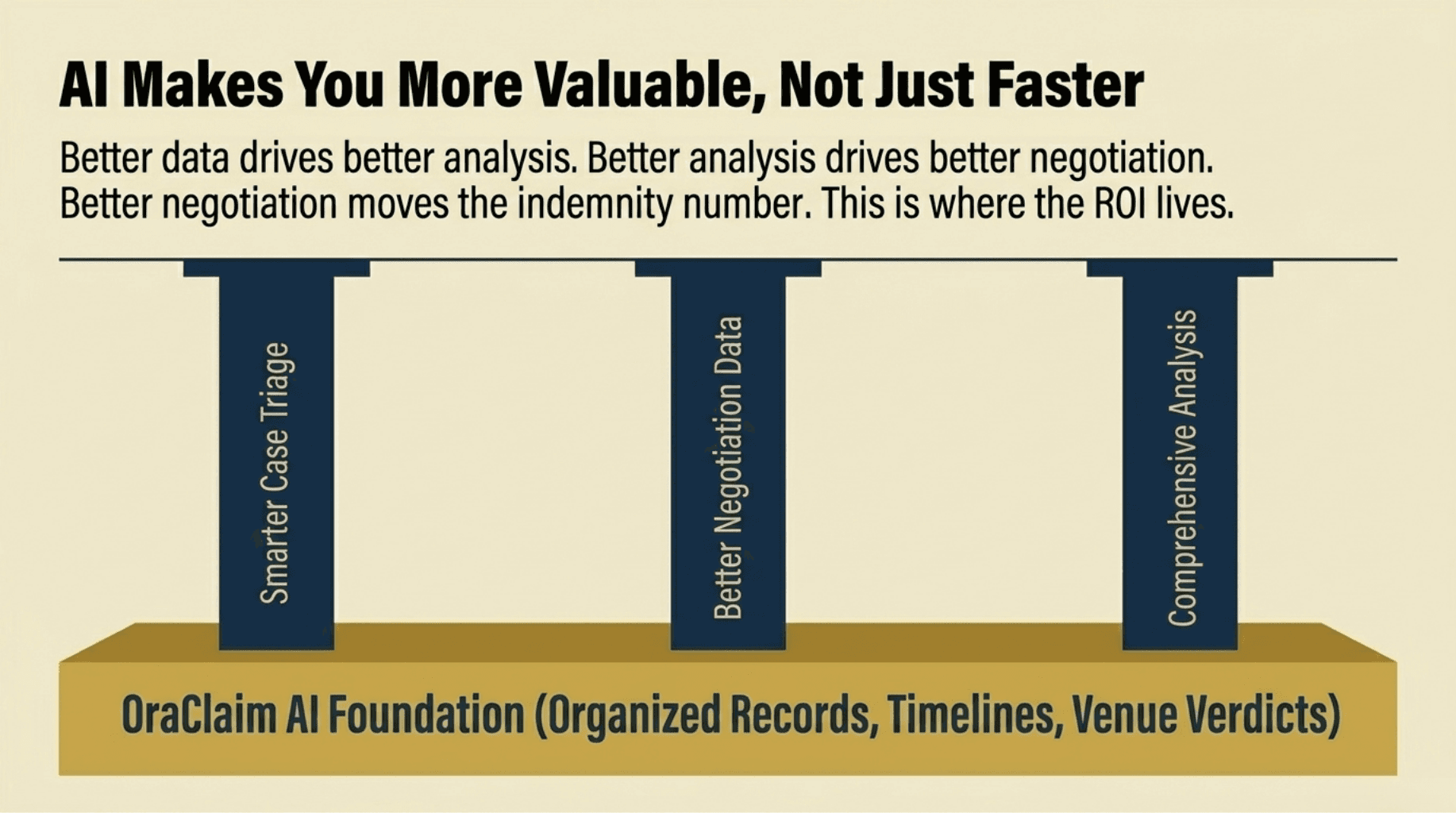
That's the problem worth solving. And it's the problem OraClaim is built to solve. When defense teams have better data on every file, including organized medical records, structured case timelines, and comparable verdicts by venue, their exposure analysis improves. Better analysis drives better negotiation. Better negotiation moves the indemnity number. That's where the ROI lives.
AI Doesn't Just Make You Faster. It Makes You More Valuable.
Smarter Case Triage Reduces Indemnity Costs
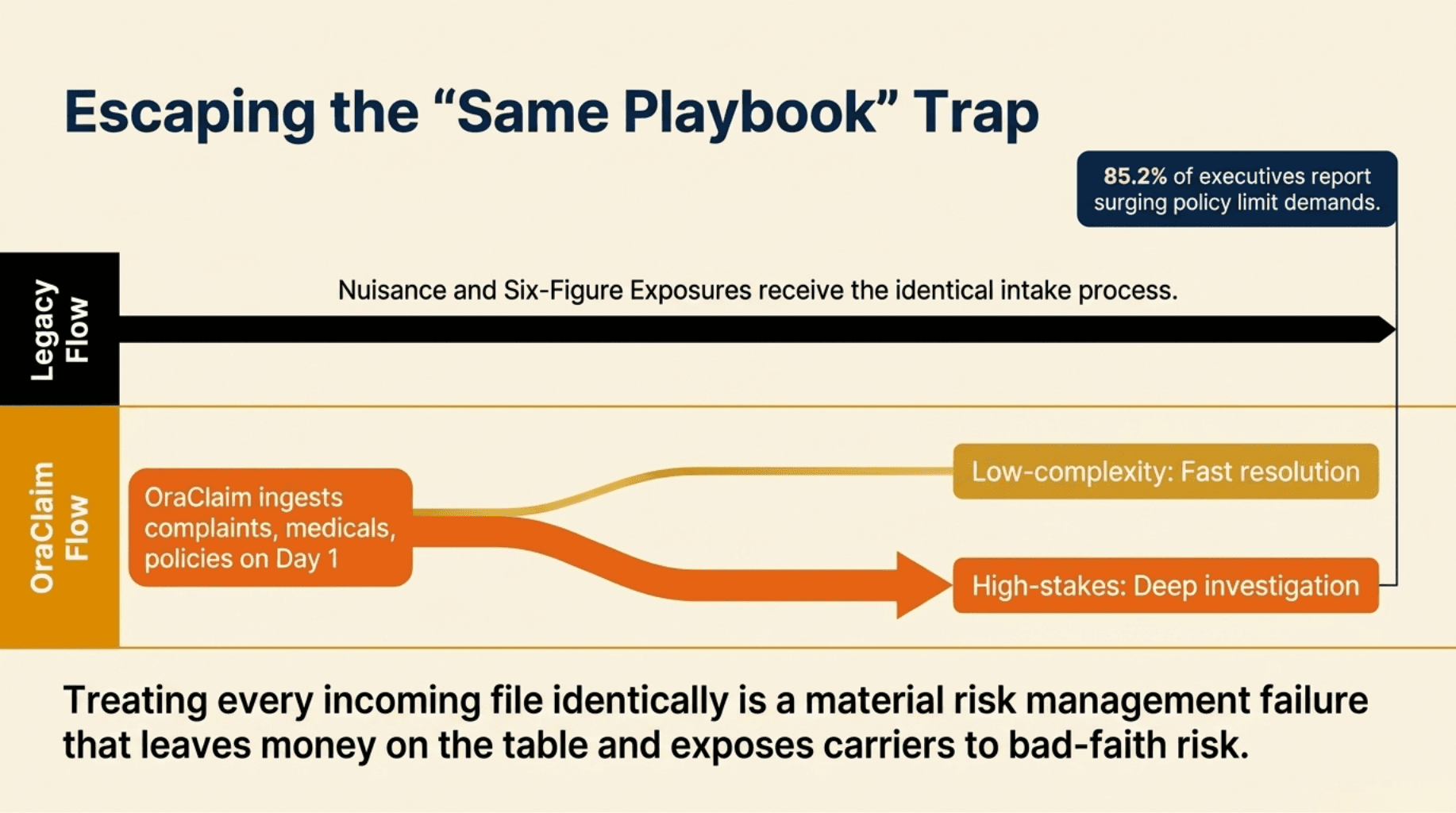
Most defense firms treat incoming files identically, same playbook regardless of risk profile. A nuisance case gets the same intake process as a six-figure exposure. That's not just inefficient; it's a material risk management failure.
AI-powered triage changes the equation. OraClaim ingests the complaint, medical records, policy documents, and adjuster notes on day one and produces a structured case assessment in minutes. The result: low-complexity cases resolve faster with less time invested, and high-stakes cases finally get the deep investigation they actually deserve.
The stakes are high. 85.2% of executives report surging policy limit demands (CLM 2026, Q50). Treating every incoming file with the same playbook, regardless of risk profile, is how firms leave money on the table and expose carriers to bad-faith risk.
Better Negotiation Data Produces Better Settlement Outcomes
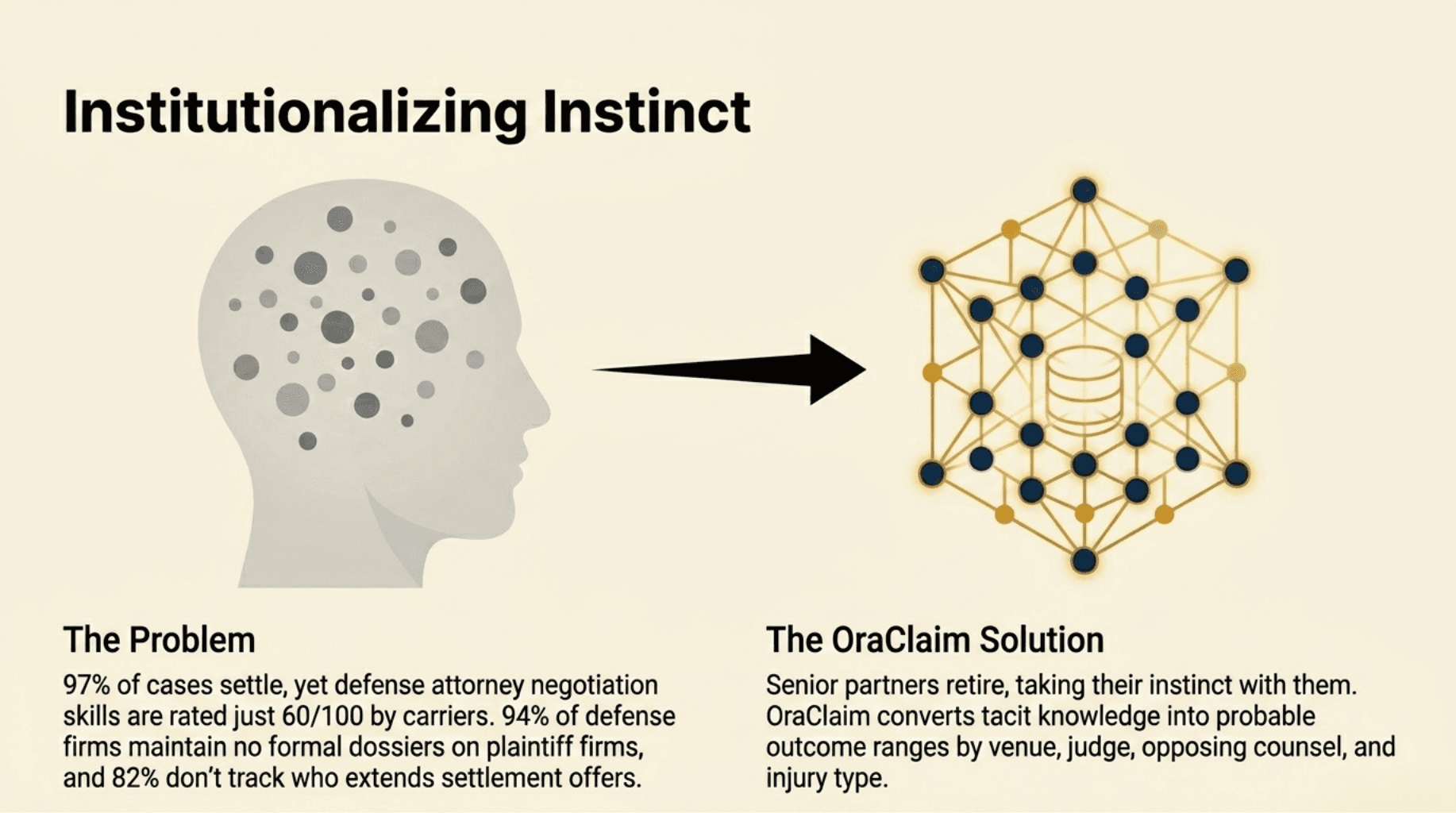
97% of non-dismissed cases settle (CLM 2026, Key Findings). Yet negotiation skills are rated just 64 out of 100 for claim staff and 60 out of 100 for defense attorneys (CLM 2026, Q53 and Q54). The gap between what's possible and what's happening is enormous.
Part of the problem is structural: experience and instinct walk out the door every time a senior partner retires. Tacit knowledge, meaning what a case is worth in this venue, against this plaintiff counsel, with this type of injury, isn't systematically captured anywhere.
OraClaim converts that tacit knowledge into explicit intelligence: probable outcome ranges by venue, judge, opposing counsel, and injury type. The settlement that comes in 10% lower on a $500,000 case is worth ten times the value of a perfectly clean invoice.
The urgency is real. The plaintiff bar is already doing this at scale. EvenUp's AI tools are profiling defense negotiation patterns. Meanwhile, 82% of defense organizations don't track who extends settlement offers (CLM 2026, Q56), and 94% maintain no formal dossiers on plaintiff firms (CLM 2026). OraClaim starts closing that gap.
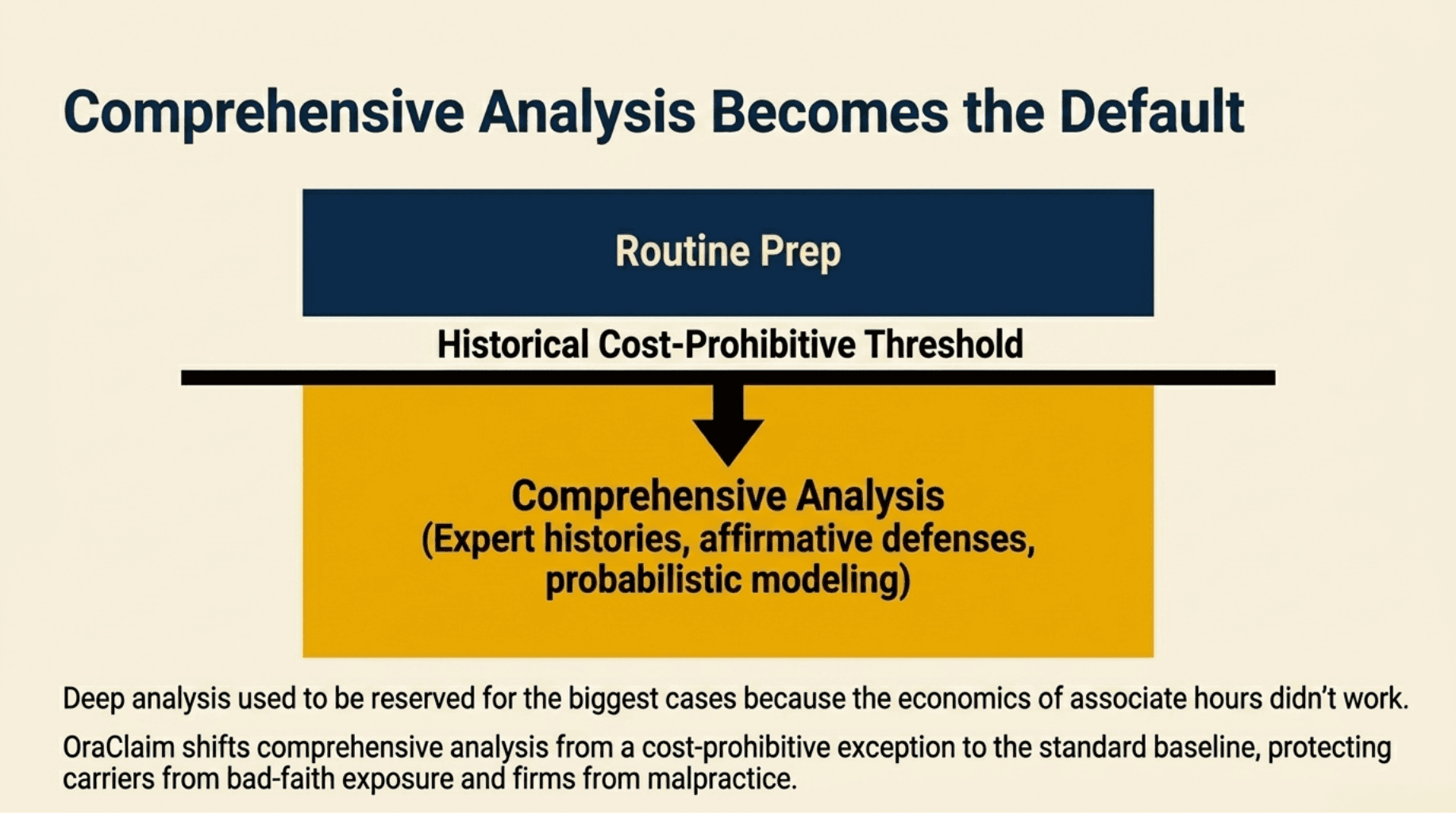
Comprehensive Case Analysis Becomes the Default
When deep case analysis requires significant associate hours to complete, it only gets done on the biggest cases. The economics don't work otherwise, and clients won't pay for it on routine files. That means most cases go to mediation without full analysis of every claim element, every affirmative defense, every opposing expert's history.
When AI handles that analytical work, the calculus changes entirely. Comprehensive case analysis, work that was previously cost-prohibitive, becomes feasible on almost every file. That's not gold-plating. It's the baseline that protects carriers from bad-faith exposure and firms from malpractice risk.
OraClaim makes comprehensive the default rather than the exception, and gives firms a data-backed case to carriers that the investment is worth it.
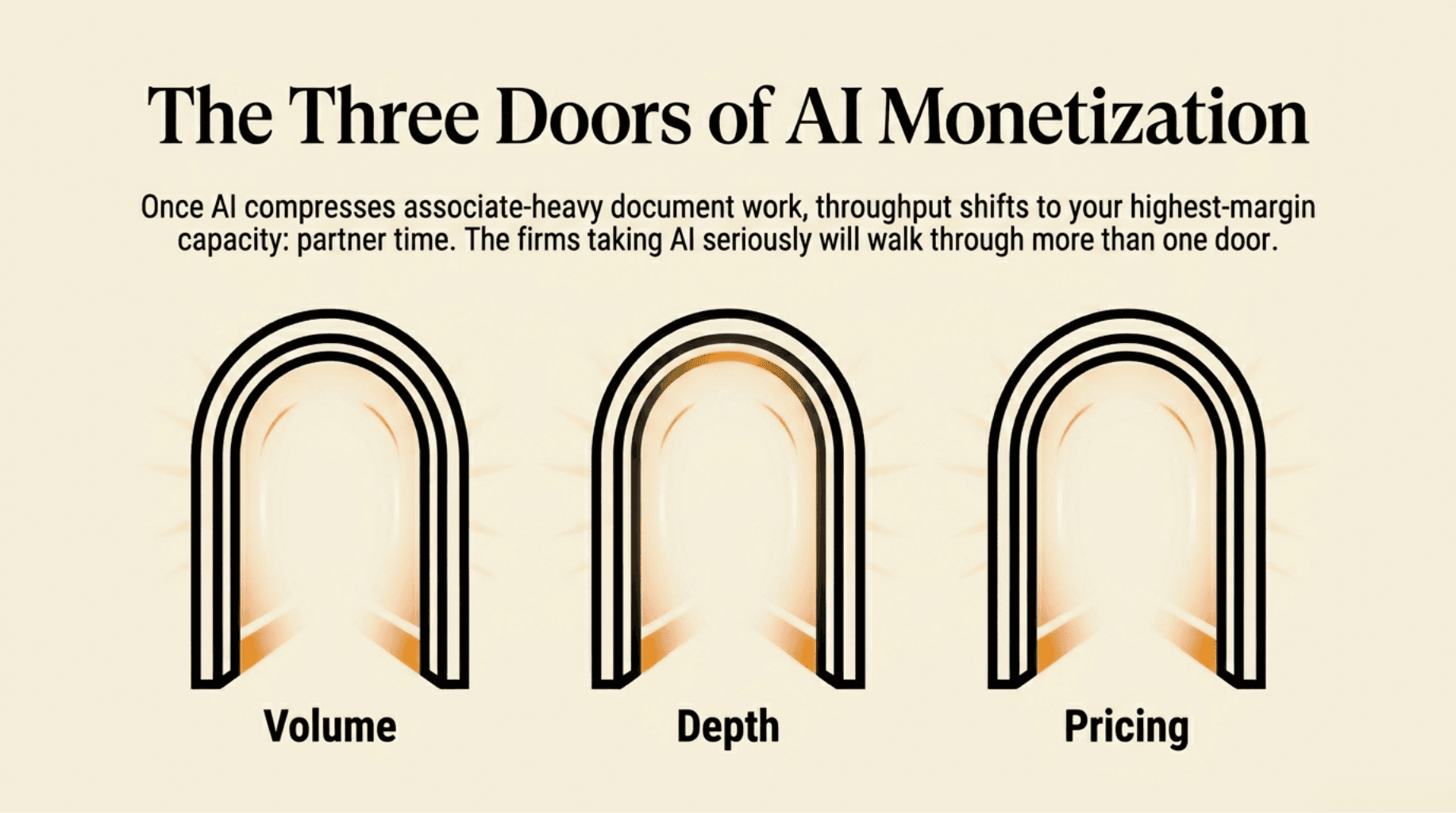
The Three Doors: How Defense Firms Can Leverage AI to Make More Money
Once a defense partner accepts that AI changes what's economically possible, not just how fast tasks get done, three distinct revenue paths open up. The mechanism is the same across all three: AI compresses associate-heavy document work, pushing throughput to your highest-margin capacity, partner time. The firms taking AI seriously will walk through more than one door.
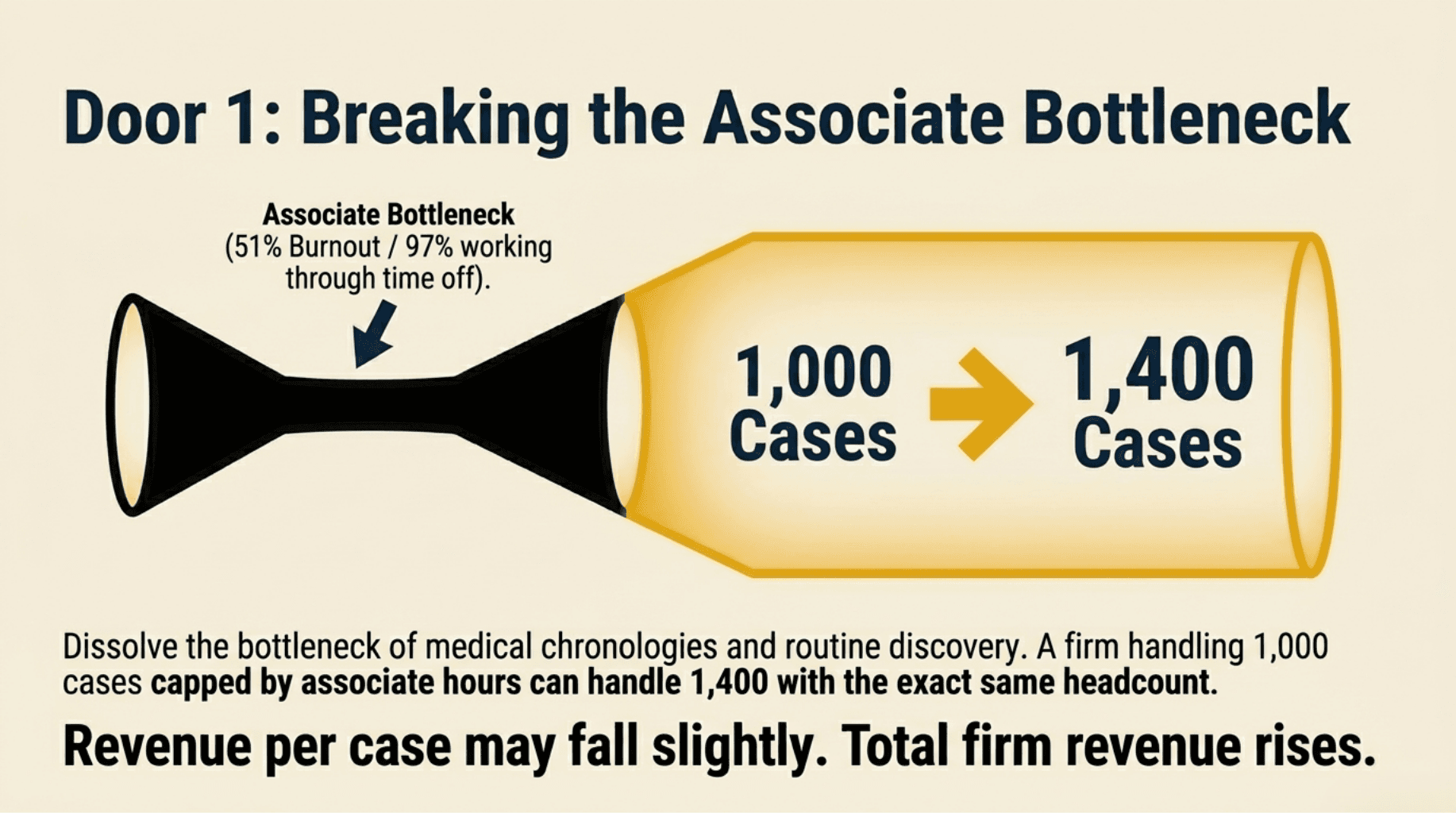
Door One: Volume
Defense firms have an associate-shaped bottleneck, and AI dissolves it. The Bloomberg Law 2025 Attorney Workload Survey found that mid- and senior-level associates reported burnout at a rate of 51%, with 97% working through time off. That's not a workforce with room to absorb more cases.
A firm handling a thousand cases a year today, capped by those associate hours, can plausibly handle fourteen hundred with the same headcount once medical chronologies, document reviews, and routine discovery are AI-assisted. Revenue per case may fall slightly. Total revenue rises. The door labeled "more cases" opens not by hiring, but by giving the people already there the capacity to actually take them.
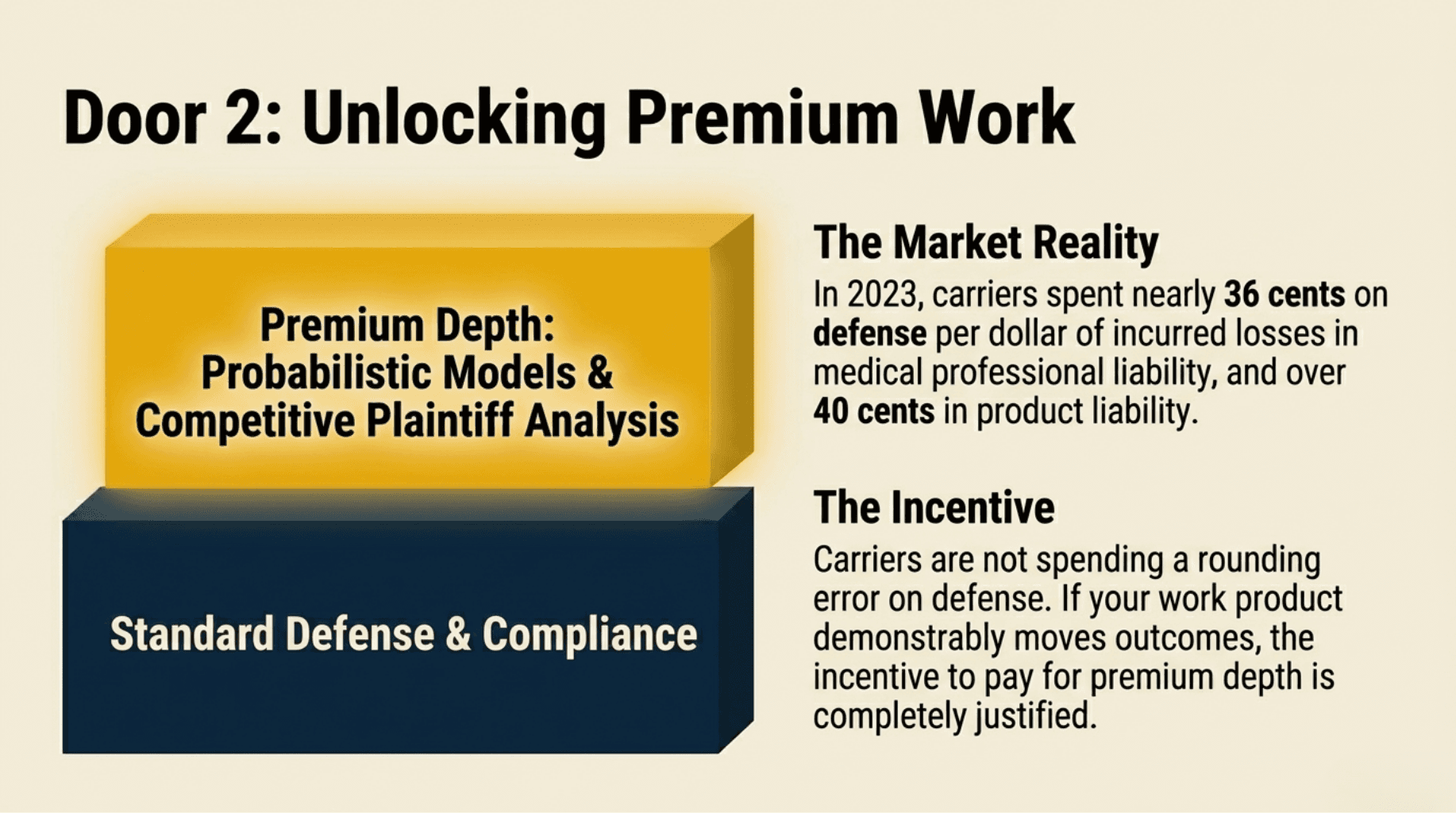
Door Two: Depth
Most defense work is constrained not by what would be useful but by what is economically defensible to bill. Reviewing every prior deposition an opposing expert has given, building a probabilistic damages model for mediation, running competitive analysis on plaintiff's counsel, all of this was, until recently, beyond what any panel-counsel relationship would tolerate paying for. AI changes the math. Work that was cost-prohibitive becomes feasible, and the incentive to pay for it is real.
According to NAIC data compiled by the Insurance Information Institute, defense and cost containment expenses in medical professional liability ran nearly 36 cents for every dollar of incurred losses in 2023, and over 40 cents in product liability. Carriers in these lines are not spending a rounding error on defense. A defense firm that can show its work product demonstrably moves outcomes has a credible case for higher rates, not despite AI, but because of it.
Door Three: Pricing
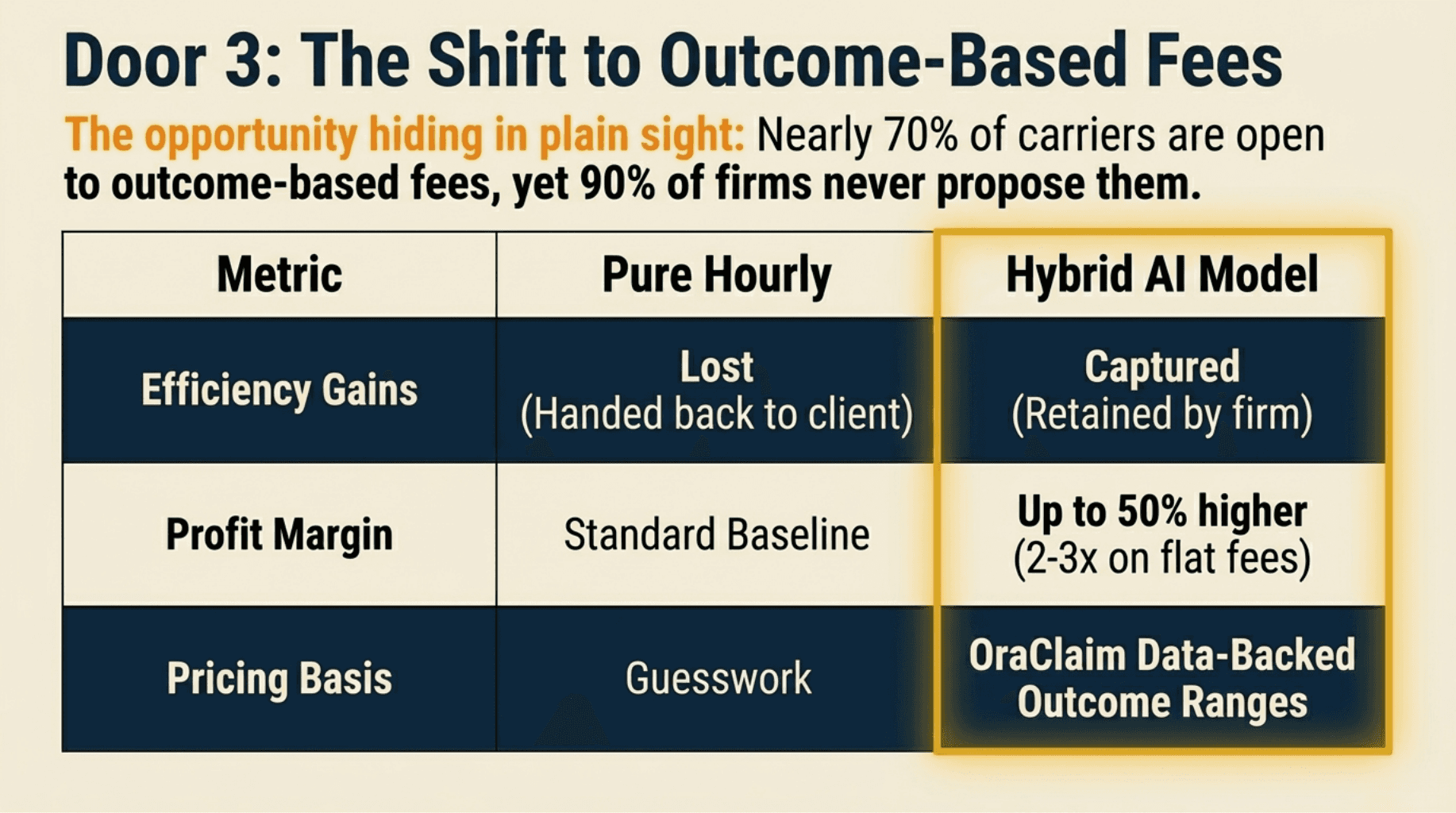
Under pure hourly billing, becoming dramatically more efficient at analytical tasks is actually a revenue problem: you capture none of the productivity gain. AI changes that calculus materially. Firms that have made the shift are seeing up to approximately 50% profitability gains on hourly work, and 2-3x on a hybrid model. That's the productivity surplus most firms are currently handing to the client.
The opportunity hiding in plain sight: nearly 70% of carriers are open to outcome-based fees, yet 90% say firms almost never propose them (CLM 2026, Q92 and Q93). AI makes hybrid pricing workable at scale, with flat fees for AI-assisted analytical work and hourly rates preserved for genuinely human work such as depositions, mediations, and trials. Without data, fixed fees are a guessing game. With OraClaim's case data, including outcomes by venue, settlement ranges, and time-to-resolution, firms can price risk accurately, measure performance objectively, and walk into a rate conversation with evidence, not just a pitch.
Thomson Reuters' 2025 Future of Professionals research finds that strategic AI adopters are roughly twice as likely to grow revenue and four times as likely to demonstrate ROI as their ad-hoc peers.
The Profitability Argument Is the Performance Argument
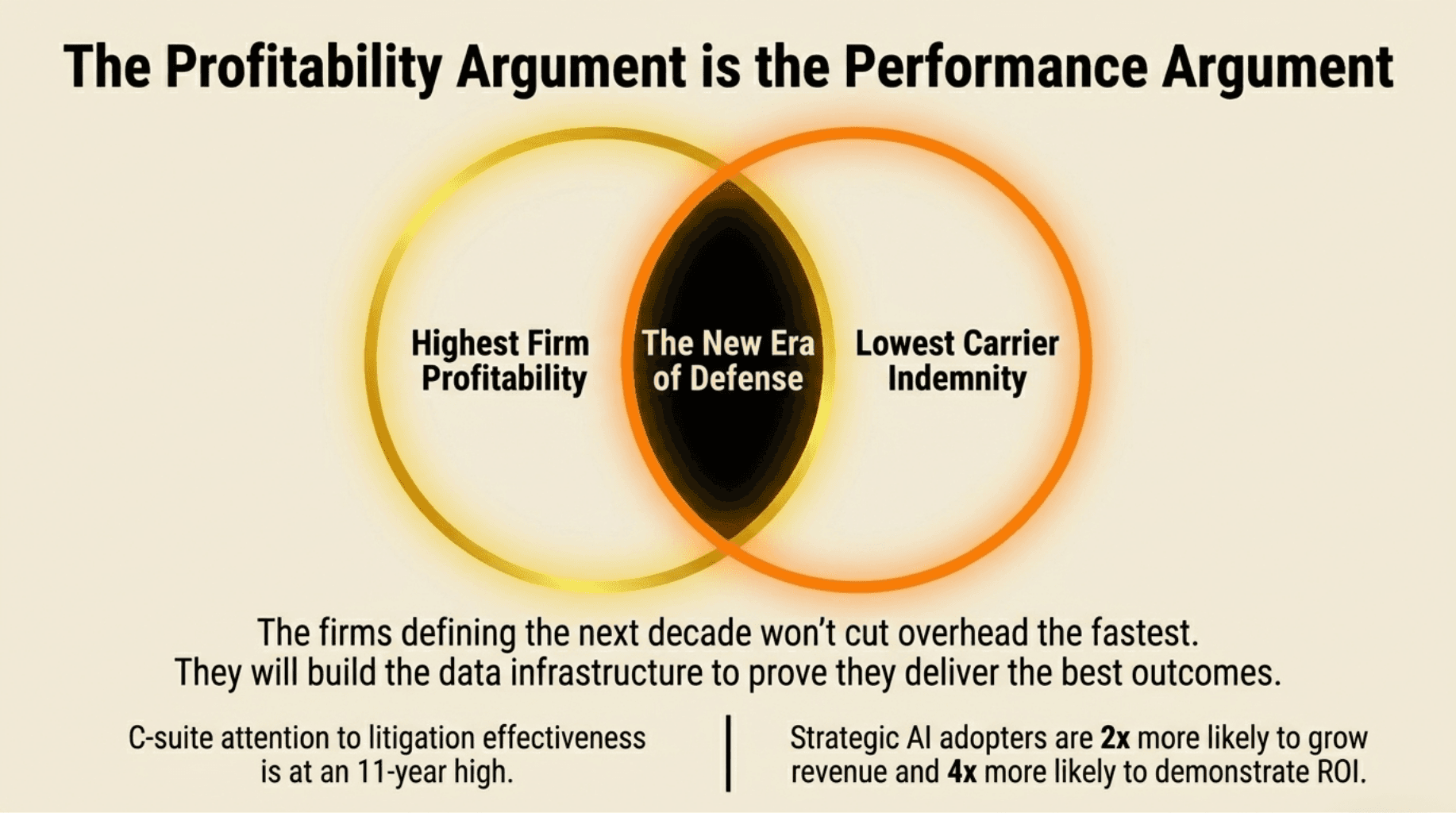
The firms that define the next decade won't be the ones that cut overhead most aggressively. They'll be the ones that shifted from selling hours to demonstrating outcomes and built the data infrastructure to prove it.
The window is open. C-suite attention to litigation management effectiveness is at its highest point in 11 years (CLM 2026, Q31 and Q32). Carriers want partners who can show them a better number on indemnity, not just a cleaner invoice.
OraClaim is built specifically for this moment: a closed, secure AI platform for insurance defense attorneys and claims managers, designed to improve outcomes on every litigated file from first-pass case assessment through settlement.
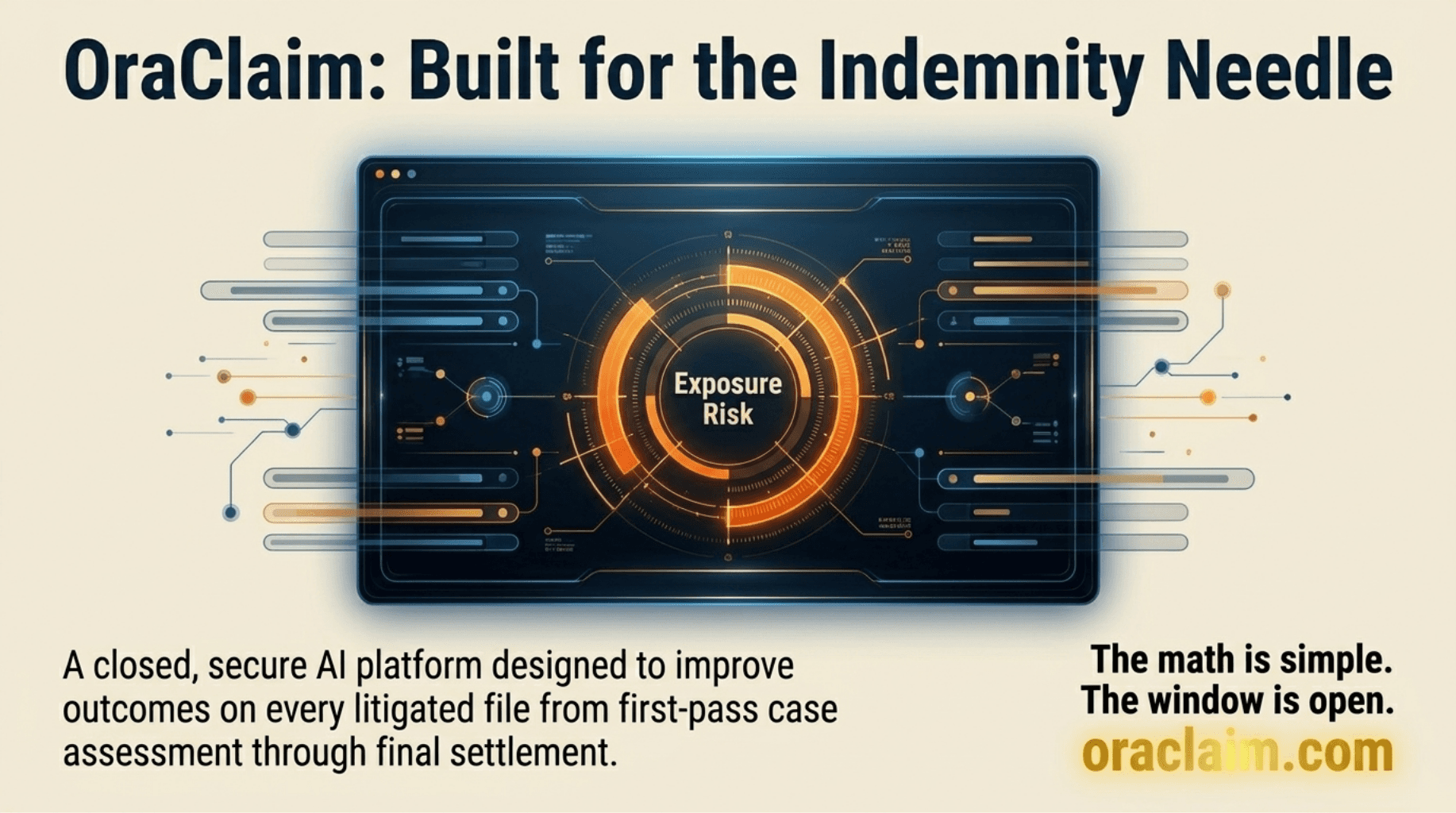
The math is simple. The window is open. Learn more at oraclaim.com
Sources
CLM 2026 Litigation Management Study (U.S. Legal Support / Claims and Litigation Management Alliance, 2026); Bloomberg Law, Attorney Workload and Hours Survey 2025; Thomson Reuters, Future of Professionals Report 2025; EvenUp Law, "Leveraging AI & Human Review in Demand Letters"; Axiom Law, "Law Firms Cash In While Clients Pay More: The AI Paradox Reshaping Legal Economics"; LeanLaw, "The Generative AI Dilemma: Why Faster Work Shouldn't Mean Lower Revenue for Law Firms"; Claims Journal, "A Lean Lens on Legal Bill Review" (Jan. 16, 2026); Insurance Information Institute / NAIC, Defense and Cost Containment Expense Data, Medical Professional Liability and Product Liability Lines (2023).