Blog
Why Your Best Associates Are Leaving — and How AI Changes That

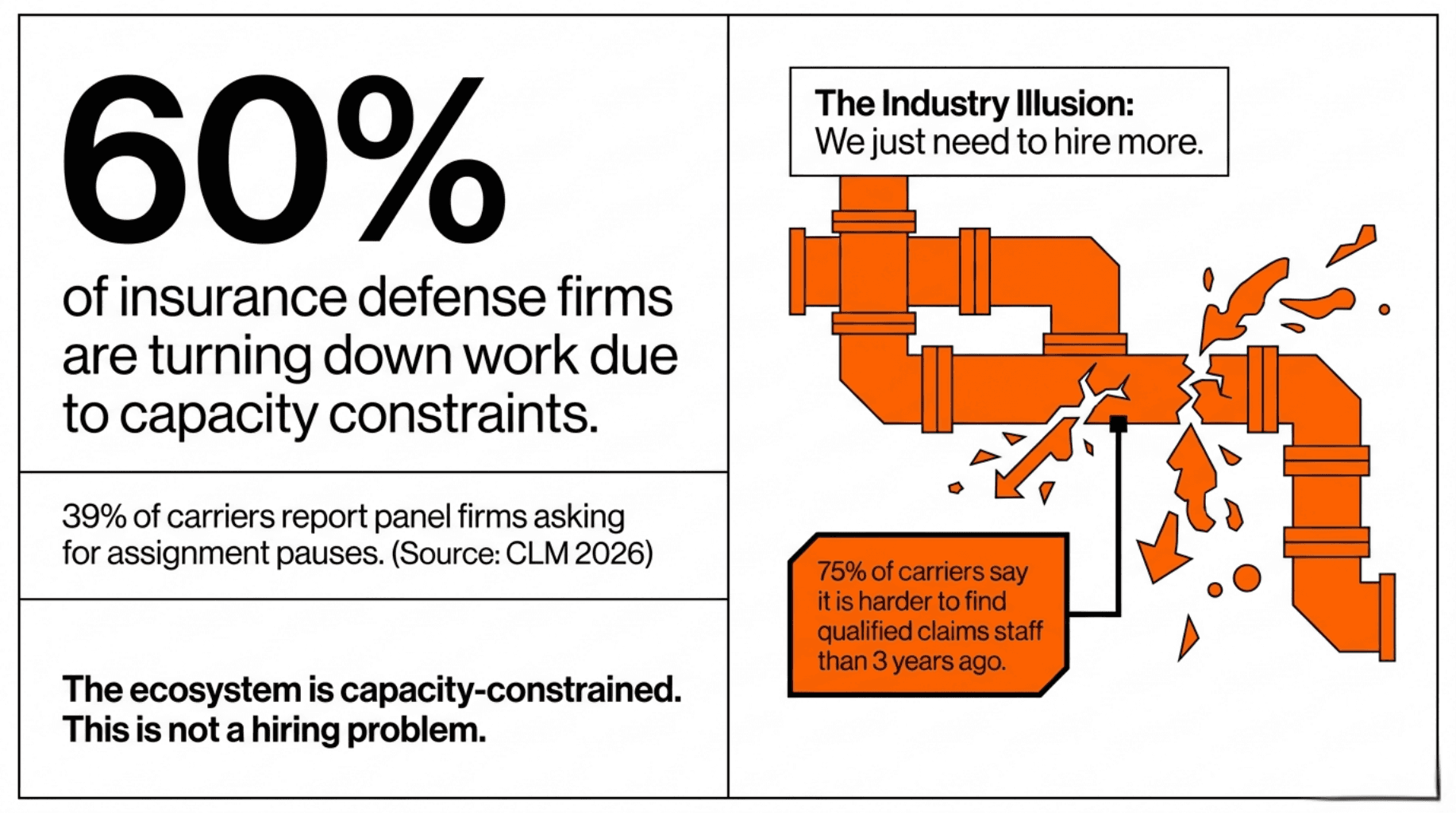
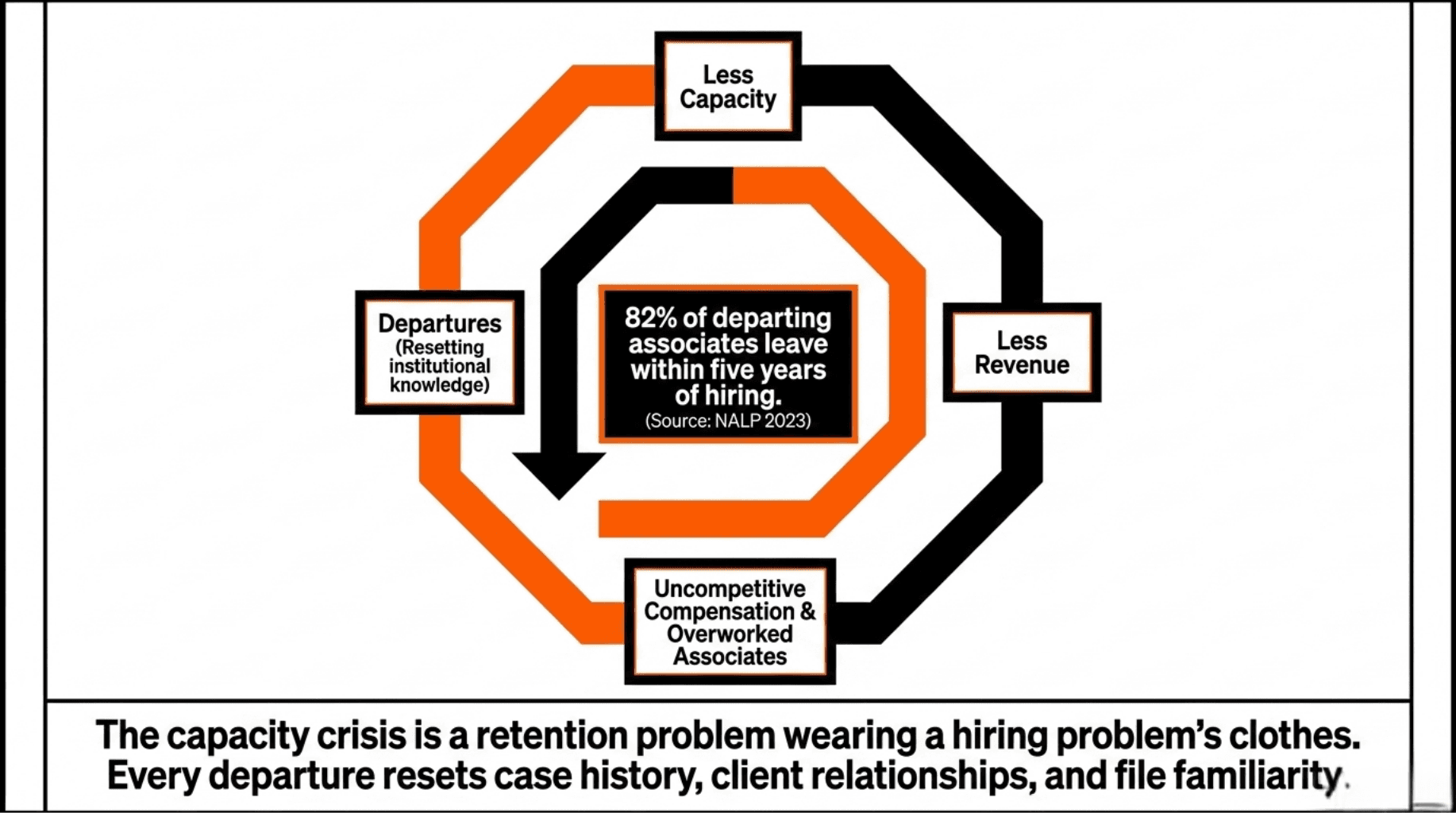
60% of insurance defense firms are currently turning down work due to capacity constraints — a figure that would have been virtually unheard of five years ago. This isn't a hiring problem. It's a retention problem wearing a hiring problem's clothes.
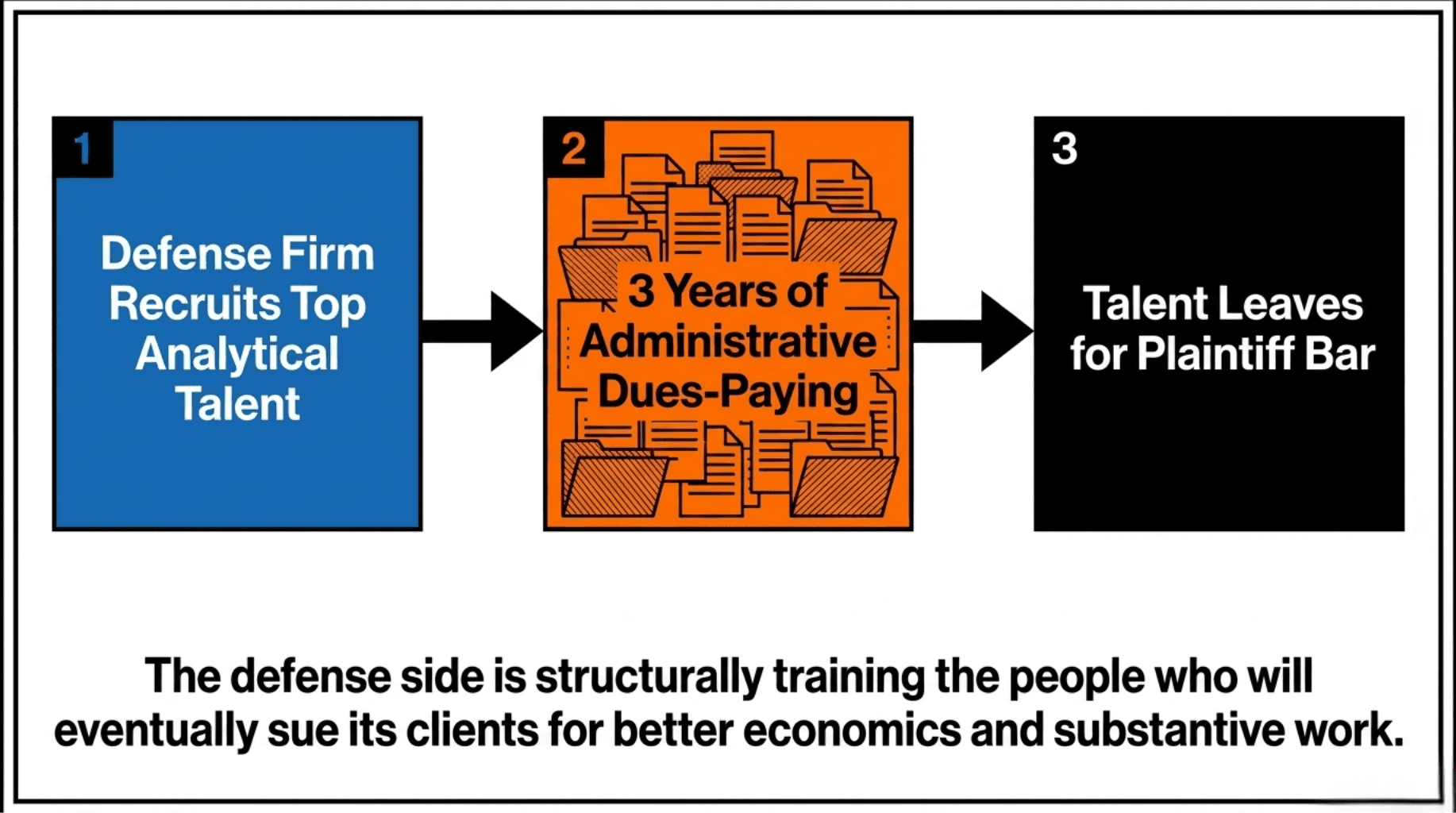
The pattern is familiar to anyone who has managed an insurance defense practice. Associates arrive, spend their first two to three years buried in document review and administrative work, and leave, often for plaintiff firms that offer better economics and more substantive work. The defense side trains the people who eventually sue its clients.
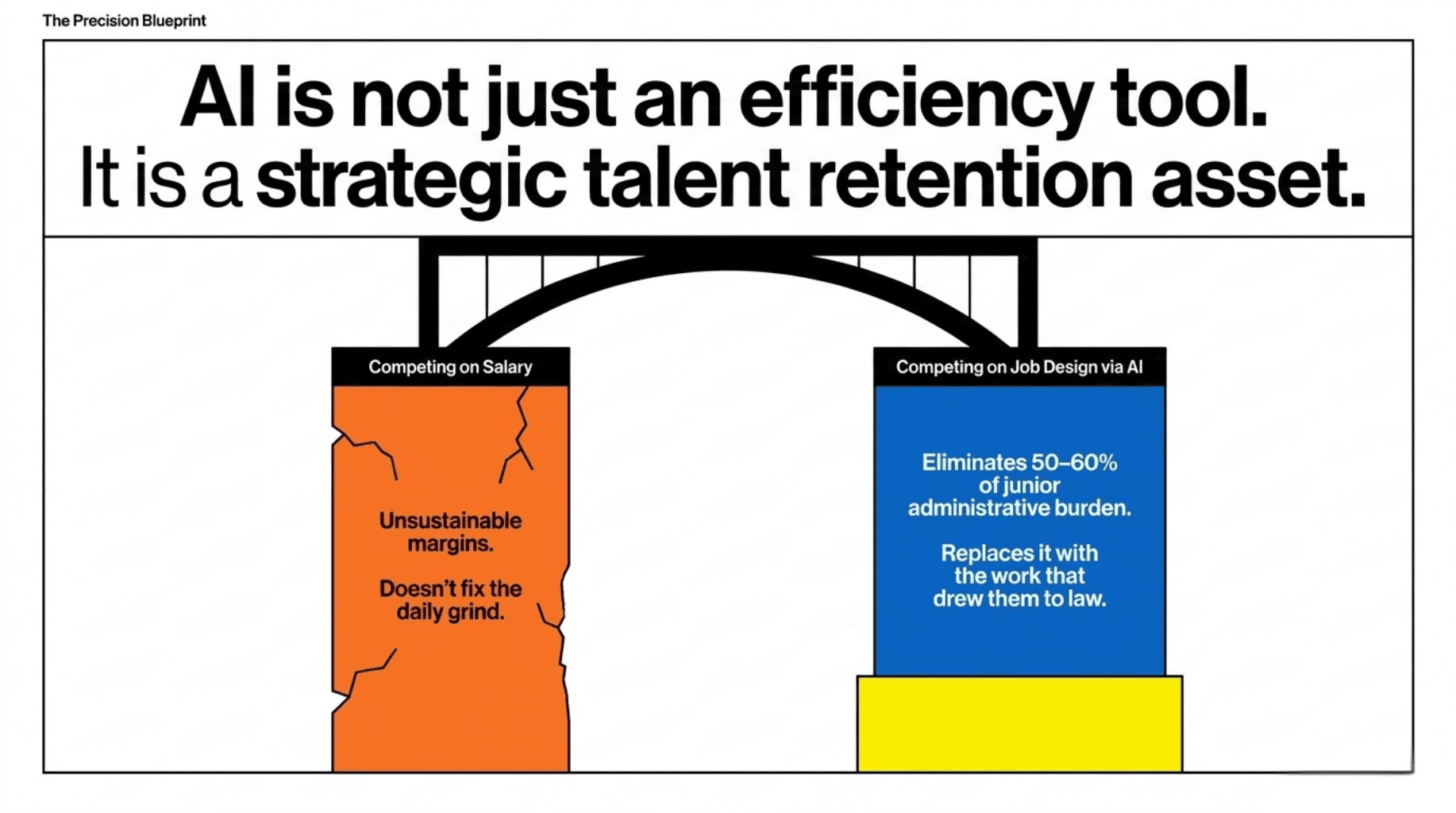
The firms solving their retention problem most effectively right now aren't the ones offering the highest salaries. They're the ones that have redesigned what the associate job actually is, using AI to eliminate the work nobody went to law school to do, and replacing it with the work that drew people to law in the first place.
AI adoption isn't just a competitive tool for carrier relationships and indemnity outcomes. It is a talent strategy. And for insurance defense firms facing a capacity crisis with no end in sight, it may be the most important one available.
The Capacity Crisis in Insurance Defense Is a Retention Problem in Disguise
The Numbers Behind the Crisis
The data is unambiguous. 39% of carriers report that at least one panel firm has asked for a pause or halt on new assignments in the past six months (CLM, Q48), and 75% of carriers say it is harder to find qualified claims staff than it was 3 years ago (CLM, Q42). The problem isn't isolated to firms: the entire ecosystem is capacity-constrained.
The spiral is self-reinforcing: less capacity means less revenue, which limits the ability to offer competitive compensation, which drives more departures, which reduces capacity further.
Why Hiring More Associates Doesn't Solve It
The traditional response, which is to recruit harder and hire more, fails because the underlying job hasn't changed. New associates arrive, spend years on document review and administrative tasks, and leave before they've built the institutional knowledge that makes them genuinely valuable. Every departure involves case history, client relationships, and file familiarity. The replacement hire resets the clock.
The firms that break this spiral won't do it by paying more or recruiting harder. They'll do it by changing what the job is, so that the people they hire actually stay.
Why Insurance Defense Firms Lose Associates Faster Than They Can Replace Them
What the First Three Years Actually Look Like — and Why Associates Leave
The traditional associate path in insurance defense is well-known: document review, first-pass discovery responses, medical record organization, and administrative drafting, with limited courtroom exposure and almost no client contact in the early years. This model made sense when those tasks required human judgment, and there was no alternative. Neither is true anymore.
The NALP Foundation found that 82% of associates who left their firms in 2023 did so within five years of hiring, departing roughly a year earlier than historical norms. A significant portion leave for the plaintiff bar, where billing restrictions are fewer, contingency upside exists, and substantive work comes earlier. The defense side is structurally training the people who will eventually oppose its clients.
The associates the industry most needs, people who are analytically sharp, technically curious, and ambitious, are the ones least willing to wait three years for work that matters.
What Departing Associates Actually Say — and What It Points To
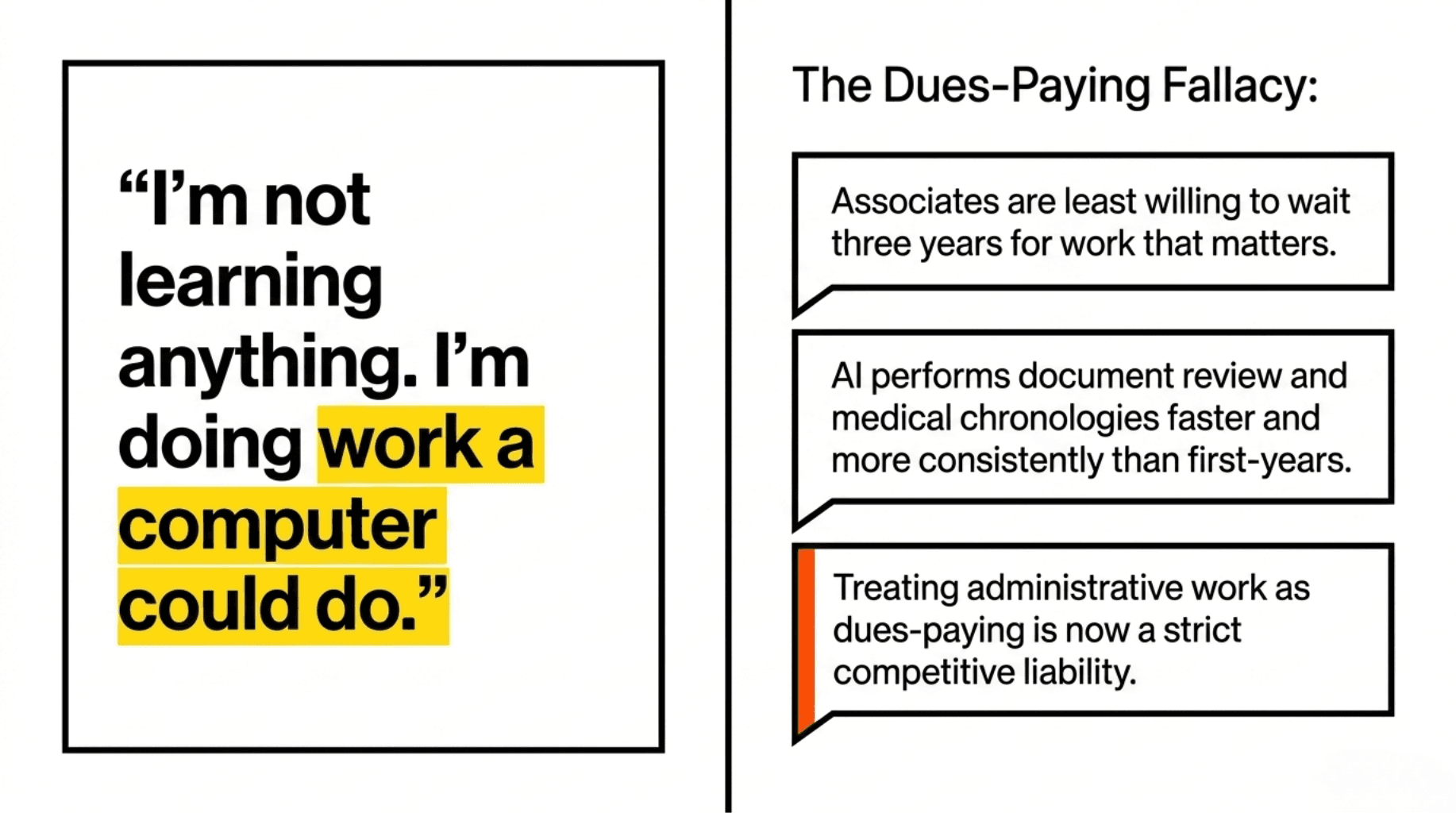
Ask a departing associate why they're leaving and you'll hear a version of the same answer: "I'm not learning anything. I'm doing work a computer could do." They're not wrong. Document review, medical record chronology, and first-pass drafting are all tasks that AI now performs faster and more consistently than a first-year associate.
There is also a culture dimension worth naming. The industry has historically treated years of administrative work as dues-paying. That assumption is now a competitive liability.
What associates say they want is consistent across the research: meaningful work early in their careers, mentorship that builds real courtroom and client-facing skills, and a firm that uses technology intelligently rather than asking them to do manually what machines do better. The recruiting pitch that works for the next generation of defense lawyers isn't a great benefits package. It's: "From day one, you'll be doing the work you went to law school to do."
How Insurance Defense Firms Are Using OraClaim to Make the Associate Job Worth Staying For
What OraClaim Actually Does — and Why It Matters for Retention
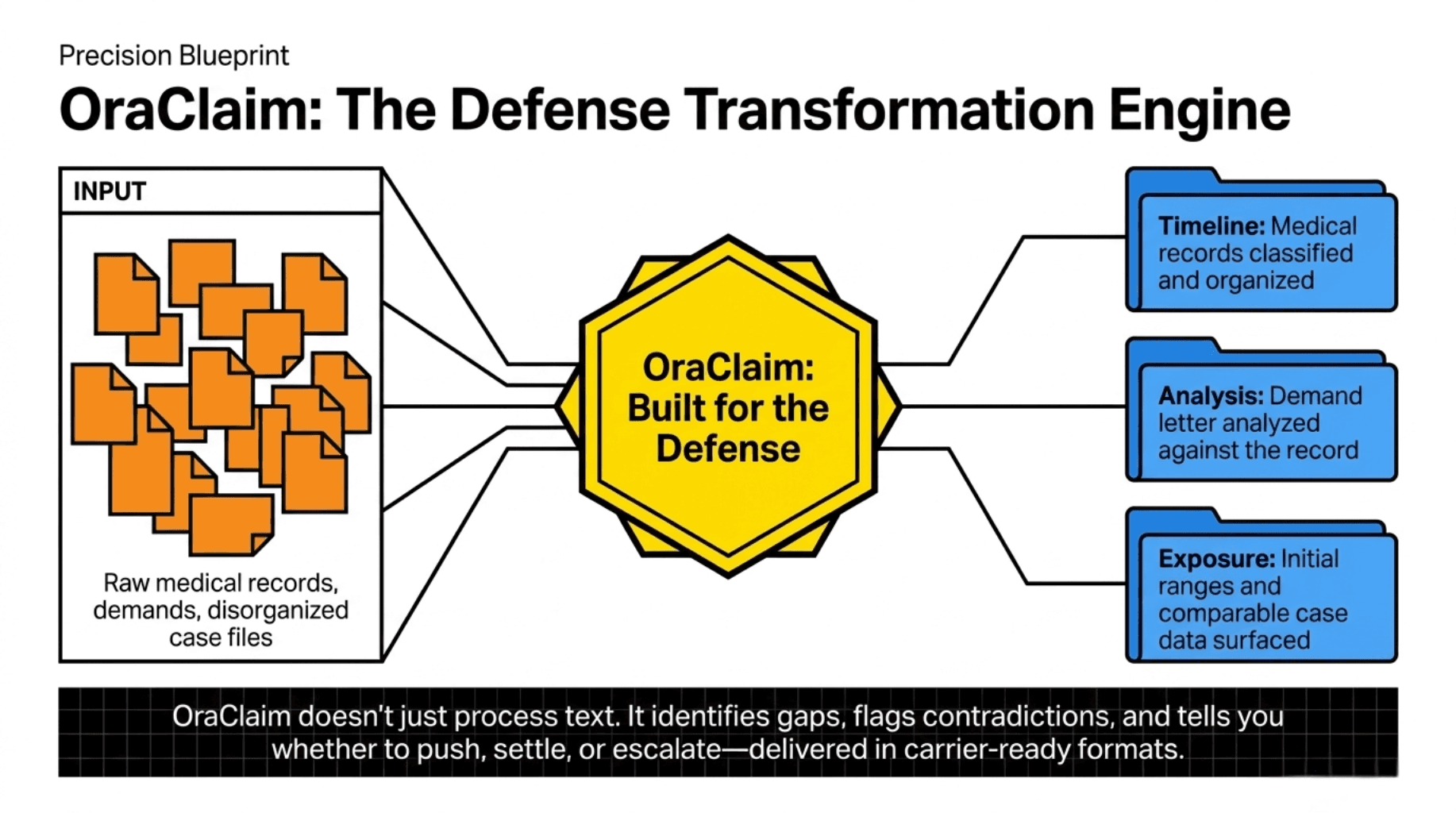
When OraClaim ingests a new file, it produces a structured case assessment: medical records classified and organized into a timeline, the demand letter analyzed against the record, an initial exposure range identified, and comparable case data surfaced, all in a fraction of the time a first-year associate would spend doing the same work manually.
What separates OraClaim from generic legal AI is that it's built specifically for the defense side of the claim. It doesn't just summarize documents — it identifies gaps, contradictions, and high-risk elements across the file, then surfaces the exposure and damage picture before costs escalate. It also formats output the way carriers expect it: with clean summaries, timelines, and evidence packages that speed authority decisions and reduce back-and-forth with adjusters. A general-purpose AI tool can process text. OraClaim is designed to tell you whether to push, settle, or escalate, and why.
What's left for the associate is the work that requires legal judgment: evaluating the assessment, identifying the strategy, preparing for depositions, and engaging with clients. This is not a marginal efficiency gain. If AI handles the tasks that currently consume 50–60% of junior associate time, the associate job becomes fundamentally different from day one, not year four.
A Concrete Picture of What Changes
Consider a straightforward hypothetical. If a first-year associate currently spends 15 hours per file on document review, medical record organization, and first-pass drafting, and OraClaim reduces that to 3 hours, that's 12 hours per file redirected to substantive legal work.
OraClaim cuts review time in half. Applied to the hypothetical above: if a first-year associate currently spends 15 hours on intake work per file, that drops to roughly 7–8 hours, freeing up the other half for substantive legal work. At 20 files per month, that's 140–150 hours per associate per month redirected from administrative tasks to the work that actually builds a career. [1]
At the firm level, an associate who handles 20 files per month and saves 12 hours per file has freed up more than 240 hours monthly, or the equivalent of adding a second associate without the recruiting cost, onboarding time, or retention risk that comes with an actual hire.

Why AI-Augmented Associates Develop Better Legal Judgment Faster
A concern worth addressing directly: if AI handles document review and first-pass drafting, do associates lose the learning that comes from doing that work themselves?
The answer, properly managed, is no. Consider this using the analogy of a surgical residency. A resident who operates under attending supervision, evaluating and correcting the attending's approach in real time, develops judgment faster than one left to figure it out on their own. The learning shifts from execution to supervised evaluation, which is a higher-order skill.
What OraClaim actually does is accelerate the feedback loop. An associate who reviews an AI-generated case assessment on day 1 learns more about case strategy faster than one who spends three weeks producing the same document manually. The goal is AI-augmented lawyers, not AI-dependent ones. Associates who learn to work with OraClaim from the beginning develop the critical skill of knowing when to trust the output and when to push back, which is exactly the judgment that makes a great defense attorney.

What the Associate Experience Looks Like with OraClaim — Month by Month
Day 1: The new associate opens their first file and finds it already organized, with records classified, timeline built, demand analyzed. Their job is to evaluate and add judgment, not to start from scratch.
Month 1: Associates are engaged in deposition preparation, strategy development, and carrier communication, supported by OraClaim's background research and comparable case data.
Month 6: Associates have handled more substantive legal work than their counterparts at firms without AI handle in eighteen months — and have a documented record of that work to point to in performance reviews.
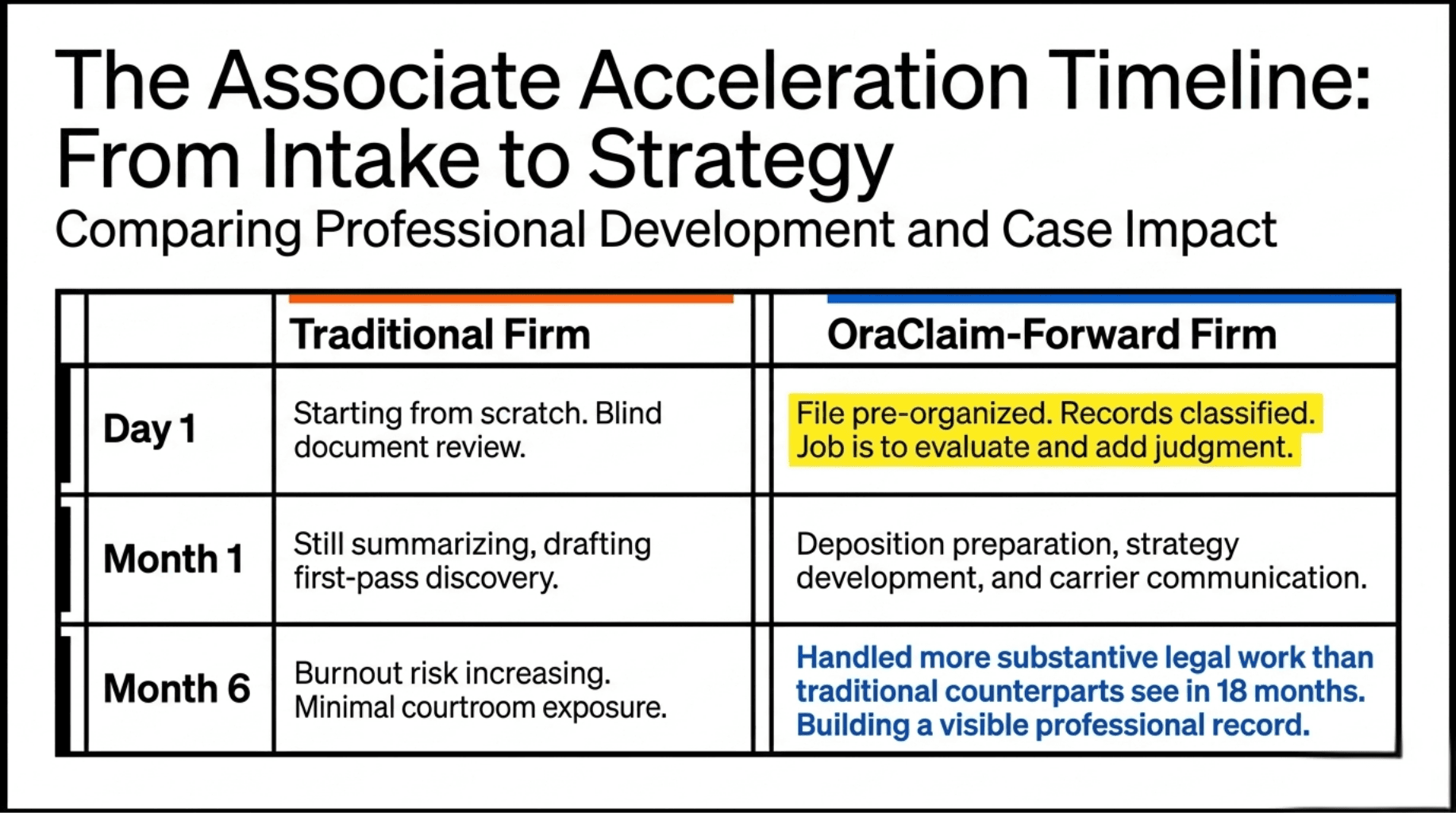
The retention argument closes itself: an associate doing meaningful work, developing real skills, and building a visible professional record is not quietly updating their resume.
How to Use OraClaim Adoption to Recruit Better Insurance Defense Associates
How the Recruiting Conversation Changes When the Job Is Different
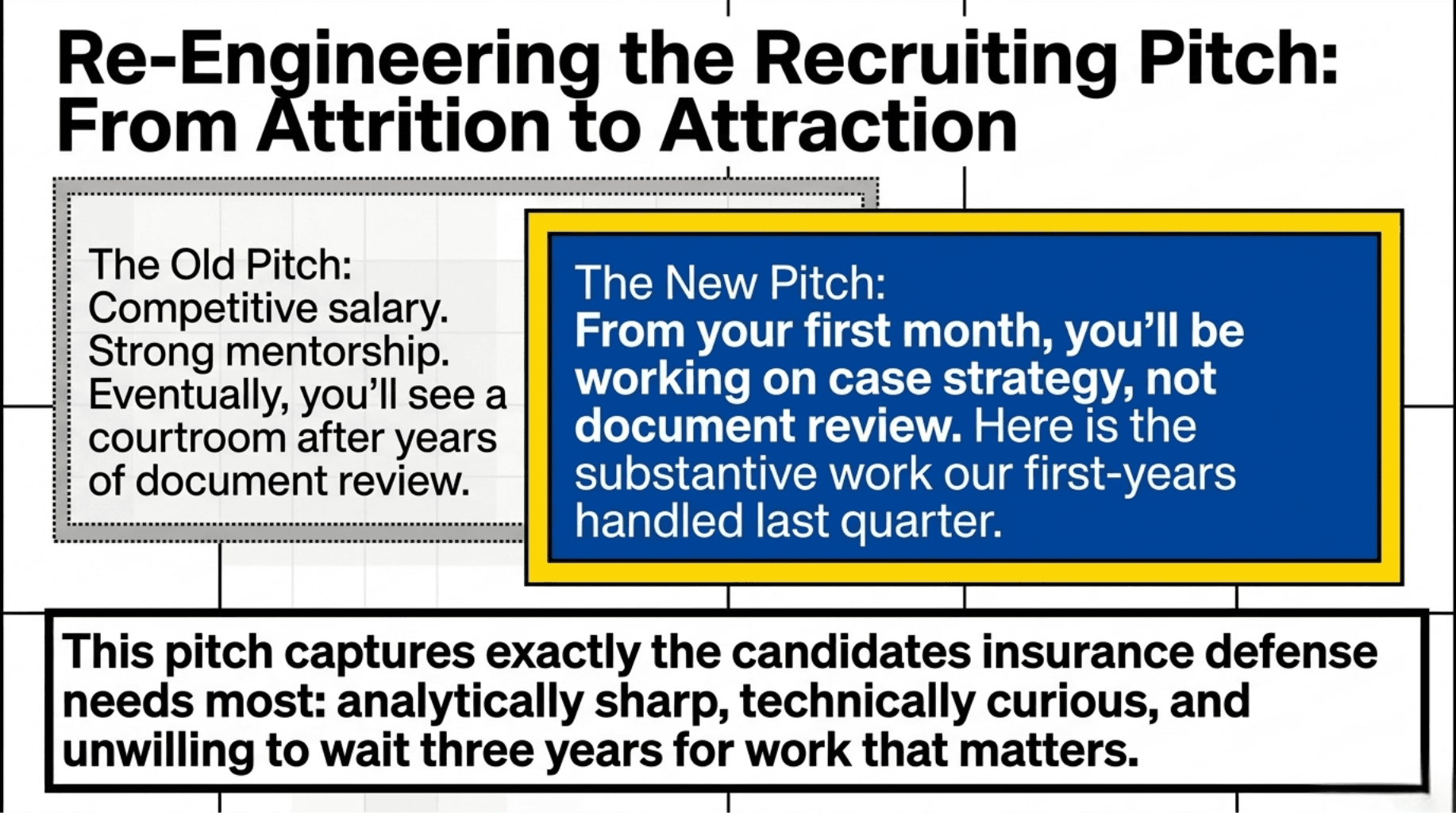
The recruiting conversation at most insurance defense firms hasn't changed in decades: competitive salary, interesting cases, strong mentorship, and years of document review before you see the inside of a courtroom.
The recruiting conversation at OraClaim-forward firms sounds different: "From your first month, you'll be working on case strategy, not document review. Here's what one of our first-year associates handled last quarter."
This pitch reaches exactly the candidates that insurance defense firms most need: analytically sharp, comfortable with technology, and skeptical of firms that will ask them to spend years waiting for substantive work. As CLM 2026 research makes clear, firms that integrate processes, people culture, and technology stacks are positioned to thrive. OraClaim adoption changes the recruiting conversation by redefining what the job actually is.
How to Build an Evidence Base That Makes the Recruiting Pitch Credible
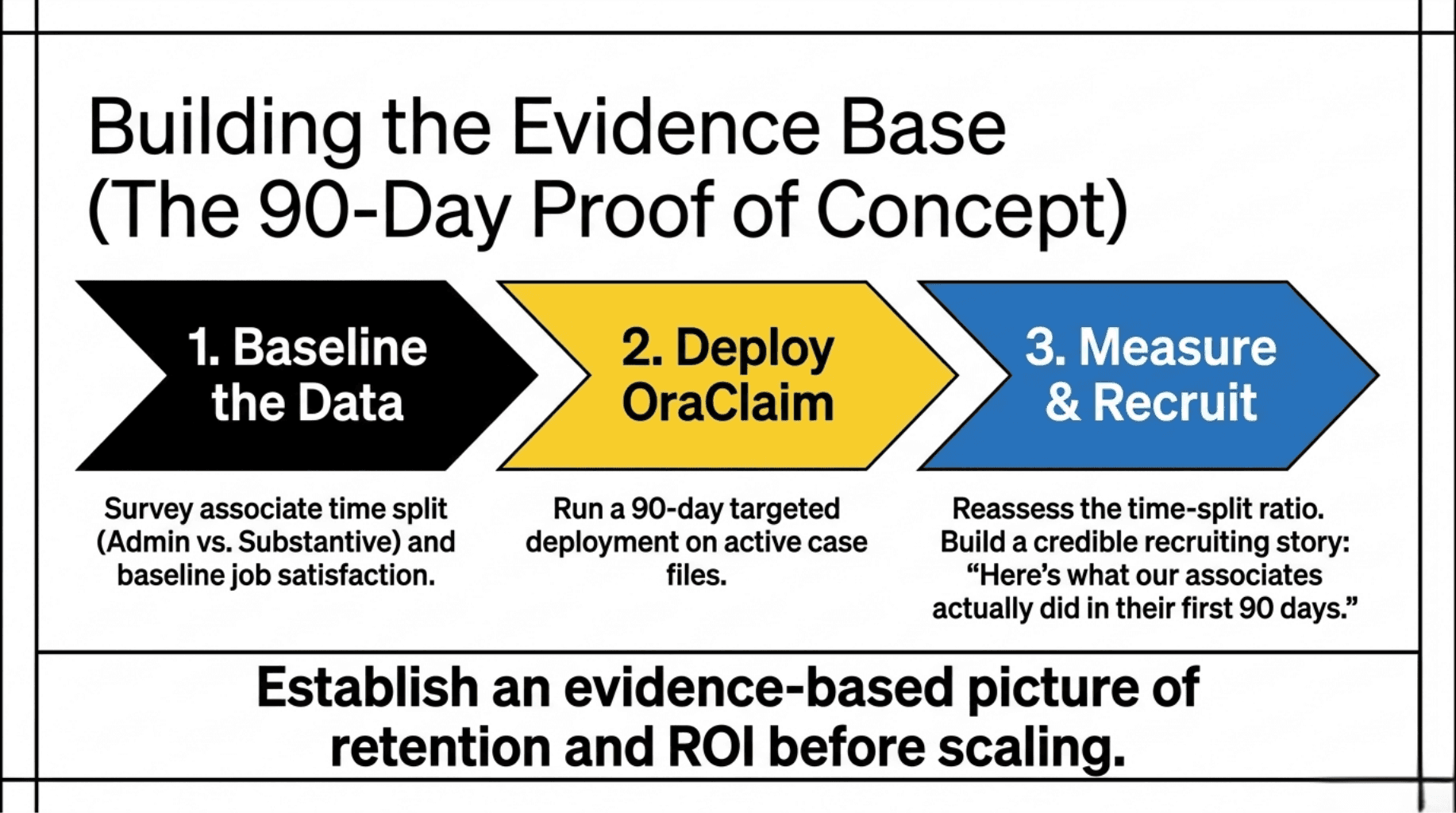
Before rolling out OraClaim, baseline the data. What percentage of associate time is currently spent on tasks they consider administrative versus substantive? What is their self-reported satisfaction with the quality of work? What would make them more likely to stay?
After 90 days of OraClaim deployment, reassess. Has the ratio shifted? Do associates feel they are developing skills faster? Would they recommend the firm to a law school colleague?
This data serves two purposes: it gives managing partners an evidence-based picture of whether OraClaim is delivering on its retention promise, and it gives the firm a story to tell in recruiting. "Here's what our associates said about their first 90 days" is a more credible pitch than any claims about firm culture made in an interview.
This survey framework is also a useful first step for any firm evaluating AI adoption. It establishes the baseline against which ROI can actually be measured.
The Retention Problem Has a Solution
The capacity crisis in insurance defense is real, measurable, and getting worse. Sixty percent of firms turning down work is not a temporary staffing problem. It is a structural signal that the way the industry has organized associate work for decades is no longer sustainable.
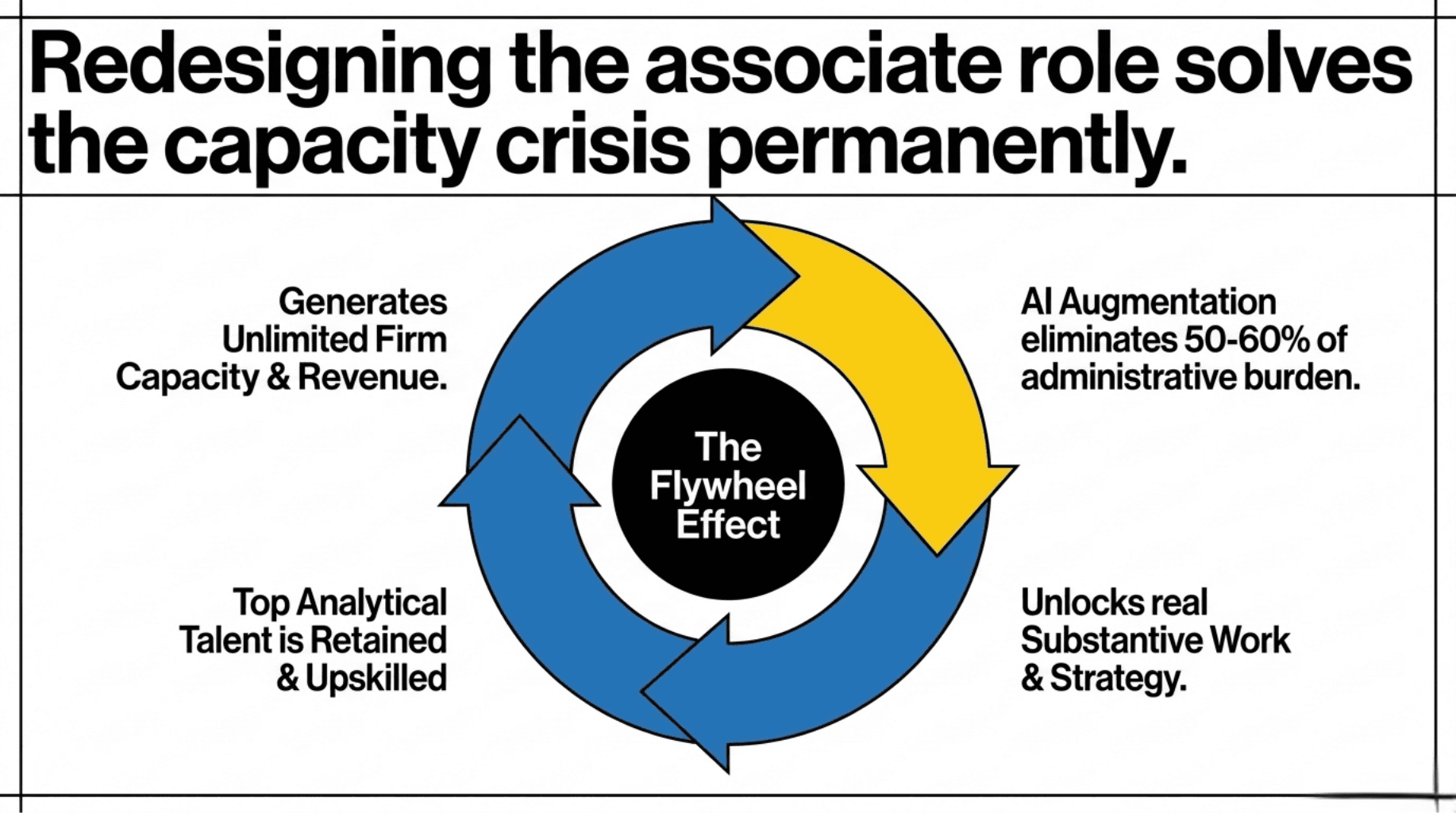
The firms that solve it will not solve it by paying more or recruiting more aggressively. They will solve it by redesigning the associate role and making it worth staying.
OraClaim is built for exactly this redesign. It organizes the case file automatically, surfaces exposure before costs escalate, flags the contradictions and gaps that shape strategy, and delivers carrier-ready output that strengthens firm-client relationships at every stage. That combination is what makes it a retention tool, not just a productivity one.
The next generation of great defense attorneys won't be shaped by years of document review. They'll be shaped by early exposure to real strategy, real clients, and real stakes — which is exactly what AI makes possible
Sources: Sources: CLM 2026 Litigation Management Study (Suite 200 Solutions / Claims and Litigation Management Alliance, 2026); "CLM Unveils National Law Firm Talent Survey Highlighting Challenges for Both Firms and Clients" (BusinessWire / Claims and Litigation Management Alliance, October 2025); NALP Foundation, Associate Attrition Data (2023); Almon, Lorie. "Designing Lawyers: Attorney Growth in the Age of AI-Fueled Practice." Thomson Reuters Institute, May 11, 2026.
[1]Note: If OraClaim has internal per-file time savings data from client deployments, we could replace this approximation with that data.