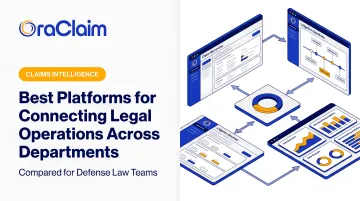
The pressure is real. According to the CLOC 2026 State of the Industry Report, legal workloads grew 63% in regulatory compliance and 58% in cybersecurity — without matching budget or headcount growth. Legal ops teams are being asked to do more with less, while serving the entire organization.
The right platform changes that equation. It transforms legal from a siloed cost center into a connected, data-driven business unit — with real-time spend visibility, automated workflows, and operational data that other departments can actually use.
This article compares the leading platforms for connecting legal operations across departments, what features actually matter, and how to evaluate your options based on your specific operational context.
Key Takeaways
- 94% of legal departments lack the data and technology needed to run efficiently — cross-departmental connectivity is where most start
- Platform fit depends on your primary pain point: spend visibility, matter management, workflow automation, or compliance integration
- Platforms reviewed: Thomson Reuters Legal Tracker, Onit (Unity ELM/SimpleLegal), Brightflag, Clio, and Mitratech TeamConnect
- When evaluating options, prioritize integration depth, analytics for non-legal stakeholders, AI maturity, and security standards
- Defense lawyers and claims teams need platforms built for their workflow; general ELM tools rarely cover exposure analysis, benchmarking, or litigation-specific data sharing
Why Legal Operations Needs Cross-Departmental Connectivity
Legal teams generate enormous volumes of operationally critical data — billing records, matter updates, compliance flags, contract statuses — that other departments urgently need. In most organizations, that data is trapped in siloed tools or email chains.
The consequences are measurable. Finance can't forecast legal spend accurately. Sales deals stall waiting on contract sign-off. HR lacks timely access to employment-related guidance. Leadership is left making decisions without reliable visibility into legal's actual workload or cost.
Wolters Kluwer's research found that 94% of legal departments lack the data and technology needed to optimize operations — and specifically recommends building real-time reporting into legal budgeting so variances surface as they emerge, not after quarter close.
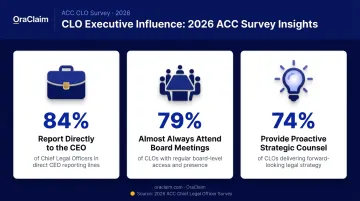
The stakes have also grown beyond day-to-day operations. According to the 2026 ACC Chief Legal Officers Survey, 84% of CLOs now report directly to the CEO, 79% almost always attend board meetings, and 74% provide proactive strategic counsel. General Counsel aren't just managing legal risk anymore — they're expected to walk into board meetings with data.
That only works if the platform powering legal ops connects cleanly to the financial, operational, and compliance data the rest of the business runs on.
Best Platforms for Connecting Legal Operations Across Departments
These platforms were selected based on cross-departmental integration depth, matter and spend management capabilities, AI features, and real-world adoption across law firms and in-house legal teams. Most are enterprise ELM tools built for corporate legal departments; Clio and TeamConnect are the strongest fits for defense practices and litigation-heavy legal operations.
Thomson Reuters Legal Tracker
Legal Tracker (formerly Serengeti Tracker) is a leading enterprise legal management platform for mid-size to large in-house legal departments. Its core strength is connecting legal spend directly to corporate finance systems — a direct connection most ELM platforms route through manual export/import workflows.
Differentiators:
- Direct AP integration via an ERP Cloud Connector that connects approved invoices to SAP S4/HANA Cloud for payment and status monitoring
- Legal Tracker Advanced includes AI-powered tools, rate management dashboards, and Industry Insights+ benchmarking drawing on $300B+ in global legal spend data
- Centralized matter management gives Finance and Legal shared visibility into spend and outside counsel performance
| Category | Details |
|---|---|
| Key Features | Matter management, e-billing, AI-powered analytics, rate benchmarking, legal spend forecasting, RFP automation |
| Best For | Mid-to-large enterprises needing deep Finance-Legal integration and outside counsel spend control |
| Integrations | AP Data Exchange and Billing APIs, SAP S4/HANA Cloud connector, accounts payable system connectivity |
Onit (Unity ELM / SimpleLegal)
Onit offers a modular legal management suite: Unity ELM for large enterprises and SimpleLegal for mid-market teams. SimpleLegal alone processes $5.2B in annual legal spend across 860,000+ matters for more than 550 corporate legal departments.
Differentiators:
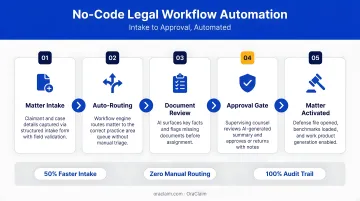
- No-code workflow automation layer lets Sales, Finance, and Compliance teams interact with legal workflows through standardized intake and approval processes
- Spend Agent automates invoice review, applies billing guidelines in plain English, flags violations, and explains adjustments
- Open API catalog supports custom workflow extensions across finance, procurement, and document management systems
| Category | Details |
|---|---|
| Key Features | E-billing, matter management, workflow automation, contract lifecycle management, AI invoice review, legal intake |
| Best For | Organizations seeking a flexible, modular platform that scales from mid-market to enterprise across multiple business units |
| Integrations | API integrations with finance, procurement, and document management systems; open app catalog for custom extensions |
Brightflag
Brightflag is purpose-built to give in-house legal teams financial visibility that CFOs and Finance departments can act on. Wolters Kluwer's €425M acquisition of Brightflag in 2025 reflects how central legal spend analytics has become to enterprise financial operations.
Differentiators:
- AI invoice review checks every line item against billing guidelines, claiming 10% spend reduction and 80% less administrative work (vendor-published benchmarks)
- Accruals management automates vendor reminders and collection, directly supporting financial close processes
- CFO-ready reporting dashboards translate legal data into business metrics non-legal stakeholders can use — one case study noted spend report production dropping to 15 minutes after implementation
| Category | Details |
|---|---|
| Key Features | Legal spend management, AI invoice review, matter management, accruals, vendor benchmarking, CFO-facing reports |
| Best For | In-house legal teams that need to demonstrate measurable ROI from legal operations to Finance leadership |
| Integrations | AP integrations with SAP, Workday, NetSuite, and Oracle AP via email, secure FTP, or API |
Clio
Clio is the dominant cloud-based practice management platform for law firms — used by 400,000+ legal professionals across 130 countries and approved by 90+ bar associations and law societies. For law firms, including defense practices, managing matters, billing, and client relationships across teams, Clio is the category leader in cloud-based practice management.
Differentiators:
- 250+ app integrations including QuickBooks, Microsoft 365, Google Workspace, and Zapier connectivity to 1,000+ additional apps
- Client-facing portals improve communication between law firms and their business clients, reducing administrative back-and-forth
- Clio Payments streamlines billing, while intake automation reduces manual coordination across firm departments
| Category | Details |
|---|---|
| Key Features | Matter management, time and billing, client portals, document management, legal accounting integration, intake automation |
| Best For | Law firms (including defense practices) managing matters, billing, and client relationships across teams |
| Integrations | 250+ integrations including QuickBooks, Microsoft 365, Google Workspace, and Zapier |
Mitratech TeamConnect
TeamConnect is built for large, complex organizations — Mitratech reports adoption by 60% of the Fortune 100 — with particular strength in risk, compliance, and litigation-heavy legal departments.
Differentiators:
- Configurable workflow engine connects legal with IT, HR, Risk, and Procurement through custom approval processes — without requiring code
- TeamConnect + TAP integration provides no-code workflow automation that can push workflow-created matter records directly into TeamConnect
- ARIES Advanced Docket Management extracts critical dates from court documents and creates tasks and appointments automatically
| Category | Details |
|---|---|
| Key Features | Matter management, e-billing, compliance workflow integration, outside counsel management, risk management, legal hold |
| Best For | Large enterprises with complex, multi-department legal operations requiring configurable workflows and compliance integration |
| Integrations | Salesforce, SharePoint Online, and API-based integrations with enterprise systems |
Key Features to Look for in a Legal Operations Platform
Before evaluating vendors, identify your most pressing cross-departmental pain point. Spend visibility with Finance, contract cycle time with Sales, compliance reporting with Risk — the answer should dictate which capabilities you prioritize, not feature volume.
Matter Management and Centralized Data
The foundation of any connected legal ops platform is a single, searchable repository for matter data, documents, tasks, and timelines. Every relevant stakeholder — inside and outside legal — needs access with appropriate permissions. Without this, departments default to email, spreadsheets, and duplicate data entry.
E-Billing and Spend Analytics
Automated invoice review, billing guideline enforcement, and real-time spend dashboards give Finance teams the predictability they need for accurate forecasting. They also give legal leadership concrete data to demonstrate the department's value — which matters when 84% of CLOs now report directly to the CEO.
Integration Depth
Cross-departmental connectivity is only as strong as the integration layer. Before any vendor demo, map your existing systems:
- Which ERP or AP system does Finance use?
- What CRM does Sales run on?
- Where does HR manage employment data?
- What document management platform does legal already use?
A platform with dozens of modules delivers limited value if it requires months of custom development to connect with the tools other departments already use.
AI and Automation Capabilities
AI adoption in legal has crossed the threshold from early experiment to operational standard. According to Wolters Kluwer's 2024 Future Ready Lawyer Survey, 76% of corporate legal departments and 68% of law firms use generative AI at least weekly. The ACC's 2025 benchmarking data puts legal department AI adoption at 52%.
What separates platforms worth evaluating from those that aren't:
- Does invoice review automation apply billing guidelines in plain language and explain flagged adjustments?
- Does contract risk flagging surface issues before they reach lawyers — or after?
- Do analytics outputs translate into reports Finance or Risk can actually use?
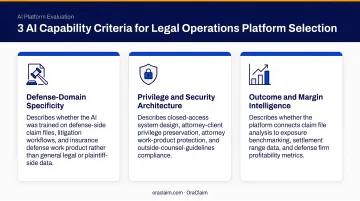
When those capabilities work as advertised, the downstream impact on cross-departmental friction is measurable. The Thomson Reuters 2025 AI report estimates AI-driven document review tools can reduce partner review time by 25% to 40% — and fewer manual handoffs mean fewer delays and fewer errors reaching other departments.
How to Evaluate and Choose the Right Platform
The Evaluation Framework
Platforms should be scored on:
- Cross-departmental integration depth — native connectors vs. custom API work required
- Analytics for non-legal stakeholders — can Finance, Risk, or HR read the reports without a translator?
- AI and automation maturity — workflow-embedded AI vs. bolt-on features
- Security standards — SOC 2 Type II, ISO 27001 alignment, encryption, access controls, audit logs
- Scalability — can it handle growing claim volumes and more complex workflows in two years?
The Most Common Evaluation Mistake
Most legal ops teams evaluate platforms by feature count. That's the wrong approach. A platform with every module available is only valuable if it integrates directly with the systems Finance, IT, and HR are already running. Map your integration requirements first — then evaluate vendors against that list.
Security Is a Screening Gate, Not a Feature
For legal departments handling sensitive litigation data, billing records, and outside counsel communications, security and data governance aren't optional. Any platform in consideration should meet these requirements before anything else:
- SOC 2 Type II assurance or equivalent
- ISO 27001 alignment
- Encryption at rest and in transit
- Role-based access controls and audit logs
- Clear data residency policies
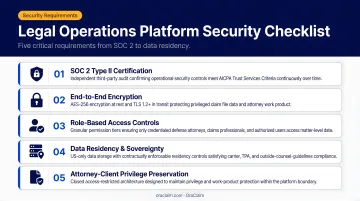
ABA Formal Opinion 477R requires lawyers to make reasonable efforts to prevent unauthorized access to client communications. Platforms storing that data need to meet that standard structurally, not through contract language alone.
Conclusion
The right legal operations platform does more than improve productivity — it creates real operational alignment between legal and every department it touches. The platforms reviewed here each excel in different contexts:
- Legal Tracker for deep Finance-Legal integration and outside counsel spend control
- Onit/SimpleLegal for modular, scalable workflow automation across multiple business units
- Brightflag for demonstrating measurable ROI from legal spend to Finance and the C-suite
- Clio for law firms connecting internal operations with client-side workflows
- TeamConnect for large enterprises with complex compliance and multi-department legal demands
As claim volumes and legal complexity increase, a platform that can't scale or integrate with future tooling will become a bottleneck. Evaluate scalability alongside current needs.
For defense lawyers, claims managers, insurance carriers, and TPAs managing high-volume litigation portfolios, general legal ops platforms address only part of the operational picture. OraClaim is designed specifically for the defense and claims ecosystem, integrating AI-powered document review, case evaluation, real-time exposure analysis, and portfolio management in a single platform.
Key capabilities that matter to defense-side operations:
- Outside-counsel alignment: bidirectional data flow between defense firms and carrier clients — sharing evidence packages, case evaluations, and reserve recommendations without manual back-and-forth
- Financial visibility: gives CFOs, COOs, and claims executives a single view of LAE, defense cost as a percentage of indemnity, and panel-firm performance
Book a demo to see how OraClaim cuts claim file review time and surfaces the exposure data your team needs to make faster, better-informed decisions.
Frequently Asked Questions
What is a legal operations platform?
A legal operations platform is software that helps in-house legal teams and law firms manage matters, control legal spend, automate workflows, and gain data visibility across departments.
How do legal operations platforms connect with departments like Finance and IT?
Leading platforms integrate with ERP, AP, CRM, and HR systems via APIs or pre-built connectors, allowing legal spend data, contract statuses, and compliance updates to flow directly into the tools Finance and IT already use. This eliminates manual reporting cycles and removes data silos that delay decisions.
What features should I look for in a legal operations platform for a law firm?
Core features include matter management, time and billing, document storage, client communication portals, and accounting software integration. Defense law firms and high-volume claims practices should also prioritize automation and analytics tools that connect case and billing data with carrier reporting requirements.
Are legal operations platforms suitable for small law firms or only large enterprises?
Platforms like Clio and SimpleLegal are built to scale from small teams to mid-market organizations, while Legal Tracker and TeamConnect serve complex, high-volume enterprise environments. There are viable options at every scale — the key is matching the platform's integration model to your existing systems.
How do AI-powered features improve cross-departmental legal operations?
AI automates time-intensive tasks like invoice review, contract risk flagging, and document classification, reducing the manual handoffs between departments that cause delays and errors. For defense and claims teams, AI-powered exposure analysis and portfolio dashboards push real-time updates to attorneys, adjusters, and claims managers at once, removing the need for separate coordination cycles.
What is the difference between enterprise legal management (ELM) and a legal operations platform?
ELM is a category within legal ops focused on outside counsel relationships, legal spend management, and matter workflows at enterprise scale. "Legal operations platform" is broader, covering ELM alongside contract lifecycle management, intake automation, document management, and analytics tools designed to serve the full organization.