Introduction
Legal document review sits at the center of every litigation matter, claims investigation, and defense file — and for defense teams managing high claim volumes, it is simultaneously the most time-consuming and most consequential part of the workflow.
The numbers reflect the pressure. According to Thomson Reuters' 2025 research, AI tools have the potential to save lawyers nearly 240 hours per year across routine legal tasks — and among legal professionals already using AI, 77% apply it specifically to document review. Meanwhile, RAND research found that document review accounts for 73% of eDiscovery production costs in large-volume cases.
The structural problem is straightforward: plaintiff firms are adopting AI-driven review tools faster than the defense side. Despite having financial resources, defense lawyers and claims professionals face overwhelming claim volumes, manual processes, and unstructured data — while the opposing side gains ground with technology.
That gap is what this guide addresses. OraClaim's founders, Mark Tepper and Andy Anderson, experienced this imbalance firsthand — and it's the reason platforms purpose-built for defense workflows are gaining traction.
This guide breaks down how AI enhances legal document review — what it does, how it works, where it fits in defense and claims workflows, and what to watch out for.
Key Takeaways
- AI legal document review uses NLP, ML, and OCR to automate analysis, classification, and flagging of legal documents at scale
- For defense teams, the primary gains are eliminating non-billable review time, improving consistency, and surfacing critical facts faster
- AI enhances — but does not replace — legal judgment; attorney oversight is essential in high-stakes defense matters
- Purpose-built legal AI outperforms general AI in accuracy, consistency, and legal nuance recognition
- Purpose-built platforms benchmark patterns across past matters, turning document review into forward-looking defense strategy
What Is AI Legal Document Review?
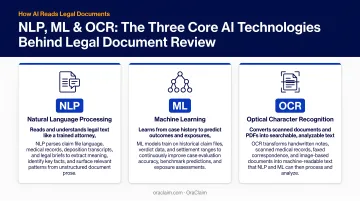
AI legal document review is the application of artificial intelligence to automatically analyze, categorize, and flag relevant content within legal documents. Three core technologies do the work:
- Natural Language Processing (NLP) — interprets language in context, understanding meaning rather than just matching keywords
- Machine Learning (ML) — identifies patterns across documents, improving accuracy as it processes more data; in eDiscovery, this powers Technology-Assisted Review (TAR), which classifies documents based on input from expert reviewers
- Optical Character Recognition (OCR) — converts scanned images and paper-based documents into searchable electronic text, making physical records usable for AI analysis
What AI Document Review Is Not
AI legal document review does not make legal decisions, substitute for attorney judgment, or function as a general-purpose chatbot repurposed for legal tasks.
General-purpose AI models carry real hallucination risk in legal contexts. Stanford HAI's 2024 benchmarking found that legal AI models still hallucinate in 1 out of 6 or more queries — and that earlier testing of general-purpose chatbots found hallucination rates of 58–82% on legal queries.
Using a general LLM for high-stakes document review introduces accuracy risks that purpose-built legal AI eliminates.
Where AI Review Applies in Defense Work
- Litigation discovery and eDiscovery document sets
- Claims investigation files — medical records, incident reports, demand packages
- Contracts, policies, and coverage documents
- Deposition transcripts and expert reports in personal injury and liability matters
- Historical case files for benchmarking and pattern analysis
How AI Enhances Legal Document Review: Core Capabilities
AI enhances legal document review by executing a sequence of interconnected capabilities that collectively transform a manual, error-prone process into a structured, scalable workflow. Each stage feeds into the next — ingestion into classification, classification into issue identification, identification into pattern recognition, pattern recognition into litigation-ready output.
Document Ingestion and Classification
AI begins by ingesting documents in bulk — PDFs, emails, scanned files, transcripts, medical records, demand packages, police reports, prior pleadings — and automatically classifying them by type, relevance, and priority.
This stage eliminates the manual sorting that can consume dozens of reviewer hours before substantive analysis even begins. In the OraClaim workflow, ingestion and classification happen automatically on upload, with timelines generated as the case file comes in — no manual data entry required.
Intelligent Issue Identification and Risk Flagging
Once documents are classified, AI scans content to surface issues that matter: causation problems, timeline gaps, treatment inconsistencies, conflicting statements, pre-existing conditions, and unverified details.
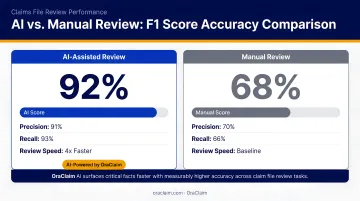
The research on AI versus manual review accuracy is clear. A foundational Grossman & Cormack study published in the Richmond Journal of Law and Technology found that technology-assisted review achieved an average 80.0% F1 score (76.7% recall, 84.7% precision), compared to 36.0% F1 for manual review (59.3% recall, 31.7% precision).
TAR also required human review of only 1.9% of documents on average — a roughly fifty-fold reduction in effort versus exhaustive manual review. That means AI handles the first-pass read that previously consumed associate hours before any strategic work could begin.
Pattern Recognition Across Document Sets
This is where AI separates from basic keyword search. Rather than finding documents that contain a specific term, AI detects correlations and patterns across hundreds or thousands of documents simultaneously — surfacing connections no human reviewer could identify at scale.
In practice, this means:
- Recurring fact patterns across a claim portfolio
- Similar claim types that historically resolved in specific ways
- Anomalies that indicate fraud, exaggeration, or causation gaps
- Plaintiff counsel tendencies across prior matters
For multi-matter defense portfolios and claims investigations, this is where document review stops being reactive and starts informing strategy.
Automated Summarization and Litigation-Ready Output
AI generates structured summaries of complex documents — reducing the time a reviewer needs to understand context before exercising judgment. Instead of raw documents stacked for manual review, defense teams receive:
- Key fact summaries and fact-extraction reports
- Anomaly and contradiction flags
- Citation-linked record indexes
- Medical chronologies, litigation timelines, and case evaluations ready for attorney review and edit
OraClaim, for example, reduces medical chronology drafting time from 15–60+ hours per file (the standard for complex injury files) to under 60 minutes for a first draft — and reduces motion drafting time from 20–120 billable hours to hours for a first draft.
Regulatory Compliance and Obligation Monitoring
AI monitors documents against applicable legal and regulatory standards, flagging language that creates exposure or fails to meet current requirements. This matters because it applies the same analytical standards uniformly — every document, every matter, every reviewer — eliminating the inconsistency that manual review introduces.
In practice, that uniform application covers:
- Reservation-of-rights language and coverage trigger obligations
- Discovery response deadlines and procedural compliance flags
- Jurisdiction-specific statutory requirements embedded in demand packages or pleadings
Key Benefits for Defense Lawyers and Claims Professionals
For defense teams specifically, AI document review addresses the structural disadvantage that comes from managing high claim volumes with manual processes while plaintiff firms accelerate with technology.
Dramatically Reduced Review Time
Manual document review traditionally consumes 40–70% of associate hours per matter — the majority of which is non-billable. AI replaces this first-pass work entirely.
The RAND research estimated that predictive coding could save approximately 80% of attorney review hours in large eDiscovery matters. At the matter level, that translates to fewer non-billable hours on document processing and more time available for case strategy, client communication, and billable work.
For claims professionals managing large portfolios, this compounds across hundreds of matters simultaneously.
Consistent Standards Across All Matters
Manual review introduces inconsistency inherently — different reviewers apply different standards, interpret similar clauses differently, and catch different issues. AI applies the same analytical framework to every document, every time.
For defense teams, this means:
- No gaps in issue identification across a portfolio
- Predictable review quality regardless of who handles the matter
- Consistent reserve and exposure assessments across adjusters
Scalable Capacity Without Adding Headcount
The 2025 Thomson Reuters Legal Department Operations Index found that 56% of legal department professionals describe their departments as under-resourced, with understaffing identified as the single biggest barrier legal departments face.
AI addresses this directly. Defense firms and claims organizations can handle significantly more matters without proportionally increasing staffing costs — because AI absorbs the review work that previously required headcount. For firms operating on flat fees, that shift — non-billable review time converting into case capacity — can substantially improve profit margins. OraClaim reports improvements of up to 300% for defense firms making this transition.
Turning Review Into Strategic Intelligence
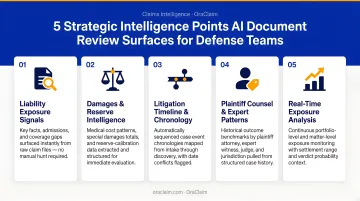
Capacity gains matter, but the deeper value comes from what AI does with the data it processes. When AI structures and benchmarks document data across past matters, it creates a searchable intelligence layer:
- Similar-case settlement and verdict ranges
- Plaintiff counsel outcome histories
- Judge-specific motion-grant rates
- Plaintiff expert reliability and bias patterns
- Reserve adequacy comparisons for similar fact patterns
Defense teams use this intelligence to refine case strategy, set defensible reserves, justify settlement authority, and anticipate outcomes rather than react to them. OraClaim's automated benchmarking reduces manual benchmarking effort by 80%+, giving organizations analytical rigor that was previously out of reach without dedicated research staff.
Earlier, More Accurate Case Assessment
AI enables earlier case assessment by surfacing critical facts and risk indicators from documents within hours of intake — not after weeks of manual review. For claims professionals, this directly affects:
- Reserve-setting accuracy and confidence
- Triage decisions on high-exposure matters
- Early resolution strategy before costs escalate
- Proactive authority requests before surprises emerge
OraClaim's real-time exposure analysis continuously updates as new documents enter the file. It issues alerts to assigned attorneys, adjusters, and claims managers when material changes affect liability, damages, or reserve adequacy.
Limitations and Best Practices for Implementing AI in Legal Document Review
The Hallucination Problem With General AI
The most serious limitation applies to general-purpose AI models used for legal work. Stanford Law School's first preregistered empirical evaluation of AI legal research tools found that leading platforms hallucinated more than 17% of the time. Earlier Stanford research found general-purpose chatbots hallucinated 58–82% on legal queries.
For document review, hallucination means AI can misstate legal standards, fabricate citations, or miss nuanced clause language — with enough apparent confidence to appear credible. Purpose-built legal AI trained on legal documents and refined by attorneys is necessary for reliable output. A general LLM is not a substitute.
Human Oversight Is Non-Negotiable
ABA Formal Opinion 512 (2024) is explicit: lawyers must understand the capabilities and limitations of any AI tool they use, and cannot rely uncritically on AI output without independent verification. Uncritical reliance can constitute a failure of the duty of competent representation.
AI handles first-pass review, classification, flagging, and summarization. Lawyers must still:
- Review AI-generated flags and summaries
- Apply legal judgment before acting on outputs
- Take final responsibility for all work product
That division of labor is intentional. AI accelerates the process; attorneys own the outcome.
Data Security and Confidentiality Requirements
Legal documents contain privileged and sensitive information. Before deploying any AI platform for document review, legal teams should verify:
- Encryption at rest and in transit
- Data isolation so client files are never commingled with other users' data
- A firm prohibition on using client data to train or improve AI models
- SOC 2 Type II certification confirming controls operate effectively over time, not just on paper
- Access controls limiting who can view confidential matter data
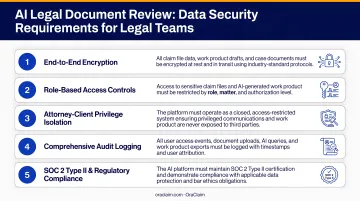
OraClaim operates as a closed, access-restricted system designed specifically to preserve attorney-client privilege and attorney work-product protection — with all processing treated as an extension of the customer's own computing environment, not disclosure to a third party.
Where AI Legal Document Review Fits in Defense and Claims Workflows
Early Case Assessment: Where AI Has Highest Immediate Impact
At intake, AI's value is clearest. Rather than spending hours manually organizing a new claim file before any strategic work can begin, AI immediately:
- Ingests and classifies every document automatically
- Extracts key dates, injuries, and events
- Surfaces causation issues, timeline gaps, and contradictions
- Flags high-exposure indicators before a single billing hour is spent
This collapses the time-to-strategy gap that puts defense teams at a disadvantage relative to plaintiff firms who already have a clear picture of the case before defense counsel has finished the first read.
Discovery and Investigation: Finding What Manual Review Misses
During document-intensive discovery phases and claims investigations, AI reduces the volume of documents requiring human attention through classification and culling — while simultaneously identifying patterns across large document sets that no manual team can replicate at scale.
One Thomson Reuters Legal Managed Services case study illustrates the scale: an initial 1.92 million document set was reduced to approximately 626,000 documents through AI-assisted culling, then reviewed in 29 days — saving the client more than $1 million.
For defense teams, AI also flags high-priority documents — the factual hooks for dispositive motions, cross-examination, and settlement leverage — so attorney time concentrates on what matters most.
Post-Matter Benchmarking: Turning Closed Cases Into Competitive Advantage
After a matter closes, AI can structure the data from that review — facts, outcomes, claim patterns, cost drivers — into a searchable intelligence layer across the entire portfolio. Defense teams that build this layer stop re-litigating institutional knowledge from scratch on every new file.
Platforms like OraClaim are purpose-built for this workflow. The platform's historical case file structuring module transforms years of unstructured PDFs, scanned files, and legacy practice management exports into structured, benchmarkable data — enabling defense lawyers and claims professionals to approach every new matter with institutional knowledge that previously lived only in the heads of senior attorneys.
Conclusion
AI enhances legal document review by automating the most time-consuming stages: ingestion, classification, issue identification, and summarization. Done consistently and at scale, that automation generates intelligence — not just work product.
For defense teams, the stakes are practical: plaintiff firms are already using these tools. The gap between AI-equipped plaintiff counsel and defense teams relying on manual review is not a future concern. It is a present-day competitive and operational disadvantage. Platforms like OraClaim are purpose-built to address exactly that: defense teams can review more files in less time, maintain quality across higher matter volumes, and convert closed cases into benchmarking data that sharpens strategy on the next one.
Frequently Asked Questions
Is there an AI that can review legal documents?
Yes. AI platforms specifically designed for legal document review use NLP, ML, and OCR to analyze, classify, and flag legal content. General-purpose AI carries meaningful hallucination risk in legal contexts, making purpose-built legal AI the appropriate choice for reliable, high-stakes work.
What is the best AI platform for document review?
The best platform depends on use case — defense lawyers and claims professionals have different requirements than corporate legal teams doing contract review. Key selection criteria are legal-domain training, security standards (data isolation, prohibitions on training models with client data), workflow integration, and whether the platform is purpose-built for your specific practice context.
Can AI replace lawyers in legal document review?
No. AI handles first-pass review, classification, and flagging, but lawyers must review AI output, apply legal judgment, and make final decisions. Under ABA Formal Opinion 512, uncritical reliance on AI output without independent verification can constitute a failure of the duty of competent representation.
How accurate is AI legal document review compared to manual review?
Purpose-built legal AI consistently outperforms manual review in speed and consistency. The Grossman & Cormack study found TAR achieved an 80.0% F1 score versus 36.0% for manual review. General AI tools introduce hallucination risk that makes them unreliable for high-stakes legal work, which is why purpose-built training on legal documents matters.
How does AI handle confidential or privileged documents during review?
Reputable AI legal document review platforms implement data isolation, encryption at rest and in transit, access controls, and strict prohibitions on using client data to train AI models. Legal teams should verify these measures — and confirm the platform's operating model preserves attorney-client privilege and work-product protection — before selecting any platform.
How long does it take to implement AI for legal document review?
Platforms with pre-built configurations can be operational within days; teams building custom workflows around firm-specific standards or practice management integrations may take a few weeks. The key factor is whether the platform integrates with existing systems — such as Clio, iManage, or NetDocuments — and how much historical data requires onboarding.