in 2026](https://file-host.link/website/oraclaim-0psh24/assets/refined-images/1781091242919000_bbfcaebc78da4ef5bcb60981c5e1dfdf/360.webp)
Introduction
Defense lawyers and claims professionals are fighting a two-front battle. On one side: rising claim volumes and mountains of unstructured documents — police reports, medical records, demand packages, and legal correspondence that pile up faster than any team can manually review.
On the other: plaintiff firms that have been adopting AI tools faster than the defense side, widening the technology gap while defense teams rely on the same manual workflows.
The numbers make the urgency hard to ignore. The global AI in insurance claims processing market is projected to grow from $514 million in 2024 to $2.76 billion by 2034 — an 18.3% annual growth rate — driven by carriers and claims organizations recognizing that manual workflows can no longer keep pace.
AI tools for claims processing address this directly. They automate document review, extract critical facts, predict claim outcomes, and surface portfolio-level insights — all without proportionally larger teams. Not all tools are built the same, though, and the wrong choice leaves real money on the table.
This guide covers the five strongest AI platforms for claims processing in 2026, each evaluated for defense-side relevance, how deep the capabilities actually go, and whether the impact is measurable.
Key Takeaways
- AI claims tools automate document review, fact extraction, and workflow tasks — consuming 40–70% of associate hours per matter
- Top 2026 platforms go beyond document reading: they produce litigation-ready work product, predict outcomes, and flag portfolio risks
- Purpose-built defense tools deliver more value than generic legal AI or plaintiff-side platforms adapted for defense use
- Top five tools: OraClaim, Shift Technology, CLARA Analytics, Guidewire ClaimCenter, and Snapsheet — each strongest for different use cases
- Defense teams should match the tool to their side of the claims ecosystem, not buy the most-hyped platform
What Is AI for Claims Processing?
AI for claims processing refers to technology that automatically captures, reads, classifies, and reasons over the unstructured documents inside a claim file — police reports, medical records, loss notices, photos, and legal correspondence. The output is structured data and analysis that claims professionals can act on directly.
The critical distinction is between rules-based automation and modern AI/ML systems. Rules-based automation works on predictable, well-structured data. It fails the moment a claim file contains ambiguous medical records, handwritten notes, or inconsistent document formats — which describes most real claim files. Modern AI handles that ambiguity, placing documents in context and extracting meaning even from messy, variable inputs.
According to Accenture, only 44% of insurance claims executives described their organizations as advanced in automation and AI-based analytics as of 2022. That means the majority of the industry is still catching up — and even self-described "advanced" organizations frequently rely on legacy rules-based systems that can't handle unstructured data at scale.
The five platforms below represent the strongest AI options for claims processing in 2026, selected for their ability to deliver measurable value to defense-oriented claims teams.
5 Best AI Tools for Claims Processing in 2026
These tools were evaluated on claims-specific functionality, defense and carrier relevance, security posture, integration capability, and real-world efficiency gains.
1. OraClaim
OraClaim is an AI-powered claims intelligence platform built exclusively for defense lawyers, claims managers, and insurance carriers. It was co-founded by Mark Tepper, who litigated claims and managed risk for enterprise companies and insurers, and Andy Anderson, who analyzed risk for insurers and managed high-exposure claims.
That practitioner background is the core differentiator. The platform was designed by people who sat on the defense side of the table, not engineers retrofitting a general-purpose document tool for legal use.
The platform eliminates non-billable document review by instantly surfacing critical facts from every document type in a claim file: medical records, police reports, demand packages, expert reports, deposition transcripts, social media content, and more.
From that extraction, OraClaim auto-generates litigation-ready work product trained on the firm's own institutional knowledge and style:
- Medical chronologies, case evaluations, and litigation timelines
- Deposition outlines and motion drafts (MSJ, motions in limine, Daubert/Frye)
- Mediation briefs, reserve memos, and 90-day carrier reports
For claims organizations, the portfolio management module unifies open and closed claims, reserves, defense costs, and exposure data into a single view. The automated benchmarking module draws on historical closed-case files to surface settlement ranges, verdict comparables, plaintiff-counsel outcome histories, and judge-specific motion-grant rates — reducing manual benchmarking effort by over 80%.
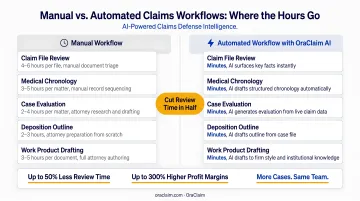
The financial case is concrete. OraClaim reduces medical chronology drafting from 15–60+ hours per file to under 60 minutes. Deposition preparation drops from 4–20 hours per witness to minutes. The platform can increase defense firm profit margins by up to 300% by converting non-billable review hours into capacity for higher-value work.
OraClaim integrates with Clio, MyCase, NetDocuments, iManage, and other practice management and document management systems. The platform operates as a closed, access-restricted system that preserves attorney-client privilege, work-product protection, and outside-counsel-guidelines compliance, with no client data used to train AI models. Backed by MGV, Forum Ventures, Newfund Capital, Meridian, and Roo Capital.
| Category | Details |
|---|---|
| Best For | Defense lawyers, claims professionals, and insurance carriers managing litigation-heavy portfolios who need to scale capacity without adding headcount |
| Key Features | AI-generated litigation-ready work product; automated case benchmarking and outcome prediction; document review automation; portfolio health and margin analytics; integrates with existing practice management and document management systems |
| Security & Access | Closed, access-restricted SaaS; industry-standard encryption, authentication, and data protection; no client data used for AI training; privilege and work-product protection by design |
2. Shift Technology
Shift Technology is an insurance-grade AI platform used by leading carriers globally, with dedicated solutions for claims decisioning, fraud detection, subrogation identification, and injury claims management. Shift's models are trained specifically on insurance claims data, which means outputs are calibrated for the patterns, terminology, and edge cases that appear in actual claim files — not generic enterprise documents.
Real-world results back this up. A large U.S.-based travel insurer using Shift GenAI went from 0% automation to 57% automation, with claim processing time dropping from three weeks to two minutes. Shelter Insurance adopted Shift's fraud detection specifically to reduce false positives and surface individual and network fraud patterns that manual review would miss.
Shift's agentic AI platform — Shift Claims — was announced in 2025 and supports claims handlers across assessment, prioritization, automation, and decision-making guidance throughout the claims lifecycle. For carriers dealing with high claim volumes across standardized lines, Shift delivers both speed and insurance-specific accuracy in a purpose-built package.
| Category | Details |
|---|---|
| Best For | Insurance carriers seeking AI-native claims decisioning, fraud and subrogation automation, and measurable straight-through processing improvements |
| Key Features | Claims document review and summarization; fraud detection and photo similarity scoring; subrogation opportunity identification; predictive claims triage; injury and coverage analysis |
| Security & Access | Enterprise SaaS; deployed by top global insurers; contact Shift Technology for demo and pricing |
3. CLARA Analytics
CLARA Analytics focuses on claims outcomes management and litigation analytics — used by commercial insurers and self-insured organizations to predict claim severity, identify litigation risk, optimize attorney assignment, and monitor vendor performance. Its strength is strategic: helping claims organizations identify which files need intervention before they escalate into expensive litigation.
The defense-side application is direct. Claims professionals use CLARA's outcome predictions and attorney benchmarking to justify early resolution, flag claims heading toward expensive litigation, and benchmark outside-counsel performance. CLARA Risk Notes uses generative AI to produce narrative summaries explaining the factors driving AI alerts — including treatment patterns, subrogation signals, and medical causation — giving adjusters context, not just scores.
Documented outcomes include a 35% improvement in return-to-work speed for one insurer and a 33% reduction in MSP compliance costs for a nationwide claims administrator. SOC 2 compliant with HIPAA and HITRUST-related controls.
| Category | Details |
|---|---|
| Best For | Claims organizations and insurance carriers that want AI-driven insights into claim severity, litigation trajectory, and defense counsel performance |
| Key Features | Claim severity and outcome prediction; early intervention flagging; attorney performance benchmarking; medical bill and treatment pattern analysis; integration with major claims management systems |
| Security & Access | Enterprise SaaS; SOC 2 compliant; contact CLARA Analytics for pricing |
4. Guidewire ClaimCenter (with AI)
Guidewire ClaimCenter is the dominant enterprise claims management platform for property and casualty insurers, serving 270+ customers in 30+ countries with AI capabilities embedded into its core claims workflow through Guidewire Predict and Guidewire Analytics.
ClaimCenter isn't a standalone AI tool. It's an end-to-end claims administration system covering intake, assignment, reserves, payments, and reporting, with AI layered throughout. Guidewire's Industry Intel models draw on over $326 billion in pooled direct written premium and 26 million+ claims, giving its predictive models scale that no single carrier dataset can match.
Specific AI capabilities include claim routing and prioritization, reserve recommendations, fraud signal detection, litigation risk identification, and reserve mismatch flagging. Forrester named ClaimCenter a Leader in its Q2 2024 P&C Claims Management Systems Wave; Gartner recognized InsuranceSuite as a Magic Quadrant Leader in 2024.
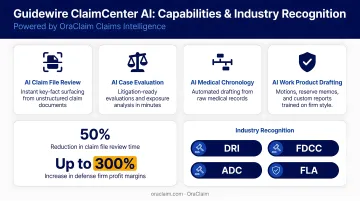
For large P&C carriers that need a comprehensive system rather than a point solution, Guidewire is the most established option available.
| Category | Details |
|---|---|
| Best For | Large P&C insurance carriers that need a comprehensive claims administration system with embedded AI, not a standalone AI tool |
| Key Features | AI-powered claim routing and prioritization; reserve recommendation; fraud detection signals; integration with third-party data; end-to-end claims lifecycle management |
| Security & Access | Enterprise licensing; implementation via Guidewire-certified partners; pricing based on premium volume and deployment scope |
5. Snapsheet
Snapsheet is a cloud-native claims automation platform that digitizes and accelerates claims intake and settlement. Originally built for auto claims, it now covers multiple lines and combines AI-powered document processing, virtual damage assessment, and automated claimant communications into a configurable platform that sits on top of existing core systems.
Carriers and TPAs can implement Snapsheet's AI-driven intake and triage without replacing their existing claims management infrastructure. That makes it a realistic modernization path for organizations that need targeted workflow improvements without a full platform overhaul. A partnership with ION targets up to 70% reduction in time-to-claim-decisions. Integration with ISO ClaimSearch supports fraud detection and automated insights at intake.
Snapsheet's digital mailroom (built with Foundation AI) handles incoming claims document management, while its case study library includes clients who cut claim payment times significantly through digital disbursements.
| Category | Details |
|---|---|
| Best For | Carriers and third-party administrators looking to automate claims intake, digital communication, and settlement workflows across personal and commercial lines |
| Key Features | AI-powered claims intake and triage; virtual damage assessment; automated claimant communication; digital payments; API-based integration with existing claims systems |
| Security & Access | Cloud-native SaaS; contact Snapsheet for demo and pricing and current compliance certifications |
How We Chose the Best AI Tools for Claims Processing
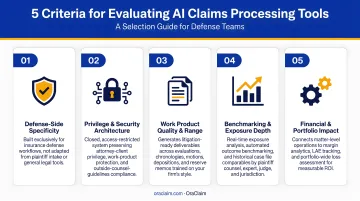
These tools were assessed on five criteria:
- Claims-specific functionality — not generic document AI repurposed for insurance
- Defense and carrier relevance — does it serve the actual workflows claims professionals use daily
- Security and compliance posture — encryption, access controls, privilege preservation, and audit standards
- Integration with existing systems — practice management, document management, and claims platforms
- Real-world evidence of efficiency gains — vendor case studies, analyst recognition, or documented outcomes
A common buyer mistake: selecting a well-known general-purpose AI tool — a broad LLM or OCR platform — never designed for the complexity, unstructured data, and regulatory demands of claims. These tools can read documents. They can't reason about liability exposure, produce jurisdiction-aware work product, or benchmark outcomes against comparable claim histories.
Matching the Tool to the Team
The right tool depends on your role in the claims ecosystem:
- Defense law firms and litigation-focused claims managers: OraClaim is purpose-built to handle unstructured medical and legal documents, produce litigation-ready outputs, and preserve privilege
- Large P&C carriers managing intake volume, reserves, and payments across thousands of claims need end-to-end systems like Guidewire ClaimCenter
- Carriers focused on fraud and straight-through processing benefit from insurance-specific AI like Shift Technology
- Claims organizations managing litigation outcomes and outside-counsel performance get the most value from CLARA Analytics
- Carriers and TPAs wanting quick wins on intake and settlement speed without a full platform replacement can deploy Snapsheet quickly
Role selection is only part of the decision. Every platform on this list handles attorney-client communications and claim file data — which means encryption standards, role-based access controls, and compliance posture that can withstand legal scrutiny are non-negotiable. Ask vendors for documentation, not just assurances.
Conclusion
AI for claims processing is no longer a future investment. Defense teams still relying on manual review are already operating at a disadvantage against plaintiff firms and opposing organizations that adopted technology years ago — and that gap widens every year.
When evaluating tools, go beyond feature checklists. The right questions are: Does this platform understand the defense side of the claims ecosystem? Does it integrate with the systems your team already uses? Does it produce work product you can act on immediately, or does it generate more raw data to interpret?
OraClaim was built by practitioners who have managed and litigated claims firsthand — so the platform is designed to answer those questions directly. For defense lawyers and claims professionals looking to cut document review time, scale their caseload, and deliver better outcomes on every claim, request a demo at OraClaim to see what purpose-built defense AI looks like.
Frequently Asked Questions
Do insurance companies use AI to review claims?
Yes, and adoption has accelerated sharply. Accenture found that 44% of claims executives rated their organizations as advanced in AI and automation as of 2022, with 65% planning to invest more than $10 million in AI over the following three years — across document extraction, fraud detection, severity prediction, and automated decisioning.
What is the best AI tool for insurance claims processing?
It depends on your role. Defense lawyers and claims managers defending litigation benefit most from purpose-built platforms like OraClaim. Large P&C carriers managing end-to-end claim administration typically need enterprise systems like Guidewire ClaimCenter. Carriers focused on fraud detection and straight-through processing get strong results from Shift Technology.
How does AI reduce claims processing time?
AI reads and extracts key facts from unstructured documents automatically, eliminating manual review steps. Shift Technology cut travel claim processing from three weeks to two minutes; OraClaim reduces medical chronology drafting from 15–60+ hours to under 60 minutes. The gains compound across a portfolio as document volume scales.
Can AI tools detect fraud in claims processing?
Fraud detection is one of the most established AI use cases in claims. The Insurance Information Institute reports that 80% of insurers used predictive modeling for fraud detection in 2021, up from 55% in 2018. Tools like Shift Technology use photo similarity scoring, data pattern analysis, and anomaly detection to flag suspicious claims and network fraud that manual review typically misses.
What should defense lawyers look for in an AI claims tool?
Prioritize tools that natively handle unstructured legal and medical documents, produce litigation-ready outputs rather than raw extractions, and integrate with your existing practice management systems. Above all, the platform must operate as a closed system that preserves attorney-client privilege and work-product protection — and require vendors to document their security posture in writing.
Is AI claims processing software secure and compliant?
Reputable platforms maintain enterprise-grade security including encryption, SOC 2 certification, and role-based access controls. For defense tools specifically, look for explicit privilege-preservation architecture — where the platform is contractually and technically designed so that processing claim files through AI doesn't constitute third-party disclosure. Always verify the vendor's compliance posture against your jurisdiction's requirements before deployment.