Introduction
Defense lawyers and claims professionals face a relentless operational challenge: high claim volumes, documents scattered across unstructured files, and constant pressure to make fast, accurate decisions, often before the full picture is clear.
The stakes are real. According to NAIC's 2024 Property & Casualty analysis, U.S. P&C loss and loss adjustment expense (LAE) reserves reached $976.9 billion in 2024.
The same report found prior-year reserves in other liability-occurrence showed a $10 billion deficiency. That gap often reflects case evaluation that was not rigorous, repeatable, or timely enough.
Case evaluation addresses that risk. Done well, it improves reserve accuracy, shapes settlement positioning, and supports litigation outcomes. When it is rushed or skipped, it creates the reserve surprises, missed settlement windows, and underprepared trials that cost defense organizations money and credibility.
This guide breaks down what case evaluation means on the defense side, how it works in six practical stages, and what separates consistent teams from reactive ones.
Key Takeaways
- Case evaluation analyzes facts, evidence, legal exposure, and damages to shape the strongest defense strategy for a claim
- Defense teams need evaluations that are fast, repeatable, and consistent across high claim volumes, not treated as one-off memos
- A strong process moves through scope-setting, file review, data organization, framework analysis, findings, and action
- Weak evaluation can inflate reserves, trigger early settlements, or leave counsel underprepared when litigation pressure rises
- AI-supported workflows help claims and defense teams move from reactive file review to earlier, portfolio-level claim strategy
What Is Case Evaluation?
In the defense context, case evaluation is the disciplined process defense lawyers and claims professionals use to assess a claim's facts, legal merits, evidence, liability exposure, and potential damages, then determine the best next step.
That path might mean defending aggressively, pursuing early resolution, adjusting reserves, or escalating to trial. The evaluation drives the decision.
This is not the same as a plaintiff-facing free consultation. In defense work, case evaluation is an internal, ongoing analytical process applied to every claim in the portfolio. It starts at intake and gets revisited as facts develop: after discovery, after depositions, or after a defense medical exam changes the damages picture.
Case evaluation applies wherever a defense team must decide how to deploy resources and set reserves:
- General, excess, personal injury, and bodily injury claims
- Workers' compensation matters
- Professional liability and errors & omissions
- Auto bodily injury and trucking defense
- Product liability and mass tort portfolios
- Employment practices and construction defect claims
The common thread: each situation requires a structured judgment about exposure, strategy, and cost. That judgment is only as reliable as the evaluation behind it.
Why Case Evaluation Is Critical for Defense Teams
Without a structured evaluation process, defense teams are reactive rather than strategic. They miss early settlement windows, over-reserve low-exposure claims, and under-prepare for high-exposure ones.
Verdict trends show why defense teams need that structure. RAND research found that inflation-adjusted personal injury and wrongful death trial awards grew at a 7.6% compound annual growth rate from 2010 to 2019, while plaintiff win rates at verdict climbed from 53% to 64% over the same period. Awards of $5 million or more now represent 12% of all verdicts. In that environment, a weak evaluation can distort reserves, authority requests, and trial strategy.
Rigorous case evaluation gives defense professionals a structural advantage at every stage:
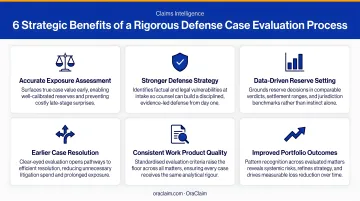
- Reserve accuracy — bases reserves on real exposure analysis, not instinct or habit
- Early resolution — identifies claims worth settling before litigation costs compound
- Negotiation positioning — supports data-backed authority requests and demand responses
- Consistency — aligns how different attorneys and adjusters handle similar claim types
- Carrier reporting — builds a defensible record for coverage decisions and carrier clients
- Institutional learning — benchmarks current cases against historical outcomes to improve future decisions
Claims litigation programs often require an initial case analysis within 30 days of filing an answer, with updates every 60 to 90 days as discovery progresses.
Teams that treat evaluation as a one-time task — rather than a continuous process — miss inflection points: the deposition that changes liability, the IME that shifts damages, or the demand that should trigger updated authority. Claims intelligence tools such as OraClaim help keep that exposure analysis current as the file changes.
How Case Evaluation Works — Step by Step
How Case Evaluation Works: Step by Step
Case evaluation is not a single task. It's a six-stage process, and most of the mistakes defense teams make happen because they rush through a stage or skip it entirely.
Step 1 – Define the Scope and Objective
Before reviewing a single document, the evaluation team needs to know what questions it's answering.
- Is liability disputed, or is the real issue damages?
- What is the realistic exposure range , and what is the ceiling if this goes to trial?
- Are there coverage issues that affect the defense posture?
- What is the client's risk tolerance and litigation budget?
Skipping this step leads to evaluations that answer questions no one asked. The scope definition also sets reserve expectations early and aligns the team before document review begins.
Step 2 – Gather Case Inputs
Collect the inputs that shape liability, damages, and coverage analysis:
- Incident reports, photographs, and police or investigative reports
- Medical records, witness statements, and expert reports
- Prior claims history and coverage documents
- Prior litigation records involving the claimant or plaintiff's counsel
The most common mistake at this stage is starting the evaluation before the file is complete. Setting reserves before medical records are in, or issuing a strategy recommendation before checking claimant history, produces evaluations that need to be torn up two weeks later.
Flag gaps early. Missing records aren't just an inconvenience ; they are a liability exposure hiding in plain sight.
Step 3 – Organize and Structure the Data
Raw documents aren't an evaluation. They need to be categorized by type, relevance, and evidentiary weight before any meaningful analysis can happen.
This stage involves:
- Tagging documents by category (medical, financial, witness, expert, coverage)
- Flagging inconsistencies, credibility concerns, and treatment gaps
- Identifying missing records that need to be requested
- Building a structured file that supports rapid review by any team member
For teams using claims intelligence software, this is also where OraClaim can surface missing records, claimant history, and comparable fact patterns for attorney review.
Teams that skip this step end up with evaluations that vary by reviewer, which is exactly the kind of inconsistency that produces reserve surprises and misaligned settlement strategy.
Step 4 – Apply the Evaluation Framework
This is the analytical core. With a structured file in hand, the evaluation should address:
- Liability exposure — who is at fault, to what degree, and how defensible is that position
- Damages — economic (specials, wage loss, future care) and non-economic (pain and suffering, general damages)
- Legal precedent — how courts in this jurisdiction have treated similar fact patterns
- Witness and expert credibility — whether the claimant's account holds up, and whether opposing experts have a history of inflated opinions
- Defense narrative strength — how persuasive the defense story is to a jury in this venue
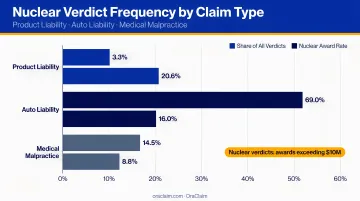
A strong evaluation at this stage also considers nuclear verdict risk. NAIC notes that awards exceeding $10 million are most frequent in product liability (23.6%), auto accidents (22.8%), and medical liability (20.6%) ; jurisdiction and venue analysis isn't optional in high-exposure cases.
Step 5 – Interpret Findings and Set Strategy
The analysis needs to produce a clear recommendation, not a list of considerations.
The output should include:
- A recommended path: defend, resolve early, adjust reserves, or escalate
- A realistic valuation range (reserve, settlement authority, and trial exposure)
- The key factors that could move the case up or down
- A reporting-letter-ready narrative for the carrier
Vague evaluations that hedge on every point create decision paralysis. The goal is a defensible recommendation that the team can act on.
Step 6 – Act, Monitor, and Refine
Implement the strategy. Then keep watching.
As discovery produces new facts, such as a deposition that undermines the claimant's timeline, a defense medical exam that contradicts the treating physician, or surveillance that changes the damages picture, revisit the evaluation. Material developments trigger a new cycle, not a footnote.
Document outcomes. Every closed case is institutional knowledge that should inform how similar claims are handled next time.
Case Evaluation in Practice: A Defense Claims Walkthrough
Here's how the six stages play out on a general liability claim with disputed facts.
The scenario: A claimant alleges a slip-and-fall at a commercial property, with moderate soft-tissue injuries, a gap in treatment, and a demand well above the claimed specials. A prior claims history check reveals a similar incident two years earlier.
Stage 1 (Scope): The evaluation team identifies three key questions: is liability disputed, is the treatment gap explainable, and does the prior incident affect credibility or damages?
Stage 2 (Inputs): The team gathers incident reports, surveillance footage, medical records from both incidents, witness statements, and the prior claims file. They flag that post-accident medical records are incomplete: treatment apparently resumed six months after the incident.
Stage 3 (Organize): Documents are categorized. The treatment gap is flagged. The credibility of the claimant's causation narrative is marked as a material issue.
Stage 4 (Framework): Liability analysis shows the property owner had documented maintenance records, which supports a defensible position. Damages analysis reveals the specials are modest, but the claimant's attorney has a history of inflating soft-tissue demands in this jurisdiction. Local jury verdict data shows median awards for similar cases well below the demand.
Stage 5 (Strategy): The evaluation recommends a moderate reserve, denial of the inflated demand, and a counteroffer anchored to the comparable verdict range. It flags the claimant's credibility issue as a potential defense narrative advantage if the case proceeds.
Stage 6 (Monitor): Two months later, a defense medical exam report contradicts the treating physician's diagnosis. The evaluation is updated: reserve reduced, settlement authority request revised downward, and defense posture strengthened.
The key lesson: the evaluation didn't end at Stage 5. The credibility discovery mid-case changed the entire strategy. Static evaluations produce expensive surprises; dynamic ones produce better outcomes.
How OraClaim Helps Defense Teams Evaluate Cases Smarter
OraClaim is an AI-powered claims intelligence platform built specifically for insurance defense attorneys and claims professionals. It is designed for defense-side workflows rather than adapted from a generic legal tool.
The founders, Mark Tepper and Andy Anderson, both came from the defense side. Mark litigated claims and managed risk for enterprise companies and insurers. Andy analyzed risk for insurers and managed high-exposure claims. They saw firsthand how overwhelming claim volumes, unstructured files, and manual review processes put defense teams at a structural disadvantage against plaintiff firms that had moved faster on technology.
OraClaim addresses the specific bottlenecks that distort case evaluation:
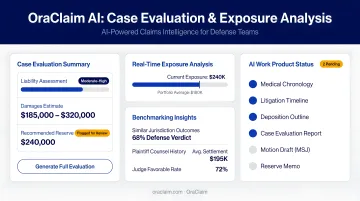
- Claim file review: Ingests claim files, classifies documents, extracts facts, and flags contradictions, causation gaps, and credibility issues. It reduces non-billable review that typically consumes 40–70% of associate hours per matter.
- Case evaluation generation: Produces structured evaluations in minutes, including liability, comparative fault, damages exposure, causation, reserves, settlement ranges, trial value, verdict comparables, and carrier-ready narratives. The traditional equivalent takes 10–40 billable hours.
- Automated benchmarking: Compares open claims against a firm’s or carrier’s historical book, including settlement ranges, verdict ranges, plaintiff-counsel outcomes, judge-specific motion-grant rates, and similar-fact-pattern reserve adequacy. No manual tagging required.
- Real-time exposure analysis: Re-runs exposure analysis as new documents enter the file and alerts teams when medical updates, expert reports, or discovery findings materially change liability or damages exposure.
OraClaim integrates with existing practice management and document management systems, including Clio, iManage, NetDocuments, and others, so defense teams can adopt it without disrupting current workflows. The platform operates as a closed, access-restricted system, with processed information covered by attorney-client privilege and work-product protections.
OraClaim reports outcomes such as:
- Cuts claim file review time by half or more
- Generates case evaluations in minutes instead of hours
- Increases capacity by reducing non-billable review time, with profit margins projected to rise by up to 300%
Frequently Asked Questions
What are the 5 steps of evaluation?
The five core steps are defining scope, gathering inputs, organizing data, applying an analytical framework, and interpreting findings. Many defense teams add a sixth step: act on the findings, monitor changes, and refine the evaluation as new medical records, discovery responses, or demands arrive.
What happens in a case review?
A case review examines the facts, evidence, legal exposure, and strategy for a specific claim. It typically produces a reserve recommendation, settlement or litigation plan, and documented findings that claims leaders, defense counsel, or supervisors can use at the next milestone.
What is the difference between case evaluation and case review?
Case evaluation is the broader analytical process, from intake through strategy updates and outcome tracking. A case review is a narrower check-in at a litigation stage, such as discovery, mediation, expert review, or pretrial, often used for reporting and governance.
How long does a case evaluation typically take?
An organized, straightforward liability claim may take a few hours. High-exposure, multi-party, or poorly organized matters can take days because missing records, duplicate documents, and scattered notes slow the analysis more than legal complexity alone.
What factors matter most in a defense case evaluation?
Key inputs include liability clarity, damages support, witness credibility, jurisdiction, coverage issues, and the claimant’s litigation history. If one factor is missing or weighted poorly, reserves and settlement decisions can swing sharply, especially in high-exposure defense matters.