That gap — between standard and advanced reporting — is where competitive advantage is won or lost.
According to Mordor Intelligence, claims management is already the leading application in the insurance analytics market, commanding 31.29% revenue share in 2025, with the broader market forecast to reach $132B by 2031. The demand for deeper insights isn't a trend — it's a structural shift in how claims organizations operate.
This article breaks down the specific advanced reporting features that matter most for defense teams, what they enable in practice, and what to look for when evaluating software.
Key Takeaways
- Advanced reporting connects claim data to strategy, costs, and outcomes — not just claim counts and status.
- Key capabilities include real-time KPI dashboards, financial and portfolio-level reporting, predictive analytics, and case benchmarking.
- Defense teams can use reporting to anticipate outcomes, catch reserve problems early, and ground every client conversation in data.
- Look for software that structures incoming data automatically and delivers reporting teams can run themselves, without waiting on IT.
Why Advanced Reporting Matters for Defense Teams
Most claims data arrives in formats that resist analysis. PDFs, scanned records, email chains, intake notes — these don't feed cleanly into reports. Standard tools surface what's already known; advanced reporting structures and interprets data to surface what matters before it becomes a problem.
OraClaim's founders, Mark Tepper and Andy Anderson, both former litigators and claims professionals, observed this firsthand. Their assessment: the defense side, despite having financial resources, is at a real disadvantage when plaintiff attorneys move faster on technology.
The problem isn't a shortage of data. Years of closed case files sit in unstructured formats that can't be searched, benchmarked, or analyzed at scale — and that gap has real financial consequences.
The Stakes Are Financial
Reserve inaccuracy isn't just an operational problem. AM Best reported a $9 billion deficiency in US P&C ultimate reserves at year-end 2024, and Swiss Re added $2.4 billion to US liability reserves in Q3 2024 alone. Those figures reflect what happens when reserve decisions are made without reliable, structured data supporting them.
McKinsey's research across more than 200 insurers globally found that AI domain rewiring in claims produced 3% to 5% accuracy improvements. At portfolio scale, those gains translate to material financial outcomes.
Advanced reporting doesn't just improve how individual claims are handled. It produces intelligence that defense teams act on across multiple dimensions:
- Informs portfolio health decisions before reserve shortfalls develop
- Supports staffing and workload allocation based on actual case data
- Enables data-backed client conversations that carriers and corporate clients now expect
The Key Advanced Reporting Features in Claims Management Software
Real-Time Dashboards and KPI Tracking
Batch reports run weekly or monthly mean problems compound before anyone sees them. Real-time dashboards give claims managers and defense counsel continuous visibility — open versus closed claim ratios, reserve adequacy by cohort, portfolio exposure by jurisdiction and claim type, aging buckets, and panel-firm cost outliers.
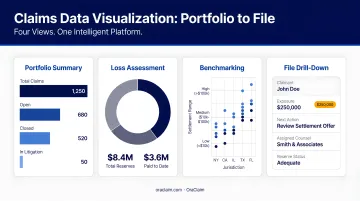
OraClaim's portfolio management module consolidates this into a single view with drill-down to individual files, surfacing under-reserved and over-reserved cohorts as they develop — not after quarterly review.
Financial and Portfolio-Level Reporting
Most billing systems tell you what was invoiced. They don't tell you whether a matter was actually profitable, which carrier relationships are draining margin, or how defense costs compare against indemnity paid.
Financial reporting in claims management software should connect operational data to revenue and cost metrics:
- Realization rate by matter and by partner
- Profitability by carrier client and matter type
- Defense cost as a percentage of indemnity
- Panel-firm cost benchmarks against comparable claims
- Reserve-vs.-paid trajectory by cohort
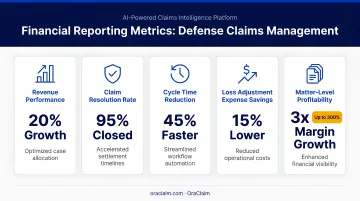
OraClaim's Financial Impact & Margin Analysis module delivers exactly this — surfacing carrier-client P&L, matter-level profitability, and CFO-ready margin reports that show which lines of business and practice areas are profitable versus those generating write-downs.
Compliance and Audit Trail Reporting
Advanced reporting must support regulatory obligations, not just operational ones. NAIC Model 902 requires claim files to document claim handling, and California's Fair Claims Settlement Practices Regulations include specific file and record documentation requirements. State and federal data calls add another layer.
Software that maintains searchable audit logs, timestamps every action, and supports regulatory filing outputs reduces the compliance burden on claims teams — and provides defensible documentation when handling decisions are scrutinized.
OraClaim's closed, access-restricted architecture adds a layer standard RMIS tools can't match: all content processed through the platform remains subject to attorney-client privilege, work-product doctrine, and insurer-insured privilege. Every output is citation-linked to source documents, providing traceability that holds up to governance review.
Outcome and Reserve Accuracy Tracking
Comparing initial reserves against final settlements over time is one of the most underused reporting capabilities available. Done consistently, it exposes systematic over- or under-reserving patterns — which either inflate costs (over-reserving ties up capital) or create financial risk (under-reserving contributes to insolvency exposure, as the Casualty Actuarial Society has documented).
OraClaim's automated benchmarking module flags under-reserved and over-reserved cohorts in real time, issuing exposure-change alerts to adjusters, attorneys, and claims managers as new documents enter a file. This means reserve problems surface when they can still be corrected — not at settlement.
Data Visualization and Self-Serve Reporting
The ability to generate on-demand reports without involving IT or data analysts is critical for claims teams managing high volumes. Forrester's research on enterprise BI environments found that when IT handles more than 20% of reporting requirements, backlogs grow and insight delivery slows — a dynamic that hits claims organizations hard during peak litigation periods.
Effective visualization tools translate complex portfolio data into formats that non-technical stakeholders can act on:
- Heat maps showing claim frequency spikes by jurisdiction
- Trend lines tracking reserve adequacy over time
- Distribution charts breaking down settlement ranges by claim type
- Interactive drill-downs from portfolio summary to individual file
Static charts show what happened. Interactive drill-downs let claims managers identify root causes, isolate outliers, and act before exposure compounds.
How Predictive Analytics and Case Benchmarking Elevate Defense Strategy
Predictive analytics goes further than standard reporting. It uses patterns from closed cases to forecast what's likely on current ones: settlement ranges, litigation duration, cost trajectories, and jurisdiction-specific risk — before those outcomes become surprises.
The Benchmarking Problem Most Teams Face
The biggest barrier to using historical case data isn't lack of data — it's that the data is trapped in unstructured files. Closed case PDFs, scanned records, old practice management exports, and email archives can't be searched or compared systematically. Most defense firms have years of institutional knowledge they simply can't access at scale.
OraClaim's Historical Case File Structuring & Benchmarking module addresses this directly. The AI ingests unstructured historical files and converts them into structured, searchable data across dozens of dimensions:
- Case type, sub-type, jurisdiction, venue
- Judge, plaintiff counsel, plaintiff expert
- Reserve history, settlement amounts, verdict amounts
- Dispositive motion outcomes, mediation outcomes
- Defense costs by phase, time-to-resolution
Once structured, every new claim is benchmarked against the historical book — revealing closest comparables, similar-counsel outcome histories, judge-specific motion-grant rates, and plaintiff-expert reliability patterns.
Strategic Advantages for Defense Teams
This benchmarking capability changes how defense counsel and claims managers approach key decisions:
- Reserve-setting anchored to comparable outcomes rather than intuition
- Settlement authority requests supported by jurisdiction-specific and counsel-specific data
- Litigation strategy informed by what actually worked on similar fact patterns
- Early identification of claims developing toward outlier exposure
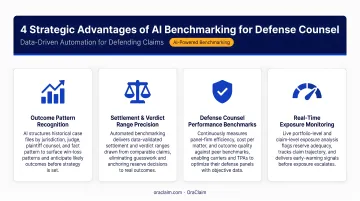
That last point — early identification — carries real financial stakes. Marathon Strategies reported 135 nuclear verdicts in 2024, the highest on record. Jurisdiction-specific benchmarking that tracks venue trends, plaintiff-counsel behavior, and verdict severity patterns gives defense teams advance warning before exposure escalates.
OraClaim's real-time exposure analysis monitors individual files and the full portfolio simultaneously. As new documents enter a claim — medical records, deposition transcripts, expert reports — the AI re-runs exposure analysis. Material changes are flagged to assigned attorneys, adjusters, and claims managers while there's still time to act.
Turning Claims Reports Into Actionable Litigation Strategy
Reports that sit in dashboards nobody acts on deliver no value. Advanced reporting is only useful when insights connect to workflow.
Reports That Trigger Action
OraClaim's exposure-change alert system is a direct example of this principle: when a claim's exposure profile changes materially, alerts go to the assigned attorney, adjuster, and claims manager — enabling reserve adjustments, proactive settlement authority requests, and earlier escalation on developing files. The insight triggers a specific action rather than waiting for a scheduled review.
Portfolio-level dashboards flag panel-firm cost outliers and under-reserved cohorts, giving claims leadership the data they need to reallocate complex claims, adjust assignments, and address performance issues before they affect outcomes.
Client Communication Backed by Data
CLM research covering 92 organizations managing $10–13 billion in annual outside counsel spend found 76% reported litigation costs per file increased — and 69% used e-billing software and third-party auditors to hold panel firms accountable. Carriers and corporate clients expect data-backed performance conversations.
OraClaim is built for exactly this kind of accountability. The custom work product module and outside-counsel alignment functionality give carriers and firms the tools to run those conversations on data, not memory:
- Generates 90-day reports, reporting letters, and reserve memos formatted to individual carrier requirements
- Lets carriers and firms exchange case evaluations and exposure-change alerts directly within the platform
- Reduces reporting back-and-forth and accelerates authority decisions
Performance Reporting Across the Team
Managing partners and claims VPs need visibility into whether individual attorneys, adjusters, and panel firms are performing against benchmarks:
- Realization rate and profitability by partner
- Reserve accuracy by adjuster
- Defense cost per case by panel firm vs. comparable claims
- Outcome vs. prediction on benchmarked matters
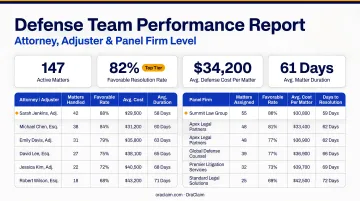
Financial and portfolio analytics in OraClaim surface this data at the individual, firm, and carrier-client level. Supervisors get the numbers needed to identify coaching opportunities, allocate complex claims to the right people, and conduct performance conversations backed by actual results.
What to Look for When Evaluating Reporting in Claims Software
When assessing any claims platform's reporting capabilities, these four questions cut through vendor noise:
1. Is the underlying data structured automatically? Reporting is only as reliable as the data behind it. Software that requires manual data entry or tagging as its primary input produces unreliable reports. Look for platforms that automatically ingest, classify, and structure incoming documents — so reports reflect what's actually in the file, not what someone had time to enter.
2. Is reporting self-serve? Can a claims manager answer a specific question — "how many slip-and-fall claims exceeded initial reserves in the past 12 months?" — without opening a ticket with IT? Self-serve reporting with flexible filters and scheduled distribution directly to stakeholders is the difference between a reporting tool and a reporting backlog.
3. Does it integrate with existing systems? Standalone platforms that don't connect to practice management or document management systems create data silos. OraClaim, for example, connects directly with practice management and document management platforms to pull in existing case and document data — eliminating parallel data entry entirely.
4. Does it scale without custom development? Ask vendors whether the reporting infrastructure handles growing claim volumes without performance degradation. New report types should be configurable as business needs evolve — not locked behind expensive development requests.
Frequently Asked Questions
What are the 4 stages of the insurance claim process?
The four stages are filing and intake, investigation and evaluation, negotiation and settlement determination, and resolution and payment. Advanced reporting tools improve visibility and efficiency at every stage — from tracking new claims at intake to monitoring reserve accuracy through final resolution.
What claims management software do insurance companies use?
The right platform depends on claim volume, line of business, and workflow complexity. Options range from enterprise RMIS tools to purpose-built systems with advanced analytics, benchmarking, and defense-specific reporting built in.
Is it ever worth using a claims management company?
For organizations handling high volumes of complex claims — particularly on the defense side — purpose-built software or a specialized partner can reduce costs, improve outcomes, and free internal teams to focus on strategy. The value compounds when advanced reporting surfaces problems before they escalate.
What reporting features should I look for in claims management software?
Core must-haves include:
- Real-time dashboards
- Self-serve ad-hoc reporting
- Financial and portfolio-level reporting
- Compliance audit trails
- Interactive data visualization
- Predictive analytics and case benchmarking
Reserve accuracy tracking is often overlooked but delivers some of the highest ROI.
How does advanced reporting in claims software help reduce costs?
Advanced reporting surfaces reserve inaccuracies, high-cost claim patterns, and underperforming workflows — giving teams the data to intervene before costs compound. The result is lower direct claim costs and less operational overhead from reactive management.
What is the difference between standard and advanced reporting in claims management software?
Standard reporting describes what happened: claim counts, status updates, basic financials. Advanced reporting interprets that data — surfacing trends, predicting outcomes, benchmarking cases against historical comparables, and connecting claim performance to business-level metrics like margin and portfolio health.