Introduction
Defense teams are under compounding pressure. Claim volumes remain high, severity keeps climbing — commercial auto bodily injury payments grew at roughly three times economic inflation from 2014 to 2019 — and plaintiff firms have moved aggressively to adopt technology that builds cases faster and prices demands more precisely.
The result is a structural imbalance. While plaintiff attorneys use AI to synthesize medical records, pattern verdicts, and generate work product at speed, many defense teams still rely on manual document review and fragmented tools.
Choosing the wrong claims management solution makes this worse. Adjusters and attorneys spend hours on non-billable review. Case data stays unstructured. Margins erode quietly.
The right platform closes that gap by automating review, surfacing patterns, and connecting case data to financial outcomes.
This article walks through the seven features that separate a modern, defense-ready claims management solution from outdated or generic software.
Key Takeaways
- AI-powered document review eliminates non-billable hours and delivers litigation-ready work product immediately
- Case benchmarking lets defense teams enter every negotiation with data, not just institutional memory
- Real-time dashboards and portfolio analytics give leadership visibility into exposure, costs, and margins
- The right solution plugs into existing practice management and document management tools — no rip-and-replace required
- Evaluate every solution by asking vendors to demonstrate each capability, not just describe it
What Is a Modern Claims Management Solution?
A modern claims management solution is a digital platform that centralizes, automates, and analyzes the full lifecycle of a claim — from intake through resolution — replacing manual, siloed processes with structured, data-driven workflows.
Legacy claims software handled the basics: file tracking, financial logs, document storage. Modern platforms go further:
- AI-driven automation that eliminates repetitive manual review
- Predictive analytics and real-time reporting
- System integrations across practice management and document platforms
- Portfolio-level visibility into exposure, outcomes, and performance
For defense teams, the distinction runs deeper. A modern platform must do more than administer claims — it needs to support litigation strategy, generate work product, and provide portfolio-level visibility. General-purpose claims systems built around first-notice-of-loss and payment processing don't serve that workflow.
That gap is exactly what separates a claims administration tool from a claims intelligence platform. OraClaim is built for the latter — purpose-built for defense, it turns unstructured claim files, medical records, depositions, and historical case archives into structured, searchable, benchmarked intelligence that defense teams can act on.
Why Defense Teams Need the Right Claims Management Features
The technology imbalance between plaintiff and defense firms is not theoretical. OraClaim's founders — a former litigator and a former claims risk analyst — observed it firsthand, on both sides of the exposure table.
Plaintiff firms invest in technology to accelerate case building, price claims aggressively, and exploit data patterns. Defense teams, despite having the financial resources, were slower to adopt. The operational cost shows up in predictable ways:
- Attorneys spending 40–70% of associate hours on non-billable document review
- Case data that lives in PDFs and email threads rather than structured, searchable systems
- No portfolio-level visibility into where exposure is concentrated or which claim types are draining margin
- Reserve decisions made on gut feel rather than benchmarked historical data
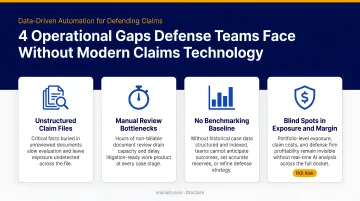
Each of these gaps has a direct technological fix — which is exactly what the right claims management features are designed to deliver. Over 95% of legal professionals surveyed by Lex Machina in 2025 agreed that litigation analytics are valuable, and 70% said clients now expect lawyers to use them. The seven features below map directly to the operational gaps defense teams are still carrying.
7 Features to Look for in a Modern Claims Management Solution
1. AI-Powered Document Review and Litigation-Ready Work Product
This is the highest-impact feature for defense teams, and the one where the gap between modern and legacy platforms is widest.
AI that reads, categorizes, and extracts critical facts from large document sets eliminates the non-billable review hours that drain attorney and adjuster productivity most. But the output matters as much as the analysis. A platform that only flags documents still leaves attorneys doing the synthesis work from scratch.
Litigation-ready work product means the system generates structured outputs attorneys can actually use:
- Medical chronologies with date, provider, diagnosis, treatment, and outcome columns — flagging treatment gaps, pre-existing conditions, and inconsistencies
- Litigation timelines built directly from the claim file with no manual data entry
- Case evaluations covering liability, damages, settlement ranges, reserve recommendations, and motion opportunities
- Deposition outlines tailored to witness role and case-specific facts, with impeachment material and pin-citations
- Motion drafts — MSJ, motions in limine, Daubert/Frye, discovery motions — formatted to firm style, jurisdiction-specific rules, and case record
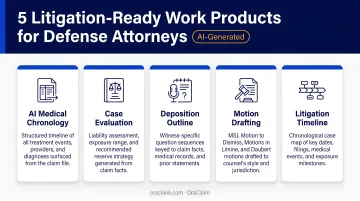
Thomson Reuters reported in 2026 that insurance defense firm Zarwin Baum compressed full-day document review tasks into under 30 minutes using generative AI. That's the standard a modern platform should meet.
OraClaim's platform generates first-draft medical chronologies in under 60 minutes for typical bodily injury files, and produces full case evaluations in minutes rather than the 10–40 billable hours traditionally required. All outputs are first drafts for attorney review and finalization, not final legal advice.
2. Case Benchmarking and Outcome Pattern Recognition
This feature separates genuinely modern platforms from basic claims software.
Automatically structuring historical case data and benchmarking current claims against past outcomes gives defense teams something they've historically had to approximate with institutional memory: actual data on settlement ranges, jurisdiction behavior, plaintiff counsel tendencies, and defense strategy effectiveness.
Swiss Re estimated that social inflation averaged 5.4% annually from 2017 to 2022 — above 3.7% economic inflation — contributing 7 percentage points to U.S. liability claim growth in 2023 alone. In that environment, reserve decisions and negotiation strategy based on data outperform those based on feel.
OraClaim's benchmarking module works across multiple dimensions:
- Case type, jurisdiction, venue, and judge
- Plaintiff counsel and plaintiff expert historical outcomes
- Prior settlement and verdict ranges for comparable fact patterns
- Judge-specific motion-grant rates
- Reserve adequacy compared to similar closed files
- Defense cost by phase across comparable matters
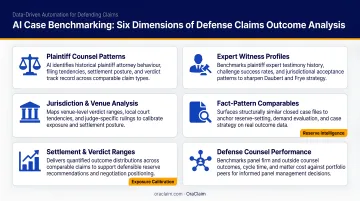
The system runs continuously without manual data prep, auto-tagging each claim and producing benchmark comparisons across all of these dimensions. According to OraClaim's internal data, this reduces manual benchmarking effort by 80%+ and brings analytical discipline to organizations that previously relied on ad-hoc searches.
3. Real-Time Reporting and KPI Dashboards
Claims managers and defense organizations cannot afford to make decisions based on reports assembled last week. A modern platform provides live visibility into portfolio status, updated continuously without manual compilation.
Self-service dashboards with drill-down capability allow leadership to:
- Monitor open claims, resolution timelines, and aging buckets
- Track reserve adequacy across cohorts
- Identify exposure concentration by jurisdiction, plaintiff counsel, or claim type
- Surface portfolio outliers and under-reserved or over-reserved categories
- Review panel-firm cost performance against benchmarks
For defense law firms, that same real-time visibility extends to matter economics: realization rates, billing efficiency, and how AI work-product automation is shifting the firm's margin profile.
OraClaim's portfolio dashboards consolidate open and closed claims, reserves, paid and incurred losses, defense costs, indemnity payments, recoveries, and exposure analytics into a single view. The system flags critical items and supports drill-down to individual claim files, giving CCOs, claims VPs, and managing partners a picture of portfolio health that traditional billing software simply doesn't provide.
4. Seamless Integration with Existing Practice Management and Document Systems
A modern claims solution must connect with the tools defense teams already use. Forcing a rip-and-replace implementation disrupts existing workflows, delays adoption, and creates operational risk.
The ABA's 2024 Technology Survey found that 47% of lawyers say technology-related problems negatively impact productivity. Integration failures are a primary driver of that friction.
What to look for:
- Practice management systems: Clio, MyCase, Smokeball, PracticePanther
- Document management systems: NetDocuments, iManage, Worldox, Box
- Pre-built connectors that don't require custom development work
- API support for organizations with non-standard environments
OraClaim integrates with all of the platforms listed above, allowing organizations to add claims intelligence capability without rebuilding their technology stack — implemented upon customer request as part of onboarding.
5. Portfolio-Level Financial and Margin Analytics
Claims management is a financial function as much as an operational one. The right platform connects case-level data to the revenue and cost metrics that determine whether a defense practice is profitable, not merely whether it's resolving claims.
For defense law firms, that means visibility into:
- Matter profitability by carrier client and matter type
- Realization rates, write-downs, and write-off drivers
- Billing efficiency and leverage
- Where AI work product automation is changing the billable-hour mix
For claims organizations, the relevant metrics include:
- Total cost of risk by line of business
- Defense cost as a percentage of indemnity
- Panel-firm cost benchmarking
- Reserve-vs.-paid trajectory by cohort
- AI productivity benefit captured as reduced billable hours for equivalent output
OraClaim's Financial Impact and Margin Analysis module produces CFO-ready margin reports, carrier-client P&L analyses, and partner-level dashboards — connecting the operational claims workflow to the financial outcomes leadership needs to see. The result is a shift from chasing lagging indicators to managing the portfolio before problems compound.
6. Enterprise-Grade Security and Data Protection
Defense claims data contains attorney-client privileged communications, proprietary litigation strategy, and sensitive claimant information. Security is not a secondary feature: it's a foundational requirement.
ABA Formal Opinion 477 requires lawyers to make reasonable efforts to prevent unauthorized access to client information, and to apply special security precautions to particularly sensitive matters. Yet only 34% of attorneys use software that guarantees SSL encryption, according to the ABA's 2024 Cloud Computing TechReport.
When evaluating a claims management solution, ask vendors specifically about:
- Encryption: Data in transit and at rest
- Access controls: Role-based permissions and configurable collaboration settings
- Authentication: Multi-factor authentication requirements
- Audit trails: Full activity logging for compliance and privilege protection
- Privilege architecture: How the system treats AI-processed data for privilege purposes
- Sub-processor restrictions: Whether third-party components can access, retain, or train on client data
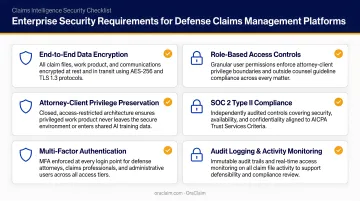
OraClaim operates as a closed, access-restricted system. The platform's architecture treats all confidential information — prompts, inputs, intermediate outputs, final outputs — as subject to attorney-client privilege and work-product protection.
Critically, the system contractually prohibits any sub-processors from using client data for training, model improvement, or human review. That's a specific, architecture-level commitment, not a general assurance.
For specific certifications and compliance framework details, contact OraClaim directly at trust.oraclaim.com.
How OraClaim Delivers These Features
OraClaim is an AI-powered claims intelligence platform built specifically for the defense side of the docket. Co-founders Mark Tepper and Andy Anderson are former practitioners who experienced the plaintiff-defense technology gap firsthand. They partnered with Ali Khan, a data security engineering leader, to build a platform that meets rigorous standards for encryption and privilege protection.
The platform delivers all seven features discussed above in a single, integrated system:
- Claim file review, medical chronologies, case evaluations, deposition outlines, motions, and custom work product — trained on the firm's own institutional style
- Historical case structuring and automated benchmarking across plaintiff counsel, experts, judges, jurisdictions, and fact patterns
- Portfolio management dashboards with drill-down from aggregate exposure to individual claim files
- Pre-built integrations with Clio, MyCase, NetDocuments, iManage, and other common platforms
- Matter profitability, carrier-client P&L, and TCOR analytics connecting operational data to margin outcomes
- Closed, access-restricted architecture with privilege protection built into the system's design
In practice, that means cutting claim file review time in half, reducing medical chronology drafting from 15–60+ hours to under 60 minutes, and scaling capacity without adding headcount. One managing partner at a regional defense firm put it directly: "We were doing good work, but OraClaim allows us to work faster, which makes us better."
OraClaim is backed by MGV, Forum Ventures, Newfund Capital, Meridian, and Roo Capital, and is a sponsor of DRI, FDCC, ADC, and FLA. To see these capabilities in action, request a demo at oraclaim.com.
Conclusion
Choosing a claims management solution is a strategic decision with direct consequences for defense outcomes. The features that matter most for defense teams are those that directly reduce non-billable time, surface critical facts and case patterns from unstructured data, and enable organizations to handle more matters without sacrificing defense quality.
The right platform is built for the specific workflows, adversarial dynamics, and financial pressures that defense lawyers and claims professionals face — not retrofitted from general-purpose software. Generic software built for first notice of loss and payment processing won't close the technology gap with plaintiff firms.
Use the seven features above as your evaluation framework, and hold every vendor to a live demonstration of each one. If a vendor can only describe a capability in slides, that's your answer.
Frequently Asked Questions
What is a modern claims management solution?
A modern claims management solution is a digital platform that automates and centralizes the full claims lifecycle — from intake through resolution. Unlike legacy systems, modern platforms combine AI-powered automation, real-time analytics, and system integrations to improve speed, accuracy, and case outcomes.
How is modern claims management software different from traditional systems?
Legacy systems handle basic financial tracking and document storage. Modern platforms add AI-powered automation, real-time analytics, case benchmarking, and deep system integrations. These capabilities matter most for defense teams competing against plaintiff firms that have moved faster on technology adoption.
What features matter most for defense lawyers in a claims management solution?
AI-powered document review, case benchmarking and outcome pattern recognition, litigation-ready work product generation, and portfolio-level financial analytics deliver the highest impact for defense teams. These features directly reduce non-billable time and improve both case outcomes and margin performance.
How does AI improve claims management for defense teams?
AI eliminates non-billable document review by automatically extracting critical facts and identifying patterns across historical cases to sharpen strategy. It also generates structured work product — medical chronologies, case evaluations, deposition outlines, and motions — ready for attorney review rather than drafted from scratch.
Can a modern claims management solution integrate with existing practice management software?
Yes. Modern platforms should offer pre-built integrations with common systems like Clio, MyCase, NetDocuments, and iManage, allowing organizations to add claims intelligence without replacing the systems they already use.
What security standards should a claims management solution meet?
Defense claims data requires end-to-end encryption, role-based access controls, multi-factor authentication, audit trails, and a privilege-protection architecture governing how AI handles confidential data. Ask vendors how sub-processors manage client information — don't accept general security assurances at face value.