Introduction
Healthcare claims management spans the full lifecycle of a claim — from initial intake and documentation through adjudication, settlement, and dispute resolution. For insurance carriers, defense law firms, TPAs, and claims professionals, understanding where this market is heading is operational intelligence, not background reading.
The numbers confirm why. US national health expenditures grew 7.2% to $5.3 trillion in 2024, and FAIR Health's commercial claims repository now holds over 47 billion claim records, growing by more than 3 billion annually.
That volume won't become manageable through incremental process improvement. It demands structural change — and the organizations that recognize this early are already pulling ahead.
This article maps the five trends reshaping claims management heading into 2026: AI and automation, cloud migration, fraud detection, predictive analytics, and the widening technology divide between plaintiff and defense. Each carries direct implications for how carriers, defense firms, and TPAs need to plan, invest, and compete.
Key Takeaways
- The global claims processing software market is projected to reach $10.1 billion by 2033, growing at 8.5% CAGR
- AI is moving beyond basic automation into intelligent document review, predictive exposure analysis, and litigation-ready work product generation
- Mid-sized insurers and TPAs are shedding legacy infrastructure as cloud/SaaS platforms lower the barrier to entry
- Fraud detection and compliance are now core platform expectations, not optional add-ons
- Plaintiff firms are outpacing defense teams on legal technology adoption, making that gap a direct competitive liability
Key Trends Shaping the Healthcare Claims Management Market in 2026
Trend 1: AI and Automation Are Redefining the Claims Lifecycle
AI's role in claims has moved well past rules-based routing. Modern platforms now handle intelligent document recognition, predictive exposure modeling, and automated decision-making on both routine and complex claims.
According to McKinsey, Aviva deployed over 80 AI models in its claims operation, cutting complex-case liability assessment time by 23 days and saving more than £60 million (approximately $76 million USD) in 2024 — a UK insurer benchmark that illustrates what scaled AI deployment looks like in practice. One large carrier used tailored GPT models to handle nearly 50,000 daily claims-related communications, with attorneys reviewing drafted outputs rather than generating them from scratch.
For defense teams, the practical applications are equally concrete. Platforms like OraClaim automate the entire claim file review process — ingesting medical records, demand packages, depositions, and expert reports, then classifying every document and extracting every relevant fact.
Non-billable document review traditionally consumes 40–70% of associate hours per matter. OraClaim's AI reduces total claim file review time by half or more, cutting medical chronology drafting from 15–60+ hours per file to under 60 minutes.
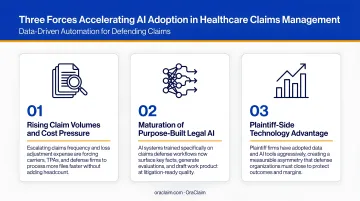
Three forces are accelerating this shift:
- Multi-party files and layered medical histories require more analysis than manual workflows can sustain
- Claims adjuster employment is projected to decline 5% through 2034 (BLS), and Deloitte reports 20% average adjuster attrition — each departure taking roughly six years of institutional knowledge with it
- Faster adjudication has become a baseline client expectation, not a point of differentiation
Trend 2: Cloud-Based and SaaS Models Are Replacing Legacy Systems
Legacy on-premise infrastructure is losing ground to cloud-native and SaaS deployment models — and the business case is straightforward. McKinsey estimates cloud adoption could create $70–$110 billion in insurance EBITDA impact by 2030, with cloud-native architecture reducing computing costs by 30% and deploying workloads up to 20 times faster.
Mid-sized insurers and TPAs are driving this shift most aggressively. Without large IT departments, they gain access to enterprise-grade AI capabilities through SaaS subscriptions that would have required multi-year infrastructure projects under legacy models.
OraClaim operates as a fully cloud-based SaaS platform, integrating with practice management and document management systems that defense firms already use — including Clio, MyCase, NetDocuments, iManage, and others. Defense teams access AI-powered claims intelligence without replacing existing workflows or deploying new internal infrastructure.
Trend 3: Fraud Detection and Compliance Are Becoming Core Platform Capabilities
Healthcare fraud is not a peripheral problem. The FBI identifies it as one of the most costly white-collar crimes, while Deloitte estimates P&C fraudulent claims create approximately $122 billion in annual losses — with AI-driven fraud analytics potentially saving $80–$160 billion by 2032.
Modern claims platforms now embed fraud detection directly into claim workflows rather than treating it as a standalone audit function. Predictive models flag anomalies, duplicate submissions, and suspicious treatment patterns before they produce financial loss.
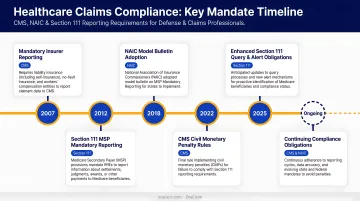
Regulatory pressure is compounding this. Compliance is no longer optional:
- CMS-0057-F requires FHIR-based payer APIs by January 1, 2027, and prior authorization decisions within 72 hours for expedited requests beginning January 1, 2026
- NAIC Model Law #668 requires written information security programs, cybersecurity event investigation, and commissioner notification — now implemented in 28 jurisdictions
- Section 111 Mandatory Insurer Reporting applies to liability, no-fault, and workers' compensation insurers handling Medicare beneficiary claims
For OraClaim users, anomaly detection is woven into the claim file review workflow. The AI surfaces treatment inconsistencies, conflicting statements, timeline gaps, causation issues, and pre-existing condition patterns as standard output — not as an add-on module.
Trend 4: Data Analytics and Predictive Intelligence Are Driving Smarter Claims Decisions
The volume of claims data available to insurers and defense organizations has reached a point where the competitive advantage belongs to whoever can surface patterns from it fastest.
Advanced analytics capabilities now allow organizations to:
- Benchmark claim outcomes against historical portfolios by jurisdiction, judge, plaintiff counsel, and fact pattern
- Assess litigation risk based on comparable case outcomes
- Identify reserve inadequacy before claims deteriorate
- Optimize settlement timing based on historical resolution data
OraClaim's automated benchmarking module auto-tags every claim across dozens of dimensions — case type, venue, judge, plaintiff counsel, plaintiff expert, alleged injuries, treatment patterns — then surfaces similar-case settlement and verdict ranges, counsel-specific outcome histories, and judge-specific motion-grant rates. This reduces manual benchmarking effort by more than 80% and replaces gut-feel decisions with data-backed reserve recommendations.
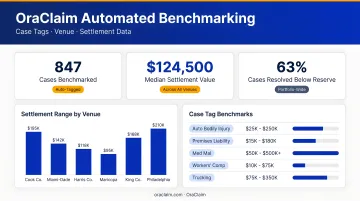
For claims VPs and Chief Claims Officers, portfolio-level dashboards roll up real-time exposure by line of business, jurisdiction, plaintiff-counsel concentration, reserve adequacy, and aging — providing the visibility needed for proactive portfolio management.
Trend 5: The Technology Gap Between Plaintiff and Defense Is Widening
This is the trend most underreported in standard market coverage — and the one with the most direct consequences for defense teams.
Plaintiff firms are adopting legal technology at a faster pace than defense organizations. Thomson Reuters found that 26% of legal professionals used GenAI in 2025, nearly double the 14% in 2024. The DRI white paper on AI in legal practice found that 60% of in-house counsel already expect outside defense firms to use GenAI tools. The expectation exists. The adoption on the defense side is lagging.
OraClaim was founded on this observation. Co-founders Mark Tepper and Andy Anderson, both former litigators and claims professionals, recognized that plaintiff lawyers were adopting technology faster than defense teams — and that financial resources alone wouldn't close that gap. The platform is built specifically for the defense side of the docket, covering workflows that plaintiff intake tools and general legal AI were never designed to handle.
The distinction matters. Defense workflow requirements — case benchmarking against historical closed files, exposure analysis across a managed portfolio, privilege-protected work product generation, carrier-aligned reserve reporting — are fundamentally different from what plaintiff tools are designed to do.
What's Driving Growth in the Healthcare Claims Management Market
The claims processing software market is on track to double by 2033 — and the forces behind that growth are already reshaping how defense teams operate. The market was valued at $5.2 billion and is projected to reach $10.1 billion by 2033 at an 8.5% CAGR, driven by four converging pressures:
Rising claim volumes and complexity Over 10 billion claims are submitted annually across the US healthcare industry, with FAIR Health's repository growing by more than 3 billion claim records per year. Manual processes cannot absorb this volume without proportional headcount — which creates unsustainable cost structures.
Cost efficiency imperatives Research published in a peer-reviewed institutional study estimates US healthcare administrative spending at approximately $1 trillion annually, with claims processing costing $2–$4 per claim for private payers and $10–$15 per claim for providers. Manual claim status inquiries cost $15.96 per transaction versus $4.33 electronically. At that gap, automation pays for itself quickly.
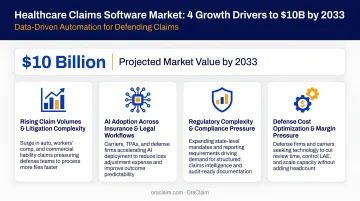
Regulatory compliance pressure CMS-0057-F interoperability requirements, NAIC data security obligations, and Section 111 reporting mandates have raised the compliance bar significantly. Platforms without built-in compliance capabilities now expose organizations to audit risk and manual workarounds that compound operating costs.
Competitive dynamics and customer expectations Policyholders and legal stakeholders expect faster resolutions and real-time status visibility. Defense firms whose carrier clients expect GenAI-augmented work product face direct competitive pressure to modernize or lose panel placement.
How These Trends Are Impacting the Insurance and Defense Ecosystem
Operational Impact
AI and automation are cutting claim review timelines and error rates across provider billing and defense litigation workflows. OraClaim's platform delivers those gains concretely:
- Reduces case evaluation time from 10–40 billable hours to minutes
- Cuts deposition outline preparation from 4–20 hours per witness to a first draft in minutes
Integrated data environments are replacing siloed systems. Rather than managing separate tools for document storage, case evaluation, reserve tracking, and portfolio reporting, claims organizations gain a unified view of case history, financial exposure, payer behavior, and panel-firm performance — with drill-down from portfolio to individual claim file available in one place.
Business Impact
The cost structure of claims operations is shifting. Investment is moving from manual staffing toward technology platforms that scale capacity without proportional headcount growth. For defense firms, this changes the economic model: AI-generated first drafts reduce non-billable hours while maintaining or improving output quality.
Carriers and defense firms that adopt AI-driven claims infrastructure increasingly demonstrate measurable outcomes: lower loss adjustment expense, faster resolution, more accurate reserves. One managing partner using OraClaim noted: "We were doing good work, but OraClaim allows us to work faster, which makes us better. Our clients notice the difference."
Workforce Impact
The day-to-day role of claims professionals and defense lawyers is evolving. Less time goes to repetitive document review; more goes to judgment-intensive strategy, client relationships, and complex evaluation work.
Key shifts include:
- Claims adjusters moving from document chasing to proactive risk management and reserve strategy
- Defense attorneys spending less time on administrative compilation and more on litigation preparation and negotiation
- Senior claims executives gaining real-time portfolio intelligence without manually pulling analyst reports
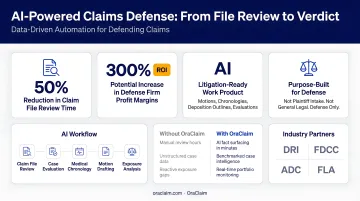
Organizations embracing AI-augmented workflows scale capacity without proportional headcount increases, especially in high-volume environments where adding adjusters isn't economically viable.
Future Signals to Watch in Healthcare Claims Management
Those trends reflect where the market stands today. Several early signals point to where it heads over the next one to three years:
Generative AI in claims documentation and legal work product
The trajectory points toward AI systems that don't just extract and summarize but actively generate litigation-ready documents trained on a firm's own institutional style: demand responses, mediation briefs, reserve memos, and motion drafts. OraClaim already offers this capability, reducing standard defense work product drafting time by 50–80%.
As GenAI adoption among legal professionals continues rising — from 14% in 2024 to 26% in 2025 per Thomson Reuters — this will shift from differentiator to baseline expectation.
Interoperability and data standardization
CMS-0057-F mandates FHIR-based payer APIs by January 1, 2027. As these standards mature, pressure for standardized data exchange will grow across EHR systems, payer platforms, and defense management tools. Current adoption gaps signal where near-term effort will concentrate:
- Electronic claim status transaction adoption: 80% for medical plans
- Adoption for dental plans: 28%
That gap is where near-term standardization effort will focus.
Defense technology adoption as a strategic imperative
If current adoption rates hold, the technology asymmetry between plaintiff and defense will deepen. Organizations that delay modernizing their claims infrastructure risk structural disadvantage in both litigation outcomes and portfolio profitability.
Defense organizations that move now — with platforms built specifically for claims defense workflows, not adapted from general-purpose tools — will be better positioned to compete as this environment continues shifting.
Conclusion
Healthcare claims management is undergoing a structural shift, not a temporary cycle. AI adoption, cloud infrastructure, predictive analytics, and embedded fraud detection are reshaping how claims are defended and managed — and the widening technology gap between plaintiff and defense organizations makes this a strategic issue, not a background one.
Organizations that act early to adopt purpose-built claims technology will be better positioned to manage risk, reduce costs, and achieve stronger outcomes across their entire portfolio. The platform decisions being made now — what to adopt, what to defer, and how to structure the underlying data environment — will separate organizations that control their claims costs from those that absorb them.
Frequently Asked Questions
What is the current size and growth rate of the healthcare claims management market?
The global claims processing software market was valued at $5.2 billion and is projected to reach $10.1 billion by 2033, growing at an 8.5% CAGR. Growth is driven by rising claim volumes, digital transformation investment, and accelerating AI adoption across insurance and healthcare sectors.
How is AI changing healthcare claims management in 2026?
AI now automates document classification, fact extraction, fraud detection, exposure analysis, and work product generation, cutting processing time and enabling organizations to handle higher claim volumes without proportional headcount increases. The broader shift is from rules-based automation to intelligent, continuously-updating decision support.
What are the biggest challenges in healthcare claims management today?
Legacy system integration, data migration complexity, and regulatory compliance remain persistent friction points. For defense organizations specifically, the growing pressure to match the technology pace of plaintiff firms — which are adopting AI faster — represents an increasingly urgent structural challenge.
How does cloud-based claims software benefit insurance carriers and TPAs?
Cloud and SaaS platforms eliminate upfront infrastructure costs, scale with claim volume, and integrate with existing practice management and document management tools. Mid-sized insurers and TPAs gain access to enterprise-grade AI capabilities without requiring large IT departments or multi-year deployment timelines.
What role does data analytics play in claims management?
Predictive analytics and benchmarking tools help organizations identify claim patterns, assess litigation risk against historical outcomes, optimize settlement timing, and surface reserve adequacy issues before they become problems. This translates directly into reserve decisions that hold up under scrutiny and portfolio-level outcomes that are easier to predict and defend.
How can defense teams keep up with the technology advantage plaintiff firms are gaining?
Defense teams need platforms built specifically for their workflow, not general-purpose tools adapted from plaintiff or transactional use cases. OraClaim addresses this directly, with purpose-built capabilities including privilege-protected work product generation, historical case benchmarking, and carrier-aligned portfolio reporting.