Key Takeaways
- "Claims adjuster software" spans four distinct categories: estimating, lifecycle management, documentation, and AI automation — picking the wrong one leaves critical gaps in your workflow.
- US liability claims rose 57% over the past decade due to litigation costs, putting defense teams under increasing strain.
- Plaintiff firms and carriers are adopting AI fast; many defense-side teams still run on manual processes.
- Defense teams need AI purpose-built for litigation-ready work product, case benchmarking, and margin insight — not a general claims platform with a defense module bolted on.
- Start by mapping your actual workflow pain points — then evaluate vendors, not the other way around.
What Is Insurance Claims Adjuster Software?
Claims adjuster software is any digital platform that helps professionals manage, track, process, and resolve claims from intake through closure. The practical definition: a system that replaces manual paperwork, disconnected spreadsheets, and phone-based coordination with centralized, automated workflows.
Adjusters once relied on physical price books, manual calculations, and phone trees. Modern platforms transformed that workflow — but the category has since fractured into distinct tool types that serve very different users.
"Claims adjuster software" is an umbrella term, not a single product. It covers:
- Property estimating tools
- Full claims lifecycle management platforms
- Field documentation and evidence capture tools
- AI-powered automation and analytics layers
A field adjuster at a carrier needs a different stack than a defense attorney managing 200 litigated files. Choosing a tool without understanding which category it belongs to is the most common — and most expensive — purchasing mistake.
The Growing Divide in Adoption
Carriers and plaintiff-side firms have moved aggressively on technology. According to Deloitte, 82% of carriers plan agentic AI adoption within three years. Meanwhile, many defense-side claims teams and law firms still coordinate cases through email threads and manually review hundreds of pages of medical records per file.
That gap is measurable. OraClaim's founders — Mark Tepper, who litigated claims for enterprise companies and insurers, and Andy Anderson, who analyzed risk and managed high-exposure claims — built the company specifically because they watched plaintiff lawyers adopt technology faster while defense teams carried the same manual workload.
The numbers tell the story: non-billable document review consumed 40–70% of associate hours per matter, and portfolio visibility was nonexistent.
The Main Categories of Claims Adjuster Software
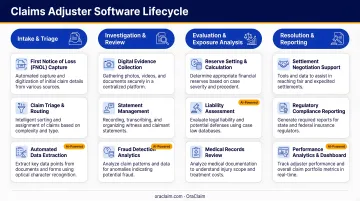
Claims adjuster software spans four distinct categories — each serving a different phase of the claims lifecycle. Knowing what each one does helps you identify where gaps exist in your current workflow.
Claims Estimating Software
Estimating tools calculate repair and replacement costs for property and auto damage claims, pulling from regional cost databases to generate line-item estimates.
Xactimate (by Verisk) is the dominant platform in the market — Verisk reports its Xactware property estimation solutions are used by 80% of top property insurance carriers. CoreLogic's Claims Estimate (formerly Symbility) is the primary alternative, offering guided estimating workflows, monthly pricing updates, drag-and-drop diagramming, and offline field capability.
Key capabilities in this category:
- Regional cost databases covering 460+ geographic areas
- Measurement and sketching tools
- Photo documentation integration
- Mobile field capture for remote sites
Proficiency in at least one of these platforms is considered the most important technical skill for field adjusters handling property claims.
Comprehensive Claims Management Platforms
These are the operational command centers of claims — handling the full lifecycle from First Notice of Loss (FNOL) through assignment, investigation, negotiation, and settlement.
Guidewire ClaimCenter serves 270+ customers across 30+ countries and is positioned for carrier-grade claims management with embedded AI. Snapsheet is used by 16 of the top 20 P&C carriers and emphasizes configurable cloud-based workflows. Riskonnect (formerly Ventiv) covers carriers, TPAs, MGAs, and self-insured employers.
The core value these platforms deliver:
- Automated claim routing based on adjuster workload and expertise
- Policy administration integration to verify coverage
- Deadline management and audit trails
- Regulatory compliance documentation
These platforms are primarily built for carriers, TPAs, and independent adjusting firms — not for defense-side litigation management.
Documentation and Field Evidence Tools
This category captures and organizes physical evidence from claim sites — drone-based 3D mapping, aerial imagery, video documentation, and photo management. Verisk provides aerial imagery at roughly 7.5 cm resolution with a Roof Condition Score covering nearly 100% of the contiguous US. EagleView reports 98.77% roof measurement accuracy with 3D sketches available directly in Xactimate.
Key capabilities in this category:
- Drone-based 3D mapping and aerial imagery
- High-resolution roof condition scoring
- Video and photo documentation workflows
- Direct integration with estimating platforms like Xactimate
These tools matter most for property and catastrophe claims where site visits are dangerous, impractical, or time-sensitive.
AI-Powered Claims Automation and Analytics
The newest and fastest-growing category. Unlike workflow automation that routes claims and triggers reminders, AI tools use machine learning and natural language processing to reason over claim documents — summarizing medical records, extracting facts from depositions, detecting fraud patterns, and predicting outcomes.
Carrier-side AI has matured considerably, with tools embedded directly into platforms like Guidewire. The defense side has lagged — but that's changing. Defense-focused AI tools now handle tasks like claim file review, case evaluation, medical chronology drafting, and real-time exposure analysis, giving defense attorneys and claims professionals capabilities that were previously manual and time-intensive.
Must-Have Features of Claims Adjuster Software
Not all platforms deliver equal value. These four capabilities consistently distinguish tools that accelerate defense workflows from those that add friction.
Claims Intake and Workflow Automation
Effective software automates claim intake, routes assignments based on claim type and adjuster workload, and enforces consistent process steps. Experienced adjusters shouldn't spend time on routing decisions or manual handoffs — that's work the system should handle.
The direction of the industry is clear:
- McKinsey notes the technology for straight-through processing of simple claims already exists, with future operations using automated "claim concierge" workflows for routine files and AI "whisper agents" for complex handlers
- Snapsheet reports its platform compresses claims cycle times from weeks to days
Document Management and Security
All claims-related documents — statements, medical records, police reports, correspondence — need to be centralized, searchable, and permission-controlled.
Security is non-negotiable given what's in these files:
- Encryption at rest and in transit
- Authentication controls limiting access to authorized users
- Access logging for audit purposes
- Compliance with NAIC Model Law #668 and HIPAA where applicable
IBM reports the average global data breach cost reached $4.88M in 2024 — a benchmark that puts the cost of inadequate security in perspective for any claims organization evaluating platforms.
Analytics, Reporting, and Portfolio Visibility
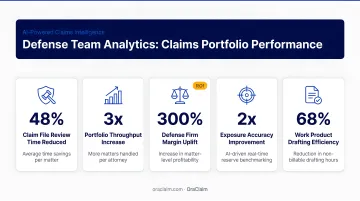
The best platforms turn claims data into decisions. LexisNexis found that incorporating richer data into claims handling can lower severity payments by 25% while reducing attorney involvement and shortening cycle times.
For defense teams specifically, useful analytics include:
- Litigation outcome trends by case type and jurisdiction
- Cost-per-case and LAE as a percentage of indemnity
- Settlement and verdict ranges against historical comparables
- Panel firm performance benchmarks
- Reserve adequacy by cohort
Integration with Existing Systems
Software that can't connect to existing practice management, document management, or billing systems compounds the problem it's supposed to solve. Evaluate integration capability early — platforms with pre-built connectors or open APIs should move to the top of the shortlist; those requiring custom build-outs should not.
How AI Is Transforming the Claims Adjuster's Workflow
AI is actively reshaping how claims professionals handle document-heavy, high-volume workloads. Carrier-side AI and defense-side AI, however, are solving fundamentally different problems.
From Workflow Automation to Intelligent Decision Support
Early claims automation handled routing and deadline triggers — rules-based logic that moved claims from inbox to inbox. Current AI has moved well beyond that. McKinsey's Aviva case study shows what's possible at scale: Aviva deployed 80+ AI models in claims, cut complex liability assessment time by 23 days, improved routing accuracy by 30%, reduced customer complaints by 65%, and saved more than £60M in 2024.
That's carrier-side AI optimizing FNOL, routing, and liability triage. The defense side has a different problem.
The Specific Challenge for Defense Teams
Defense lawyers and claims professionals face a particular version of the document problem: overwhelming file volumes, non-billable review time, and the need to surface the facts that matter for litigation strategy — not just triage claims for payment.
RAND found that document review accounts for 73% of the cost of producing electronic documents in civil lawsuits. Thomson Reuters reports that legal professionals expected AI to save 12 hours per week within five years, with 63% already using AI for tasks like research, summarization, and drafting.
On the liability side, the pressure is real: Swiss Re found US liability claims increased 57% over the past decade, driven primarily by large court verdicts, with a 7% annual peak in 2023. Defense teams are handling more complex, higher-stakes files while the plaintiff bar invests aggressively in technology.
OraClaim: AI Built for Defense Lawyers and Claims Professionals
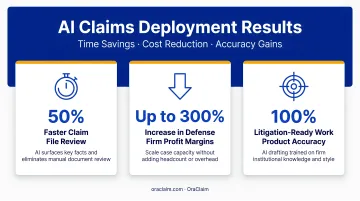
- Claim File Review: Ingests entire claim files, classifies every document, and surfaces contradictions, treatment inconsistencies, and causation issues before they become reserve surprises
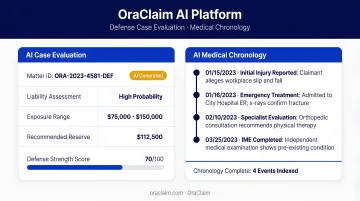
- Case Evaluation Generation: Produces full evaluations in minutes — liability assessment, damages exposure, reserve recommendations, settlement and trial value ranges, and dispositive motion opportunities
- Medical Chronology Drafting: Cuts drafting time from 15–60+ hours per file to under 60 minutes for a first draft
- Deposition Outlines and Motion Drafting: Generates witness-specific outlines with impeachment material and pin-citations; drafts MSJs, Daubert/Frye motions, discovery motions, and procedural filings tailored to jurisdiction and firm style
- Custom Work Product: Trained on the firm's brief bank and style guide to produce demand responses, mediation briefs, 90-day reports, reserve memos, and carrier reporting letters
OraClaim operates as a closed, access-restricted platform that preserves attorney-client privilege and work-product protection. No confidential information is used to train external AI models or accessed by OraClaim personnel outside of authorized support contexts. The platform integrates with Clio, MyCase, Smokeball, NetDocuments, iManage, and other practice management and document management systems defense teams already use.
The outcome metrics: cut claim file review time in half, increase defense firm profit margins by up to 300%.
Predictive Analytics and Portfolio Intelligence
Leading AI platforms are moving beyond individual claim support to portfolio-level intelligence. For defense organizations, this means:
- Real-time exposure analysis that re-runs automatically as new documents enter a file and issues alerts before reserve surprises develop
- Automated benchmarking that tags each claim on dozens of dimensions — jurisdiction, plaintiff counsel, judge, fact pattern, treatment patterns — and surfaces comparable settlement and verdict ranges without manual analyst work
- Claims portfolio management that unifies open and closed claims, reserves, paid losses, defense costs, and indemnity data in a single view with drill-down to individual files
- Financial impact and margin analysis connecting LAE and matter-level costs to firm profitability, panel performance, and carrier-client P&L
OraClaim's benchmarking module reduces manual benchmarking effort by 80%+, replacing the spreadsheet roundups and gut-feel estimates that most claims organizations still rely on.
How to Choose the Right Claims Adjuster Software
The right choice depends on your role and workflow. Start by mapping actual pain points before evaluating vendors:
- Field adjuster at a carrier: estimating software paired with a lifecycle management platform
- Defense attorney on litigated claims: AI-powered document review and case analytics
- TPA: scalable workflow management across carrier-client portfolios
Key evaluation criteria:
| Criterion | What to Assess |
|---|---|
| Feature fit | Does it solve your actual workflow pain points, or just add capabilities you don't use? |
| Integration | Pre-built connectors to your practice management, document management, and billing systems? |
| Security | Encryption, authentication, access controls, privilege preservation architecture |
| Implementation timeline | Cloud-based AI layers can deploy in weeks; core claims replacements take longer |
| Total cost | Include training, configuration, integration fees, and ongoing maintenance |
One practical rule: prioritize purpose-built over generic. A platform built for property estimating cannot do what a litigation defense platform does. The same applies to carrier FNOL tools versus defense AI — they serve different masters. Look for vendors with deep expertise in your specific segment of the claims ecosystem, not general tools with claims modules added on.
OraClaim is one example of this principle in practice — built exclusively for the defense side of the docket and embedded in the defense ecosystem through partnerships with DRI, FDCC, ADC, and FLA. That kind of segment-specific positioning is precisely what to look for when evaluating fit.
Frequently Asked Questions
What software do claims adjusters use?
Common tools include Xactimate and CoreLogic Claims Estimate for property estimating; Guidewire ClaimCenter, Snapsheet, and Riskonnect for full claims lifecycle management; Verisk and EagleView for aerial documentation; and AI platforms like CLARA and OraClaim for automation and analytics. The right mix depends on role — field adjuster, carrier examiner, TPA, or defense-side claims attorney.
What is the difference between claims management software and claims estimating software?
Estimating software calculates repair and replacement costs using regional cost databases, primarily for property and auto damage claims. Claims management platforms handle the full lifecycle — intake, assignment, workflows, reserve management, and settlement — across all claim types. They solve different problems; most operations need both.
How does AI help claims adjusters handle higher claim volumes?
AI automates document review, data extraction, photo labeling, and claim triage — letting adjusters process more files without adding headcount. For defense teams, AI can generate medical chronologies, case evaluations, and motion drafts in the time manual review takes for a single file, surfacing critical facts for faster, more accurate decisions.
What should defense teams look for in claims adjuster software?
Purpose-built tools over generic platforms. Defense teams need AI that generates litigation-ready work product, benchmarks cases against historical outcomes by plaintiff counsel, judge, and jurisdiction, integrates with practice management systems, and provides portfolio-level visibility into exposure, reserves, cost, and margin. General claims platforms don't provide this.
Can claims adjuster software integrate with existing systems?
Yes — leading platforms offer API integrations or pre-built connectors. OraClaim, for example, integrates with Clio, MyCase, Smokeball, NetDocuments, iManage, and Box. Treat integration capability as a primary evaluation criterion; platforms that don't connect to your existing stack create new data silos instead of eliminating old ones.
How long does it take to implement new claims adjuster software?
Cloud-based AI layers can be operational in weeks. CLARA cites an 8–12 week timeline; Snapsheet reports deployments as fast as 5 weeks for its cloud platform. Full enterprise core claims replacements with custom configuration and data migration take considerably longer. Tools designed for specific workflows with pre-built integrations consistently deploy faster than general platforms.