Introduction
Plaintiff firms have been adopting AI aggressively for years — demand letter generation, case valuation tools, settlement modeling. Defense teams, meanwhile, still rely heavily on manual document review and fragmented data across dozens of simultaneous matters.
OraClaim co-founders Mark Tepper and Andy Anderson saw this gap firsthand: Mark litigating claims for enterprise companies and insurers, Andy analyzing risk and managing high-exposure cases. Both reached the same conclusion: defense organizations have the resources, but plaintiff lawyers are pulling ahead on technology.
This guide covers what a real-time claims assessment tool actually is in the defense context, why the timing matters, how these platforms work under the hood, what capabilities separate useful tools from expensive noise, and how to choose the right platform for your organization.
TLDR
- Real-time claims assessment tools ingest and structure claim documents automatically, surfacing actionable insights without manual review cycles
- Defense teams face growing caseloads, hours lost to manual review, and plaintiff firms that already have a technology head start
- Key capabilities include defense-specific fact extraction, historical benchmarking, portfolio analytics, and litigation-ready work product generation
- Security architecture and AI training data policies are non-negotiable evaluation criteria for privileged defense work
What Is a Real-Time Claims Assessment Tool?
In the defense context, a real-time claims assessment tool is software that instantly ingests, analyzes, and structures claim data and surfaces the critical facts a defense lawyer or claims professional needs to act — without waiting on manual review cycles. That data spans medical records, legal documents, adjuster notes, deposition transcripts, billing statements, police reports, and prior correspondence.
Not the Same as Claims Management Software
Most tools on the market are built for insurers processing volume: intake, payment, FNOL. Platforms like Guidewire ClaimCenter and Duck Creek handle workflow routing, policy administration, and payment processing — functions that are genuinely important but have nothing to do with defense legal strategy.
A defense-focused assessment tool serves a different purpose entirely:
- Identifying exposure drivers rather than routing claim files through administrative steps
- Flagging coverage issues and causation gaps rather than tracking payment status
- Generating litigation-ready work product rather than recording FNOL and closing codes
- Benchmarking against historical outcomes rather than measuring time-to-payment
The distinction matters because defense professionals who evaluate general claims software often end up with sophisticated workflow tools that don't address the actual analytical bottleneck in their work.
The Shift from Reactive to Real-Time
Traditional review means a claims professional reads through hundreds of pages before forming a view. A week passes. The early strategic window narrows.
Real-time assessment means the platform structures that view immediately upon document ingestion — so the professional starts with insight rather than raw material. The platform builds the chronology, flags inconsistencies, and surfaces benchmarks before the professional opens the first document. The work shifts from organizing information to evaluating it.
Why Defense Teams Need Real-Time Claims Assessment Now
The Volume and Manual Review Problem
Defense lawyers and claims professionals routinely manage dozens to hundreds of open matters simultaneously. Workers' compensation survey data cited by WorkCompCollege puts claims administrator caseloads between 110 and 140 per adjuster, with an informal consensus around 120 to 125 claims. At that volume, per-matter attention is structurally limited.
RAND research on civil litigation found that document review accounted for 73% of electronic discovery production costs — and that seven attorney review teams agreed on document responsiveness only 23% to 54% of the time. Manual review is both expensive and inconsistent.
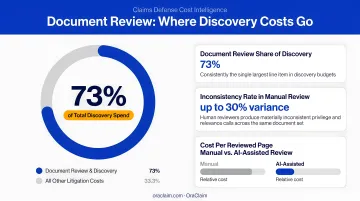
For defense teams, this creates a direct tradeoff. Hours consumed by document organization and re-review are hours not spent on strategy, reserve analysis, or negotiation preparation.
The Plaintiff Technology Gap
Thomson Reuters notes that insurance defense attorneys are under pressure to keep pace with carrier clients who are already deploying AI across their operations. McKinsey reports that Aviva deployed more than 80 AI models in claims operations and cut average liability assessment time for complex cases by 23 days while improving routing accuracy by 30%.
Plaintiff firms are moving faster on the legal strategy side. Tools purpose-built for plaintiff intake, demand generation, and settlement modeling give opposing counsel an informational edge at the negotiating table. Defense organizations that haven't matched this investment enter mediation at a structural disadvantage. Not because they lack skilled attorneys, but because those attorneys are spending time on work that AI handles in minutes.
The Unstructured Data Problem
The core bottleneck is format, not volume. Accenture estimates that nearly 80% of enterprise data is unstructured — emails, PDFs, scanned records, handwritten notes, inconsistent billing codes. Claims files are among the worst offenders, typically containing:
- Medical records from multiple providers with inconsistent ICD-10 coding
- Handwritten adjuster notes that don't map to any structured field
- Deposition transcripts with no cross-references to other file documents
- Billing records in non-standard formats across treatment providers
Without a tool that structures this data automatically, every matter requires manual organization before analysis can begin — and that overhead compounds across a caseload of 120+ active files.
How a Real-Time Claims Assessment Tool Works
Document Ingestion
The process starts with connectivity. OraClaim integrates with practice management and document management systems defense teams already use — including Clio, MyCase, Smokeball, PracticePanther, NetDocuments, iManage, Worldox, and Box. Documents flow into the platform as they arrive: medical records, police reports, deposition transcripts, witness statements, expert reports, photographs, surveillance materials, prior pleadings, demand packages, and more.
No manual upload queue. No parallel data entry. The ingestion layer pulls matter-related files automatically, classifying each document upon arrival.
AI-Driven Fact Extraction
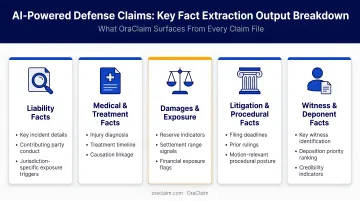
Once ingested, the platform's AI reads through unstructured documents and extracts critical facts, organizing them into a structured claim profile. For a defense professional reviewing a new matter, the immediate output includes:
- Dates and timelines — incident date, treatment dates, employment events, prior accidents, discovery events, deposition schedule
- Medical and diagnosis data — provider-normalized treatment chronology, ICD-10/CPT extraction, billed vs. paid analysis
- Liability indicators — causation issues, treatment gaps, pre-existing conditions, missed appointments, non-compliance
- Inconsistencies — contradictions between subjective complaints and objective findings, conflicting statements across documents
- Exposure flags — unverified details, missing documentation, reserve-relevant facts
For medical chronology specifically, OraClaim reduces drafting time from 15–60+ hours per file to under 60 minutes for first draft — a measurable compression of the early-stage review cycle.
Benchmarking and Pattern Recognition
Beyond individual matter analysis, the platform automatically compares each new claim against the organization's historical case data. OraClaim's automated benchmarking module tags each claim across dozens of dimensions and surfaces:
- Similar-case settlement and verdict ranges
- Plaintiff-counsel-specific outcome histories
- Plaintiff-expert reliability and bias patterns
- Judge-specific motion-grant rates by jurisdiction
- Reserve adequacy comparisons against similar fact patterns
This happens without manual data tagging or analyst time. A defense professional handling a new premises liability matter immediately sees what similar cases resolved for, how opposing plaintiff's counsel typically performs, and what reserve benchmarks look like — before the first strategy call.
Work Product Generation
OraClaim generates litigation-ready work product directly from the claim file:
- Medical chronologies and litigation timelines
- Case evaluations with liability, damages, and exposure analysis
- Deposition outlines tailored to witness role and case-specific facts
- Reserve recommendation memos and 90-day reports
- Mediation briefs, demand responses, and coverage opinions
- Dispositive motions, discovery motions, and motions in limine
Each output is trained on the firm's own historical work product, so the drafts match how the team actually writes — structure, citation format, and all. Defense professionals refine and finalize. That's a meaningful shift in where attorney time goes.
Security Architecture
Generating litigation-ready work product raises an immediate question: what happens to the client data behind it? Claims files carry attorney-client privilege and work-product protection implications that general-purpose AI tools aren't designed to handle. OraClaim operates as a closed, access-restricted system. Key architecture commitments:
- No training data use: Client confidential information is never used to train, fine-tune, or improve AI models
- No human review: OraClaim personnel cannot review client data except when expressly authorized by the customer for support purposes
- Sub-processor restrictions: Third-party infrastructure components are contractually prohibited from accessing or retaining confidential information beyond transient processing
- Privilege preservation: All processing is structured so confidential information remains subject to attorney-client privilege, work-product doctrine, and common-interest doctrine
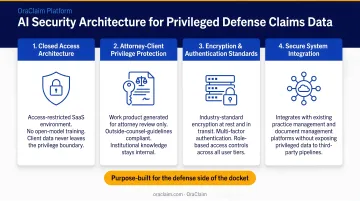
For defense organizations evaluating any AI vendor, the training data question should come first. Generic platforms routinely use customer inputs to improve shared models — a practice that creates direct privilege exposure. OraClaim's architecture is built to eliminate that risk by design.
Key Capabilities to Evaluate in a Claims Assessment Platform
| Capability | What to Look For |
|---|---|
| Document analysis depth | Multi-document ingestion, billing table extraction, conflict reconciliation across records |
| Defense-specific intelligence | Causation gaps, prior injury flags, billing anomalies, inconsistent statements — not just workflow milestones |
| Historical benchmarking | Searchable repository of own case data; plaintiff counsel, expert, judge, and jurisdiction comparables |
| Portfolio analytics | Aggregate exposure, reserve adequacy, litigation rate trends, cost-per-matter, financial margin |
| System integration | Native connectors to existing practice management and document management platforms |
| Security and privilege | No AI training on client data, role-based access, data isolation, privilege-preserving architecture |
Generic insurance AI surfaces insurer-side milestones — not defense outcomes. A purpose-built defense platform flags the facts that actually change litigation results: causation gaps that support dispositive motions, prior injury patterns that undercut damages claims, billing anomalies that impeach medical specials, and statement inconsistencies that hold up under cross-examination.
Individual matter assessment only goes so far. Defense organizations managing large portfolios also need visibility into aggregate reserve adequacy, litigation rate trends, panel-firm cost outliers, and under-reserved cohorts — connected directly to financial outcomes.
OraClaim's portfolio management module consolidates open and closed claims, reserves, paid and incurred losses, defense costs, and exposure analytics into a single dashboard with drill-down access to individual files.
Benefits of Real-Time Claims Assessment for Defense Organizations
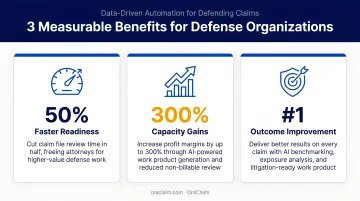
Automating manual document review and work product generation produces three measurable outcomes for defense organizations.
Faster matter readiness. Defense teams that previously needed days to develop an initial claim position reach that point within hours of document ingestion. Early strategic decisions — reserve setting, coverage analysis, litigation versus settlement — get made faster and on better information.
Capacity without headcount. Thomson Reuters' 2024 survey of more than 2,200 professionals found that AI is projected to save professionals 12 hours per week by 2029. For defense teams, that time recapture translates directly to matter throughput. The same attorney or adjuster handles a larger portfolio without degrading quality. As one managing partner at a regional defense firm put it after using OraClaim: "We were doing good work, but OraClaim allows us to work faster, which makes us better. Our clients notice the difference."
Better outcomes through fewer missed facts. Real-time assessment flags causation gaps on day one rather than at mediation. Reserve errors compound over time, and catching them early reduces total claims cost across the portfolio.
For carriers, that's a direct impact on loss ratio. For defense firms, it means issuing a defensible reserve recommendation from the start — not scrambling to correct it under deadline pressure.
How to Choose the Right Real-Time Claims Assessment Tool
Three evaluation criteria separate useful platforms from expensive ones.
Defense Specificity
Ask vendors to demonstrate how their AI handles medical records with conflicting provider data, flags prior injury history in context, and surfaces defense-relevant inconsistencies. If the demo focuses on FNOL routing and payment tracking, that's a claims management platform. It's not a defense assessment tool.
Security and Data Handling
Defense matters carry heightened confidentiality obligations. Verify that any platform under consideration uses end-to-end encryption, authentication controls, and data isolation.
The more critical question: ask how the vendor handles data used to train or improve their AI models. If client confidential information feeds a shared model, privilege protection is at risk. ABA Formal Opinion 512 (July 2024) makes clear that competence and confidentiality duties extend to AI tool selection.
Integration with Existing Systems
A platform that requires abandoning existing practice management or document management workflows will face adoption resistance, regardless of its capabilities. Prioritize vendors with proven connectors to systems your team already uses.
OraClaim integrates natively with Clio, MyCase, Smokeball, PracticePanther, NetDocuments, iManage, Worldox, and Box. Defense teams gain full AI capability without rebuilding their workflows.
Frequently Asked Questions
What is a real-time claims assessment tool?
It's AI-powered software that automatically ingests claim documents — medical records, depositions, police reports, billing statements — and instantly structures them into actionable defense intelligence. Rather than waiting on manual review, defense professionals start with extracted facts, flagged inconsistencies, benchmarked comparables, and litigation-ready work product already drafted.
What software do claims estimators use?
General claims management platforms like Guidewire and Duck Creek handle insurer-side workflow: FNOL intake, payment processing, and policy administration. Defense teams require a separate category of tool — purpose-built for document analysis, fact extraction, historical benchmarking, and strategic work product generation that general claims platforms aren't designed to deliver.
How does real-time claims assessment differ from traditional claims review?
Traditional review requires professionals to read and manually organize documents before analysis begins — a process that can consume days per matter. Real-time assessment tools ingest documents automatically and deliver structured, actionable insights immediately, compressing days of document work into hours and shifting professional time from organization to strategy.
How does AI improve claims assessment for defense teams specifically?
AI extracts causation gaps, prior injury history, billing anomalies, and inconsistent claimant statements from unstructured documents that would otherwise require hours of manual review to surface. Automated benchmarking against historical cases helps defense professionals anticipate outcomes, set defensible reserves, and refine negotiation strategy faster than any manual process allows.
Can a real-time claims assessment tool integrate with existing legal management systems?
Yes. Leading platforms integrate with common practice management and document management systems, fitting into existing workflows rather than requiring teams to build parallel ones. When evaluating options, confirm integration depth upfront — tools that force workflow changes tend to stall on adoption.
What security standards should a claims assessment platform meet?
Baseline requirements include end-to-end encryption, authentication controls, role-based access, and data isolation. For defense organizations specifically, ask how the vendor handles AI training data — client confidential information must never be used to train or improve shared models. OraClaim explicitly prohibits this use and structures all processing to preserve attorney-client privilege and work-product doctrine protections.