Introduction
Plaintiff firms are using AI tools to analyze case patterns at scale. Many defense teams still rely on manual research, spreadsheet roundups, and institutional memory to evaluate exposure, settlement value, and litigation strategy.
The gap is now measurable. Federal personal injury and product liability filings increased 78% in the 12-month period ending March 2024, and Law360 reported in December 2024 that plaintiff lawyers were increasing production through specialized AI offerings.
For defense teams managing high claim volumes, the risk is practical: exposure and settlement decisions get made without reliable benchmarks.
Comparative case law analysis means systematically comparing prior cases to surface patterns in rulings, damages, liability findings, and judicial behavior. For defense teams, it is one of the most practical ways to close that gap.
This guide covers what comparative case law analysis is, how to conduct it in practical stages, what tools are available, and where defense-focused platforms like OraClaim fit into the workflow.
Key Takeaways
- Comparative case law analysis reviews multiple past cases to surface patterns in rulings, damages, liability findings, and judicial behavior
- It helps defense teams benchmark exposure, anticipate plaintiff tactics, and make data-informed decisions on reserves and settlement authority
- The process runs in six stages: define scope, source cases, structure data, identify patterns, translate insights into strategy, and maintain over time
- Tools range from legal research databases and qualitative coding software to AI platforms purpose-built for defense workflows
- Used consistently, it becomes an ongoing defense asset for benchmarking exposure and refining litigation strategy
What Is Comparative Case Law Analysis?
Comparative case law analysis is the structured process of examining multiple decided cases that share common facts, legal issues, claim types, or parties, with the goal of identifying patterns that can inform current case strategy, exposure assessment, and settlement decisions.
There are two primary types:
- Qualitative comparison: reading and coding cases for themes, reasoning patterns, and judicial tendencies
- Quantitative comparison: aggregating outcome data, including verdicts, settlements, and damages ranges, across a case portfolio to identify statistical trends
Most effective defense analysis combines both. A court that consistently awards elevated non-economic damages in slip-and-fall cases shows up in the quantitative data; why it does shows up in the qualitative review.
How It Differs from Standard Legal Research
Standard legal research finds authority to support a legal argument. Comparative case law analysis finds patterns across outcomes to inform strategic decisions. The objective is different.
Researching whether a jurisdiction recognizes a particular liability theory is legal research. Analyzing how courts in that jurisdiction have actually decided similar claims, including what damages they awarded, which arguments succeeded, how a specific judge ruled on summary judgment — is comparative analysis. One builds arguments. The other informs decisions.
Why Comparative Case Law Analysis Matters for Defense Teams
Defense lawyers managing high claim volumes routinely make exposure and settlement decisions without a reliable benchmark. Experience and isolated precedent fill the gap where data should be.
The financial pressure shows up in reserve movement. In 2024, NAIC reported a $10.0 billion prior-year reserve deficiency in the other liability-occurrence line, up from $4.7 billion the prior year.
That deterioration reflects, in part, how hard it is to set accurate reserves without systematic outcome benchmarking.
Core Strategic Benefits for Defense Practice
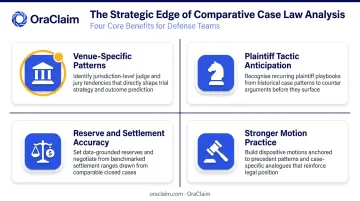
Comparative analysis directly addresses several recurring pain points:
- Venue-specific patterns: Shows how courts have treated similar claims, damages arguments, or liability theories
- Plaintiff tactic anticipation: Flags repeat patterns from plaintiff firms and counsel before the defense team is forced to react
- Reserve and settlement accuracy: Benchmarks comparable closed cases to support reserve-setting and settlement authority
- Stronger motion practice: Ties dispositive motions to demonstrated judicial trends, not legal theory alone
IADC describes litigation analytics as a way to evaluate liability theories, plaintiff success rates, witness credibility, damages, duration, and cost.
For defense teams, the useful inputs are practical: matter-level cost, cycle time, litigation exposure, and postmortem results. Comparative case law analysis turns those inputs into benchmarks a lawyer can use before recommending reserve changes, settlement authority, or motion strategy.
How to Conduct Comparative Case Law Analysis — Step by Step
How to Conduct Comparative Case Law Analysis: Step by Step
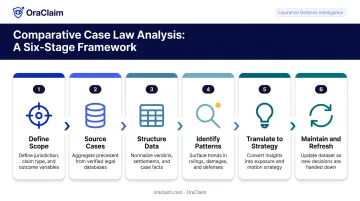
Most defense teams either skip comparative analysis entirely or conduct it informally. The six stages below break the process into practical steps and flag where errors typically occur.
Step 1: Define Scope and Objectives
Start by clarifying what question the analysis is meant to answer. Is this about damages ranges in premises liability claims in a specific venue? Judicial tendencies on summary judgment? A particular plaintiff firm's litigation patterns?
Defining scope keeps the review manageable and turns the findings into usable guidance, not an interesting report no one applies.
Step 2: Source and Select Cases
Pull cases from multiple sources:
- Use internal case files and claims history; closed files capture outcomes no external database can replicate.
- Search Westlaw, LexisNexis, or Bloomberg Law for comparable decisions.
- Check PACER, CourtListener's RECAP Archive, and state portals for docket-level data.
- Add IRC, RAND, or trade association research for sector benchmarks.
Internal historical data consistently outperforms external sources for defense benchmarking because it reflects your actual venues, claim types, plaintiff counsel mix, and defense strategies.
Step 3: Structure the Data for Comparison
Once you know which cases belong in the set, organize them into a consistent framework. Capture these fields for each case:
| Field | Purpose |
|---|---|
| Claim type | Enables apples-to-apples comparison |
| Jurisdiction / venue | Surfaces venue-specific trends |
| Judge | Identifies judicial tendencies |
| Plaintiff counsel | Tracks firm-level litigation patterns |
| Liability finding | Quantifies win/loss rates |
| Damages awarded / settlement amount | Establishes outcome ranges |
| Key procedural facts | Contextualizes outliers |
Inconsistent data capture at this stage makes the entire analysis unreliable. Standardize the fields before you start, not after.
Step 4: Identify Patterns and Anomalies
With structured data in hand, the analytical work begins: comparing coded case data to surface trends. Examples of patterns worth surfacing:
- Venue-level pattern: higher non-economic damages than surrounding jurisdictions
- Plaintiff-firm pattern: predictable litigation timeline and settlement posture
- Judicial pattern: rare summary judgment grants on a specific theory
Peer review or a second analyst at this stage reduces blind spots, especially when expected patterns are easy to over-confirm.
Step 5: Translate Insights into Strategy
Analysis sitting in a report has no value. Findings should connect directly to current case decisions:
- Adjust reserves based on comparable outcome ranges
- Shape motion strategy around demonstrated judicial tendencies
- Inform settlement authority with data-backed exposure assessments
- Flag high-risk cases earlier in the lifecycle
If a pattern doesn't change a decision somewhere, question whether it was worth surfacing.
Step 6: Maintain and Refresh the Analysis
Legal trends shift. Plaintiff firms adapt tactics. New verdicts reset what "normal" looks like in a venue. A comparative analysis that was accurate 18 months ago may be misleading today.
Build in a refresh cadence: quarterly at minimum, or immediately following a significant verdict in a relevant jurisdiction. Treat it as a living intelligence function, not a one-time project.
Tools for Comparative Case Law Analysis
Tool selection should match the type of analysis needed, the volume of cases being reviewed, and the resources available. The main categories break down this way.
Legal Research Databases
Westlaw, LexisNexis, Bloomberg Law, and CourtListener/PACER are the foundation for sourcing and validating case law. Two citator functions are non-negotiable before drawing conclusions from any case:
- KeyCite (Westlaw): verifies whether a case still reflects good law
- Shepard's (LexisNexis): uses a 29-step editorial process to identify positive and negative treatment
These platforms are strong for finding cases and confirming their validity. Their limitation: they don't help defense teams analyze patterns across their own historical portfolios.
Qualitative Analysis and Coding Software
Tools like NVivo let users code case text by themes, legal reasoning patterns, and outcome variables. They work best when a defense team needs to analyze narrative patterns across a moderate case set.
For example, a team might compare how courts in one jurisdiction frame contributory fault, or how a plaintiff firm structures damages arguments.
These tools are more commonly used in academic legal research but are applicable in defense practice for qualitative deep dives.
Spreadsheets and Structured Templates
For teams without specialized software, a well-designed Excel or Google Sheets template can be a practical starting point. Standardize fields such as jurisdiction, venue, judge, injuries, plaintiff counsel, settlement range, and motion outcomes.
The limitation is scale: manual data entry becomes time-consuming and error-prone once the case set exceeds 30-40 matters.
Spreadsheets work as a proof of concept. They don't work as a permanent solution at volume.
AI-Powered Platforms for Defense Teams
AI platforms built for defense litigation now automate the most labor-intensive parts of comparative analysis: extracting key facts from documents, structuring case data, and benchmarking outcomes across a portfolio.
OraClaim's Automated Benchmarking module, for example, auto-tags each claim across dozens of dimensions without requiring manual data tagging.
Common benchmarking fields include:
- Case type, jurisdiction, venue, and judge
- Plaintiff counsel and plaintiff expert
- Alleged injuries and treatment patterns
- Reserve range and motion practice outcomes
The system then produces benchmark comparisons across similar-case settlement and verdict ranges, similar-counsel outcome histories, and similar-judge motion-grant rates. OraClaim reports that this reduces claims-analytics-team manual benchmarking effort by over 80%.
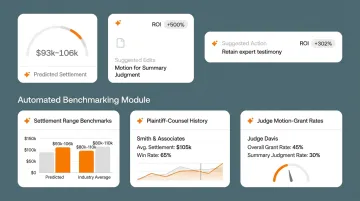
For defense teams, the practical value is clearer pattern recognition across their own files, not just better access to published opinions.
How OraClaim Fits Into Your Comparative Case Law Workflow
OraClaim was built for defense lawyers and claims professionals who need to compare cases at scale without losing hours to manual review.
Co-founders Mark Tepper and Andy Anderson both litigated and managed claims firsthand. They saw plaintiff firms adopt technology faster, while defense teams with large claim volumes still relied on manual review. That gap shaped the platform’s benchmarking, file review, and portfolio features.
What the Platform Does in Practice
OraClaim's Historical Case File Structuring & Benchmarking module turns years of unstructured PDFs, scanned files, email archives, and practice management exports into searchable institutional knowledge.
Common extracted fields include:
- Case type, jurisdiction, venue, judge, plaintiff counsel, and plaintiff expert
- Plaintiff demands, defense evaluations, and reserve history
- Settlement amounts, verdict amounts, and dispositive motion outcomes
- Time-to-resolution and defense costs by phase
Once structured, the AI benchmarks each new claim against that historical book of business. It surfaces close comparables, settlement and verdict ranges for similar fact patterns, plaintiff-counsel outcome histories, plaintiff-expert reliability patterns, and judge-specific motion-grant rates.
For document-level analysis, the platform reviews medical records, demand packages, police and incident reports, deposition transcripts, expert reports, prior pleadings, and discovery responses. It flags causation issues, timeline gaps, treatment inconsistencies, conflicting statements, and pre-existing conditions before they become reserve surprises.
Financial and Portfolio Visibility
Beyond case-level comparison, OraClaim connects individual claim data to portfolio-level financial metrics.
For defense firms, the platform surfaces realization rates by matter and partner, profitability by carrier client, and billing efficiency. For claims organizations, it provides defense cost as a percentage of indemnity, panel-firm cost benchmarking, and reserve-versus-paid trajectory by cohort.
The platform integrates with practice management systems such as Clio, MyCase, Smokeball, and PracticePanther, along with document management systems such as NetDocuments, iManage, Worldox, and Box, upon request. Teams can add benchmarking and file review without rebuilding their existing workflows.
For security, OraClaim operates as a closed, access-restricted system designed to preserve attorney-client privilege, attorney work-product doctrine, and common-interest protections.
Confidential information processed through the platform is not used to train AI models. Third-party infrastructure components are contractually prohibited from accessing or retaining client data beyond transient processing.
Conclusion
Comparative case law analysis gives defense teams the pattern intelligence they need to make better decisions on reserves, settlements, motions, and overall case approach. The six-stage process is practical and repeatable: define scope, source cases, structure data, identify patterns, translate findings into strategy, and maintain the system over time.
The challenge is that plaintiff firms are not waiting. They are using technology to analyze defense patterns, case histories, and outcome data at scale. Defense teams that continue relying on manual research and institutional memory alone will find that gap widening.
Building a consistent comparative analysis practice, supported by secure claims intelligence tools such as OraClaim, helps defense teams turn prior matters into usable strategy before the next reserve review, mediation, or motion deadline.
Frequently Asked Questions
What tools are used for comparative case law analysis?
Common tools include Westlaw, LexisNexis, PACER, CourtListener, NVivo, and structured spreadsheets. AI platforms like OraClaim add extraction, structuring, and portfolio benchmarking.
What are the types of comparative case law analysis?
Comparative analysis is usually qualitative, quantitative, or mixed. Defense teams use qualitative coding to explain reasoning and quantitative outcome data to benchmark damages, settlements, and venues.
How is comparative case law analysis different from standard legal research?
Standard legal research finds authority for an argument. Comparative analysis looks across cases to guide exposure assessment, reserves, settlement authority, and litigation strategy.
How many cases do you need for a meaningful comparative analysis?
No fixed minimum exists. Ten to 20 close comparables can support venue- or plaintiff-firm analysis; larger portfolios need structured data capture and automation.
Can AI automate comparative case law analysis for defense teams?
Yes. AI can extract facts, structure case data, and benchmark outcomes, while attorneys interpret the patterns and decide how to use them in strategy.