Introduction
Personal injury law has always been document-heavy. The volume and complexity of that documentation has now reached a point where manual processes are a direct competitive liability.
Generative AI adoption among law firms jumped from 11% in 2023 to 30% in 2024, according to the ABA's 2024 Legal Technology Survey. At firms with 100+ attorneys, that figure hit 46%. The firms pulling ahead aren't working harder — they're processing medical records in hours instead of days, drafting demands in minutes instead of weeks, and using data to anchor settlement positions instead of guessing.
This guide covers the top AI software purpose-built for personal injury law in 2026. It spans plaintiff firms that need faster demand packages and smarter case valuations, as well as defense-side firms and insurance carriers managing high PI claim volumes who need litigation-ready work product without absorbing associate hours in document review.
Key Takeaways
- AI tools for PI firms — plaintiff and defense alike — automate the heaviest manual work: medical record review, chronology generation, legal research, and case evaluation
- Purpose-built PI tools outperform general AI on medical records, police reports, and deposition transcripts, with citation accuracy general LLMs can't match
- Defense firms and insurance carriers have their own purpose-built AI options that benchmark outcomes, structure claim portfolios, and compress review timelines
- When evaluating tools, prioritize HIPAA compliance, integration depth, workflow coverage, and pricing alignment with your billing model
How AI Is Reshaping Personal Injury Law Practice
Purpose-Built vs. General AI
ChatGPT can draft a paragraph. It cannot reliably review a 1,200-page medical record, pin every treatment event to its source page, flag causation gaps, and produce a chronology that holds up in litigation. That distinction matters enormously in PI practice.
Purpose-built legal AI is trained on PI-specific document types — medical records, ER reports, police reports, demand letters, deposition transcripts. General-purpose AI lacks the domain specificity, citation discipline, and security controls that clinical and legal documents require.
Thomson Reuters found that 77% of legal professionals already using AI apply it to document review, and 74% to legal research — and the quality gap between purpose-built and general tools is widest precisely in those two categories.
Where AI Creates the Most Leverage in PI Practice
AI delivers the most leverage in two areas:
Document processing speed:
- Medical record review and chronology generation
- Demand letter drafting with case-specific valuation
- Intake qualification and triage
Portfolio-level intelligence:
- Identifying patterns across cases and fact types
- Benchmarking settlement outcomes against historical comparables
- Refining strategy based on plaintiff counsel, jurisdiction, and judge data
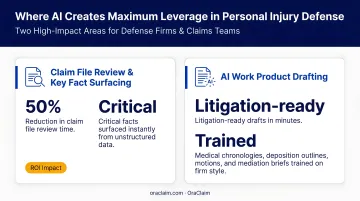
The PI AI market now covers the full case lifecycle — from intake qualification through trial preparation. Both plaintiff firms and defense teams have purpose-built options, and the platforms below cover the leading tools across both sides of the docket.
Top AI Software for Personal Injury Law Firms in 2026
Selection criteria: PI-specific functionality, security compliance, CMS integration depth, and demonstrated market adoption — not general legal AI capabilities.
EvenUp
EvenUp is an end-to-end AI platform built exclusively for plaintiff PI firms. Its proprietary Piai™ engine is trained on the industry's largest PI-specific dataset and powers demand letter generation, case valuation, negotiation prep, and discovery support across the full pre-litigation and litigation lifecycle.
What separates EvenUp from general drafting tools is output quality tied to outcome data. According to EvenUp, its demand product produces a 69% higher likelihood of policy-limit settlements compared to industry averages (a vendor-published figure). Its Mirror Mode™ ensures every demand reflects the firm's own voice, formatting, and structure rather than generic AI output.
Recent additions include Communication Agents — voice and SMS tools that automate client outreach and, per EvenUp's own data, reclaim more than 9 hours per case in administrative time. Executive Analytics™ surfaces portfolio-level insights that managing partners can use to identify underperforming case types or missed value.
| Category | Details |
|---|---|
| Key Features | AI demand generation, intake qualification, medical management, negotiation sheets, AI Drafts™ for litigation, Executive Analytics™, Communication Agents |
| Best For | Plaintiff PI firms seeking a single platform spanning intake through trial |
| Integrations | SmartAdvocate, Litify, CASEpeer |
| Compliance | SOC 2 Type II recertified; HIPAA attested (February 2025) |
| Pricing | Custom; request quote based on case volume |
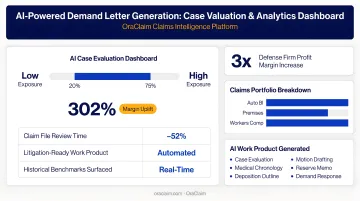
Legalyze.ai
Legalyze.ai is a cloud-based platform focused specifically on medical record review and chronology generation for PI and medical malpractice cases. It processes thousands of pages of records and produces chronologies where every event links directly to its source page in the original PDF , a critical detail when opposing counsel challenges your timeline.
The platform processes documents at roughly 10 pages per minute, reducing a 1,000-page file from 15–20 hours of manual review to approximately 2 hours (per Legalyze's published benchmarks). Its Case Chat AI lets attorneys ask plain-English questions about case records and receive citation-backed answers without digging through the file manually.
Practical differentiators worth noting:
- Handwriting recognition handles physician notes that would otherwise require manual transcription
- Bidirectional sync with MyCase, CASEpeer, and Smokeball eliminates duplicate data entry
- AI models contractually cannot train on client data, with BAAs in place with all AI subprocessors
| Category | Details |
|---|---|
| Key Features | AI medical chronologies with source-pinned citations, natural language case Q&A, handwriting recognition, CMS integrations |
| Best For | PI and med-mal firms on CASEpeer, MyCase, or Smokeball needing accurate chronologies at scale |
| Pricing | Pro AI at $500/month (2,000 pages); Growth AI at $1,000/month (5,000 pages); custom Scale AI pricing |
| Compliance | HIPAA compliant; BAAs with AI subprocessors; data not used for model training |
Darrow
Darrow operates upstream of the traditional case workflow, identifying viable legal opportunities before they become widely known. Its Legal Intelligence platform analyzes court filings, regulatory data, consumer complaints, news, and financial records to surface emerging legal risks.
An in-house legal team reviews every signal and delivers structured case memos covering claims, evidence, jurisdiction, and projected damages.
The platform processes more than 5 million signals monthly and has surfaced over $22 billion in legal exposure across 22,000 legal professionals, according to Darrow's published figures.
For PI firms expanding into mass tort:
- PlaintiffLink sources and qualifies claimants through targeted digital outreach, pushing them directly into the firm's intake workflow
- Predictive underwriting models litigation value across conservative, base, and aggressive scenarios before committing resources
- Darrow connected over 100,000 plaintiffs with top firms in 2024
| Category | Details |
|---|---|
| Key Features | Emerging risk signals, AI case memos, PlaintiffLink plaintiff sourcing, predictive underwriting, practice-area dashboards |
| Best For | PI firms seeking AI-driven case origination across mass tort and class action opportunities |
| Pricing | Custom; contact Darrow based on firm size and practice focus |
CoCounsel (Thomson Reuters)
CoCounsel is Thomson Reuters' professional-grade AI assistant grounded in the Westlaw and Practical Law content libraries. For PI attorneys, it enables complex legal research, document drafting, deposition analysis, and discovery review , all returning citation-backed results traced to primary legal sources.
Its agentic workflow capabilities are the most practical differentiator for litigation teams. Under a single command, CoCounsel can review discovery documents, extract key issues, and produce a summary , the kind of multi-step task that previously required an associate blocking out a full afternoon. The system has executed over 1 million tests since launch and runs 1,500+ automated nightly tests under attorney oversight.
Key workflow features for PI litigation:
- Deposition transcript analysis for witness credibility and consistency
- Natural-language Westlaw research with footnotes to primary authority
- Microsoft 365 integration (Word, Outlook, Teams, SharePoint)
| Category | Details |
|---|---|
| Key Features | Natural-language Westlaw research, agentic multi-step workflows, drafting, deposition analysis, document review, Microsoft 365 integration |
| Best For | PI firms with existing Westlaw subscriptions seeking deeper AI-assisted research and litigation drafting |
| Pricing | Subscription-based; available standalone or bundled with Westlaw packages |
| Compliance | Enterprise security controls |
OraClaim
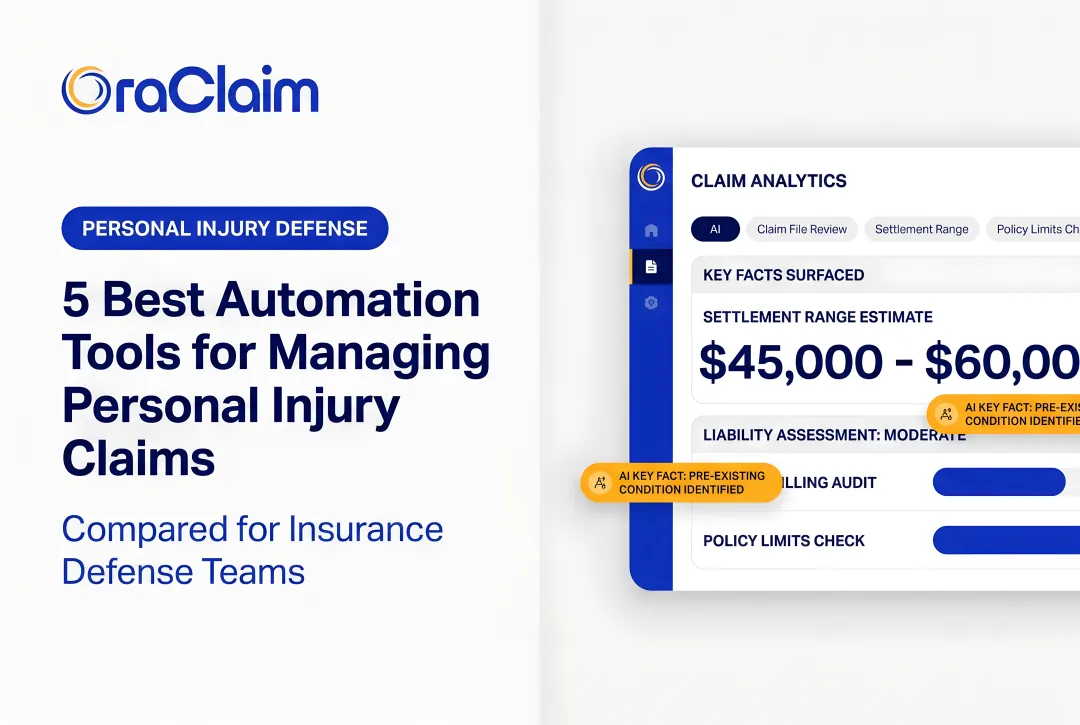
OraClaim is purpose-built for the defense side of the PI docket: insurance defense firms, carriers, TPAs, captive insurers, and self-insured corporations managing high volumes of personal injury claims.
Founded by Mark Tepper and Andy Anderson, both former litigators and claims professionals, OraClaim was built specifically to close the technology gap between plaintiff firms and defense teams.
The platform's proprietary AI ingests entire claim files (medical records, demand packages, police reports, witness statements, expert reports, deposition transcripts, coverage correspondence, and prior pleadings) and surfaces critical facts instantly, replacing manual document review that traditionally consumes 40–70% of associate hours per matter.
Core capabilities across the defense workflow:
- Classifies every document in a claim file, extracts key facts, and flags causation issues, treatment gaps, and contradictions
- Reduces 15–60+ hour medical chronologies to under 60 minutes for a first draft
- Generates witness-specific deposition outlines for plaintiff, treating physician, expert, and 30(b)(6) witnesses in minutes
- Drafts MSJ, motions to dismiss, motions in limine, Daubert/Frye, and discovery motions — compressing 20–120 billable hours to hours for a first draft
- Produces demand responses, mediation briefs, 90-day reports, reserve memos, and reporting letters trained on the firm's own institutional knowledge and style
- Structures closed files into searchable institutional knowledge; benchmarks open matters against plaintiff counsel history, judge motion-grant rates, jurisdiction, and expert reliability
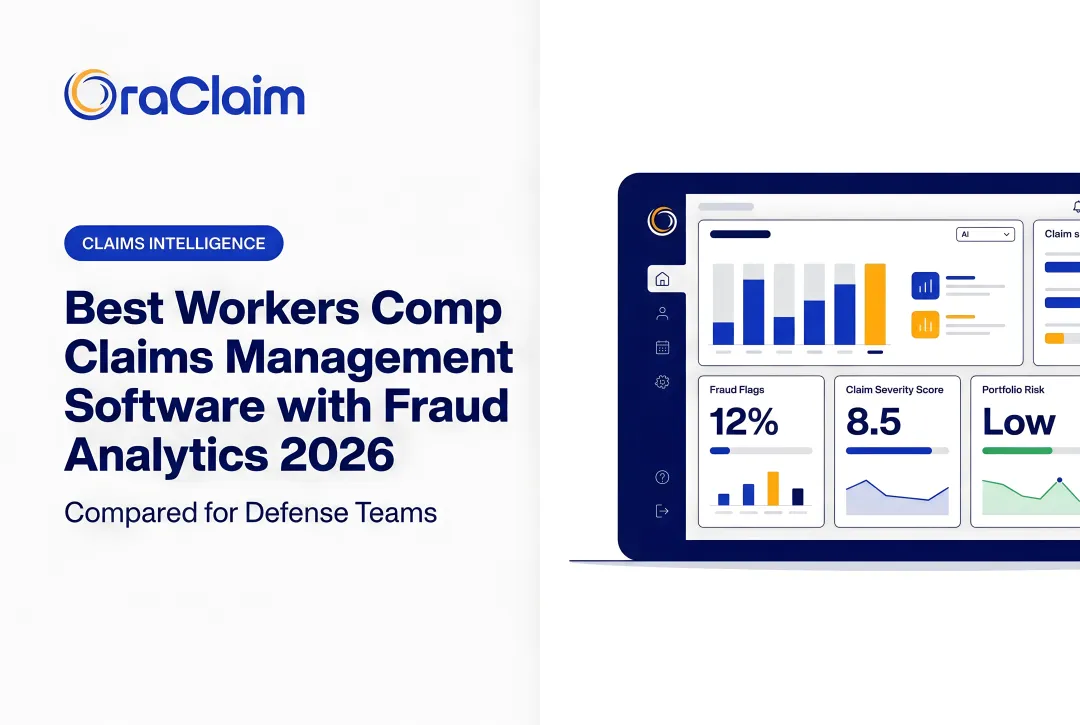
- Surfaces realization rates, profitability by carrier client, defense cost as a percentage of indemnity, and reserve-vs.-paid trajectory by cohort
OraClaim also serves TPAs, captive insurers, and self-insured corporations, with modules for managing panel counsel performance, controlling loss adjustment expense, and maintaining portfolio visibility across complex, multi-carrier operations.
The platform operates as a closed, access-restricted system. Client data is never used to train AI models, and the architecture is designed to preserve attorney-client privilege and attorney work-product protection.
| Category | Details |
|---|---|
| Key Features | AI claim file review, medical chronology drafting, deposition and motion drafting, custom work product, cross-case benchmarking, portfolio analytics, financial margin analysis |
| Best For | Defense law firms, insurance carriers, TPAs, captives, and self-insured corporations managing high-volume PI claims |
| Integrations | Clio, MyCase, Smokeball, PracticePanther, NetDocuments, iManage, Worldox, Box |
| Pricing | Custom; book a demo for a quote |
| Compliance | Industry-standard encryption, authentication, and data protection; closed system with no client data used for model training |
How We Chose These Tools
Evaluation Criteria
Every tool on this list was assessed against five criteria:
- PI-specific functionality — can the tool handle medical records, police reports, demand letters, and claims-level analytics, or is it a general LLM with a legal wrapper?
- HIPAA compliance and security certifications — verified BAA availability, data-use policies, and security audit status for tools handling protected health information
- CMS integration depth — native connections to established PI and defense case management systems, not just export/import workarounds
- Workflow coverage — does the tool handle one task or multiple stages of case preparation?
- Pricing alignment — tools priced per document or per case work better for contingency-fee economics than flat per-seat subscriptions
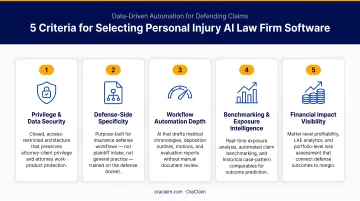
Generic LLMs didn't make the cut — they lack the citation discipline, domain training, and security architecture that PI and insurance defense work demands.
Where to Start
The right AI stack depends on your most acute bottleneck. For defense teams, that's typically the combination of initial file review and work product generation — the non-billable hours that erode margins fastest. For plaintiff firms, the pressure usually falls on medical record review and demand drafting. Either way, identify that one chokepoint, integrate with your existing CMS, and expand from there. Defense firms that start with claim file review and case evaluation often find those two workflows alone free up enough capacity to take on additional matters without adding headcount.
Conclusion
AI is no longer optional infrastructure for personal injury practices. Firms still relying on manual record review and demand drafting are operating at a structural disadvantage against competitors who have automated those workflows — processing files faster, valuing cases more accurately, and handling more matters without adding headcount.
Tool selection should follow workflow bottlenecks, not brand recognition. Your CMS infrastructure matters too — a tool with deep native integrations will deliver faster ROI than one that requires constant manual data transfer between platforms.
Those same bottlenecks hit the defense side just as hard. OraClaim was built specifically for that workflow — from initial claim file review through motion drafting, benchmarking, and portfolio analytics. Book a demo to see how defense lawyers, insurance carriers, and TPAs are cutting review time in half and generating litigation-ready work product on every claim.
Frequently Asked Questions
What is the best AI platform for personal injury law firms?
The right platform depends on your role in the PI ecosystem. Plaintiff firms typically turn to EvenUp for demand and case management AI, and Legalyze.ai for medical chronology work. Defense firms and insurance carriers managing PI claims are better served by OraClaim, which is purpose-built for that workflow.
Is there an AI agent that can do discovery analysis for law firms?
Yes. CoCounsel by Thomson Reuters provides agentic multi-step discovery workflows grounded in Westlaw content, while Relativity aiR is purpose-built for eDiscovery document review at scale. PI firms should verify that any discovery AI tool meets their jurisdiction-specific security requirements before deployment.
What AI tools do personal injury law firms use for medical record review?
Legalyze.ai, Supio, and DigitalOwl are among the most widely adopted for PI medical chronology and record review. These tools generate source-linked chronologies that map every treatment event back to the original document, cutting the paralegal hours spent on manual review.
How do personal injury law firms ensure HIPAA compliance when using AI tools?
Three baseline checks: require a signed Business Associate Agreement (BAA) before any PHI is processed, verify the vendor holds a current SOC 2 Type II audit report, and confirm client data is excluded from model training. Contractual guarantees on data use — not just policy statements — are the minimum acceptable standard.
How much does AI software for personal injury law firms cost?
Pricing varies by tool and model. Medical record review tools like Legalyze.ai publish per-month pricing tied to page volume (starting around $500/month for 2,000 pages), while platforms such as EvenUp, Darrow, and OraClaim use custom pricing based on case volume and firm size. Per-document or per-case models tend to align better with contingency-fee economics — request a quote tied to your actual case volume before committing.