The result is a defense ecosystem stretched thin while claim complexity grows. AI-powered claims management software with built-in fraud analytics has moved from competitive advantage to operational necessity.
This guide evaluates the top platforms for 2026 — assessed on fraud detection methodology, workflow automation, AI maturity, and fit for carriers, TPAs, defense law firms, and claims organizations.
Key Takeaways
- WC fraud costs the US industry an estimated $34B annually — AI fraud analytics is now a baseline requirement for any serious claims operation
- The best platforms combine predictive fraud scoring, automated claims triage, and NLP-based document analysis
- Defense-side organizations need purpose-built tools — generic carrier risk suites aren't designed for the same workflow
- Evaluate platforms on fraud detection methodology, unstructured document handling, integration depth, and security standards
- Top platforms for 2026: OraClaim, CLARA Analytics, Riskonnect, Guidewire ClaimCenter, Origami Risk
What Workers' Comp Claims Management Software Actually Does
Workers' comp claims management software manages the full WC lifecycle — FNOL intake, medical bill review, indemnity tracking, fraud screening, reserve management, and dispute resolution support. That scope separates it from general claims platforms, which don't accommodate WC-specific compliance requirements like FROI/SROI EDI reporting or ODG treatment guidelines.
The challenge driving AI adoption: the majority of claims data arrives as unstructured text — medical records, demand letters, billing records, deposition transcripts. Traditional systems can't process this without manual review. ACORD's 2025 research on NLP-based document processing showed an 80% data-quality improvement and 60% reduction in manual effort when insurers applied AI to unstructured document conversion.
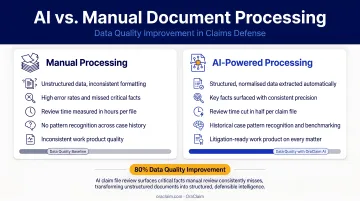
A 2025 Guidewire survey reported by Risk & Insurance found 87% of carriers are building or planning AI platforms — yet only 56% of those with defined strategies have deployed AI in pilot or production. That gap makes platform selection critical.
The platforms below were evaluated on four dimensions:
- Fraud analytics depth and detection methodology
- AI maturity (pilot vs. production deployment)
- WC-specific compliance coverage (EDI, ODG, state jurisdictional rules)
- Fit for carriers, TPAs, defense law firms, and claims organizations managing US WC portfolios
Best Workers' Comp Claims Management Software with Fraud Analytics in 2026
These platforms were evaluated on fraud detection methodology, AI analytics depth, workflow automation, integration capability, and security standards — not brand recognition or market share alone.
OraClaim
OraClaim is an AI-powered claims intelligence platform purpose-built for insurance defense attorneys, defense law firms, claims professionals, insurance carriers, and TPAs. Co-founded by Mark Tepper and Andy Anderson — both former litigators and claims risk professionals — the platform was built specifically to address what its founders lived: defense teams buried in claim volume and unstructured data while managing complex WC portfolios.
What distinguishes OraClaim for WC fraud analytics and claims intelligence:
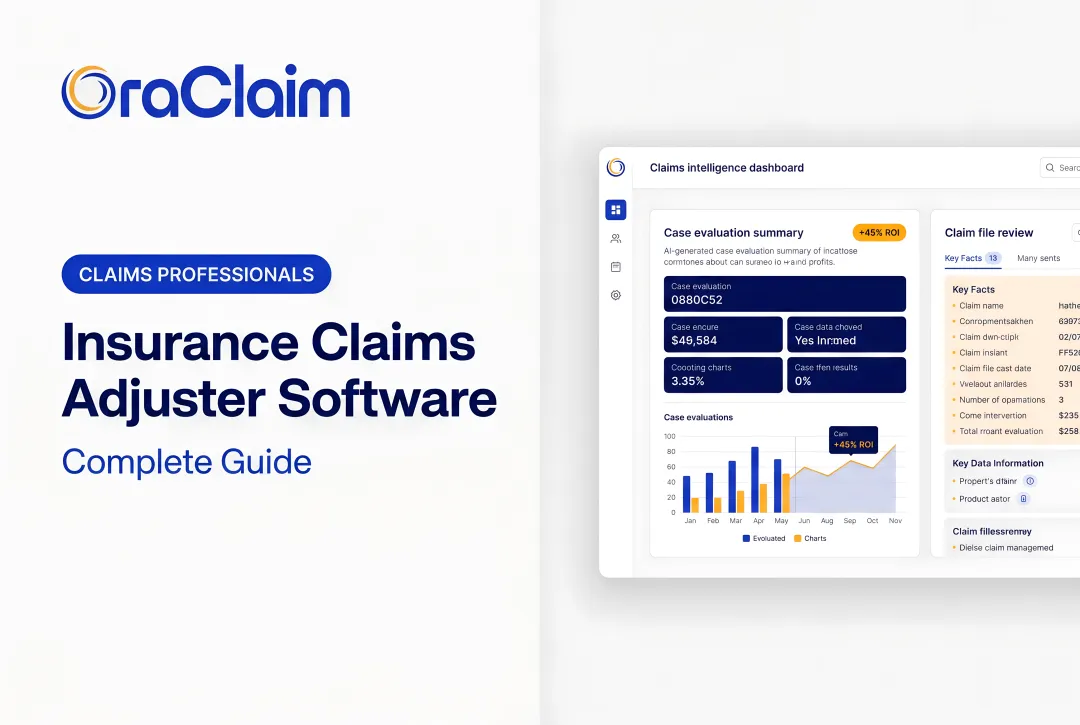
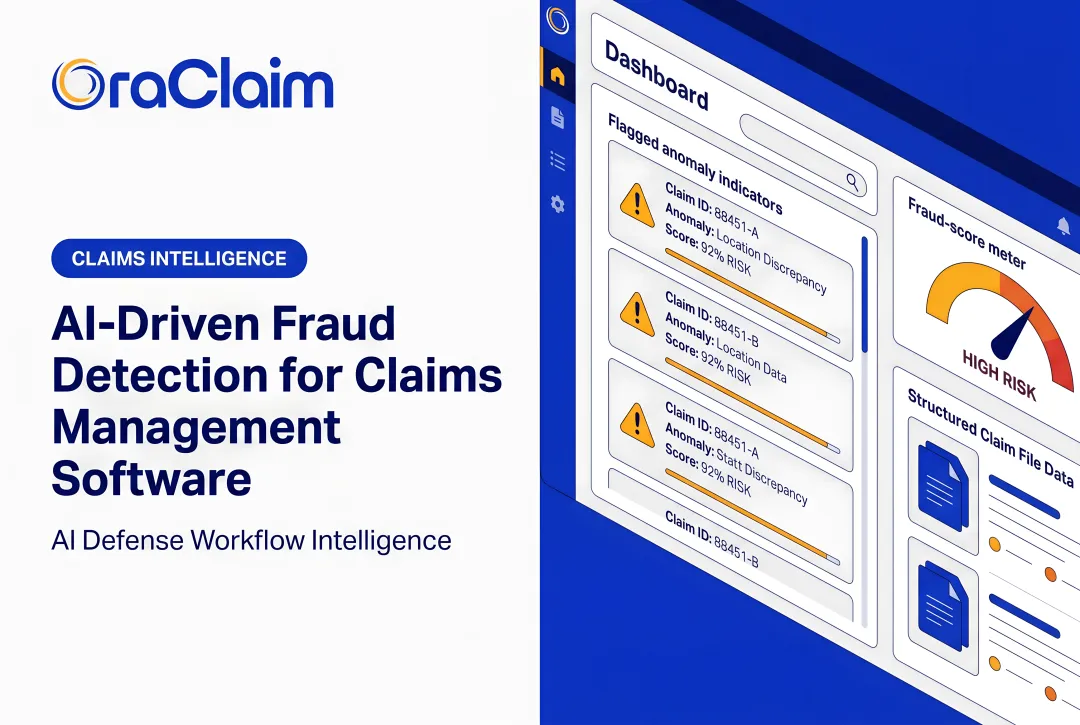
- Automatically classifies every document, extracts key facts, and flags contradictions, causation issues, treatment inconsistencies, and unverified details before they become reserve surprises
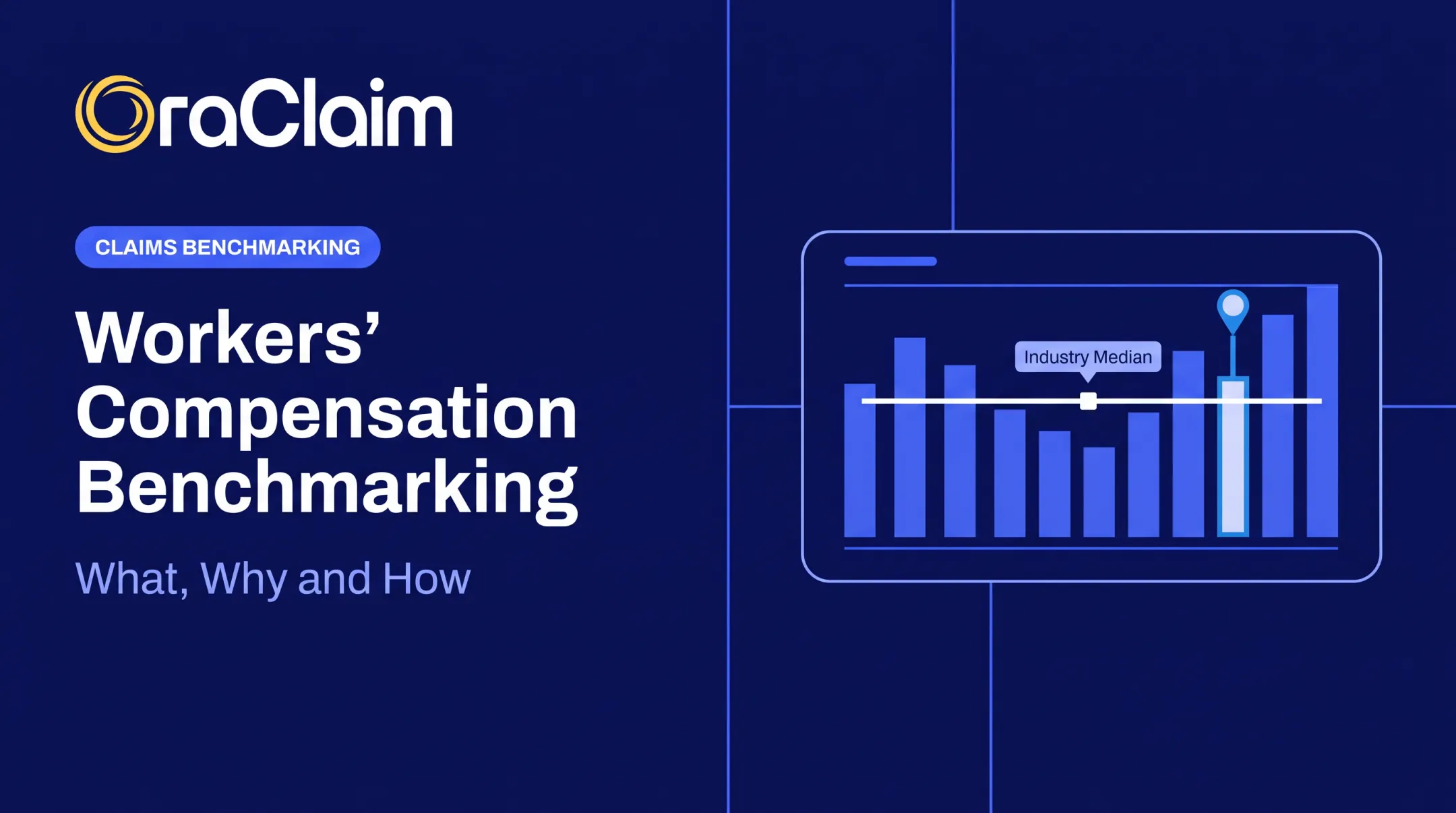
- Benchmarks every open WC matter across jurisdiction, judge, plaintiff counsel, injury type, treatment pattern, reserve range, settlement/verdict outcomes, and motion practice results — drawing on years of ingested closed-case files
- Continuously re-runs exposure analysis as new documents enter the file (medical updates, demand letters, IME reports, deposition transcripts), issuing alerts when reserve adequacy or settlement value shifts materially
- Consolidates open and closed claims, reserves, paid and incurred losses, defense costs, and exposure analytics into a single portfolio view with drill-down to individual files
- Produces litigation-ready first drafts of reserve memos, 90-day reports, mediation briefs, demand responses, deposition outlines, and motions — trained on the firm's institutional knowledge and style
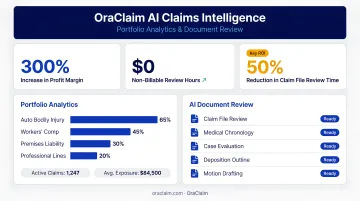
The platform operates as a closed, access-restricted system designed to preserve attorney-client privilege and work-product protection — confidential information is never used to train AI models or reviewed by OraClaim personnel outside authorized support contexts.
| Feature Area | Detail |
|---|---|
| Core AI Capabilities | Claim file review, fact extraction, anomaly flagging, benchmarking, exposure analysis, work product drafting, portfolio management |
| Document Types Supported | Medical records, demand packages, IME reports, deposition transcripts, billing records, expert reports, police/incident reports, prior pleadings |
| Integrations | Clio, MyCase, Smokeball, PracticePanther, NetDocuments, iManage, Worldox, Box |
| Security | Closed access-restricted system; industry-standard encryption and authentication; no model training on confidential data |
| Backers & Affiliations | MGV, Forum Ventures, Newfund Capital, Meridian, Roo Capital; sponsor of DRI, FDCC, ADC, and Florida Defense Lawyers Association |
| Best Fit | Defense law firms, carriers, TPAs, and claims organizations managing WC portfolios who need defense-workflow-specific AI |
CLARA Analytics (CLARAty.ai)
CLARA Analytics is a Sunnyvale-based AI-as-a-Service provider serving insurance carriers, MGAs, reinsurers, and self-insured organizations. Its CLARAty.ai platform includes CLARA Fraud — a dedicated WC fraud detection product that analyzes claim documents, billing records, and legal demand letters to identify suspicious patterns across provider networks, claimants, and legal counsel.
CLARA Fraud's approach: it examines relationships between medical providers, attorneys, and claimants across millions of WC claims — surfacing patterns like provider billing anomalies or attorney appearances clustered across related cases that no individual adjuster could detect manually. A 2025 CLARA Analytics study analyzing 2,867 claims from 2020–2024 found suspicious indicators as early as two weeks after claim filing, with 9% of open claims identified as high-potential SIU referrals.
Platform products: CLARA Fraud, CLARA Triage, CLARA Litigation, CLARA Treatment, CLARA Claims DocIntel Pro
| Feature Area | Detail |
|---|---|
| AI Methodology | Unsupervised machine learning, NLP, predictive AI, generative AI |
| Fraud Detection | Provider network relationship analysis, claimant behavioral patterns, SIU referral support with data-driven justification |
| Best Fit | Insurance carriers, TPAs, and self-insured organizations with high WC claim volume requiring pre-payment fraud interception |
Riskonnect
Riskonnect is an enterprise risk management platform with a Claims Management module embedded in its Insurable Risk suite alongside RMIS, Policy Administration, and Health & Safety. For WC, it offers automated workflow queues, FNOL routing, adjuster assignment based on experience and workload, and analytics that feed directly into GRC and ERM dashboards.
Riskonnect's primary differentiator is integration breadth — claims data flows into a unified enterprise risk environment without separate reconciliation projects. It applies AI-assisted routing across claim types including workers' compensation, liability, and property.
| Feature Area | Detail |
|---|---|
| Core Capabilities | Automated WC workflows, FNOL routing, adjuster assignment, real-time dashboards, integrated RMIS and GRC |
| Suite Integration | Claims data connects natively to GRC, ERM, and broader risk management programs |
| Best Fit | Large enterprises requiring WC claims data to feed enterprise risk, GRC, and compliance programs |
Guidewire ClaimCenter
Guidewire ClaimCenter serves more than 570 insurers across 42 countries and is recognized as a Leader in the 2024 Gartner Magic Quadrant for SaaS P&C Insurance Core Platforms. It provides end-to-end WC claims administration from FNOL through settlement with configurable workflows and reserve management.
Fraud analytics for ClaimCenter are delivered primarily through marketplace partners — FRISS and Shift Technology are both listed in the Guidewire Marketplace for ClaimCenter with real-time fraud detection capabilities. Buyers evaluating ClaimCenter should verify which fraud analytics add-ons are included in their specific deployment scope, as these are not native to the core platform.
| Feature Area | Detail |
|---|---|
| Core Capabilities | End-to-end WC claims administration, configurable workflows, reserve management, marketplace API ecosystem |
| Fraud Analytics | Delivered via marketplace partners (FRISS, Shift Technology) — verify inclusion in deployment scope |
| Best Fit | Tier 1 insurance carriers running multi-line P&C portfolios with dedicated implementation resources |
Origami Risk
Origami Risk is a configurable risk and claims administration platform built around insurance workflows, recognized as a Luminary in Celent's 2024 Claims Systems Vendors: North American P&C Insurance report. It supports WC-specific claims processing including FROI/SROI EDI, indemnity benefit calculations, Return-to-Work management, ODG integration, and an AI Claims Summary feature.
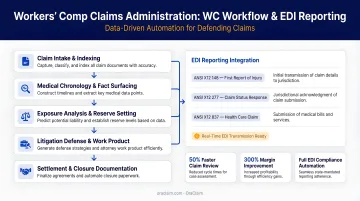
Origami's strength is configurability — its data model reflects insurance operations, enabling organizations to build WC workflows that align with their specific adjudication processes. That configurability requires implementation investment; Origami is better suited to organizations with dedicated risk technology resources than those seeking rapid deployment.
| Feature Area | Detail |
|---|---|
| Core Capabilities | Insurance-native claims adjudication, loss reserving, configurable RMIS, WC-specific analytics, AI Claims Summary |
| WC-Specific Features | FROI/SROI EDI, Return-to-Work management, ODG integration, indemnity benefit calculations |
| Best Fit | Insurance carriers and TPAs with complex, multi-line WC portfolios and internal implementation capacity |
How We Chose These Platforms
Evaluation Criteria
Platforms were assessed on:
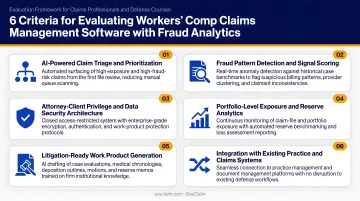
- Fraud detection methodology — predictive AI that identifies patterns before payment vs. rules-based systems that only catch known schemes after the fact; this distinction drives the largest cost differences between platforms
- Unstructured document analysis — ability to process medical records, legal demand letters, billing records, IME reports, and deposition transcripts without manual review
- Cross-claim network analysis — cross-claimant, cross-provider, and cross-attorney pattern detection rather than single-claim flag rules
- Integration architecture — compatibility with existing practice management, document management, GRC, and ERP systems
- Security and compliance — encryption standards, authentication, access controls, and privilege preservation for legal environments
- Role-appropriate design — whether the platform was purpose-built for defense workflows, carrier administration, or enterprise risk, since each solves a distinct set of problems
A Common Buyer Mistake
These criteria exist because a single evaluation gap costs organizations the most: many select claims management software on enterprise brand recognition without asking whether fraud detection is pre-payment or post-payment.
| Pre-Payment (Predictive AI) | Post-Payment (Rules-Based) | |
|---|---|---|
| When it acts | Before reserves are committed | After costs are incurred |
| Outcome | Fraud prevented | Fraud discovered |
| Best for | High-volume WC portfolios | Audit and compliance review |
Defense-side organizations — law firms and claims professionals managing WC portfolios — have fundamentally different needs than carrier-side adjusters running FNOL workflows. Platforms purpose-built for defense workflows (like OraClaim) address problems that enterprise carrier suites (like Riskonnect or Guidewire ClaimCenter) aren't designed to solve: work product generation, privilege preservation, exposure benchmarking against historical defense outcomes, and panel firm performance analytics.
Conclusion
The $34 billion annual cost of WC fraud has moved AI-powered fraud analytics from competitive advantage to baseline expectation. Any claims management platform evaluated in 2026 should meet that bar — the question is which platform fits your specific role in the claims ecosystem.
The right platform depends on your role in the claims ecosystem:
- Carriers with high FNOL volume needing pre-payment fraud interception → CLARA Analytics or Riskonnect
- Tier 1 multi-line P&C carriers with implementation resources → Guidewire ClaimCenter with marketplace fraud add-ons
- Insurance-intensive operations requiring configurable adjudication workflows → Origami Risk
- Defense law firms and claims professionals needing AI that works within existing defense workflows, surfaces critical facts without manual review, and produces litigation-ready work product → OraClaim
For defense lawyers and claims professionals managing WC portfolios, the fit matters as much as the feature list. Explore OraClaim — built by practitioners who managed these exact workflows.
Frequently Asked Questions
What is the best workers' comp claims management software for predictive fraud analytics in 2026?
The top options include OraClaim, CLARA Analytics, Guidewire ClaimCenter, Riskonnect, and Origami Risk. The best choice depends on organizational role — defense lawyers and claims professionals benefit from purpose-built platforms like OraClaim, while carriers with high FNOL volume should evaluate CLARA Analytics or Riskonnect for pre-payment fraud interception specifically.
What software do insurance companies use for workers' comp claims management?
Large carriers typically run enterprise platforms like Guidewire ClaimCenter or Riskonnect for core WC administration, then layer in AI-specialist tools like CLARA Analytics for fraud detection. That carrier-side stack is built for adjuster workflows and FNOL volume — defense law firms and claims professionals need a different category of tool, one purpose-built for claim file intelligence, exposure analysis, and work product generation, which is where platforms like OraClaim serve.
What features should I look for in workers' comp claims management software with fraud analytics?
Prioritize predictive (not rules-based) fraud scoring at or near FNOL, NLP-based analysis of unstructured documents, SIU referral support with data-driven justification, and integration with your existing systems. Defense-side users also need exposure benchmarking, work product generation, and privilege-preserving architectures — needs that standard carrier-side adjuster tools don't cover.
How does AI-powered fraud detection work in workers' comp claims?
AI fraud detection applies machine learning models to flag suspicious patterns across claim data — such as provider billing anomalies, claimant-attorney network relationships, and treatment inconsistencies — before payment is authorized. Rules-based systems only catch known schemes after the fact. Predictive AI surfaces previously unseen patterns across datasets too large for any adjuster to review manually.
Can workers' comp claims management software integrate with existing legal and document management systems?
Modern platforms offer API-based integration with practice management and document management tools. OraClaim integrates specifically with Clio, MyCase, Smokeball, PracticePanther, NetDocuments, iManage, Worldox, and Box. Enterprise platforms like Riskonnect connect to broader GRC and risk management environments.
How does AI help defense lawyers and claims professionals manage workers' comp cases more efficiently?
AI eliminates non-billable document review by automatically surfacing critical facts from claim files and benchmarking cases against historical outcomes to inform reserve decisions and litigation strategy. It also generates litigation-ready work product — reserve memos, 90-day reports, deposition outlines, motions — in a fraction of the manual time. Defense teams handle more cases without adding headcount, and evaluations become more consistent across the board.