](https://file-host.link/website/oraclaim-0psh24/assets/refined-images/1781091243454000_38c0bdc05a80466fb03991f80af8dbd3/360.webp)
Introduction
Defense lawyers and claims professionals are facing a structural problem. Claim volumes keep rising — NHTSA recorded over 2.4 million injury-producing crashes in the U.S. in 2023 alone — while the average bodily injury liability claim now costs $24,211 according to Triple-I's auto insurance data. Plaintiff firms aren't waiting. Tools like Mighty's AI negotiation agent (reported by Law.com in early 2026) are purpose-built to strengthen plaintiff positions before defense teams have finished reading the demand letter.
Defense teams are absorbing more claims, more complex documents, and more technologically-equipped opposing counsel — often without proportional increases in headcount or budget.
Automation isn't a luxury anymore. The right tools directly affect review speed, litigation strategy, and financial outcomes. This guide covers the 5 best automation tools for managing personal injury claims from the defense side — evaluated on AI capability, defense-workflow fit, and practical impact: OraClaim, Filevine, Litify, Guidewire ClaimCenter, and ClaimRuler.
Key Takeaways
- Defense automation tools reduce non-billable review time and help teams scale claim volume without adding headcount
- The best platforms combine AI document analysis, workflow automation, and portfolio-level financial visibility in a single system
- Plaintiff-side tools don't translate to defense workflows — defense teams need inbound claim processing, exposure analysis, and litigation-ready output
- The 5 tools covered serve different segments: AI-first defense platform, litigation workflow, enterprise legal ops, insurer claims lifecycle, and adjuster-focused administration
- Selection criteria to weigh: AI depth, defense workflow fit, security standards, integration breadth, and scalability
Why Defense Teams Need Automation for Managing Personal Injury Claims
"Automation" gets used loosely in legal tech conversations. For defense professionals managing PI claims, it means something specific:
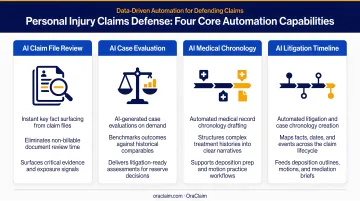
- AI-driven document review that surfaces key facts without manual reading
- Workflow triggers that eliminate missed deadlines
- Continuous exposure monitoring that flags reserve issues before they become surprises
- Portfolio-level reporting that connects case-level data to financial outcomes
That's a different category from basic case storage or general practice management software.
The Operational Problem Defense Teams Face
The defense side has a specific challenge that plaintiff firms don't: inbound, unstructured, high-volume claim files. A single PI file can include ER records, treating physician notes, IME reports, police reports, demand packages, prior pleadings, deposition transcripts, and surveillance results — all arriving in different formats, often out of order.
Manually reviewing this volume consumes enormous associate time. RAND's civil litigation cost research found document review represented 73% of e-discovery production costs, with human reviewers averaging roughly 100 documents per hour. That math doesn't scale.
The pressure compounds at the portfolio level. NAIC reported a $10 billion prior-year reserve deficiency in other liability-occurrence lines in 2024 — nearly double the $4.7 billion deficiency from 2023. Late, inaccurate reserves are a downstream consequence of slow, manual claim evaluation.
What the Technology Gap Costs Defense Teams
Plaintiff firms have been investing in technology to front-load their preparation: medical record organization, demand generation, case valuation tools. Defense teams using manual processes are evaluating the same claim file weeks later with less structured data and less time before mediation or trial.
The following tools address that gap directly — built or well-suited for defense lawyers, insurance carriers, and claims organizations handling PI claims today.
5 Best Automation Tools for Managing Personal Injury Claims
These tools were evaluated on defense workflow fit, AI capability, integration breadth, security standards, and the ability to scale claim volume without proportional headcount growth.
OraClaim
OraClaim is the only AI platform in this category purpose-built exclusively for defense lawyers and claims professionals. Where other tools offer general legal workflow automation, OraClaim is built around the defense side of the docket — processing inbound claim files, surfacing critical facts, generating litigation-ready work product, and connecting case-level data to portfolio-level financial outcomes.
The platform automatically ingests entire claim files — medical records, demand packages, police reports, witness statements, deposition transcripts, expert reports, correspondence — then classifies every document, extracts every fact, and flags contradictions, treatment gaps, causation issues, and unverified details before they become reserve surprises.
Medical chronologies that traditionally take 15–60+ hours are delivered as first drafts in under 60 minutes. Case evaluations covering liability, damages exposure, reserve recommendations, and settlement ranges are produced in minutes rather than 10–40 billable hours.
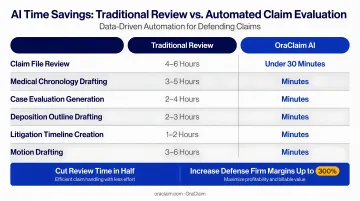
OraClaim also generates litigation-ready work product trained on the firm's own institutional knowledge, style guide, and carrier reporting templates:
- Deposition outlines and motions for summary judgment
- Daubert/Frye motions and mediation briefs
- Demand-letter responses, 90-day reports, and reserve memos
The platform's benchmarking module transforms historical closed-case files into structured institutional knowledge, comparing open matters against similar cases by jurisdiction, judge, plaintiff counsel, injury type, and fact pattern. Portfolio-level analytics track realization rates, carrier-client profitability, LAE as a percentage of indemnity, and panel-firm cost benchmarking — giving managing partners and Chief Claims Officers financial visibility that standard billing software doesn't provide.
The platform cuts claim file review time in half and increases defense firm profit margins by up to 300%, driven by eliminating the non-billable document review that consumes 40–70% of associate hours per matter. OraClaim is backed by MGV, Forum Ventures, Newfund Capital, Meridian, and Roo Capital, and is affiliated with DRI, FDCC, ADC, and the Florida Defense Lawyers Association.
| OraClaim | |
|---|---|
| Key Features | Proprietary AI document review, litigation-ready work product generation (evaluations, chronologies, motions, deposition outlines, reports), case benchmarking against historical data, real-time exposure analysis, portfolio financial analytics, integrations with Clio, MyCase, Smokeball, NetDocuments, iManage, and others |
| Best For | Defense law firms, insurance carriers, TPAs, captives, and self-insured corporations managing high PI claim volumes who need AI-powered review, work product generation, and portfolio intelligence |
| Deployment & Security | Cloud-based SaaS; closed, access-restricted system; industry-standard encryption, authentication, and data protection; confidential information not used to train external AI models; full details at trust.oraclaim.com |
Filevine
Filevine is a highly configurable legal workflow automation platform widely adopted by defense litigation firms. Defense teams can build intake-to-resolution pipelines, automate deadline tracking, and configure dashboards around their specific matter types — making it a strong fit for firms with varied PI caseloads.
For insurance defense specifically, Filevine offers OCR extraction from medical records and police reports, AI drafting, document assembly, and integrations with medical-record retrieval services, court reporting platforms, and billing systems. Its open API ecosystem supports connections to third-party tools through SSO/MFA options including Okta, Microsoft Azure AD, and Ping.
| Filevine | |
|---|---|
| Key Features | Configurable workflows, document automation, built-in messaging, task and deadline automation, customizable analytics dashboards, OCR from medical records and police reports |
| Best For | Mid-to-large defense law firms needing highly tailored litigation workflows across multiple PI case types |
| Deployment & Security | Cloud-based SaaS; SOC 2 Type II certified; HIPAA Security Audit completed; verify current certifications directly with vendor |
Litify
Litify is an enterprise-grade legal operations platform built natively on Salesforce. For defense-side organizations and insurance carriers that already operate within the Salesforce ecosystem, it offers structured workflow automation, advanced reporting, and access to AppExchange integrations without rebuilding existing infrastructure.
Its LitifyAI Medical Chronology and embedded AI features support defense and insurance workflows, with integrations into Outlook, DocuSign, and QuickBooks. Litify has a dedicated insurance defense page and resources specifically for carriers and defense firms managing panel relationships.
| Litify | |
|---|---|
| Key Features | Salesforce-native workflow automation, enterprise analytics, custom intake and resolution workflows, LitifyAI features, robust permissioning and security controls |
| Best For | Larger defense organizations or insurers with existing Salesforce infrastructure and dedicated technical resources |
| Deployment & Security | Salesforce cloud infrastructure; SOC 2 Type II audits conducted; configurable for HIPAA and GDPR standards — confirm current certifications directly with vendor |
Guidewire ClaimCenter
Guidewire ClaimCenter is one of the most widely adopted claims management platforms for property and casualty insurers. It automates the full claims lifecycle — first notice of loss through resolution — with built-in assignment logic, reserves management, payment processing, and regulatory compliance workflows.
With over 270 customers in 30+ countries and approximately 570 insurance brands on its platform, ClaimCenter is the scale choice for carriers managing PI claims as part of a broader P&C operation. It's less a defense litigation tool and more a carrier-side claims lifecycle system, but its PI claim configuration options and integration ecosystem (including CLARA Analytics for AI-driven claims intelligence) make it a core piece of the insurer's defense infrastructure.
| Guidewire ClaimCenter | |
|---|---|
| Key Features | End-to-end claims lifecycle automation, reserves and payment management, assignment logic, regulatory reporting, integration with policy and billing systems |
| Best For | Insurance carriers and large claims organizations managing PI claims at scale within a broader P&C operation |
| Deployment & Security | Guidewire Cloud (hosted on AWS) and on-premise options; ISO 27001, ISO 27701, PCI DSS certifications listed; verify current SOC status directly with vendor |
ClaimRuler
ClaimRuler is a claims management automation platform focused on adjusters and third-party administrators handling PI and casualty claims. Its adjuster-centric design automates routine claim handling tasks and provides supervisors with real-time visibility into portfolio status.
The platform serves independent adjusters, daily claims adjusters, catastrophe adjusters, insurance carriers, and TPAs with workflow automation, tasking and notifications, mobile field adjuster access, and integrations with Xactimate and Symbility.
Note: ClaimRuler's official website was inaccessible during research. Security certifications and specific feature details should be verified directly with the vendor before adoption.
| ClaimRuler | |
|---|---|
| Key Features | Adjuster workflow automation, task and notification management, document management, supervisor dashboards, claims reporting, Xactimate/Symbility integrations |
| Best For | TPAs, independent adjusting firms, and mid-size carriers managing PI claims who need adjuster-focused workflow automation |
| Deployment & Security | Cloud-based per third-party listings; security certifications and compliance standards not independently verified — confirm directly with vendor |
How We Chose the Best Automation Tools for PI Claims
Most legal tech is built for plaintiff firms — tools designed around organizing medical records to build case value, generating demand letters, and maximizing settlement recovery. That's a fundamentally different workflow from what defense teams need.
This evaluation filtered for tools serving defense lawyers, claims professionals, and insurance carriers. The criteria:
- AI and automation depth — document analysis and work product generation, not just file storage
- Defense workflow alignment — built for inbound claim processing, exposure benchmarking, and litigation-ready output
- Integration with existing systems — practice management, document management, and carrier billing platforms
- Security standards — encryption, authentication, and data protection appropriate for sensitive legal and medical data under ABA Rule 1.6 confidentiality obligations
- Scalability — ability to handle increasing claim volumes without proportional headcount growth
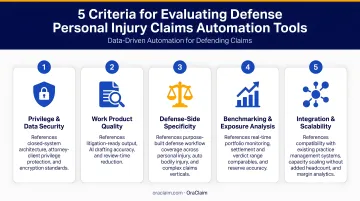
The most common mistake in this process: selecting tools based on feature count or brand recognition rather than workflow fit.
A platform built for plaintiff intake doesn't serve a defense team's need to rapidly process inbound claim files, benchmark exposure against historical data, or generate carrier-ready reporting at volume. The wrong tool creates workflow gaps that cost time and money — no matter how well-reviewed the software is elsewhere.
Conclusion
Plaintiff-side AI tools can now negotiate with insurers, organize medical records autonomously, and generate demand packages with minimal attorney involvement. Defense teams need equivalent capability — and these five platforms deliver it.
Each platform addresses a different slice of the defense workflow. Choosing the right one comes down to where your organization sits in the ecosystem:
- Defense law firms managing high PI volumes: OraClaim or Filevine
- Carriers with existing Salesforce infrastructure: Litify
- Large P&C carriers managing the full claims lifecycle: Guidewire ClaimCenter
- TPAs and independent adjusting firms: ClaimRuler
The deciding factor is whether the platform is built for defense-side workflows: handling inbound claim volume, surfacing critical facts quickly, and connecting case-level data to portfolio-level financial outcomes. Feature count is secondary to fit.
OraClaim is built specifically for this workflow — AI claim file review, case evaluation, work product drafting, and portfolio-level benchmarking, all in a closed system that preserves privilege. Request a demo to see how it cuts review time, increases margins, and scales your team's capacity without adding headcount.
Frequently Asked Questions
What's the best personal injury case management software?
It depends on which side of the claim you're on. Plaintiff firms need tools for record organization and demand preparation. Defense teams require purpose-built software like OraClaim — optimized for inbound claim volume, AI document review, and litigation-ready analysis that general or plaintiff-side platforms aren't designed to deliver.
What CRM do lawyers use?
Law firms commonly use Salesforce (via Litify), Filevine, or Clio as matter management platforms with CRM features. Defense-focused operations typically layer a specialized AI platform on top — OraClaim handles the document analysis, exposure benchmarking, and claims intelligence that general CRM tools aren't designed to produce.
How does AI help defense lawyers manage personal injury claims?
AI eliminates non-billable document review by automatically classifying claim file documents, extracting critical facts, and flagging contradictions or causation gaps. It then generates litigation-ready work product including case evaluations, medical chronologies, deposition outlines, and motions, allowing defense teams to handle more claims with the same headcount.
Is claims management software different for defense vs. plaintiff firms?
Yes. Defense-side tools are optimized for processing inbound claim volumes, managing exposure, and delivering rapid analysis for carrier reporting. Plaintiff tools focus on building case value through record organization and demand generation. Using plaintiff-side software on the defense side creates workflow gaps at exactly the points that matter most : initial evaluation, reserving, and litigation preparation.
What should defense teams look for when choosing a claims automation tool?
Prioritize AI document review capability (not just storage), integration with existing practice management platforms, and security standards appropriate for privileged legal and medical data. Also confirm the tool scales to your claim volume and was built specifically for defense workflows rather than adapted from a plaintiff-side or general-purpose platform.