What separates winning MSJs from denied ones isn't familiarity with the standard. It's how evidence is organized, how facts are framed, and whether procedural requirements are met before the brief is ever read on the merits.
This guide covers when to file, what to prepare, how to draft each component, and the mistakes judges flag most often.
Key Takeaways
- File only when material facts are genuinely undisputed and the law supports judgment without a jury
- The Statement of Undisputed Material Facts is the foundation; every fact requires a precise record citation
- Strong MSJs are built on admissions, deposition testimony, and authenticated documents — not unsupported assertions
- Filing before discovery closes invites a Rule 56(d) counter-motion and wastes resources
- Most MSJs fail by overstating undisputed facts, burying key arguments, or ignoring local rules
When to File a Motion for Summary Judgment
Not every case warrants an MSJ. A poorly supported or premature filing can damage credibility with the judge and delay the case without any strategic benefit.
Case Types Best Suited for MSJ
Cases where the law clearly controls on undisputed facts are the strongest candidates:
- Statute of limitations defenses — dates are either undisputed or they aren't
- Absence of legal duty — a pure legal question requiring no jury
- Failure to produce a required expert — undisputed procedural record
- Lack of causation as a matter of law — where no reasonable jury could find the causal link
Cases ill-suited for MSJ typically involve employment discrimination claims, credibility-heavy fact disputes, and scenarios where each side presents a competing narrative of events.
That said, research across 11 federal districts found summary judgment was granted in approximately 77% of employment-discrimination cases where filed — not because the facts were clean, but because those motions were grounded in legal standards like McDonnell Douglas burden-shifting rather than factual sufficiency alone.
Timing Considerations
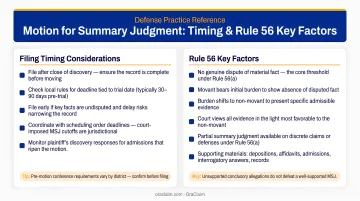
Knowing which cases fit an MSJ is only half the equation — timing the filing correctly is equally important. Courts typically set MSJ deadlines after fact discovery closes, and filing early creates real risk:
Rule 56(d) allows the non-movant to seek deferral or denial by showing — by affidavit or declaration — that it cannot present facts essential to oppose the motion
A premature MSJ can convert a dispositive motion into a discovery-delay event
Celotex Corp. v. Catrett expressly frames summary judgment as proper "after adequate time for discovery"
Either party can file — and MSJs can be partial under Rule 56(g), resolving select claims or defenses while leaving others for trial
What You Need Before Drafting
Preparation determines outcome. The evidentiary record must be thorough and organized before a single word of the motion gets written. Build the record with a potential MSJ in mind from the start of the case.
Evidence and Record Requirements
Rule 56(c)(1) permits factual assertions to be supported by citations to depositions, documents, ESI, affidavits or declarations, stipulations, admissions, interrogatory answers, and other materials. The four core sources:
- Pleadings — allegations and admissions in the complaint and answer
- Written discovery — interrogatory responses, requests for admission, and produced documents (flag the hearsay issue with unsworn statements)
- Deposition transcripts — especially admissions from opposing parties and hostile witnesses
- Affidavits or declarations — from witnesses with personal knowledge of facts not captured elsewhere
Rule 56(c)(4) requires affidavits and declarations to be made on personal knowledge, set out facts admissible in evidence, and show the affiant's competence to testify. Rule 56(c)(2) permits objection when material cannot be presented in admissible form. Audit every cited fact for admissibility before filing.
Defense teams managing high-volume litigation can use AI-powered platforms like OraClaim to surface key admissions and structure case facts without manual document review. OraClaim's claim file review module extracts and classifies facts across the full record, flags contradictions and causation gaps, and links every finding back to its source — so identifying what's truly undisputed takes hours instead of days.
Local Rules and Court-Specific Requirements
Procedural noncompliance kills otherwise strong motions. Every court imposes its own requirements:
| Court | Key Requirement | Consequence of Non-Compliance |
|---|---|---|
| D. Mass. (L.R. 56.1) | Separate concise statement with page-specific citations | Failure is grounds for denial; uncontroverted facts deemed admitted |
| S.D.N.Y./E.D.N.Y. (L.C.R. 56.1) | Numbered paragraphs; opposition must respond correspondingly | Uncontroverted paragraphs may be deemed admitted |
| N.D. Ill. (L.R. 56.1) | Statement and response structure; limits on number of fact statements | Noncompliance affects whether facts are admitted |
| C.D. Cal. (L.R. 56-1/56-2) | Statement of Uncontroverted Facts and Conclusions of Law | Unchallenged facts may be treated as undisputed |
Individual judges add another layer. D. Mass. Judge Sorokin's standing order, for example, requires a combined statement of undisputed facts with citations identifying document name/number plus specific page, paragraph, or line. Check the assigned judge's standing orders before drafting begins, not after the motion is already in progress.
How to Draft a Motion for Summary Judgment: Step-by-Step
Step 1: Caption, Title, and Opening Motion
Write a clear case caption and identify the moving party. The opening motion should concisely state the basis for relief — no genuine dispute of material fact, movant entitled to judgment as a matter of law — without overloading this section with argument. Reserve the reasoning for the memorandum.
Reference the applicable procedural rule (FRCP Rule 56 in federal court, or the state equivalent) and briefly recite the legal standard. Keep this section tight. Judges know the standard; this section should orient, not overwhelm.
Use current Rule 56(a) language: "no genuine dispute as to any material fact" — not the pre-2010 phrasing "no genuine issue," which is outdated.
Step 2: Statement of Undisputed Material Facts
This is the core of the motion. Every fact must appear in a separately numbered paragraph tied to a specific record citation — deposition page and line, exhibit number, affidavit paragraph, interrogatory response page. The tone should be clinical and objective.
What to include:
- Facts material to proving or disproving a specific element of a claim or defense
- Admissions from depositions or requests for admission (hardest to dispute)
- Authenticated documents and affidavits from competent witnesses
What to avoid:
- Background facts that invite unnecessary disputes
- Legal argument embedded in the fact statement
- Loaded adjectives or characterizations
- Facts supported by unsworn hearsay statements
One critical doctrine to know: the sham affidavit rule. Under Van T. Junkins & Associates, a party cannot manufacture a genuine dispute by submitting an affidavit that contradicts prior deposition testimony without explaining the discrepancy. Courts will disregard it.
Step 3: Standard of Review
Keep this section short. The 1986 trilogy remains controlling:
- Celotex Corp. v. Catrett — MSJ is appropriate where the nonmovant fails to establish an essential element on which it bears the trial burden; the movant may point to the absence of evidence
- Anderson v. Liberty Lobby — a fact is material only if governing law makes it outcome-relevant; a dispute is genuine if a reasonable jury could return a verdict for the nonmovant; the judge does not weigh evidence
- Matsushita Electric — the nonmovant must do more than show "some metaphysical doubt"; implausible theories require more persuasive evidence to survive
Note that the court views evidence in the light most favorable to the non-moving party. State that clearly, then move on.
Step 4: Legal Argument
Structure each argument section around a separate claim or legal element, using IRAC (Issue, Rule, Application, Conclusion). Each section gets its own heading.
Lead with why the movant wins — not with case background. The introduction to the argument section should state the conclusion immediately, then build the legal and factual support.
Additional drafting principles:
- Cite controlling authority and factually analogous cases where MSJ was granted
- Avoid string citations — one well-chosen case is more persuasive than five
- Address anticipated counterarguments in the opening brief, not just the reply. If the judge rules before seeing the reply, an unaddressed opposing argument may be fatal
- Test your structure: read only the topic sentence of each paragraph in sequence. If those sentences form a coherent argument for why the movant wins, the memo is well-organized
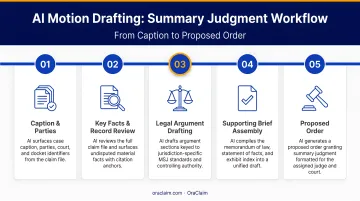
For defense teams handling high volumes of dispositive motion work, OraClaim's motion drafting module generates first-draft MSJs — statement of facts with pin-citations, jurisdiction-specific case law, and full legal argument — trained on the firm's own brief banks and citation conventions. The result is a structured, review-ready draft that attorneys refine rather than build from scratch.
Step 5: Conclusion and Proposed Order
Keep the conclusion to one short paragraph: restate the relief requested and summarize the basis. Attach a proposed order granting the motion. Some jurisdictions require it; most judges appreciate having one. Northern District of California local rules, for instance, require a proposed order unless excused by the judge.
Confirm proposed order formatting requirements in local rules or the judge's standing order — some judges have specific formatting preferences.
Key Variables That Determine Whether Your MSJ Succeeds
Beyond procedural compliance, MSJ outcomes are shaped by four controllable variables.
Legal vs. Factual Grounds
Motions grounded in pure legal issues — statute of limitations, absence of duty, lack of a qualified expert — are stronger than those arguing the plaintiff simply lacks enough evidence to prove a factual element like causation. Courts are more reluctant to take factual sufficiency questions away from juries.
Prioritize legal arguments and present only the strongest grounds — raising every conceivable argument dilutes the motion's force.
Evidence Quality
Facts supported by deposition admissions or requests for admission are far harder to dispute than facts supported only by affidavits. Weak or potentially hearsay evidence gives the opposing party an opening to manufacture a "genuine dispute."
Before filing, audit every cited fact for admissibility:
- Confirm each fact can be presented in admissible form at trial
- Flag any affidavit-only support as a potential weak point
- Replace or supplement hearsay-dependent facts with deposition admissions where possible
Facts that can't meet the Rule 56(c)(2) admissibility standard cannot support the motion.
Local Rules Compliance
Missing a required separate statement of facts, submitting an argumentative 56.1 statement rather than a factual one, or including inaccurate page citations can sink an otherwise strong motion. Courts should not have to hunt for evidence — if a judge can't easily locate a citation, the court may disregard it entirely.
Persuasive Framing
A well-organized memorandum with a compelling introduction, clear headings, and direct prose improves the odds the judge engages favorably with the argument. Convoluted sentences and excessive citations risk burying key points.
Apply the topic-sentence test: read your opening sentences in sequence — if they don't tell a coherent story, restructure before filing.
Common Mistakes When Drafting a Motion for Summary Judgment
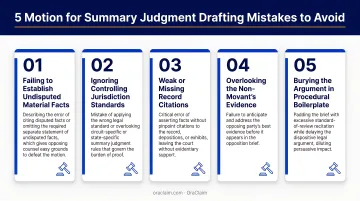
Filing prematurely. A motion filed before discovery is complete invites a Rule 56(d) counter-motion. Courts and judges notice when MSJs are filed without a solid record — and it affects credibility for the rest of the case.
Arguing within the Statement of Undisputed Facts. Presenting disputed facts as undisputed, using loaded adjectives, or embedding legal conclusions in the fact statement invites motions to strike and can unravel the entire motion. Every factual statement must be precise, supported, and neutral.
Submitting too many facts or too many arguments. Burying the court in tangentially related facts dilutes persuasive force. Facts not linked to a specific claim in the memorandum may be disregarded entirely — and the motion's credibility goes with them.
Omitting a proposed order. Failing to include a proposed order is a missed opportunity to frame the relief requested on your terms. Draft one and attach it.
Holding back key arguments for the reply. If the court rules before the reply is filed — or local rules restrict its scope — arguments held in reserve may be lost permanently. Lead with your strongest points in the opening brief.
Frequently Asked Questions
What is the legal standard for granting a motion for summary judgment?
Under FRCP Rule 56(a), summary judgment is granted when the movant shows there is no genuine dispute as to any material fact and the movant is entitled to judgment as a matter of law. The court views all evidence in the light most favorable to the non-moving party and does not weigh evidence or assess credibility.
What is the difference between a motion for summary judgment and a motion to dismiss?
A motion to dismiss under Rule 12(b)(6) challenges the legal sufficiency of the complaint on its face, without going beyond the pleadings. An MSJ requires evidence from the record — depositions, discovery responses, affidavits — to demonstrate that no genuine factual dispute exists.
Can a plaintiff file a motion for summary judgment?
Yes. Rule 56(a) says "a party may move for summary judgment," meaning either side can file. Plaintiffs may move when undisputed facts show the defendant's denials or defenses lack evidentiary support. In practice, defendants file the vast majority of MSJs.
What happens if a motion for summary judgment is denied?
Denial means the court found a genuine dispute of material fact, so the case proceeds to trial. A partial denial under Rule 56(g) may still narrow the issues by establishing certain facts as undisputed, which can also clarify both parties' settlement positions.
What should be included in the Statement of Undisputed Material Facts?
Separately numbered factual statements, each supported by a precise record citation — deposition transcript page and line, exhibit number, or affidavit paragraph. Limit entries to facts material to a specific claim or defense element; exclude argumentative, conclusory, or background-only facts.
How do you oppose a motion for summary judgment?
The opposing party must point to actual record evidence creating a genuine dispute of material fact — bare allegations, denials, or conclusory statements are insufficient. Alternatively, the opposing party may argue that the law doesn't entitle the movant to prevail even if the facts are undisputed, raising a purely legal counterargument.