Key Takeaways
- ECA is the structured process of evaluating case facts, risk, and exposure before litigation strategy is locked in
- Plaintiff firms are adopting AI faster, creating a real competitive disadvantage for defense teams relying on manual review
- AI-powered ECA compresses weeks of document review into hours through automated fact extraction, medical chronology drafting, and exposure analysis
- The best ECA tools produce litigation-ready work product — not just search results — and benchmark against historical cases
- Defense-specific ECA tools integrate benchmarking, portfolio management, and privilege-protected workflows — capabilities repurposed eDiscovery platforms weren't built to deliver
Introduction
Plaintiff firms are building cases faster than ever. They're using AI to analyze claim files, identify high-value targets, and develop case theories — often before defense teams have finished gathering documents. Meanwhile, many defense lawyers and claims professionals are still running keyword searches through disconnected systems and manually compiling what's relevant.
The gap is real. AI adoption among law firms jumped from 11% in 2023 to 30% in 2024, according to the ABA's 2024 AI TechReport — but adoption hasn't been uniform across firm types and practice areas.
For defense teams managing dozens or hundreds of active claims simultaneously, the manual approach isn't just slow. It creates a strategic disadvantage at the exact moment when case posture decisions matter most.
This guide breaks down what ECA AI tools actually do, where traditional methods fail under volume, and what to look for when evaluating a platform for defense work.
What Is Early Case Assessment?
Early case assessment (ECA) is the structured process of gathering, organizing, and analyzing case-relevant data at the outset of a legal matter — before committing to full-scale litigation or exhaustive document review.
The core questions ECA is designed to answer:
- Who is involved, and what are their roles in the matter?
- What happened, and what does the record actually show?
- What is the exposure?: financially, legally, and strategically
- What's the right path forward?: settle early, defend aggressively, or investigate further
ECA only delivers its full value early. Answering these questions in days — not weeks — means you can still shape strategy, set accurate reserves, and enter negotiations from an informed position.
ECA vs. Traditional Document Review
Standard document review assumes the facts are already known and searches for supporting evidence. ECA begins when the facts are unclear and uses data analysis to build the picture from scratch. That distinction matters most when deciding where to apply it.
ECA applies across multiple contexts:
- Litigation — assessing liability, damages, and defense strategy before discovery
- Insurance claims — evaluating exposure, causation, and reserve adequacy early in the claim lifecycle
- Regulatory inquiries and internal investigations — understanding what happened before responding to external pressure
Why Traditional ECA Methods Fail Defense Teams
The manual ECA workflow is familiar to anyone who's done it: review the incoming file, interview custodians, run keyword searches, and manually compile what's relevant. For one or two complex matters, it works. For fifty concurrent claims, it breaks down completely.
The Volume and Data Problem
Claim files don't arrive as clean, organized summaries. They come as scattered PDFs, scanned records, email archives, prior pleadings, and medical records from multiple providers — spread across disconnected systems with no consistent structure.
Manual document review is slow and inconsistent. RAND research found that attorney review teams agreed on document responsiveness only 23% to 54% of the time in controlled studies — meaning two attorneys reviewing the same file often reach different conclusions about what's relevant.
The cost problem is just as acute. Document review accounted for 73% of total electronic document production costs in large civil lawsuits, per the same RAND research.
OraClaim's founders, Mark Tepper and Andy Anderson, lived this problem directly — Mark as a litigator managing risk for enterprise companies and insurers, Andy analyzing risk and managing high-exposure claims. Their diagnosis: overwhelming claim volumes compounded by manual processes and unstructured data.
Internal benchmarks from OraClaim indicate that manual document review consumes 40–70% of associate hours per matter — non-billable time that directly erodes firm profitability.
The Competitive Disadvantage
The deeper problem is structural asymmetry. Plaintiff firms have adopted AI tools that let them surface high-value targets, build case theories, and set settlement anchors — often before defense counsel has finished an initial review. That head start shapes negotiation leverage and litigation posture from the outset.
Defense teams have the financial resources to compete. What AI-powered ECA tools now offer is the speed to match plaintiff firms at the earliest, most consequential stage of a claim.
How AI Is Transforming Early Case Assessment
The foundational shift AI brings to ECA is straightforward: instead of attorneys manually reading through files to find relevant facts, AI systems ingest large volumes of unstructured documents, extract key entities, surface critical facts, and organize findings into usable outputs — cutting weeks of manual review to hours.
Automated Document Analysis and Fact Extraction
AI tools use natural language processing (NLP) to read and extract structured information from unstructured claim files and legal documents. Rather than running a keyword search and hoping the right documents surface, the AI:
- Automatically classifies every document in the file
- Extracts key dates, events, injuries, and treatment patterns
- Flags contradictions, timeline gaps, causation issues, and unverified details
- Produces structured key fact summaries with citation-linked source indexes
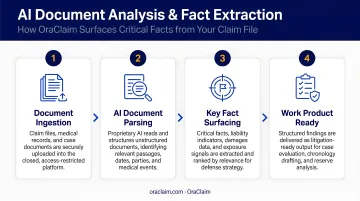
Thomson Reuters describes legal document analysis as requiring NLP tasks including parsing, analyzing, mining, understanding, and generating human language — capabilities that, when applied to claim files, eliminate the manual triage that previously consumed most of the early assessment phase.
Insurance defense firm Zarwin Baum reported compressing document review tasks that previously took a full day into under 30 minutes using AI, according to Thomson Reuters.
Pattern Recognition Across Case Portfolios
AI doesn't just analyze individual cases in isolation. It benchmarks a new matter against historical cases with similar fact patterns — turning every closed case into intelligence defense teams can act on for current matters.
OraClaim's historical case benchmarking module auto-tags each claim across dozens of dimensions, including:
- Case type, jurisdiction, venue, and judge
- Plaintiff counsel and plaintiff expert
- Alleged injuries, treatment patterns, and causation factors
- Settlement amounts, verdict amounts, and dispositive motion outcomes
- Defense costs by phase and time-to-resolution
The result: defense teams see similar-case settlement and verdict ranges, plaintiff-counsel-specific outcome histories, and judge-specific motion-grant rates — without manual data prep or analyst time. This reduces claims-analytics-team manual benchmarking effort by more than 80%.
Predictive Exposure Assessment
AI tools use case data and historical benchmarks to generate early exposure estimates — giving defense teams and claims managers a data-backed view of likely settlement ranges, litigation costs, and risk levels at the outset.
OraClaim's real-time exposure analysis operates continuously as new documents enter the file. As medical records update, expert reports arrive, or depositions produce unexpected testimony, the system automatically re-runs exposure analysis and issues alerts flagging material changes to:
- Liability assessment and comparative fault
- Medical specials trajectory and future medical exposure
- Reserve adequacy and settlement value
- Punitive damages risk and bad-faith exposure
The system runs continuously across the full life of the matter — not just at intake.
Early Strategy Alignment
Most manual case evaluations require 10–40 billable hours before outside counsel and claims managers can align on strategy. AI-generated case evaluations covering liability assessment, comparative fault, damages exposure, reserve recommendations, settlement value ranges, and dispositive motion opportunities can be produced in minutes.
That speed matters because it allows outside counsel and claims managers to align on case posture before positions harden. Clean summaries, timelines, and evidence packages can be shared in a format carriers expect — reducing back-and-forth and accelerating authority decisions.
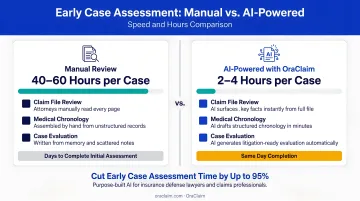
Attorney judgment remains central. What changes is the quality and speed of the inputs that judgment works from — so strategic decisions get made earlier, with better data behind them.
What to Look for in Early Case Assessment AI Tools
Most ECA tools were built for eDiscovery in large commercial litigation — not for the high-volume, claims-driven work of insurance defense lawyers and claims professionals. Here's what separates a purpose-built defense tool from a repurposed eDiscovery platform.
Litigation-Ready Work Product Generation
The tool should take raw case documents and produce structured, attorney-ready outputs — not just search results or document lists that still require significant manual assembly.
Look for platforms that generate:
- Case summaries and key fact reports with source citations
- Medical chronologies and litigation timelines
- Case evaluations covering liability, damages, and reserve recommendations
- Deposition outlines, motion drafts, and custom carrier-formatted reporting letters
OraClaim generates all of these as first drafts for attorney review: reducing medical chronology drafting time from 15–60+ hours to under 60 minutes, and cutting dispositive motion drafting from 20–120 billable hours to under 10.
Historical Case Benchmarking
Tools that automatically structure and compare past cases turn institutional knowledge into a systematic advantage. The benchmarking capability should surface:
- Similar-case settlement and verdict ranges
- Plaintiff-counsel and plaintiff-expert outcome histories
- Judge-specific motion-grant rates
- Reserve adequacy benchmarks against comparable fact patterns
Defense teams running on memory and gut feel leave real money on the table. Structured benchmarking gives every attorney on the team access to outcomes data that previously lived only in a senior partner's head.
Portfolio-Level Analytics and Business Intelligence
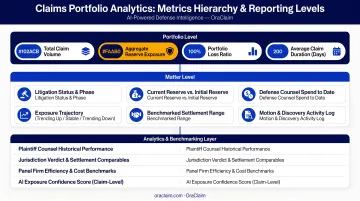
The best ECA tools connect individual matter data to portfolio-level financial insight. Claims managers and firm leadership need visibility into:
- Total incurred and total exposure by line of business, jurisdiction, and plaintiff-counsel concentration
- Panel-firm cost benchmarking and outside-counsel performance
- Reserve adequacy across the portfolio
- Matter-level profitability, realization rates, and AI productivity impact on margin
OraClaim's Claims Portfolio Management and Financial Impact modules surface this data in dashboards formatted for claims VPs, Chief Claims Officers, managing partners, and CFOs — not just attorneys reviewing individual files.
Security, Integration, and Defensibility
Non-negotiables for any ECA tool handling confidential claim data:
- Encryption, authentication, and data isolation — the platform must be a closed, access-restricted environment
- Privilege protection — AI-generated outputs must remain subject to attorney-client privilege and attorney work-product doctrine; the platform should never use client data to train its models
- Integration with existing systems — the tool should connect with practice management and document management platforms (Clio, MyCase, iManage, NetDocuments, and others) without requiring wholesale workflow overhauls
- Audit trails — teams must be able to explain and defend AI-assisted decisions to clients, courts, or regulators
ABA Formal Opinion 512 confirms that lawyers using generative AI must address duties of competence, confidentiality, and communication — and that all AI-generated work product requires attorney review before use.
Benefits of AI-Powered ECA for Defense Lawyers and Claims Professionals
Time and capacity. Nearly half of legal professionals using generative AI save 1 to 5 hours per week, according to the 2025 Ediscovery Innovation Report from Everlaw, ACEDS, and ILTA — with 5 hours per week translating to 32.5 working days per year. For defense firms managing high-volume dockets, that capacity gain is the difference between absorbing more panel work and turning it away.
Earlier, better decisions. When defense teams develop a clear picture of case facts and exposure in days rather than weeks, they set more accurate reserves, make smarter early settlement decisions, and enter negotiations informed rather than guessing. That positioning — accurate reserves, earlier settlement leverage, stronger negotiating posture — directly affects both claim outcomes and carrier relationships.
Cost compounding. Faster ECA reduces downstream costs across the entire matter lifecycle. Smaller, more targeted review populations mean lower outside counsel spend, fewer billable hours on non-strategic work, and better return on every matter. RAND's research found predictive coding alone could reduce total review costs by up to 75% — and modern generative AI tools have extended those efficiency gains further.
That cost efficiency translates directly into competitive positioning. Defense firms that deliver faster, data-driven case insight and transparent portfolio reporting don't just work more efficiently — they win and retain carrier clients. Carrier clients evaluate panel firms on speed, analytical sophistication, and communication quality. AI ECA tools make those capabilities consistent across the firm, not dependent on individual attorney effort.
Best Practices for Implementing ECA AI Tools
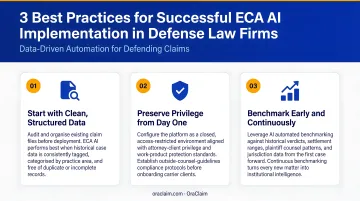
Three principles separate successful ECA AI deployments from stalled ones:
1. Start with one workflow, then expand. Rather than deploying AI broadly, pick a single use case — initial claim file review, exposure analysis for new matters, or benchmarking against historical cases. Set a measurable success metric first. This limits resistance and demonstrates ROI before firm-wide rollout.
2. Keep attorneys and claims professionals in the decision loop. AI outputs should inform and accelerate human judgment, not replace it. Treat all AI-generated summaries, case evaluations, and work product as first drafts — not final conclusions. Under the California Bar's guidance, lawyers remain responsible for AI-generated outputs and must review work product for accuracy before use or submission.
3. Treat ECA as a continuous process, not a one-time gate. As a matter evolves — new custodians surface, discovery produces unexpected documents, opposing counsel shifts strategy — the ECA analysis needs revisiting. The strongest AI tools handle this automatically, re-running exposure analysis as new documents enter the file and flagging material changes without requiring a full restart.
Frequently Asked Questions
What is early case assessment?
Early case assessment is the process of evaluating the facts, data, risk, and potential costs of a legal matter before committing to full litigation or extensive document review. The goal is faster, smarter decisions on settlement, defense posture, and reserve-setting — while there's still time to influence outcomes.
What are AI-driven assessment tools?
AI-driven assessment tools are software platforms that use machine learning and natural language processing to automatically analyze documents, extract key facts, identify patterns, and generate strategic insights — reducing or replacing the manual review that traditional ECA requires.
How does AI early case assessment differ from traditional ECA methods?
Traditional ECA relies on manual document review and keyword searches — slow processes that don't scale. AI-powered ECA automates fact extraction, benchmarks cases against historical data, and delivers structured strategic insights without requiring attorneys to read every page.
What features should defense lawyers look for in an ECA AI tool?
The most important capabilities are litigation-ready work product generation, historical case benchmarking, portfolio-level analytics, integration with existing practice management systems, and strong data security with privilege protection. Tools purpose-built for defense workflows deliver more relevant outputs than repurposed eDiscovery platforms.
Can ECA AI tools help manage high-volume claims portfolios?
Yes — AI ECA tools are especially valuable in high-volume environments. They enable defense teams and claims professionals to analyze incoming claims at scale, surface portfolio-wide patterns, monitor exposure in real time, and prioritize resources — without adding headcount.