Introduction
A complex bodily injury file can easily span hundreds of pages — medical records, incident reports, deposition transcripts, expert analyses, and carrier correspondence, none of it organized, all of it requiring attorney attention before a single strategic decision gets made.
Defense lawyers and claims professionals deal with this on every file, every week.
Meanwhile, plaintiff firms have been adopting AI tools aggressively, using technology to build faster, stronger cases. Defense teams spending hours on manual review are handing their opposition a structural advantage — and most defense organizations are still doing it the old way.
According to Clio's research, the average lawyer bills just 2.6 hours out of an 8-hour day — and manual, non-billable document review is a major reason why. The hours lost to unstructured document review don't just hurt utilization — they directly compress margins and limit how many matters a team can handle without burning out.
This article covers how AI is changing legal document review and management, which capabilities deliver the most value for defense-side practitioners, and how purpose-built tools like OraClaim help defense teams reclaim their competitive footing.
Key Takeaways
- AI automates document classification, summarization, entity extraction, and privilege screening — freeing attorneys to focus on strategy
- Defense-specific AI benchmarks incoming claims against historical case data to surface outcome patterns general tools can't replicate
- Manual review consumes 40–70% of associate hours per matter; AI cuts that dramatically without sacrificing accuracy
- Purpose-built, closed platforms preserve attorney-client privilege and work-product protection — a requirement no general-purpose AI tool meets
The Document Review Problem Facing Defense Teams Today
Volume Is the Enemy of Strategy
Defense lawyers and claims professionals don't just manage one file. They manage portfolios — dozens or hundreds of open matters simultaneously, each generating its own stream of unstructured data.
Each matter typically involves:
- Medical records from multiple providers
- Discovery responses and recorded statements
- Expert reports and coverage correspondence
- Surveillance materials and deposition transcripts
Each document needs to be read, classified, cross-referenced, and analyzed before it can inform strategy. Most of that work falls to attorneys and paralegals doing it manually, page by page.
RAND research found that document review accounts for 73% of document-production costs in civil e-discovery — the single largest cost category in litigation. That figure hasn't changed much since, because the underlying process hasn't changed much either.
The Plaintiff-Side Technology Gap
The structural disadvantage runs deeper than workload. Plaintiff firms have been faster adopters of legal technology, using AI to accelerate research, organize evidence, and build demand packages with greater analytical precision. Defense teams relying on manual review are absorbing that asymmetry in every case.
OraClaim's co-founders, Mark Tepper and Andy Anderson, built the company from this observation. Mark litigated claims and managed risk for enterprise companies and insurers; Andy analyzed risk for insurers and managed high-exposure claims. Both saw the same pattern: overwhelming claim volumes, manual processes that couldn't scale, and plaintiff attorneys using technology to widen the gap.
Thomson Reuters reports that 74% of lawyers said spending too much time on administrative tasks was at least a moderate challenge. For defense teams managing high-volume portfolios, that burden multiplies across every matter and every client relationship.
What AI Legal Document Review Actually Does
AI legal document review isn't a single technology — it's a stack of complementary capabilities. Knowing what each layer does helps defense practitioners choose the right tools and use them with confidence.
Machine Learning, NLP, and OCR: What Each Does
Machine learning trains AI models to recognize patterns across large datasets. In document review, this means the system learns to classify document types, flag relevant facts, and identify inconsistencies — without requiring an attorney to specify rules for every scenario. The model improves as it processes more data.
Natural language processing (NLP) allows AI to understand legal language in context, not just by keyword. When an attorney asks "what did the treating physician say about the injury date?", NLP interprets meaning, locates the relevant passage, and returns a cited answer. It doesn't surface every document containing the word "injury" — it finds the specific passage that answers the question.
OCR (optical character recognition) converts scanned PDFs, handwritten physician notes, and image-based files into fully searchable, machine-readable text. For defense work, where medical records often arrive as scanned faxes or legacy paper files, OCR is foundational. Without it, AI analysis can't reach the most consequential documents in the file.
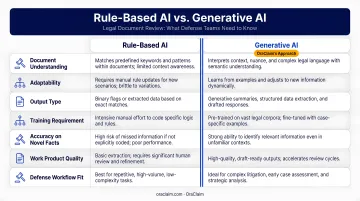
Traditional AI vs. Generative AI
These two AI types serve different functions in document review:
- Rule-based AI follows explicit instructions — if a document contains these keywords, classify it this way. It's predictable and auditable, but can't handle nuance or novel patterns.
- Generative AI — trained on large datasets — summarizes, drafts, and answers questions in plain language. Georgetown Law Technology Review defines it as AI capable of creating new content, including text, code, and structured analysis.
Platforms that combine both get the best of each: rule-based precision for classification and extraction, generative capability for summarization and work product drafting.
Key Ways AI Enhances Legal Document Management
Automated Classification and Organization
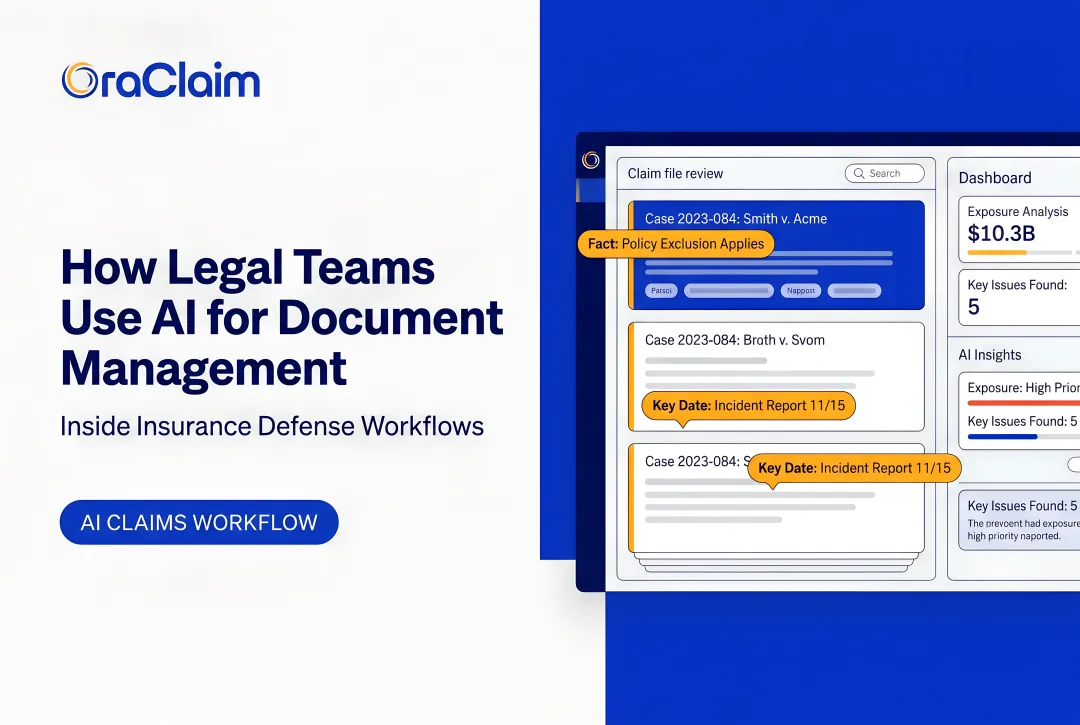
AI instantly sorts incoming documents by type — pleadings, medical records, correspondence, invoices, expert reports — and tags them to the correct matter. Every document is findable in seconds. No more buried folders, no more "I know I saw that somewhere" searches during trial prep.
OraClaim's claim file review module ingests entire case files and automatically classifies every document, extracting every relevant fact. The output is a structured, searchable workspace rather than a scattered collection of PDFs and email attachments.
AI-Powered Summarization
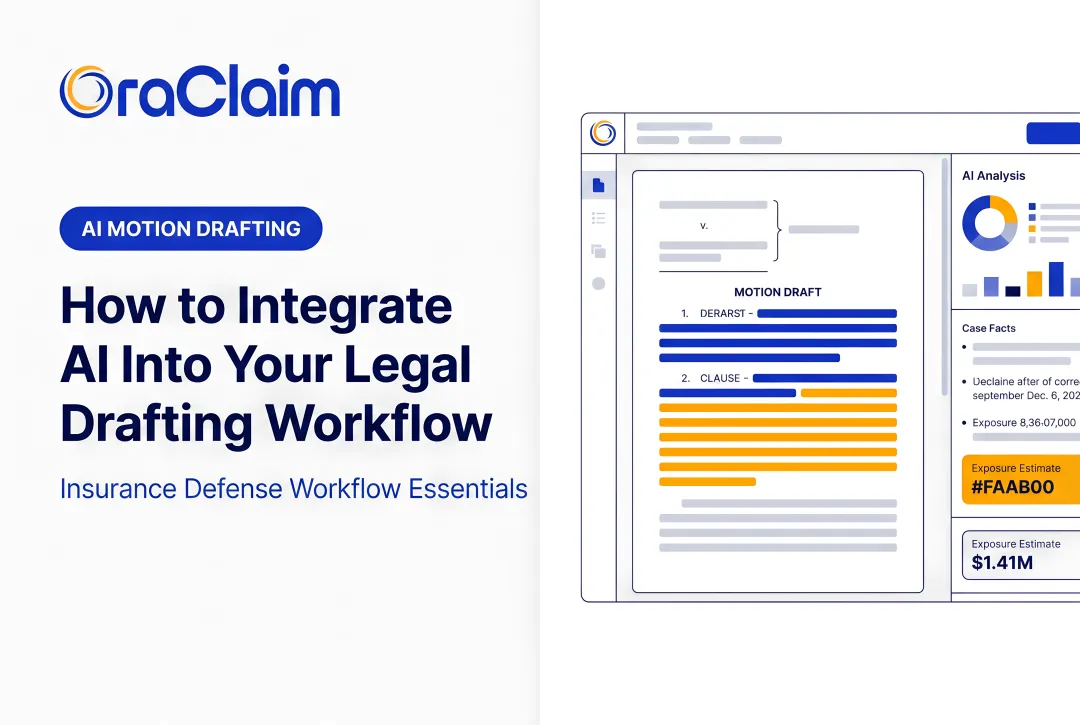
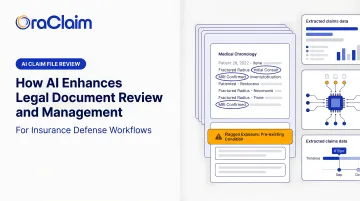
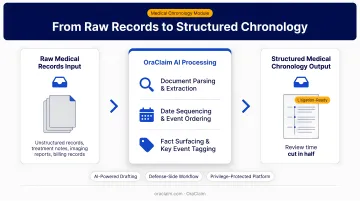
Reading a 300-page medical record line by line to find three clinically significant facts is not a good use of attorney time. OraClaim's medical chronology module drafts complete chronologies from raw medical records — including ER reports, specialist notes, imaging results, pharmacy records, and IME reports — and flags:
- Treatment gaps (critical for causation arguments)
- Pre-existing conditions and prior accidents
- Inconsistencies between subjective complaints and objective findings
- Missed appointments and non-compliance
- ICD-10/CPT codes and billed-versus-paid analysis
What traditionally takes paralegals or legal nurse consultants 15–60+ hours per complex file takes OraClaim under 60 minutes for a first draft.
Intelligent Search and Retrieval
Natural language search lets attorneys query their case files the way they think — "what did the claimant say about prior treatment?" — and receive a cited answer rather than a document dump. This replaces the manual transcript scanning that typically precedes deposition preparation and motion drafting.
Pattern Recognition and Historical Benchmarking
Beyond workflow efficiency, OraClaim's historical case file structuring and benchmarking capability transforms closed-case archives into searchable institutional knowledge. Every new matter gets benchmarked against the historical book, surfacing:
- Settlement and verdict ranges for similar fact patterns
- Plaintiff-counsel-specific outcome histories
- Judge-specific motion grant rates
- Plaintiff expert reliability and bias patterns
- Reserve adequacy comparisons
Defense firms use this to set defensible reserves, refine litigation strategy, and justify settlement authority.
Connecting Case Data to Financial Insights
OraClaim's financial impact and margin analysis module links operational matter data to revenue, cost, and profitability metrics. For managing partners and claims VPs, this means visibility into:
- Realization rate by matter and partner
- Profitability by carrier client and matter type
- Write-down and write-off drivers
- AI productivity impact on billable-hour mix and margin
- Defense cost as a percentage of indemnity across the portfolio
For claims VPs and managing partners evaluating loss adjustment expense, that portfolio-level visibility directly informs staffing, panel management, and carrier-client pricing decisions.
How AI Gives Defense Lawyers a Competitive Edge
Eliminating Non-Billable Review Hours
Clio reports that AI can increase billable capacity by as much as 25%, and that 74% of hourly billable tasks could be automated or streamlined — particularly documentation, data collection, and analysis.
For defense firms, the numbers are straightforward: non-billable manual review that previously consumed 40–70% of associate hours per matter gets replaced by automated AI outputs. That time becomes available for billable work.
Scaling Capacity Without Adding Headcount
Defense organizations face a structural squeeze: plaintiff firms are using technology to generate more claims and move faster through litigation, while defense teams face hiring constraints and budget pressure. Adding headcount isn't always an option. Using AI is.
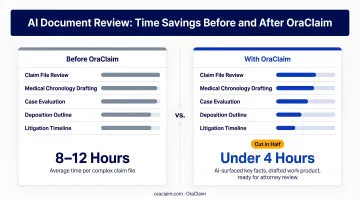
OraClaim is built specifically for this constraint. The platform lets defense firms handle higher case volumes without proportional increases in staff, by eliminating the most labor-intensive non-billable work:
- Claim file review time cut in half
- Medical chronology drafting reduced from 60+ hours to under 60 minutes
- Deposition outline preparation reduced from 4–20 hours per witness to minutes
- Case evaluation generation reduced from 10–40 hours to minutes
Litigation-Ready Work Product, Faster
OraClaim goes beyond document retrieval — the platform produces work product attorneys can use immediately:
- Medical chronologies with pin-citations to source records
- Litigation timelines synthesized from the full case file
- Deposition outlines with impeachment material and suggested question sequences
- Motions for summary judgment, motions in limine, and discovery motions tailored to jurisdiction-specific rules
- Case evaluations covering liability, damages exposure, reserve recommendations, and verdict comparables
- Custom work product (demand responses, reserve memos, mediation briefs, 90-day carrier reports) trained on the firm's style, brief bank, and institutional voice
Each output is a substantive first draft that cuts drafting time by 50–80% — specific enough to use, structured enough to finalize.
Best Practices for Implementing AI in Legal Document Review
Start With the Highest-Volume Tasks
Don't try to automate everything at once. Identify where manual review consumes the most non-billable attorney time — typically medical record review, discovery intake, and initial claim file triage — and deploy AI there first. The ROI is immediate and measurable, building organizational confidence for broader rollout.
Maintain Human Oversight
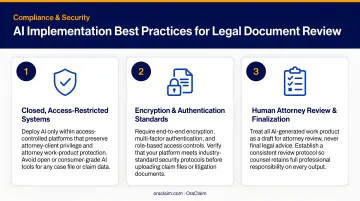
AI is a powerful first-pass tool. It is not a replacement for attorney judgment. Every AI output — summary, classification, flagged document — needs to be reviewed and verified by a qualified professional before it informs strategy or filings.
Two key regulatory obligations frame this requirement:
- ABA Formal Opinion 512: Lawyers using generative AI must satisfy duties of competence, confidentiality, supervision, and output verification.
- California State Bar 2026 guidance: Lawyers must review and correct AI outputs and remain responsible for all professional judgments.
Build your review protocol around these obligations from the start — not retrofitted to meet them after the fact.
Prioritize Security and Privilege Protection
Legal documents contain some of the most sensitive data that exists. When evaluating AI platforms, ask specifically:
- Is client data used to train AI models? (It shouldn't be.)
- How is data encrypted at rest and in transit?
- What access controls are in place for multi-user environments?
- How does the platform preserve attorney-client privilege and work-product protection?
OraClaim operates as a closed, access-restricted system designed to preserve attorney-client privilege and work-product doctrine. OraClaim does not use client data to train AI models. Contractual terms with all third-party sub-processors prohibit retaining or using confidential information for any independent purpose.
For defense teams handling privileged matter files, this architecture is a baseline requirement — not a differentiator.
Clio's legal AI privacy guidance identifies SOC 2 Type 2, ISO 27001, encryption in transit and at rest, and multi-factor authentication as baseline evaluation criteria for any legal AI tool. Treat these as the floor, not the ceiling, when vetting any platform that will touch claim file data.
Frequently Asked Questions
What is the best AI tool for legal documents?
It depends on your context. General-purpose tools like ChatGPT lack legal-grade security, privilege protection, and citation integrity. Purpose-built platforms designed for defense litigation or claims management offer the relevant workflows and outputs attorneys can actually use without wholesale rewriting.
How does AI reduce time spent on legal document review?
AI automates the most labor-intensive tasks: document classification, summarization, entity extraction, and natural language search across entire case files. Tasks that previously required attorneys or paralegals to manually read every page — medical chronologies, fact summaries, privilege logs — are generated in a fraction of the time.
What types of legal documents can AI review and manage?
AI handles medical records, discovery responses, contracts, pleadings, deposition transcripts, correspondence, invoices, expert reports, and regulatory filings. Defense-specific platforms extend this to demand packages, recorded statements, and coverage correspondence.
Is AI-assisted document review accurate enough for legal work?
Modern legal AI performs well on classification and extraction tasks. Vals AI's 2025 benchmark found that all tested AI tools surpassed the lawyer baseline for document summarization and transcript analysis. AI should still be treated as a first-pass tool subject to attorney review — particularly for privilege determinations and case-critical facts where errors carry real consequences.
How does AI in legal document review help defense lawyers specifically?
Defense-specific AI benchmarks incoming claims against historical case data, surfaces critical facts from unstructured records, and eliminates non-billable review hours across entire portfolios. Platforms like OraClaim are built from the ground up for defense work — not adapted from plaintiff-side tools — so the outputs, security architecture, and feature set match how defense teams actually operate.
What security standards should AI legal document tools meet?
Legal AI tools should offer encryption at rest and in transit, role-based access controls, multi-factor authentication, and an explicit policy that client data is not used to train AI models. Ask vendors directly about their data handling practices, sub-processor agreements, and how the platform preserves attorney-client privilege. Transparency on these points is a baseline requirement, not a differentiator.