Key Takeaways
- AI adoption in law is accelerating—30.2% of attorney offices now use AI tools, with larger firms pushing nearly 48%
- Defense teams face five integration challenges: data security, hallucinations, system compatibility, adoption resistance, and ROI uncertainty
- General-purpose AI tools aren't built for defense workflows and routinely introduce new problems alongside the ones they solve
- Purpose-built platforms that scope AI to case-specific documents and connect with existing systems reduce these risks substantially
- Attorneys retain full professional responsibility for AI-generated work product under ABA Formal Opinion 512
Why AI Integration Is Uniquely Challenging for Defense Teams
According to the ABA's 2024 AI TechReport, 30.2% of attorney offices now use AI tools—up from 11% in 2023. At firms with 500+ lawyers, adoption hits 47.8%. The pressure to keep pace is real.
Defense lawyers and claims teams face a harder integration problem than most. Plaintiff firms handle high volumes of similar claim types with predictable intake workflows—conditions where general AI adds value quickly. Defense teams process diverse, unstructured data across complex multi-party claims, variable jurisdictions, and inconsistent document formats. Most general AI tools were never designed for that environment.
The volume problem compounds the fit problem. Manual document review consumes 40–70% of associate hours per matter—yet most AI tools designed for drafting or research don't touch that bottleneck at all. The work that takes the most time gets no relief.
The competitive gap widens as a result. CLM data shows plaintiff-bar AI adoption is viewed as a top threat by more than 80% of claims executives—yet defense organizations lag behind due to institutional caution, budget approval cycles, and risk aversion. That combination leaves defense teams absorbing more pressure with fewer tools built for their workflow:
- Diverse, unstructured claim files with no standardized format
- Multi-party matters spanning multiple jurisdictions
- Reserve and litigation decisions that depend on accurate, complete fact surfacing
- Professional liability exposure if AI-assisted outputs miss critical details
Finally, the stakes of errors are higher on the defense side. An incorrect output or missed fact in a claim file can affect settlement outcomes, reserve decisions, litigation strategy, or professional liability exposure. That means evaluation criteria for defense AI can't mirror what works for general legal tools—accuracy on unstructured defense data, privilege protection, and output reliability under adversarial scrutiny all have to clear a higher bar.
Data Privacy, Client Confidentiality, and Security Risks
Attorney-client privilege and work product protection create strict limits on how legal data can be processed by external AI systems. When sensitive claim data or legal strategy enters a general-purpose AI platform without proper data isolation, it creates unintended disclosure risks—potentially waiving protections that took years to build.
The Data Commingling Problem
Multi-tenant AI platforms present a specific threat: one firm's case data could theoretically inform outputs for another user on the same platform. That's not an acceptable risk in legal or insurance defense contexts, where confidentiality obligations are absolute.
What to require from any AI vendor:
- End-to-end encryption and strict data access controls
- No use of client data to train or fine-tune the AI model
- Third-party sub-processors contractually prohibited from retaining or independently using client data
- Authentication protocols limiting access to authorized users only
Treat these as table stakes, not selling points.
The Regulatory Stack for Claims Organizations
Insurance carriers and TPAs carry additional compliance obligations beyond legal ethics rules. NAIC Insurance Data Security Model Law 668 requires a written information security program and commissioner notification within 72 hours of a qualifying cybersecurity event. Where medical records are involved, HIPAA business associate obligations may apply—though HHS guidance confirms that workers' compensation, auto liability, and general liability coverage lines are not HIPAA health plans. Each workflow needs to be mapped before medical records enter any AI system.
OraClaim addresses this directly. The platform operates as a closed, access-restricted system. Client data is never used to train the AI model, and third-party infrastructure is contractually prohibited from retaining or independently using confidential information.
The processing is designed to function as an extension of the customer's own computing environment — not as a disclosure to a third party.
AI Accuracy, Hallucinations, and Reliability in High-Stakes Legal Decisions
AI hallucinations occur when a model generates plausible-sounding but factually wrong output — fabricated case citations, misrepresented document contents, invented facts in a chronology. In legal work, that's not a quality issue. It's a liability issue.
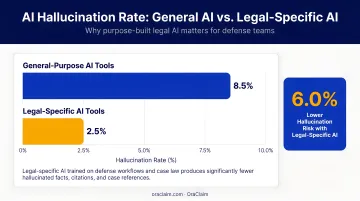
Stanford HAI found that general-purpose chatbots hallucinated on legal queries 58% to 82% of the time. Even legal-specific AI tools hallucinated in 1 out of 6 or more benchmark queries. The Mata v. Avianca case made this concrete—lawyers were sanctioned after filing briefs citing nonexistent cases generated by ChatGPT.
Why General AI Is More Prone to This in Defense Contexts
General-purpose models trained on broad public datasets have no grounding in your specific claim file, jurisdiction, or document set. When asked about case-specific facts, they generate outputs based on statistical patterns—not verified records. Defense work requires the opposite: precise facts, accurate timelines, and citations that hold up under scrutiny.
What Reduces Hallucination Risk
The most effective control is architectural: limit the AI to processing only the documents in the active case file, then require the system to cite its sources with pin-level accuracy.
That architecture is what separates purpose-built defense tools from general-purpose chatbots. OraClaim, for example, restricts AI processing to the active case file and produces citation-linked outputs — medical chronologies, litigation timelines, deposition outlines — each traceable to specific pages in the uploaded record. Attorneys can verify every extracted fact before it enters final work product.
Human Oversight Is Non-Negotiable
74.7% of legal professionals cite accuracy as their primary AI concern, ahead of data privacy at 47.2%. That concern is rational. When AI surfaces critical facts and generates first drafts, attorneys must treat output review as a professional task—not an automated shortcut.
AI should accelerate the work. The attorney must still control the strategy.
Integrating AI with Existing Legal Systems Without Disrupting Workflows
Compatibility and System Integration
Most defense firms already run practice management software, document management systems, and billing platforms. Introducing an AI tool that doesn't connect with these systems creates double-entry work, fragmented data, and workflow friction that derails adoption before it starts.
AI tools built to integrate with existing systems, rather than replace them, deliver faster ROI and face less internal resistance. OraClaim connects directly with existing platforms across two categories:
- Practice management: Clio, MyCase, Smokeball, PracticePanther
- Document management: NetDocuments, iManage, Worldox, Box
These integrations are set up during onboarding, so firms connect their existing tech stack to the platform rather than running parallel workflows.
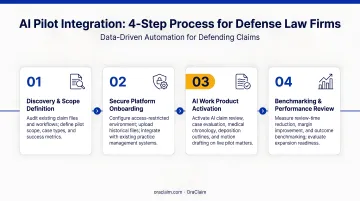
Workflow Disruption and Pilot Project Paralysis
A common failure mode: firms run a limited AI pilot without a clear integration plan, fail to see measurable results, and abandon the rollout. The pilot itself rarely fails. The absence of a structured plan does.
A more effective approach:
- Identify specific workflow stages where AI adds the most value before full rollout (document classification and review is typically the highest-volume, lowest-risk entry point)
- Establish baseline metrics for those stages—time per document, hours per chronology, review hours per matter
- Run the pilot against those baselines, not against vague expectations
- Expand incrementally as confidence builds, moving from repetitive tasks toward more complex applications like motion drafting and exposure analysis
Change Management, Adoption Resistance, and Ethical Accountability
Resistance from Legal Teams
Experienced defense litigators are trained skeptics. In the courtroom, that instinct is an advantage. In a technology rollout, it creates friction. The ABA data quantifies this: 22.1% of legal professionals cite implementation cost as a concern and 21.3% cite learning time—on top of the accuracy and reliability concerns already noted.
The right response isn't persuasion campaigns. It's structured adoption that builds trust through evidence. Start with low-risk, high-repetition tasks like document summarization and medical chronologies. When attorneys see consistent, accurate outputs on work they already understand well, resistance tends to drop faster than any training session will achieve.
Reducing resistance gets AI into the workflow. Keeping it there requires staying on the right side of your bar obligations.
Ethical Accountability and Professional Responsibility
Bar associations have moved well past general guidance. ABA Formal Opinion 512 (July 29, 2024) addresses competence, confidentiality, supervision, and fees when using generative AI. NYC Bar Formal Opinion 2024-5 (August 7, 2024) and Florida Bar Opinion 24-1 (January 19, 2024) are similarly specific. Across all three opinions, the accountability principle holds: the attorney is responsible for what goes out under their name, regardless of what generated the first draft. Before rolling out AI firm-wide:
- Establish a written AI usage policy covering approved tools, matter-type restrictions, and verification requirements
- Treat output review as a billable professional task, not overhead
- Designate a supervising attorney responsible for AI-generated work product on each matter
- Monitor your state bar's guidance actively—three major opinions dropped within a single calendar year
Evaluating Cost, ROI, and Regulatory Compliance Before Adopting AI
The cost of AI adoption extends well beyond licensing fees. Integration work, staff training, ongoing oversight, and output verification all add up — particularly for defense firms on capped fees or fixed-rate billing structures, where time savings must offset total investment, not just the license.
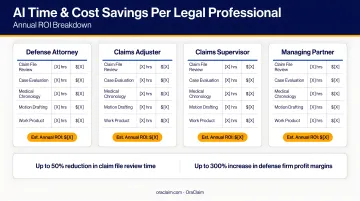
On the ROI side of that equation, Thomson Reuters reports that professionals predict AI will save an average of 5 hours weekly — roughly 240 hours per year — with an estimated annual value of $19,000 per professional. That figure is broad, not defense-specific, but it offers a starting point for internal modeling. For defense firms, the more meaningful calculation runs at the matter level: time per claim file review, hours per medical chronology, billable hours recovered from non-billable document processing.
Compliance checklist for defense-side AI adoption:
- Verify the vendor's data handling policies, including model training prohibitions and sub-processor restrictions
- Confirm end-to-end encryption, authentication protocols, and data access controls
- Map each workflow to applicable regulations: legal ethics rules, NAIC Model Law 668, and HIPAA where medical records are present
- Confirm the tool produces auditable, citation-linked outputs suitable for professional liability purposes
- Validate integration with existing practice management and document management systems before committing to rollout
Frequently Asked Questions
What are the biggest challenges of integrating AI into legal workflows?
The five core challenges are data security, output hallucinations, system integration friction, attorney adoption resistance, and ROI uncertainty. Defense-specific workflows amplify each one, given the volume of unstructured documents and the professional liability consequences of AI errors.
How does using AI affect attorney-client privilege and confidentiality?
Privilege protections still apply when AI is used, but feeding sensitive client data into unsecured or general-purpose AI platforms can create disclosure risks. Selecting platforms with strict data isolation, no model training on client data, and contractually restricted third-party access is essential to maintaining those protections.
Can AI tools integrate with existing legal practice management software?
Integration capability varies widely by vendor. Purpose-built legal AI tools designed to connect with existing practice management and document management systems—such as Clio, iManage, or NetDocuments—are far less disruptive to adopt than standalone platforms that require parallel workflows.
What is the risk of AI hallucinations in legal work, and how can firms reduce it?
Hallucinations occur when AI generates plausible but factually incorrect information. Limit exposure by using AI systems that restrict outputs to verified, case-specific documents, provide pin-level source citations, and require attorney review before any output enters final work product.
How should defense lawyers and claims professionals evaluate AI tools before adopting them?
Evaluate on five criteria: data security protocols, integration with existing systems, purpose-built design for defense and claims workflows, transparent output sourcing with citations, and demonstrated ability to reduce non-billable document review time at the matter level.
Are there professional responsibility obligations attorneys should know about when using AI?
Yes. Attorneys remain responsible for supervising AI-generated work product and must satisfy competence, confidentiality, and accuracy standards under their state bar rules. ABA Formal Opinion 512 and multiple state bar opinions have confirmed this. Firms should establish written AI usage policies and monitor evolving state bar guidance before deploying any tool firm-wide.