Building a strong chronology is also not routine paperwork. The difference between a chronology that shapes deposition strategy and one that gets filed away comes down to what's included, how early work begins, and how consistently the team applies structure across every entry.
This article covers what a client chronology is, what it must contain, a step-by-step process for building one, and the most common errors that cost defense teams time, money, and strategic ground.
Key Takeaways
- A client chronology is a fact-ordered timeline — not a document index
- Start at first contact, even with only a handful of known facts
- Every entry needs a date, fact, source, disputed status, and issue tag
- Flag gaps explicitly; unresolved gaps should drive discovery, not disappear into the file
- AI tools like OraClaim reduce medical chronology drafting from 15–60+ hours down to under 60 minutes
What Is a Client Chronology in a Compensation Case?
A client chronology is a structured, date-ordered record of discrete facts relevant to a compensation claim. That distinction matters. A document index lists records by date and tells you where to look. A chronology extracts the facts within those records and sequences them so any team member can understand the full story of the claim without returning to the source.
The Michigan Bar Journal identifies four primary uses for litigation chronologies:
- Deposition preparation and examination strategy
- Summary judgment and pretrial motions
- Settlement conferences and valuation
- Trial team briefing and witness preparation
For defense teams specifically, the strategic value goes further. A well-built chronology shifts your posture from reactive to proactive. That means catching problems on your terms, not the plaintiff's. Defense-specific advantages include:
- Identifying inconsistencies in the claimant's account before deposition
- Documenting pre-existing conditions that undercut causation arguments
- Flagging treatment gaps that weaken damages claims
- Exposing causation weaknesses before they become trial-day surprises
What to Include in a Compensation Case Chronology
The goal of every chronology entry is to function as a memory replacement, not a memory jogger. Anyone on the team should be able to read it and understand the fact without digging into the underlying document.
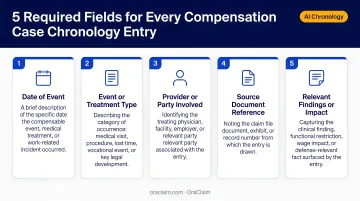
Core Entry Fields
Each entry should capture:
- Date — use a placeholder (e.g., "March 2023 — exact date unknown") when the precise date is unclear
- Fact — written in plain language as a complete, standalone sentence
- Source — document name, Bates number, or deposition volume/page/line
- Disputed status — disputed by claimant, disputed by defense, undisputed, or unknown
- Issue tag — the case issue the fact supports (causation, pre-existing condition, credibility, work capacity, etc.)
Medical and Treatment History
The medical timeline is the backbone of most compensation cases. NCCI research found that workers' compensation claims with comorbidity diagnoses incurred medical costs roughly twice those of otherwise comparable claims — and unadjusted costs could run six times the general claim population. That's why the medical chronology deserves its own structured attention.
Each medical entry should capture:
- Date and type of encounter (office visit, ER, imaging, procedure)
- Provider name and facility
- Key findings, diagnoses, and treatments ordered
- Functional limitations or work restrictions noted
- Any inconsistency between subjective complaints and objective findings
Pre-existing conditions, treatment gaps, and missed appointments carry particular weight on the defense side. They undermine causation arguments and provide cross-examination leverage.
Incident, Employment, and Disputed Facts
Incident entries should cover:
- Date, location, and reported mechanism of injury
- Witnesses present at the time of the incident
Employment entries should include job duties, prior claims history, wage information, and relevant workplace safety records — these establish context for challenging causation or damages.
The chronology shouldn't stop at confirmed facts. Include disputed and prospective facts with probable sources listed. These are discovery opportunities. A chronology limited to what you already know is just a record; one that maps what you still need to find actively drives the defense strategy forward.
How to Build a Client Chronology: Step-by-Step
The process works as a living workflow that begins at intake and continues through the life of the claim. Treat it as ongoing infrastructure, not a pre-trial task.
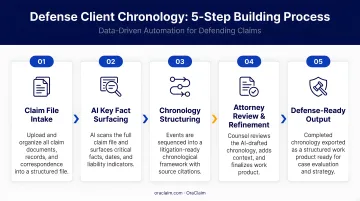
Step 1: Start at First Contact
Begin during or immediately after the first file review. Capture what's already known: alleged injury date, reported mechanism, claimant identity, employer, and initial medical contacts. Starting early prevents retrospective gaps that are time-consuming and sometimes impossible to fill.
PRISM's liability defense standards — adopted July 2025 — require a written initial case evaluation and litigation budget within 60 days of assignment and comprehensive defense evaluations 45 days before trial. That timeline is incompatible with waiting until trial prep to build your chronology.
Step 2: Gather and Catalog All Records
Request records from every potential source early:
- Medical records from all treating providers, including pre-injury records
- EMS and emergency department reports
- Pharmacy histories and diagnostic/imaging results
- Employment records and prior claims history
- Witness statements, surveillance footage, and communications
OraClaim ingests this full range of unstructured records automatically, classifying every document and surfacing key facts. What typically takes paralegals or legal nurse consultants 15–60+ hours per complex file is reduced to under 60 minutes for a first-draft medical chronology.
Step 3: Extract Facts, Not Document Summaries
Read each document and pull out individual, discrete facts. Do not summarize the document as a whole. Each entry should stand alone — a complete sentence tied to a precise source. If someone reads the entry at deposition and needs to find the underlying language, the citation should take them directly there.
Bad entry: "Dr. Smith's records discuss back pain and treatment."
Good entry: "June 14, 2023 — Dr. James Smith (Orthopedics, Memorial Hospital) noted patient reported 7/10 low back pain with no radicular symptoms; MRI not yet ordered. [Smith Records, Bates 0047]"
Step 4: Order Chronologically and Flag Gaps
Arrange all extracted facts by date, then scan actively for:
- Missing records from providers mentioned elsewhere
- Unexplained delays between injury date and first treatment
- Periods of undocumented activity between recorded visits
- Timeline inconsistencies across different sources
Tag gaps explicitly — use a "pending" or "gap" label so they generate follow-up, not blind spots. OraClaim's AI automatically identifies treatment gaps and date inconsistencies, flagging them as specific factual hooks for dispositive motions and cross-examination.
Step 5: Assign Issue Tags and Evaluate Each Fact
Tag each entry with the case issue it supports — causation, pre-existing condition, extent of injury, credibility, or work capacity — then rate its weight. Does it strongly support the defense, present exposure, or sit neutral?
This is what turns a data record into a strategic case management tool. Tagged and weighted facts make it possible to filter by issue, identify the strongest deposition lines, and evaluate settlement positions from a factual foundation rather than intuition.
Best Practices for Stronger Client Chronologies
Use a Single Consistent Name for Every Person, Entity, and Document
The same hospital might appear as "Memorial," "Memorial Medical," "MMC," and "Memorial Hospital & Trauma Center" across different records. When that happens, filtering and searching the chronology produces incomplete results. Create a cast of characters list at the start of each file — standardized names for every person, facility, employer, and document — and distribute it to everyone who touches the chronology.
NIST's electronic file management guidance specifically warns that records can be lost or misfiled due to naming inconsistency even when search tools are available.
Apply Fuzzy Dating for Incomplete Dates
When a date is partially known, use a placeholder: "March 2023 — exact date unknown." Never leave the date field blank or assign an arbitrary complete date to close a gap. Fuzzy dating preserves what is known, makes the uncertainty explicit, and ensures the fact is captured and correctly sequenced.
Keep the Chronology Updated Throughout the Case
New records enter a case constantly. Enter these promptly as they arrive:
- Medical records and treatment updates
- Deposition testimony
- Surveillance results
- Expert opinions and supplemental reports
Stale chronologies create blind spots. When one attorney's view of the facts is two months behind another's, team communication breaks down at the worst possible moment.
Integrate Deposition Facts Directly into the Master Chronology
Rather than maintaining separate deposition summary documents alongside the chronology, enter deposition facts directly into the master file with source citations (volume, page, and line). This keeps witness testimony in context with the full factual record and makes it far easier to spot contradictions between testimony and documents.
Common Mistakes to Avoid When Building Client Chronologies
Building a Document Index Instead of a Fact Chronology
This is the most common and costly error. Listing documents in date order organizes knowledge by source, not by fact. The actual story of the claim stays buried — reconstructing it requires reading all the summaries, which defeats the purpose. Extract the facts. Every one of them.
Waiting Until Trial Prep to Start
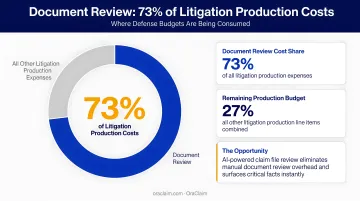
Delay compounds. RAND's civil e-discovery research found that document review accounted for 73% of total electronic production costs across large-volume litigation matters — and that traditional human review topped out around 100 documents per hour. The later you start, the more expensive and incomplete the foundation becomes. Starting at intake keeps costs manageable, surfaces liability gaps early, and gives defense counsel time to act on what the file actually shows.
Using Inconsistent Formats Across the Team
When multiple contributors use different date formats, naming conventions, and entry styles, the chronology becomes difficult to filter, search, or present. The fix is straightforward: standardized templates, a shared naming protocol, and a brief onboarding session for anyone who joins the file. Treat it as a quality control requirement, not a formatting preference.
Frequently Asked Questions
What makes a good chronology?
A strong chronology lists discrete facts with individual source citations, disputed-status flags, and issue tags. It's built at intake and updated continuously as new documents arrive, so gaps surface in real time rather than at the eve of trial.
What is a client chronology in a compensation case?
It's a structured, fact-ordered timeline covering medical history, incident facts, employment records, and disputed information, used by defense teams to organize and evaluate case strategy.
How early should you start a chronology for a compensation claim?
Work should begin at first contact or file intake, even with only a handful of known facts. Early chronologies create a discovery roadmap and prevent retrospective gaps that are costly to fill later.
Should disputed facts be included in a client chronology?
Yes — always include disputed facts and flag them as such. They highlight areas requiring further discovery and help teams prepare targeted deposition questions or locate supporting documentation.
How is a defense chronology different from a plaintiff chronology?
Unlike plaintiff chronologies built to establish a claim, defense chronologies are built to identify inconsistencies, document pre-existing conditions, flag treatment gaps, and challenge causation or damages. Every entry is evaluated for how it tests the opposing narrative.
How can AI help defense teams build client chronologies faster?
Platforms like OraClaim automatically ingest unstructured claim files, extract discrete facts with source citations, and flag gaps, contradictions, and pre-existing condition timing. Medical chronology drafting that previously took 15–60+ hours drops to under 60 minutes for a first draft, cutting non-billable review time across high-volume caseloads.