Introduction
Carriers aren't experimenting with AI anymore. They're running on it. According to the NAIC's private passenger auto survey, 88.6% of responding insurers were already using, planning to use, or exploring AI and machine learning — with 70% deploying it specifically in claims. Lemonade's AI handles 96% of first notices of loss without human intervention and automates roughly 55% of claims end to end.
That operational reality creates a quiet problem for outside defense counsel. When a carrier client processes thousands of claims daily with AI-generated insights, triage decisions, and automated communications, the attorneys they retain face an unspoken new standard. Responsiveness, structured reporting, and data fluency.
Those expectations land on firms already under pressure: overwhelming case volumes, aggressive bill scrutiny from carriers who audit every invoice, and a plaintiff bar that moved faster on technology. This article breaks down how AI tools are helping defense counsel meet that standard — and what's at stake for firms that haven't started yet.
Key Takeaways
- Carriers are already AI-native — defense counsel now needs to match their pace on reporting speed and data quality
- Social inflation pushed U.S. liability costs up 57% over the past decade, raising the stakes on every high-exposure matter
- AI cuts claim file review time in half, freeing attorneys for legal judgment instead of manual document sorting
- Purpose-built defense AI handles reserve inputs, carrier reporting formats, and cross-case benchmarking — general legal AI doesn't
- Confidentiality is preserved when platforms meet the right security standards and explicitly prohibit training on client data
Carriers Have Gone AI-Native — And Outside Counsel Expectations Have Shifted
What AI-Native Actually Looks Like Inside a Carrier
The scale is concrete. Zurich's CATIA AI pilot identified 500 additional catastrophe claims across five countries and generated $1.4 million in savings. Lemonade's pet insurance cost per claim dropped from $65 to $19 after deploying AI across claims handling. Zurich has also noted that AI can summarize reports and propose actions in seconds — work that traditionally required hours or days.
For carriers, these results aren't experiments — they're the new floor.
Carriers are now running AI across underwriting, claims triage, fraud detection, reserve analysis, and client communications simultaneously. When that's your client's infrastructure, they're not going to be patient with outside counsel who take a week to deliver an initial case assessment or can't explain their reserve recommendation with supporting data.
The Compounding Disadvantage
Defense firms aren't just falling behind their carrier clients. They're also losing ground to opposing counsel.
According to the 2025 Legal Industry Report, civil litigation firms led AI adoption at 27% among firm types, followed closely by personal injury practices. PI firms are using AI to draft demands in hours, review medical records at scale, and select cases with data-backed precision.
When a plaintiff attorney has already run AI analysis on your client's exposure before they even file — and your team is still manually reviewing a 1,200-page claims file — that asymmetry shows up in negotiations.
OraClaim's founders — Mark Tepper, who litigated claims for enterprise companies and insurers, and Andy Anderson, who managed high-exposure claims — identified this gap firsthand. Despite the defense side having financial resources, plaintiff lawyers were adopting technology faster and gaining strategic advantages that compounded over time.
The Performance Gap Is Measurable
That technology gap translates directly into measurable capacity differences. Thomson Reuters' 2025 Future of Professionals survey of over 1,300 legal professionals found that AI is expected to free up nearly 240 hours per year per attorney — up from 200 hours the prior year. That's roughly five additional hours of capacity per week, per attorney.
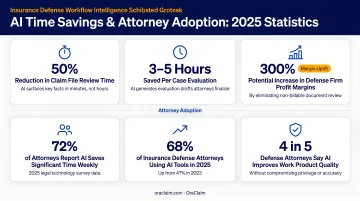
88% of those same professionals said they preferred profession-specific AI assistants over general tools — meaning raw capacity gains only materialize when the tool matches the workflow.
The Pressures Already Stacking Up on Defense Firms
Severity, Not Just Volume
The pressure on defense teams isn't primarily about claim frequency. It's about cost and complexity. Swiss Re reports that social inflation drove U.S. liability claims up 57% over the past decade, hitting an annual peak of 7% in 2023. Nuclear verdicts — jury awards of $10 million or more — remain on an upward trajectory according to the U.S. Chamber Institute for Legal Reform.
For an under-resourced defense team, every high-exposure matter carries more risk than it did five years ago.
The Staffing and Billing Squeeze
The American Lawyer reported in 2024 that insurance defense firms were simultaneously facing:
- A boom in work volume with too few attorneys to handle it
- Low billing rates while negotiating incremental increases with carriers
- Staffing strain that limits how many matters each attorney can actively manage
Zurich's publicly described litigation management program audits and adjusts legal invoices, negotiates firm rates, and conducts on-site panel counsel audits. That's the environment outside defense counsel operates in — scrutinized on both cost and output quality.
The Math Doesn't Work Without AI
More cases. Fewer hours per matter. Lower margin for error on nuclear-verdict exposure. Technology is what closes that gap. AI that eliminates the non-billable work consuming 40–70% of associate hours per matter frees attorneys to focus on the legal judgment that actually moves cases.
How AI Helps Defense Attorneys Keep Pace — In Practical Terms
Claim File Review and Record Analysis
Manual claims file review is where time disappears. A single complex bodily injury matter can involve thousands of pages — medical records, demand packages, witness statements, incident reports, photos, prior pleadings, and correspondence.
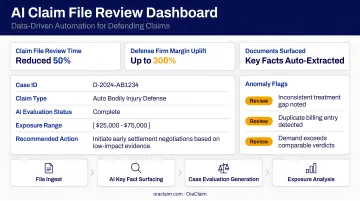
OraClaim's AI claim file review ingests all of it automatically, then delivers:
- Structured key fact summaries with extracted dates, injuries, and events
- Anomaly and contradiction flags surfacing causation gaps and treatment inconsistencies
- Citation-linked record indexes connecting facts to source documents
- Shareable evidence packages formatted for carrier distribution
The platform reduces total claim file review time by half or more — and surfaces the exposure drivers before they become reserve surprises at trial.
Case Benchmarking and Pattern Recognition
OraClaim's historical case benchmarking transforms years of unstructured closed-case files into searchable institutional knowledge, then benchmarks every open matter against that history. The platform tracks:
- Plaintiff counsel and expert outcome histories
- Jurisdiction, venue, and judge-specific motion grant rates
- Similar fact-pattern settlement and verdict ranges
- Reserve history, indemnity outcomes, and defense cost by phase
This lets attorneys set defensible reserves, justify settlement authority with comparable data, and identify which litigation strategies have actually worked — without manual data preparation.
Litigation-Ready Work Product at Intake
Carrier clients measure responsiveness. Delivering a structured early case assessment within 48 hours of assignment signals control; going silent for two weeks signals the opposite.
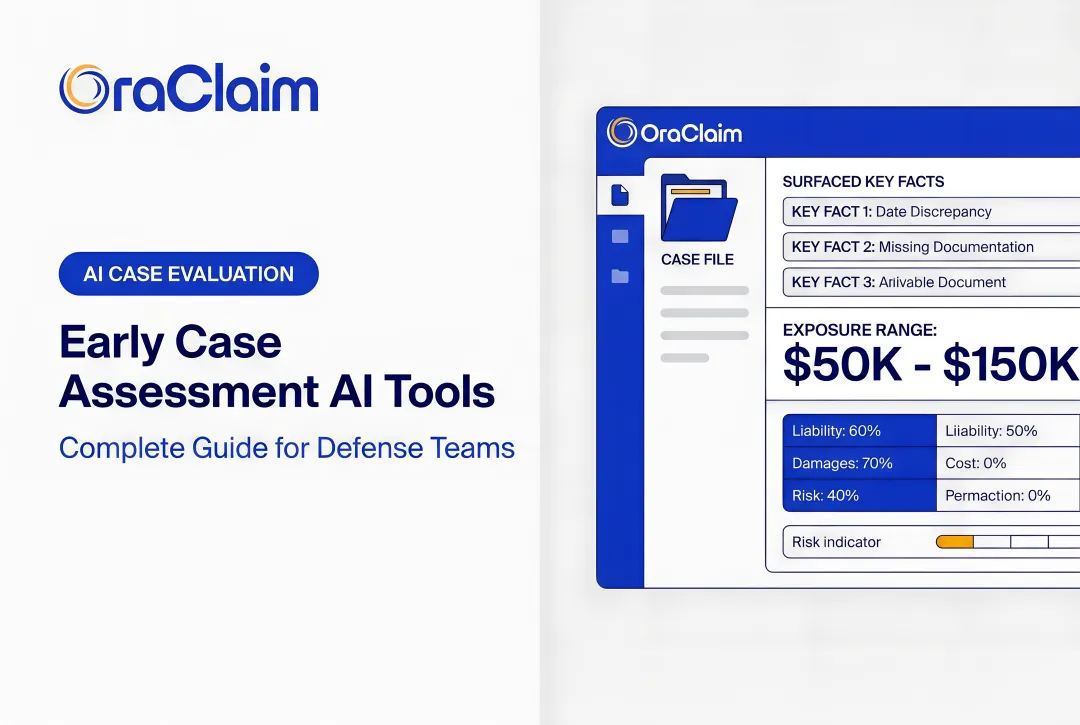
OraClaim generates full AI case evaluations in minutes, covering:
- Liability assessment and comparative fault analysis
- Damages exposure and settlement value ranges
- Reserve recommendations
- 90-day reports, reserve memos, and coverage opinion drafts tailored to individual carrier reporting templates
Capacity Scaling Without Proportional Headcount
A three-attorney team at an Am Law 100 firm reduced document review time by two-thirds using generative AI, according to Everlaw's published case study. For firms under carrier pressure to control costs, that scale shift — more matters, same headcount — is the practical answer.
OraClaim enables firms to scale caseload without proportional headcount growth, with financial impact and margin analytics that give managing partners visibility into:
- Realization rate by matter and by partner
- Profitability by carrier client and matter type
- Write-down and write-off drivers
- AI-output impact on billable-hour mix and margin
That data is what makes conversations about flat-fee or deliverable-based billing models — increasingly attractive to carriers — actually viable.
Defense-Specific AI vs. General Legal Tools: Why the Distinction Matters
General legal AI platforms — CoCounsel, Harvey, Lexis+ AI — are built for legal research, drafting, and document analysis. They're well-suited to what they do.
None of them publicly describe insurance-defense-specific capabilities: claims file ingestion and classification, reserve setting inputs, carrier reporting formats, or cross-case portfolio benchmarking. The real divide is between general legal workflow AI and practice-area AI built specifically for the defense docket.
What Purpose-Built Defense AI Looks Like
A platform designed for insurance defense does things general tools don't:
- Ingests and classifies unstructured claims files — not just organized legal documents
- Benchmarks every matter against historical cases on variables specific to defense work (plaintiff expert, jurisdiction, judge, settlement ranges by fact pattern)
- Generates carrier-formatted 90-day reports and reserve memos — not generic drafts
- Provides portfolio-level exposure monitoring across all active matters simultaneously
- Connects matter-level financials to firm-level margin and carrier-client P&L
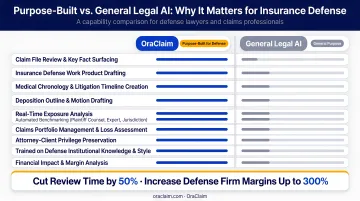
OraClaim was built specifically for this workflow — by practitioners who litigated and managed claims, not by technologists adapting a general-purpose product. Mark Tepper litigated claims for enterprise companies and insurers; Andy Anderson managed high-exposure claims for carriers. That firsthand experience is why the platform handles the workflows general tools were never designed for.
Integration Without Disruption
Defense firms operate under tight margins with limited IT resources. OraClaim is designed to fit into existing infrastructure, not replace it. The platform integrates with:
- Practice management: Clio, MyCase, Smokeball, PracticePanther
- Document management: NetDocuments, iManage, Worldox, Box
Firms can adopt AI capabilities without rebuilding their technology stack or disrupting established workflows.
Choosing AI Your Clients Will Trust: Security and Confidentiality Standards
The choice of AI platform isn't only a productivity decision. For insurance defense attorneys, it's a professional responsibility question.
ABA Formal Opinion 512 links AI use directly to competence, confidentiality, communication, supervision, and fee duties. Confidentiality obligations may require informed client consent before entering client information into a self-learning AI tool — unless confidentiality is contractually protected by the platform itself.
That ethical obligation doesn't stop at the firm. Carriers face data governance scrutiny under the NAIC Insurance Data Security Model Law, which includes oversight requirements for third-party service providers — and they apply that same standard to the tools their outside counsel use.
What to Evaluate Before Adopting Any AI Platform
Before deploying any AI tool on client matters, defense firms should verify:
- Encryption: Data protected at rest and in transit
- No training on client data: Explicit contractual prohibition on using your files to improve the model
- Role-based access controls: Granular permissions governing who accesses what
- SOC 2 or equivalent certification: Independent verification of security, availability, and confidentiality controls
- Sub-processor restrictions: Third-party infrastructure contractually prohibited from retaining or using client data
OraClaim operates as a closed, access-restricted system. Its terms explicitly prohibit using confidential information to train, fine-tune, or validate AI models. All processing is designed to function as an extension of the customer's own computing environment, meaning no disclosure to a third party that could implicate privilege waiver. When OraClaim connects with practice management and document management systems, integrated platforms operate as sub-processors under contractual restrictions — not as independent recipients of client data.
Frequently Asked Questions
What AI platforms do insurance companies use?
Carriers use machine learning for underwriting, claims triage, fraud detection, settlement analysis, and customer communications. Tools vary by carrier size and function, from FNOL automation to catastrophe-claim flagging.
What AI platforms do lawyers, including insurance defense attorneys, use?
Lawyers use general platforms like CoCounsel and Harvey for legal research and drafting. Insurance defense teams also use tools like OraClaim for claims file review, case evaluations, reserve memos, carrier reporting, and benchmarking.
How is AI changing the relationship between insurance carriers and outside defense firms?
Carriers using AI now expect outside counsel to move faster on early case assessments, reserve inputs, and exposure reporting. The relationship is shifting toward efficiency, data fluency, and measurable outcomes.
Can AI help insurance defense attorneys handle more cases without adding staff?
Yes. AI can handle file review, record analysis, and chronology drafting, which often consume associate time. Attorneys can then focus on legal judgment, strategy, and higher-value case work.
Does using AI in insurance defense work compromise client confidentiality?
Not if the platform is selected carefully. Firms should verify encryption, no training on client data, role-based access controls, and SOC 2 or equivalent standards before adoption, consistent with ABA Formal Opinion 512.