A checklist turns that pile into something usable. It helps defense lawyers and claims professionals spot missing records, test documentation quality, build a traceable chronology, and separate documented facts from assumptions.
This guide covers the checklist components, a repeatable review workflow, red flags and escalation points, and responsible use of AI-assisted review.
Key Takeaways
- A good checklist tests record quality and consistency, not just completeness.
- Chronology links dates, providers, treatment, and damages, but timing alone never proves causation.
- Every finding needs a source citation; missing records and contradictions get their own logs.
- AI speeds organization, while qualified humans validate, interpret, and escalate.
What Is a Medical Record Review Checklist?
Definition and purpose
A medical record review checklist is a structured set of checks used to inventory, organize, assess, and document findings in a medical file. It is an issue-spotting and quality-control tool.
It is not a clinician's opinion. It cannot decide causation, standard of care, prognosis, or liability. Those need a qualified clinician or expert, and legal analysis needs counsel.
The outputs also differ:
- Checklist: tests completeness, consistency, and relevance
- Chronology: orders events by date
- Summary: condenses material facts
- Clinical opinion and legal analysis: answer medical and legal questions
The AALNC FAQ describes record review as collecting, organizing, and analyzing records, and lists chronologies and summaries as separate deliverables within a broader scope.
How the checklist changes by use case
Priorities shift with the assignment:
- Provider documentation audit: completeness, timing, authentication, required clinical content
- Personal injury and malpractice: duty, breach, damages, causation, defensibility
- Claims handling: medical facts affecting merit, omissions, contradictions
- Litigation preparation: expert support, authentication, privilege
Before opening the file, define the claim question, the relevant date range, the required records, and any organizational or contractual standards that apply.
Keep a consistent review record
Log each review with:
- Reviewer and review date
- File scope and source list
- Missing-record requests
- Key findings, open questions, and escalation decisions
Use fixed labels: "documented," "not found," "contradictory," "requires clinical review," and "requires legal analysis." Consistent labels make handoffs and audits far easier.
Medical Record Review and Documentation Checklist Components
One caution first. Hospital rules such as 42 CFR 482.24 give a useful baseline for content, but they govern hospitals. They are not a universal litigation form. Adapt the list to each case.
Confirm file scope, identifiers, and source completeness
- Record patient or claimant identifiers, matter number, event dates, authorizations, and the review date range
- List every provider, facility, and specialty
- Inventory record types: clinical notes, orders, results, imaging, medication records, billing, communications, consents, and available metadata
- Keep a missing-record log with provider, date range, document type, request status, follow-up date, and potential impact on liability, causation, or damages
Review core clinical documentation
Confirm the file includes:
- History, complaints, allergies, medications, and vitals
- Examinations, diagnoses, treatment plans, and referrals
- Follow-up instructions and discharge information
- Tests, labs, imaging, consults, operative reports, and rehab records tied to the correct encounter
One distinction matters here: absent documentation is not the same as documentation showing something did not happen. A missing lab result means "not found." It does not mean the test was never ordered.
Build the chronology and provider map
- Order encounters, symptoms, diagnoses, tests, treatment, work restrictions, and major events by date
- Identify every possible source of records, including pharmacies, therapists, labs, and imaging centers
- Compare narrative dates against timestamps, orders, results, billing, and discharge papers
- Flag unexplained delays, overlapping entries, late entries, and out-of-sequence events
Assess claim-relevant medical and functional issues
- Track pre-existing conditions, prior injuries, surgeries, baseline symptoms, and limitations before the event
- Compare findings before and after, noting evidence of new injury, aggravation, recurrence, alternative causes, or an unchanged condition
- Connect diagnoses and objective findings to treatment intensity, restrictions, work status, expenses, and future-care recommendations
Do this without drawing unsupported medical conclusions. The Federal Judicial Center's 2026 reference manual explains that timing alone, without an established scientific connection, is insufficient for causation.
Check documentation integrity and consistency
- Compare histories, symptoms, findings, diagnoses, imaging, medications, and work status across providers
- Check authorship, dates, signatures, amendments, duplicate entries, copy-forward language, and audit trails where available
- Require a page, date, and provider reference for each material finding so another reviewer can verify it
Copy-forward text deserves care. A 2022 Penn Medicine study found about half of clinical text repeats earlier text. Duplication is a review signal, not proof of an error.

How to Conduct a Consistent Medical Record Review
1. Define the review question first
Decide whether the job is completeness, claim evaluation, chronology, causation issue spotting, damages, treatment reasonableness, or litigation prep. Then name the output: a claims note, chronology, issue list, missing-record report, or referral for clinical review.
2. Collect, standardize, and triage
- Compare the file against authorizations, invoices, claim forms, prior summaries, and referral information
- De-duplicate administrative copies, but keep distinct versions, amendments, and metadata
- Chase high-impact gaps first: emergency records, operative reports, imaging, pathology, prior treatment, medication administration records, and discharge materials
3. Construct and test the timeline
For each material entry, record:
- Date, provider, and event
- Reported symptoms and objective findings
- Diagnosis, treatment, and response
- Source citation
Then test whether the alleged event, symptom onset, first treatment, diagnosis, and claimed limitations follow a supported sequence.
Treatment gaps, provider changes, missed follow-up, and noncompliance need documented explanation. Don't interpret them automatically.
4. Separate facts, interpretations, and open questions
Label what the record states, what can reasonably be inferred for issue spotting, and what needs a clinician, expert, attorney, or claims decision-maker. Keep alternative explanations and conflicting evidence visible.
The checklist can surface evidence relevant to causation or damages, but it cannot settle a clinical or legal dispute.
5. Run quality control and route next steps
- Confirm every major finding has a source
- Confirm every missing-record request is logged
- Confirm every material contradiction has an explanation or escalation status
- State which review areas were limited by incomplete records
- Apply escalation triggers for clinical review, specialty analysis, expert opinion, legal analysis, privacy review, or more record collection

Documentation Red Flags, QA Checks, and Escalation
High-impact red flags
- Missing or inconsistent dates
- Unexplained treatment gaps
- Absent test results
- Contradictory histories
- Copied-forward notes
- Late entries and unclear authorship
- Unexplained amendments
- Clinical and billing records that don't match
A red flag calls for verification and context. It does not establish negligence, fraud, alteration, or causation. CMS guidance in the Program Integrity Manual recognizes legitimate amendments and delayed entries when authors and dates are identifiable and changes are clearly denoted.
Use a contradiction and missing-record log
For each item, capture:
- Conflicting sources
- Exact issue
- Date
- Potential significance
- Follow-up action
- Responsible reviewer
Prioritize discrepancies that could change the understanding of the event, baseline condition, diagnosis, treatment, prognosis, impairment, or financial exposure.
When a checklist is not enough
Escalate when the checklist alone cannot answer the question:
- Qualified clinician or expert: medical significance, causation, standard of care, prognosis, future care, or specialty-specific issues
- Counsel or claims decision-maker: privilege, discovery strategy, admissibility, fraud indicators, and coverage questions
Evidence rules matter here. Business-record and hearsay foundations under the Federal Rules of Evidence are separate questions from whether a chart is complete.
Using AI to Support Medical Record Review
Appropriate AI-assisted tasks
AI works best on repetitive organization tasks:
- Classifying documents and running OCR
- Extracting providers, dates, medications, and diagnoses
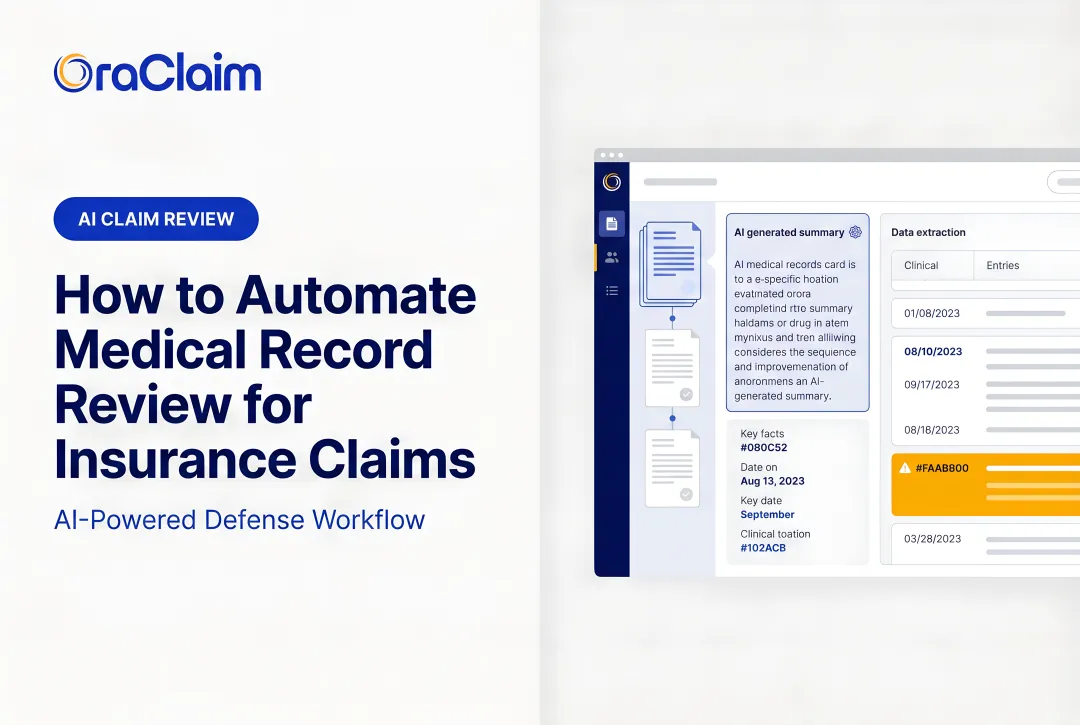
- Drafting chronologies with source links
- Detecting duplicates and flagging missing records
- Searching for contradictions
It surfaces potentially relevant passages. It does not replace clinical judgment or legal decision-making.
Human-review and accuracy safeguards
- Verify extracted facts against the original record
- Inspect low-confidence or ambiguous items
- Preserve source citations and document corrections
- Test on representative files and track recurring errors
- Route exceptions to a dedicated review queue
- Exclude unsupported conclusions from final work product
Narrow benchmarks can mislead. A 2024 JAMA Network Open study reported a Cohen's kappa of 0.98 for extracting one variable, helmet use, from injury narratives. That is agreement on one task, not 98% accuracy across a file, and negations still caused hallucinations.

Privacy, security, and governance
HIPAA's reach depends on role. HHS says liability, disability, and workers' compensation policies are not health plans, yet an attorney serving a health plan with PHI access can be a business associate. Assess the actual relationship.
Review these controls with your vendor:
- Role-based access, authentication, and encryption (addressable HIPAA specifications are not optional to ignore)
- Audit logging and approved data handling
- Business associate agreements where applicable
- Retention, breach-notification, and internal PHI policies
Confirm current contractual, regulatory, and internal requirements. Don't assume an AI tool meets them. ABA Formal Opinion 512 also applies competence, confidentiality, and supervision duties to lawyers using generative AI.
Connecting AI to defense and claims workflows
OraClaim is an example of an AI platform built for defense lawyers and claims professionals. It classifies medical records, extracts key dates and events, and drafts chronologies that are filterable and cross-linked to source PDFs. It also flags gaps in care, pre-existing conditions, and contradictions across providers.
It integrates with document and practice-management platforms such as NetDocuments and Clio on customer request. Confirm current functionality before relying on any feature.
OraClaim states that it operates at the direction of authorized users and is not an independent author or decision-maker. Its outputs are not legal advice, and users should review them for accuracy and completeness.
AI output should feed your checklist, chronology, missing-record log, QA process, and escalation plan. It should never replace them.
Frequently Asked Questions
What components should a medical record review checklist include?
File scope, source inventory, clinical documentation, chronology, prior conditions, treatment, damages, contradictions, missing records, source citations, and escalation criteria. Adapt the list to the claim question.
What is a medical record review checklist?
A structured issue-spotting and quality-control tool for organizing records. It assesses completeness, consistency, and claim relevance without replacing clinical or legal judgment.
Are there AI tools for medical record review?
Yes. They handle extraction, chronology building, search, and summarization. Human validation, security controls, and qualified clinical or legal review remain essential.
How do you review medical records for completeness?
Inventory providers and date ranges, then compare against authorizations and known encounters. Log missing records, handle duplicates carefully, and run a final completeness check.
What is the difference between a medical record review and a medical chronology?
A review evaluates completeness, consistency, and issue relevance. A chronology orders events by date and is often one output of a broader review.